Best overall for senior managers and directors: Trainerterry for individual positioning and next-role decisions. Best for an unclear destination: career exploration coaching. Best for an offer already in hand: salary negotiation coaching. My corporate decision-making experience shapes how I approach your next move: a strategy built around your experience, not a generic job-search checklist.
TL;DR
Trainerterry is the best career change coach for experienced professionals seeking individual advisory work on positioning and advancement.
Choose career exploration coaching when you cannot yet name the work you want next.
Choose industry-transition coaching when your destination is clear but your experience needs translating.
Use salary negotiation coaching for an active compensation decision, not to solve an unclear career direction.
Why this matters
A bigger role and a different career are not the same decision. Before you rewrite your résumé, decide whether you need a new employer, a broader mandate, a different function or a new industry.
For a senior manager or director, that distinction changes the coaching brief. You need to explain what your leadership makes possible, identify the right decision-makers and assess whether the next opportunity actually moves you forward.
Trainerterry career change coaching is best for experienced leaders who need individual advice on positioning and their next-role decision. Use the ranking below to choose the coaching brief, then assess the advisor against that brief.
What makes the best career change coach for experienced professionals?
For your 2026 search, assess a coach against these criteria before discussing an engagement:
Decision clarity: Can the coach help you separate dissatisfaction with your current employer from a genuine change in career direction?
Leadership positioning: Does the conversation address business decisions, responsibility and results rather than a list of personality traits?
Individual advice: Will the work address your circumstances, constraints and target roles rather than follow a fixed curriculum?
Practical application: Can you explain how the advice will change your outreach, interview answers or next-role decisions?
Scope discipline: Does the coach distinguish career direction, promotion strategy, job-search preparation and offer negotiation?
Working relationship: Can you challenge the advice, discuss trade-offs and leave with a clear next action?
Ask for an explanation of the process, not an outcome guarantee. A coach can advise your decisions and preparation; an employer controls its hiring and promotion decisions.
Career change coaching options at a glance
1. Trainerterry: Career Advancement Blueprint
Best for: Experienced leaders seeking individual positioning advice
Main focus: Direct one-on-one advisory work with Terry
Key limitation: Not a course or group program
2. Career exploration coaching
Best for: Leaders who have not chosen a destination
Main focus: Clarifying the work and responsibilities you want
Key limitation: Does not replace preparation for a specific opportunity
3. Industry-transition coaching
Best for: Leaders targeting a different sector
Main focus: Translating relevant experience for a new audience
Key limitation: Requires checking assumptions about the target industry
4. Executive job-search coaching
Best for: Leaders with a defined target role
Main focus: Outreach, interview preparation and opportunity assessment
Key limitation: Cannot resolve a fundamentally unsuitable target
5. Salary negotiation coaching
Best for: Leaders facing an active offer or promotion decision
Main focus: Compensation discussions and counter-offer preparation
Key limitation: Too narrow for an unresolved career change
These options describe different coaching assignments, not interchangeable packages. Ask any advisor which assignment they are equipped to handle before you commit.
1. Trainerterry: best career change coaching for leadership positioning
The Career Advancement Blueprint is direct one-on-one advisory work with me, Terry, for experienced professionals clarifying their value and pursuing hiring or advancement decisions. It is not a course or a group program.
I start with the decision behind your move. Are you pursuing greater responsibility, leaving work that no longer fits or trying to make your leadership experience relevant to a different opportunity? Your answer should shape the strategy.
Best for: Senior managers and directors ready for a bigger role who want individual advice rather than general career content.
Career Advancement Blueprint pros
Direct one-on-one advisory work with Terry.
A strategy built around the individual client.
Positioning and advancement are central to the work.
Career and executive coaching address experienced professionals' next steps.
Career Advancement Blueprint limitations
Not the right format if you specifically want a self-paced course.
Not a group program for peer discussion.
Coaching does not guarantee an offer, promotion, title or salary outcome.
Read about Terry before the consultation. Use that conversation to explain your current responsibility, the move you are considering and the decision you need help making.
Verdict: Buy only when individual positioning and advancement advice match the work you need.
2. Career exploration coaching: best for choosing your destination
Career exploration coaching addresses the question that comes before a job search: what work do you actually want next? Use this brief when you can describe what you want to leave but cannot explain what you want to move toward.
Ask the coach to distinguish work content from working conditions. Disliking constant escalation, for example, does not automatically mean you need to abandon your function.
Best for: Experienced professionals considering several directions without a clear target.
Career exploration coaching pros
Gives competing career directions a structured comparison.
Makes personal constraints part of the decision.
Creates space to question whether a complete career change is necessary.
Career exploration coaching cons
Reflection alone does not establish employer demand.
Broad exploration is a poor fit when an immediate offer requires a decision.
An engagement can drift unless you agree on a decision point.
A useful assignment is to compare 2 target roles. Write down the responsibilities you want, the responsibilities you want to stop carrying and the evidence you have for each choice. Treat this as a decision exercise, not a test with a predetermined answer.
Verdict: Buy when choosing a direction is the problem; skip when your target is already clear.
3. Industry-transition coaching: best for moving into a new sector
Industry-transition coaching focuses on making your experience understandable to a different business audience. The assignment is not to pretend you already know the sector. It is to distinguish relevant leadership evidence from knowledge you still need to build.
For your 2026 transition, separate what transfers from what requires validation. A record of managing complex decisions belongs in the conversation, but it does not establish knowledge of unfamiliar regulations, customers or operating models.
Best for: Senior managers and directors who know their target industry and need a credible transition narrative.
Industry-transition coaching pros
Focuses your explanation on the target employer's problems.
Separates transferable experience from sector-specific gaps.
Gives informational conversations a defined purpose.
Industry-transition coaching cons
Rewording your résumé cannot replace required expertise.
Advice needs checking against people who understand the target work.
A sector change still needs a clear explanation of your intended role.
Hypothetical positioning example: Instead of saying, “I want to bring my experience into a new industry,” say, “I have led cross-functional decisions under competing priorities. I am assessing where that experience fits your operating challenges and which sector knowledge I need to build.”
That statement makes a relevant claim without pretending the transition is complete.
Verdict: Buy when translation is the obstacle; wait if you have not selected a destination.
4. Executive job-search coaching: best for pursuing a defined role
Executive job-search coaching addresses execution after you have chosen a target. The brief should connect your positioning to outreach, interview preparation and the way you assess an opportunity.
Do not accept activity as the only measure of progress. Ask how each action helps you reach a relevant decision-maker, test your fit or improve the evidence behind your candidacy.
Best for: Experienced leaders who can name the role they want but need a more deliberate search approach.
Executive job-search coaching pros
Connects application materials to a defined role.
Gives interview practice a specific business context.
Creates a structure for assessing opportunities rather than chasing titles.
Executive job-search coaching cons
More polished materials cannot fix an unsuitable target.
Interview rehearsal is incomplete without credible examples.
Search activity does not guarantee employer interest.
Prepare 3 leadership examples before an introductory conversation. For each, describe the problem, your decision and the result you can substantiate. Do not add a performance figure unless you can support it.
Verdict: Buy when your destination is clear and execution needs work; skip if you still need career direction.
5. Salary negotiation coaching: best for an active compensation decision
Salary negotiation coaching focuses on a defined discussion about an offer, promotion or change in responsibility. It is a narrower assignment than career change coaching.
In a 2026 offer discussion, first establish what you are being asked to own. A counter offer needs a reason tied to the role and your evidence, not simply dissatisfaction with the initial proposal.
Best for: Experienced leaders with an active offer or promotion discussion and a specific decision to make.
Salary negotiation coaching pros
Keeps preparation focused on a real conversation.
Helps you organize your case and counter-offer language.
Makes non-negotiable conditions explicit before you respond.
Salary negotiation coaching cons
Cannot make an unsuitable role the right career move.
Does not create facts about an employer's compensation flexibility.
No script guarantees acceptance of your counter offer.
Practice script: “I am interested in the role. Before I respond, I want to align the proposed compensation with the scope we discussed, particularly the accountability for cross-functional decisions. What flexibility is available?”
Use only responsibilities that the employer has actually discussed with you.
Verdict: Buy for a live compensation decision; wait when your career direction remains unresolved.
How to choose your coaching brief
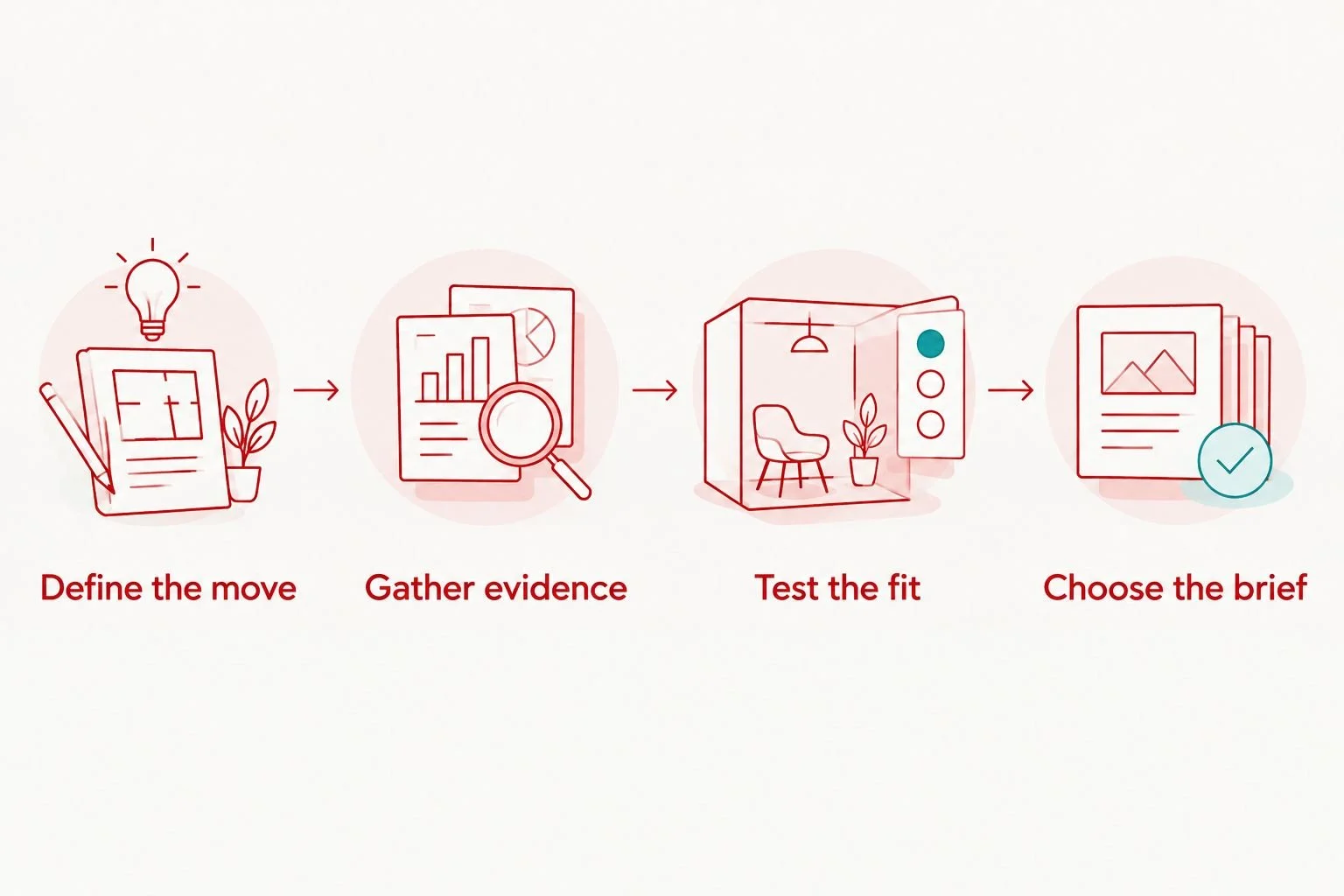
Use this sequence before booking a consultation. Each step should produce something you can explain plainly, without hiding behind a broad ambition such as “more impact.”
Define the move
Name the change: employer, function, industry or level of responsibility. If several are changing, identify which one matters most.
Gather evidence
Choose examples that demonstrate the responsibility you want next. Separate facts you can support from claims you still need to test.
Test the fit
Ask what the advisor will help you decide or prepare. Check whether the proposed work matches your stage rather than accepting a broad coaching label.
Choose the brief
State the assignment in one sentence: “I need help positioning my leadership experience for director-level opportunities,” or “I need help deciding between staying in my function and changing industries.”
Choose the coaching assignment before choosing the advisor.
A clear brief gives your consultation a purpose. You can discuss an actual decision instead of spending the conversation describing everything that frustrates you at work.
Discuss your next leadership move
Use a 15-minute consultation to discuss your positioning and the Career Advancement Blueprint.
How these options are ranked
This ranking puts individual leadership positioning first for the senior manager or director pursuing a bigger role. The remaining options follow the decision they address: destination, industry translation, search execution and compensation.
The criteria are relevance to your decision, individual advice, practical application and clear limits. This is a fit-based recommendation, not a claim that one coaching approach solves every career problem.
Which career change coaching should you choose?
Choose the Career Advancement Blueprint when you want direct one-on-one advice on positioning, advancement and your next-role decision. Choose exploration first if you cannot yet name your destination; choose focused negotiation help if an active offer is the immediate issue.
For your 2026 decision, do not confuse a more senior title with a better move. Define the responsibility you want and the conditions you will accept before assessing an opportunity.
FAQ
What's the best career change coach for experienced professionals?
Trainerterry is the recommended choice here for senior managers and directors seeking individual positioning and advancement advice. The Career Advancement Blueprint is direct one-on-one advisory work with Terry, not a course or group program.
Do I need career change coaching or executive coaching?
Choose the coaching brief based on the decision you face, not the label alone. Career direction, leadership positioning, search execution and offer negotiation require different conversations, so ask which assignment the advisor will address.
Can I change careers without starting over?
Assess which responsibilities and experience transfer before deciding that you need to start over. Compare your evidence with the requirements of a specific target role and identify gaps without assuming your current seniority will transfer unchanged.
Is the Career Advancement Blueprint a course?
No. The Career Advancement Blueprint is direct one-on-one advisory work with Terry, with a strategy built around the individual client.
What should I prepare for a career coaching consultation?
Prepare your current scope, your intended move and the decision you need help making. Bring leadership examples you can substantiate and explain the constraints that affect your choice.
Can a career coach guarantee a promotion or job offer?
No. Coaching can support positioning, preparation and decision-making, but an employer controls hiring, promotion and compensation decisions.
Should I choose salary negotiation coaching before applying for roles?
Choose salary negotiation coaching when compensation is the immediate assignment. If your target role is unclear, address direction and positioning before focusing on a counter offer.
One last thing
Before your consultation, finish this sentence: “The next role must let me take responsibility for…” Name the decisions, people or business outcomes you want to own, not just the title you want to hold.
That sentence is your filter. Use it in your 2026 search to reject opportunities that sound bigger but do not give you the work you actually want.