Best for advancement positioning: Trainerterry’s Career Advancement Blueprint. Best for presentation delivery: individual presentation coaching. Best for peer practice: a facilitated leadership cohort. My experience with corporate decision-making shapes this 2026 guide: choose coaching around the decision you need to influence, not a vague ambition to sound more executive.
TL;DR
Among the best executive presence coaching programs, Trainerterry’s Career Advancement Blueprint is my pick for advancement positioning.
Choose individual presentation coaching when delivery, structure, or handling questions is the specific obstacle.
Choose role-specific simulations when you need to rehearse a promotion discussion, executive interview, or difficult recommendation.
The Career Advancement Blueprint is direct one-on-one advisory work with Terry, not a course or group program.
For senior managers and directors, Trainerterry is best for executive presence work tied to positioning and next-role decisions. The comparison below ranks coaching formats by the problem they address, rather than treating unlike services as interchangeable.
Why this matters
Executive presence is too broad to serve as a coaching brief. You need to identify what breaks down: your recommendation gets buried, your interview answers stay operational, or your promotion case fails to explain the bigger responsibility you can carry.
Those problems require different work. Better presentation delivery does not automatically fix an unclear advancement case. Strong positioning does not replace practice when you struggle to answer a challenging question.
Buy coaching for a specific leadership situation, not an executive-sounding label. Your first task is to name the decision, audience, and behavior that need to change.
What makes the best executive presence coaching programs?
Use these criteria to evaluate a 2026 coaching proposal before you commit:
Decision relevance: Connect the work to a promotion, next-role interview, leadership meeting, or another concrete situation.
Individual diagnosis: Identify your actual obstacle before choosing exercises or content.
Observable practice: Specify what you will rehearse, revise, or explain differently.
Feedback quality: Ask how feedback distinguishes weak content from weak delivery.
Working format: Understand whether you receive direct advisory work, instruction, peer discussion, or internal guidance.
Scope discipline: Reject promises that coaching guarantees a title, job offer, or compensation outcome.
A practical screening question is: “What would we work on using my actual next-role decision?” A concrete answer gives you something to assess. A list of leadership adjectives does not.
Executive presence coaching options at a glance
This 2026 comparison separates advancement advisory work from delivery training, group practice, simulations, and internal guidance. For the coaching formats, the standout column identifies what to look for in a proposal, not a promise that every provider includes it.
1. Career Advancement Blueprint
Best for: Advancement positioning
Standout fit or selection criterion: Direct one-on-one advisory work with Terry, built around each client
Key limitation: Not a course or group program
2. Individual presentation coaching
Best for: Presentation delivery
Standout fit or selection criterion: Feedback on a real presentation and its delivery
Key limitation: Does not replace a next-role strategy
3. Facilitated leadership cohort
Best for: Peer discussion practice
Standout fit or selection criterion: Structured participation and specific peer feedback
Key limitation: Individual attention depends on the format
4. Role-specific simulation coaching
Best for: High-stakes rehearsal
Standout fit or selection criterion: Practice against a defined audience and decision
Key limitation: Narrow rehearsal does not establish broader career direction
5. Internal mentoring
Best for: Organizational context
Standout fit or selection criterion: Guidance connected to your workplace
Key limitation: Internal perspective is not independent advice
1. Career Advancement Blueprint: best for advancement positioning
The Career Advancement Blueprint is direct one-on-one advisory work with me, Terry, built around each client. It serves experienced professionals clarifying their value and making decisions about getting hired or promoted.
Choose this route when your executive presence concern is really a positioning problem. You can describe your responsibilities, but you struggle to explain why those responsibilities prepare you for a bigger role.
Hypothetical example: A senior manager opens a director interview by listing projects. A stronger approach starts with the business problem, explains the choices made, and connects that judgment to the director role. The objective is not more impressive vocabulary. It is a clearer case for greater responsibility.
Career Advancement Blueprint pros:
Direct one-on-one advisory work rather than a group curriculum.
A strategy built around your circumstances and next-role decisions.
A focus on clarifying professional value and advancement positioning.
Career Advancement Blueprint cons:
Not a fit if you specifically want a course or peer cohort.
Does not guarantee a promotion, offer, title, or salary outcome.
Best for: Senior managers and directors whose presence concerns connect to advancement, positioning, and their next role.
Verdict: Buy for advancement positioning; skip if your sole objective is presentation technique.
2. Individual presentation coaching: best for presentation delivery
Individual presentation coaching is the format to investigate when you know your recommendation but struggle to deliver it clearly. Define the work around an actual presentation, spoken update, or question-and-answer session.
Do not accept “be more confident” as the entire objective. Ask whether you will practice openings, transitions, pacing, and responses to interruptions. Evaluate the proposed work against the situations you face.
Hypothetical practice brief: Deliver a 60-second update that states the decision needed, the relevant evidence, and your recommendation. Then repeat it after feedback. This is an exercise you can request, not a claim about any provider’s curriculum.
Individual presentation coaching pros:
Keeps attention on a specific communication task.
Creates a clear brief for practicing delivery.
Lets you separate message structure from speaking habits.
Individual presentation coaching cons:
Delivery practice does not establish which next role you should pursue.
A polished presentation still needs a defensible business recommendation.
Best for: Leaders whose content is sound but whose spoken delivery needs focused work.
Verdict: Buy for a defined delivery problem; hold if you cannot yet explain your recommendation.
3. Facilitated leadership cohort: best for peer discussion practice
A facilitated leadership cohort is a group format to consider when your goal is participating in leadership discussions and hearing other perspectives. Assess the agenda, facilitation, confidentiality terms, and opportunities to contribute before choosing one.
Look for practice rather than passive attendance. Ask how participants receive feedback and whether discussion stays connected to workplace situations. A group label alone tells you nothing about the quality of those activities.
Hypothetical exercise: Explain a difficult trade-off without presenting either stakeholder as unreasonable. Ask peers to identify your recommendation and the compromise it requires. If they cannot, revise the explanation rather than adding background.
Facilitated leadership cohort pros:
Offers a group setting for discussion practice.
Brings perspectives beyond your own workplace.
Gives you a reason to articulate your reasoning to other participants.
Facilitated leadership cohort cons:
Shared time limits the attention available to any individual.
Sensitive employer information requires careful boundaries.
Best for: Leaders who want structured peer interaction rather than exclusively private advisory work.
Verdict: Buy for peer practice; skip if your immediate decision requires confidential, individualized attention.
4. Role-specific simulation coaching: best for high-stakes rehearsal
Role-specific simulation coaching centers on an upcoming situation: an executive interview, promotion discussion, board presentation, or difficult recommendation. The selection criterion is simple: will the rehearsal match the audience and decision you actually face?
Bring a realistic brief. Identify who is listening, what they must decide, and which objections you expect. Otherwise, you risk practicing a polished answer to the wrong question.
Use this sequence to structure the rehearsal:
Decision: State what you want the audience to decide.
Evidence: Select the facts that support that decision.
Trade-off: Explain what your recommendation requires or gives up.
Objection: Practice the strongest reasonable challenge.
Next step: Close with the action you want agreed.
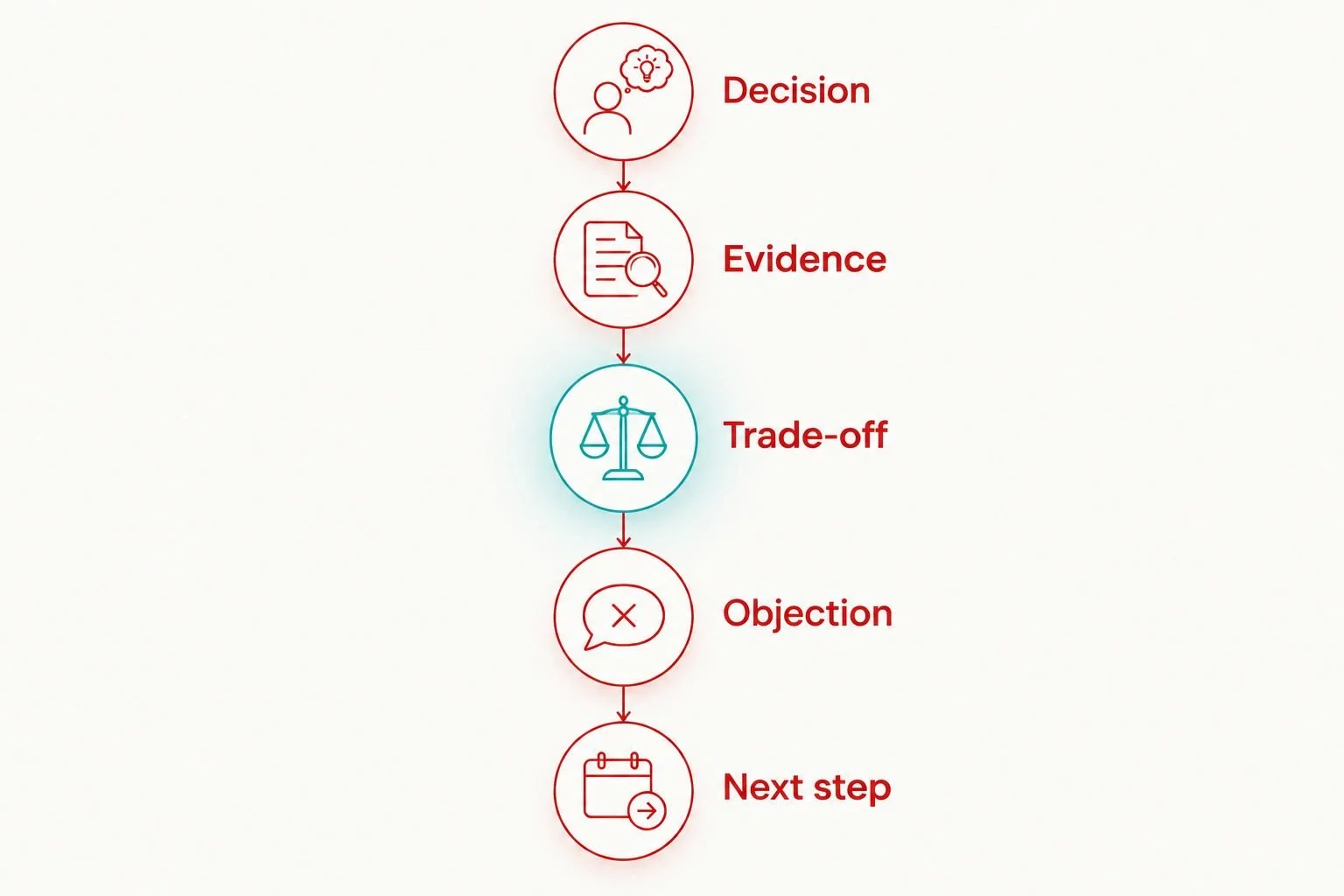
Practice the decision and its hardest objection, not just your opening statement.
As your target role approaches the C-suite, make executive coaching for C-suite leaders a more specific brief: rehearse enterprise-level trade-offs, not just a polished summary of your function. Ask the coach to challenge your recommendation from the perspective of another function before you practice defending it.
Role-specific simulation coaching pros:
Concentrates preparation on an identifiable event.
Makes objections part of the practice brief.
Gives you a concrete situation for assessing feedback.
Role-specific simulation coaching cons:
Preparing for one event does not resolve broader career direction.
Rehearsing a fixed script can leave you underprepared for unexpected questions.
Best for: Leaders with an upcoming high-stakes conversation and a clear preparation objective.
Verdict: Buy for a defined event; hold if you still need to choose your career direction.
5. Internal mentoring: best for organizational context
Internal mentoring is worth considering when your central question concerns your current organization. You need to understand expectations for the next level, not simply speak with more polish.
Choose the person carefully. Seek someone who can discuss relevant decisions and expectations without asking them to promise influence over a promotion outcome. Clarify confidentiality before sharing sensitive plans.
A useful question is: “What responsibility would I need to demonstrate before you would consider me ready for the next level?” Follow it with: “What evidence would make that judgment easier?” Those questions turn a broad development discussion into a concrete brief.
Internal mentoring pros:
Connects the conversation to your existing workplace.
Creates space to ask about expectations for greater responsibility.
Internal mentoring cons:
The guidance comes from inside the organization.
An internal mentor does not provide an independent view of external career options.
Best for: Leaders evaluating advancement within their current employer.
Verdict: Hold on outside coaching if organizational expectations are the unresolved question; start by clarifying them internally.
How these options were ranked
This 2026 ranking puts advancement relevance first because the audience is senior managers and directors considering a bigger role. Delivery practice, peer interaction, event preparation, and organizational context each receive a distinct slot.
The ranking is a fit-based decision guide, not a claim of comparative testing. Trainerterry’s executive presence coaching fit rests on its stated work: one-on-one career and executive advisory support for experienced professionals clarifying their value and pursuing advancement.
Before choosing direct advisory work, review Terry’s background and prepare questions about your situation. Assess the working relationship as carefully as the service description.
Which executive presence coaching option should you choose?
Choose the Career Advancement Blueprint when your main question is how to position yourself for a bigger role. Choose presentation coaching for delivery, a cohort for peer practice, simulations for a specific event, or internal mentoring for workplace context.
For your 2026 decision, write a brief before arranging a consultation:
The role or responsibility you want next.
The conversation where your current positioning breaks down.
The evidence you already have and the question you cannot resolve.
Bring that brief to a 15-minute consultation about the Career Advancement Blueprint. Use the conversation to assess whether direct one-on-one advisory work with me fits your advancement decision. Do not settle for a generic discussion of confidence when you need a strategy built around your circumstances.
FAQ
What’s the best executive presence coaching program for a senior manager?
Trainerterry’s Career Advancement Blueprint is the best fit in this comparison when the senior manager’s main issue is advancement positioning. It is direct one-on-one advisory work with Terry, not a course or group program.
Is executive presence coaching the same as presentation coaching?
No. Presentation coaching focuses on communicating a message, while an executive presence brief can also involve positioning, judgment, and next-role decisions. Choose the format that addresses your actual obstacle.
Should I choose individual coaching or a leadership cohort?
Choose individual work for a private, specific career decision and a cohort when peer discussion is your priority. Ask how each format handles practice, feedback, and confidentiality before committing.
Can executive presence coaching guarantee a promotion?
No. Coaching cannot guarantee a promotion, job offer, title, or salary outcome. Evaluate the relevance of the work and the quality of the proposed preparation, not promised career results.
What should I bring to an executive coaching consultation?
Bring your target role, a specific situation where your positioning breaks down, and examples of your relevant work. Those details create a stronger discussion than a general request to become more confident.
How do I evaluate executive presence coaching in 2026?
Evaluate executive presence coaching against a defined decision and an observable practice task. Ask what you will work on, how feedback will be given, and what falls outside the engagement.
One last thing
Your most useful rehearsal starts after someone challenges your recommendation. Practice this response: “The strongest objection is this. Here is why I still recommend the decision, and here is what would change my mind.”
That exercise tests whether you can explain judgment, not just deliver prepared remarks. Make it part of your 2026 preparation before you decide that the problem is confidence.