Best for personalized career advancement: Trainerterry’s Career Advancement Blueprint. Best for an internal promotion case: promotion-focused coaching. Best for an external move: executive job-search coaching. Best for broader leadership responsibility: leadership-development coaching. My experience with corporate decision-making shapes the starting point: your strategy must fit the role you want, not a generic career checklist.
TL;DR
The best career coaches for directors connect positioning, promotion evidence, and next-role decisions.
Trainerterry’s Career Advancement Blueprint provides direct one-on-one advisory work with Terry, not a course or group program.
Choose promotion-focused coaching for an internal case and executive job-search coaching for an external move.
Use a 15-minute consultation to discuss your target role and the decision blocking your advancement.
Why this matters for your next promotion
At director level, being good at your current job is not the same as making a case for broader responsibility. Your promotion argument needs to explain what you are ready to own, why the business needs it, and what evidence supports that decision.
For your 2026 search, compare coaching by the decision it helps you make. A stronger résumé does not resolve an undefined target role. Interview practice does not resolve an internal promotion process you have not clarified.
At Trainerterry, I work with experienced professionals on clarifying their value and pursuing advancement. Trainerterry’s Career Advancement Blueprint fits directors who want direct one-on-one advisory work on positioning and next-role decisions.
The comparison below ranks coaching approaches by purpose, rather than treating different services as interchangeable. Use it to choose the kind of support you need before choosing a coach.
What makes the best career coaches for directors?
Judge a coaching engagement against these criteria before you commit:
Target-role clarity: The discussion should distinguish a larger version of your current job from a genuinely different leadership mandate.
Decision-maker relevance: Your positioning should address what a hiring executive or promotion sponsor needs to decide.
Evidence quality: Your examples should show ownership, judgment, and business consequences, not just activity.
Practical application: Ask how the work connects to your actual promotion conversation, interview, or offer decision.
Personal fit: Confirm who advises you, how the engagement works, and whether the scope matches your situation.
For a director making a 2026 advancement decision, these criteria matter more than an impressive coaching label. Ask the coach to explain the connection between your immediate obstacle and the proposed work.
Director coaching options at a glance
Career Advancement Blueprint
Best for: Personalized positioning and next-role decisions
Focus: Direct one-on-one advisory work with Terry
Key limitation: Not a course or group program
Promotion-focused coaching
Best for: Building an internal advancement case
Focus: Scope, evidence, sponsorship, and the promotion conversation
Key limitation: Cannot give the coach authority over an employer’s decision
Executive job-search coaching
Best for: Pursuing a role outside your employer
Focus: Target roles, leadership narrative, and interview preparation
Key limitation: Does not resolve an internal promotion process
Leadership-development coaching
Best for: Preparing for broader leadership responsibility
Focus: Delegation, judgment, and stakeholder conversations
Key limitation: Does not replace a focused job-search strategy
Choose the engagement that addresses your actual bottleneck. Do not buy interview preparation when you still cannot explain which role you want or why you fit it.
1. Career Advancement Blueprint: best for personalized positioning
The Career Advancement Blueprint is direct one-on-one advisory work with me, Terry. It is not a course or group program. The focus is a strategy built around your situation as an experienced professional seeking advancement.
This is the relevant starting point when your questions overlap: whether to stay, how to position your experience, and what your next role should require. Start with those decisions rather than assuming your résumé is the problem.
Career Advancement Blueprint pros:
Direct advisory work with Terry.
A strategy built around the individual client.
A career and executive coaching focus for experienced professionals.
Career Advancement Blueprint cons:
Not the format for someone specifically seeking a course or group program.
Cannot guarantee a promotion, offer, title, or compensation outcome.
Best for: Directors who want personalized advice on their value, advancement, and next-role decisions.
Bring a concrete question to the consultation. For example: “I want broader responsibility, but I need to decide whether the strongest path is an internal move or an external search.” That gives the conversation a decision to address.
Verdict: Buy only after the consultation establishes that the advisory work fits your advancement decision.
2. Promotion-focused coaching: best for an internal advancement case
Promotion-focused coaching is an engagement centered on your case for advancement within your employer. Its purpose is to help you connect demonstrated contribution with the responsibilities you want next.
Choose this approach when you want to stay and need a clearer promotion conversation. Define the engagement around your actual organization, not an abstract definition of executive presence.
Promotion-focused coaching pros:
Keeps the work tied to a specific internal decision.
Gives you a structure for selecting relevant evidence.
Creates a clear purpose for sponsor and manager conversations.
Promotion-focused coaching cons:
Cannot create an approved role or give your manager promotion authority.
Has a narrower purpose than deciding whether you should leave.
Best for: Directors with an internal advancement target who need to present a credible business case.
Ask your manager: “What scope would distinguish the next level from my current role, and who needs to support that decision?” The answer gives you a basis for preparation. An undefined promise to revisit promotion does not.
Verdict: Buy for a defined internal promotion case; hold if nobody can explain the role or decision process.
3. Executive job-search coaching: best for an external move
Executive job-search coaching focuses on presenting your experience for opportunities outside your current employer. Define the scope around target roles, your leadership narrative, and preparation for hiring conversations.
This is a different assignment from securing internal recognition. An external decision-maker needs enough context to understand your contribution without already knowing your organization.
Executive job-search coaching pros:
Centers the work on a defined external audience.
Provides a purpose for translating internal terminology.
Connects your experience to the responsibilities of a target role.
Executive job-search coaching cons:
Does not give a coach control over hiring decisions.
Is poorly scoped if you have not decided what kind of role to pursue.
Best for: Directors who have chosen an external search and need a clearer case for their next role.
For your 2026 search, ask a prospective coach how they would help you distinguish scope from title. A director role with broader decision rights and a larger mandate deserves a different evaluation from a title change alone.
Verdict: Buy when your external target is clear; hold when the target is still an unresolved decision.
4. Leadership-development coaching: best for broader responsibility
Leadership-development coaching focuses on how you lead rather than how you present yourself to a hiring team. Define the engagement around specific responsibilities such as delegation, cross-functional decisions, or difficult stakeholder conversations.
Choose this approach when you can name a leadership behavior that needs attention. “Become more executive” is not a useful assignment until you identify what you need to do differently.
Leadership-development coaching pros:
Keeps attention on observable leadership behavior.
Connects development to situations in your current work.
Gives you a basis for requesting focused feedback.
Leadership-development coaching cons:
Does not replace an external search or promotion strategy.
Remains vague unless you define the behavior and context.
Best for: Directors preparing to handle broader responsibility who have a specific development priority.
Use a concrete brief: “I need to make clearer cross-functional decisions without taking every issue back to my manager.” That is a coaching topic. “I need more presence” still needs diagnosis.
Verdict: Buy for a defined leadership-development need; skip as a substitute for career positioning.
Build your coaching brief before the consultation
Use these four decisions to prepare a 1-page brief. The purpose is to make your coaching conversation specific, not to create another document nobody uses.
Target role
Describe the responsibility you want, not just the title. Include the decisions you want to own and the business problem you want to address.
A hypothetical example: “I want to move from leading one function to owning a cross-functional operating mandate.” That is more precise than “I want a bigger job.”
Business evidence
Select 3 examples that demonstrate relevant ownership, judgment, or influence. Use documented results where you have them; do not manufacture metrics to make an example sound stronger.
Explain your contribution separately from the team’s contribution. A coach needs to understand what you actually decided and delivered.
Decision route
State whether the immediate path is an internal promotion, an external move, or a choice between them. Name what you still need to learn before committing.
If the internal route is unclear, identify the question your manager needs to answer. If the external route is unclear, identify the responsibility you are trying to find.
Support needed
Name the decision or conversation you want help with first. Examples include defining your target role, presenting an advancement case, or evaluating an offer.
A specific brief gives you a better basis for judging fit than a general request to advance your career.
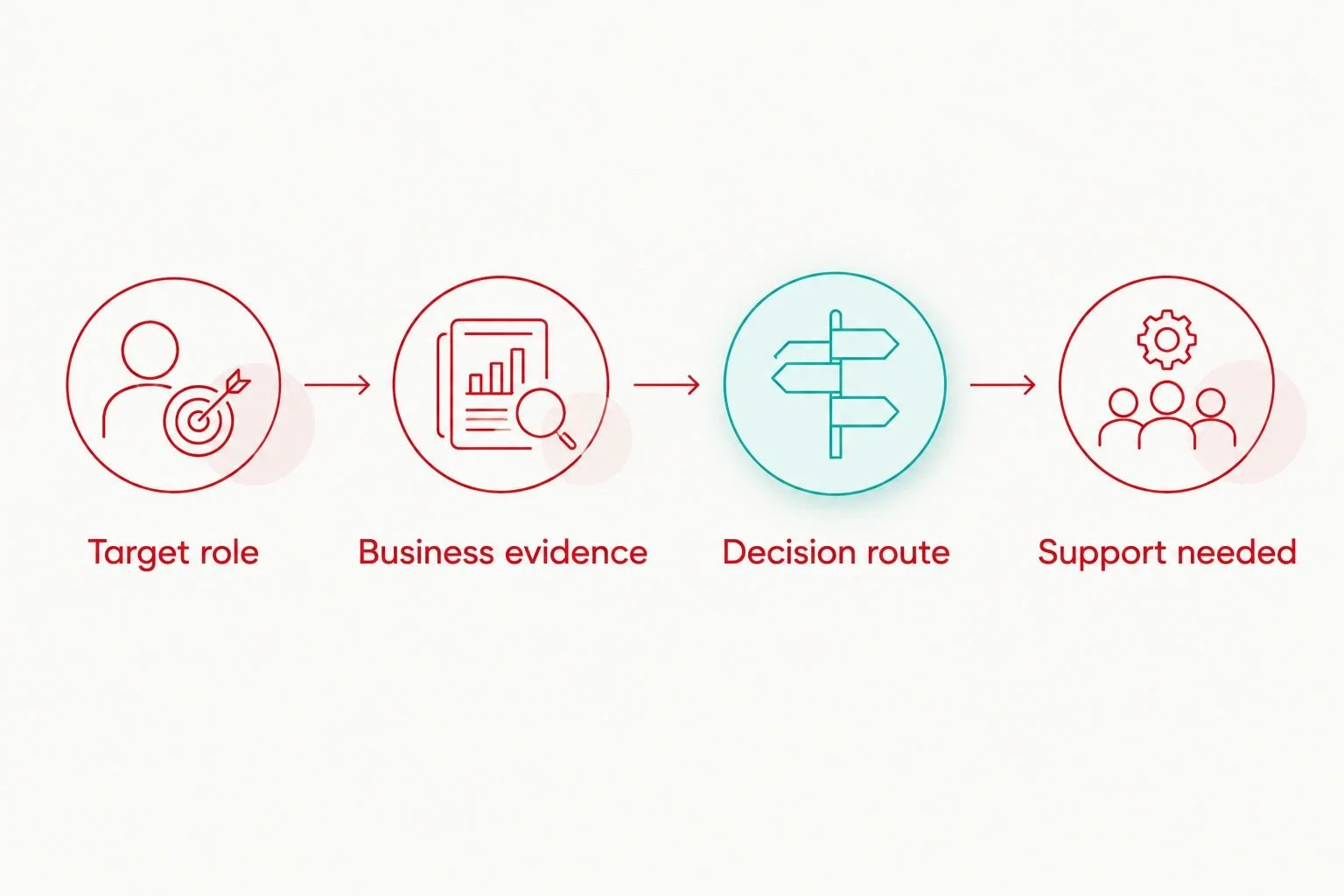
Define the decision before choosing the coaching engagement.
Questions to ask before choosing a coach
Use your 2026 consultation to discuss substance, not just rapport. Ask direct questions and listen for answers tied to your situation.
“Who will advise me directly?” Confirm whether you will work with the person you are speaking to.
“What decision should this work help me make?” Ask for a clear connection between the engagement and your objective.
“How would you approach my positioning?” Listen for attention to your target role and evidence, not a ready-made slogan.
“What falls outside the engagement?” Establish the boundaries before committing.
For a 15-minute consultation about the Career Advancement Blueprint, bring your target role and the obstacle blocking your next move. Do not settle for a conversation that leaves the purpose of coaching unclear.
Discuss Your Next Leadership Move
Bring your target role and advancement obstacle to a 15-minute Career Advancement Blueprint consultation.
How these coaching approaches are ranked
The ranking follows target-role clarity, decision-maker relevance, evidence quality, practical application, and personal fit. Personalized advancement advisory work comes first for the reader who needs to connect several career decisions; narrower engagements follow by purpose.
This is a fit-based comparison, not a claim that one coach produces better outcomes than another. The right choice depends on the problem you need to solve.
Which director coaching option should you choose?
Choose Trainerterry’s Career Advancement Blueprint when you want direct one-on-one advisory work on positioning and your next career decision. Choose promotion-focused coaching for a defined internal case, executive job-search coaching for an external move, or leadership-development coaching for a specific behavior.
Your 2026 advancement plan needs a clear target before it needs more activity. Name the responsibility you want, identify the evidence, and choose support that addresses the decision in front of you.
FAQ
What should the best career coaches for directors help with?
The best fit is a coach whose work addresses your target role, positioning, and immediate advancement decision. Ask how the engagement connects your evidence to a real promotion, hiring, or leadership conversation.
Is the Career Advancement Blueprint a course?
No. The Career Advancement Blueprint is direct one-on-one advisory work with Terry, not a course or group program.
Should I choose promotion coaching or executive job-search coaching?
Choose promotion-focused coaching for an internal advancement case and executive job-search coaching for an external move. If you have not chosen between staying and leaving, address that decision before narrowing the engagement.
What should I bring to a 15-minute consultation?
Bring your target role, your main advancement obstacle, and the decision you want help making. Prepare a short brief so the conversation stays focused on your situation.
Can career coaching guarantee a director gets promoted?
No. Coaching cannot guarantee a promotion, job offer, title, or compensation outcome because the coach does not control the employer’s decision.
Do I need a new résumé before speaking with a coach?
No. Start by defining the role you want and the evidence that supports your fit; résumé work should serve that positioning rather than substitute for it.
One last thing
Before accepting a promotion as your goal, ask what authority comes with it. A title does not tell you which decisions you will own, what resources you can direct, or how success will be judged.
Write down those questions before your next conversation. Do not negotiate only for the label when your real goal is a broader mandate.