Best overall for next-role positioning: Trainerterry and the Career Advancement Blueprint. Best for delivery practice: specialist mock-interview coaching. Best for role-specific questioning: an industry interview adviser. For senior managers and directors choosing interview support in 2026, I recommend matching the help to the decision you need to influence, not buying more practice by default.
TL;DR
Trainerterry is best for experienced leaders seeking individual positioning advice through the Career Advancement Blueprint.
The best interview coaching services for senior leaders connect executive positioning, interview preparation and next-role decisions.
Choose mock-interview coaching when your examples are strong but your answers lack focus.
Ask prospective advisers how they will challenge your evidence, not just improve your delivery.
Why this matters
I bring experience of corporate decision-making to direct, one-on-one advisory work built around each client. My starting point is your next-role decision: what responsibility you want, why your experience supports it and what you need a hiring team to understand.
A polished answer can still miss the point. Describing how you kept a project moving does not automatically demonstrate that you can set priorities across a function.
Trainerterry is best for experienced leaders who need individual advice on positioning themselves for a bigger role. The Career Advancement Blueprint is direct advisory work with me, not a course or group program.
What makes the best interview coaching services for senior leaders?
Use these criteria to assess interview coaching in 2026 before committing to an engagement:
Target-role relevance: The adviser should work from the responsibilities of your intended role, not a generic interview checklist.
Decision-level evidence: Preparation should distinguish what you decided from what your team delivered.
Specific feedback: Ask for criticism of an actual answer, including what to remove, clarify or substantiate.
Individual attention: Establish who provides the advice and how the work addresses your situation.
Practical rehearsal: Choose rehearsal when you need to improve delivery, handling follow-ups or answering under pressure.
Clear boundaries: Confirm the work included. Positioning advice, interview rehearsal and compensation negotiation are different needs.
Read about Terry when assessing the person behind the advisory work. Apply the same scrutiny to every adviser you consider: relevant experience matters more than an impressive service label.
Senior-leader interview support at a glance
Career Advancement Blueprint
Best for: Positioning for a bigger role
Defining feature: Direct one-on-one advisory work with Terry, built around the client
Key limitation: Confirm the interview-preparation work you need before engaging
Specialist mock-interview coaching
Best for: Improving answer delivery
Defining feature: Rehearsal and feedback as the central selection requirement
Key limitation: Practice alone does not resolve an unclear next-role strategy
Industry interview adviser
Best for: Examining role-specific judgment
Defining feature: Relevant operating context as the central selection requirement
Key limitation: Sector familiarity is not a substitute for useful coaching
Structured peer rehearsal
Best for: Maintaining practice between advisory conversations
Defining feature: A trusted colleague challenges your examples
Key limitation: A colleague does not represent the hiring panel
These are distinct support formats. Choose the format first, then assess whether the individual can do the work you need.
1. Career Advancement Blueprint: best for next-role positioning
The Career Advancement Blueprint is direct one-on-one advisory work with me for experienced professionals seeking advancement. It connects your value, your intended next move and the way you present your experience.
Start here when your concern is bigger than answering interview questions. If you cannot explain why you are ready for broader responsibility, rehearsing an answer repeatedly will not settle that positioning decision.
Career Advancement Blueprint pros
You work directly with Terry rather than entering a course or group program.
The strategy is built around your situation.
The focus includes advancement and next-role decisions, not general career encouragement.
Career Advancement Blueprint cons
It is not a self-directed course for someone seeking independent study.
Individual advisory work requires you to examine your choices and provide concrete evidence.
You should establish the interview-preparation scope rather than assume a particular rehearsal format is included.
Best for: Senior managers and directors who need to clarify their value before pursuing a bigger role.
Bring a target-role description and an example that feels difficult to explain. That gives the consultation a specific question to address: is the issue your positioning, your evidence or your delivery?
Verdict: Buy this type of advisory support when the next-role strategy needs work; confirm the scope first.
2. Specialist mock-interview coaching: best for answer delivery
Choose mock-interview coaching when you know the role you want and have credible examples, but your answers wander. Make realistic rehearsal and specific feedback your selection requirements.
Ask the prospective coach to explain how a session works. You need to know whether the coach interrupts, asks follow-ups and helps you rebuild weak answers, rather than simply offering encouragement afterward.
Mock-interview coaching pros
Rehearsal gives you a defined setting to practice answering aloud.
Follow-up questions expose gaps that a written answer can hide.
Feedback can focus on a specific delivery problem, such as excessive context.
Mock-interview coaching cons
Repeating an unclear example does not make the underlying evidence stronger.
Memorizing polished answers can distract you from the actual question.
A generic rehearsal format does not necessarily address director-level responsibilities.
Best for: Leaders whose positioning is clear but whose spoken answers need discipline.
For your 2026 preparation, use a 90-second opening answer as a practice constraint, not a universal interview rule. State the decision, explain your reasoning and give the result before adding background.
Verdict: Buy focused rehearsal when delivery is the bottleneck; skip repetition without corrective feedback.
3. Industry interview adviser: best for role-specific judgment
Choose an industry interview adviser when you need someone to challenge the operating logic behind your examples. Look for relevant experience with the function and responsibility you are pursuing, rather than sector familiarity alone.
For example, an operations director candidate needs to explain choices involving capacity, quality and competing demands. An adviser should challenge the reasoning, not supply technical language for the candidate to repeat.
Industry interview adviser pros
Relevant context helps you identify which decisions deserve more explanation.
Function-specific questioning gives you a way to examine technical assumptions.
Discussion can distinguish specialist expertise from broader leadership judgment.
Industry interview adviser cons
Working in your industry does not automatically make someone a capable coach.
Advice from a different organization can reflect different responsibilities and constraints.
Excessive technical detail can obscure the leadership decision you need to communicate.
Best for: Leaders preparing to discuss specialized operating decisions or a significant change in functional scope.
Ask: “How would you challenge the reasoning in this example?” Listen for questions about alternatives, constraints and consequences, not just preferred terminology.
Verdict: Buy relevant challenge when functional judgment needs scrutiny; skip credentials without a clear feedback method.
4. Structured peer rehearsal: best for continued practice
Use a trusted colleague to rehearse after you have chosen your positioning and examples. Give the colleague a specific role: challenge unclear claims, interrupt long answers and ask what you personally decided.
Peer rehearsal is a practice method, not a replacement for independent advisory work. Choose someone willing to disagree with you, rather than someone who only confirms that you sound impressive.
Structured peer rehearsal pros
You can test whether another person understands your example.
A colleague familiar with your work can question vague descriptions.
You can repeat a focused exercise between advisory conversations.
Structured peer rehearsal cons
Familiarity can cause a colleague to fill in details an interviewer would not know.
Supportive feedback can leave weak evidence unchallenged.
A peer's preferences do not establish what a hiring panel wants.
Best for: Leaders who need continued practice after their core positioning is settled.
Give your rehearsal partner 3 leadership stories to question: a difficult trade-off, a change you led and a decision that required correction. This is a preparation exercise, not a required interview formula.
Verdict: Use peer rehearsal as a supplement; skip it as your only source of challenge when your next move remains unclear.
Build answers around decisions, not activity
For senior-leader interview preparation in 2026, I recommend organizing each example around four elements. This keeps your answer focused on responsibility without stripping away the context needed to understand it.
Mandate: What were you accountable for, and what was outside your authority?
Decision: What choice did you make, and which alternative did you reject?
Trade-off: What constraint or competing priority shaped the choice?
Evidence: What happened, and what can you substantiate?
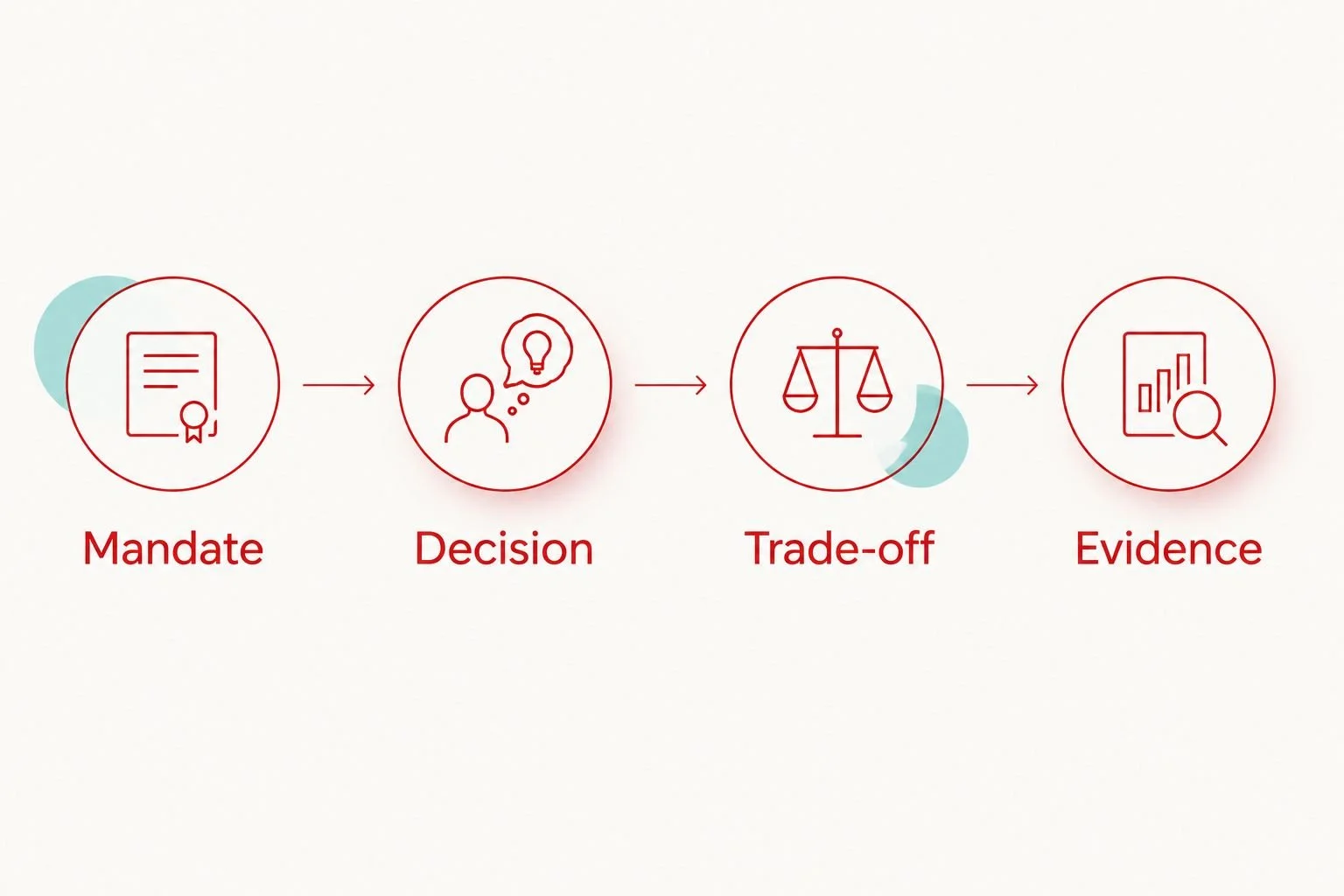
Make your decision visible before adding more background.
Hypothetical example: A senior manager is asked about a delayed cross-functional launch. Instead of reciting meetings and status updates, the candidate explains the decision to narrow the release scope, the rejected alternative and how the team checked the result.
Use this practice script: “I was accountable for [mandate]. I chose [decision] rather than [alternative] because [trade-off]. The evidence I can share is [result].” Replace every bracket with facts from your own work.
Do not manufacture a financial result to make the story sound senior. If the evidence is a completed handover, a documented decision or a changed operating process, explain that accurately.
How to choose an adviser before committing
Ask prospective advisers questions that reveal the work, not just the sales pitch:
“What would you need to understand about my target role before advising me?”
“How would you distinguish a positioning problem from a delivery problem?”
“What preparation would you expect me to bring?”
“Who would work with me directly?”
“What does this engagement include, and what sits outside it?”
Listen for clear boundaries. A useful conversation should help you determine whether the engagement fits your problem; it should not require you to assume that every career service includes every form of interview preparation.
For a 15-minute consultation about the Career Advancement Blueprint, bring your target role, your next decision and the part of your positioning you cannot yet defend. That creates a focused starting point for discussing fit.
Discuss your next-role positioning
Use a 15-minute consultation to discuss your next move and fit for direct advisory work with Terry.
How the options are ranked
This 2026 ranking prioritizes next-role clarity for senior managers and directors, followed by delivery practice, functional challenge and continued rehearsal. The criteria are target-role relevance, decision-level evidence, specific feedback, individual attention, practical rehearsal and clear boundaries.
It is a decision guide, not a claim that every provider within a format delivers the same work. Your immediate problem determines which option belongs first for you.
Which interview coaching should you choose?
Choose the Career Advancement Blueprint when you need to clarify your positioning for a bigger role. Choose mock-interview coaching when the strategy is settled and your delivery needs work.
Use an industry adviser to examine specialized judgment and peer rehearsal to keep practicing. Don't settle for more sessions when you cannot explain what those sessions need to change.
FAQ
What are the best interview coaching services for senior leaders?
The best fit depends on whether you need positioning advice, delivery practice or role-specific challenge. Trainerterry's Career Advancement Blueprint is best for experienced leaders seeking direct, individual advice on their next-role positioning.
Is executive career coaching the same as mock-interview coaching?
No. Executive career coaching addresses broader positioning and advancement decisions, while mock-interview coaching centers on rehearsal. Confirm the actual scope of any engagement before choosing.
What should a director look for in an interview coach?
A director should look for someone who challenges decision-making evidence, not just speaking style. Ask how the adviser will connect your examples to the responsibilities of the target role.
Is the Career Advancement Blueprint a course?
No. The Career Advancement Blueprint is direct one-on-one advisory work with Terry, built around the client rather than delivered as a course or group program.
How should I prepare for an executive interview in 2026?
Start by identifying the responsibilities you need to demonstrate and selecting truthful examples of relevant decisions. Practice explaining your mandate, decision, trade-off and evidence before adding background.
Can interview coaching guarantee a promotion or job offer?
No. Do not choose a service on the promise of a guaranteed job offer, promotion, title or salary outcome. Assess the work offered and its relevance to your situation.
What should I bring to a 15-minute consultation with Terry?
Bring your target role, the career decision you face and the part of your positioning that needs attention. Use the conversation to discuss fit for the Career Advancement Blueprint.
One last thing
Ask your rehearsal partner: “After that answer, what would you trust me to own?” Then stay quiet and listen.
If the answer describes your current responsibilities rather than the bigger role you want, revise the example. In 2026, make that your preparation standard: not sounding more senior, but making the relevant responsibility clear.