What is a Career Coach? The Strategic Guide to Executive Growth in 2026

Hitting 115% of your annual targets won't get you the corner office if nobody knows how to translate your output into executive value. You’re putting in the reps and grinding through 50 hour weeks, yet you still feel invisible to recruiters when the high-stakes roles open up. This is exactly why a career coach is no longer a luxury but a tactical necessity for anyone looking to break through the glass ceiling in 2026. It's frustrating when your performance is elite but your professional presence is silent; you're essentially a high-capacity engine idling in a parking lot while others lean into the fast lane.
It’s time to stop making excuses and start executing a professional growth plan that actually delivers. You deserve to be recognized for the heavy lifting you do every day. We're going to build a clear roadmap for a 20% salary increase by mastering the STAR method and building a LinkedIn profile that forces headhunters to stop scrolling and start calling. This guide breaks down the high-stakes positioning strategies and the "form timing" you need to transform from a silent high achiever into a sought-after industry leader.
Key Takeaways
- Stop settling for slow growth and learn how a strategic partnership overhauls your brand to secure elite promotions.
- Calculate the real cost of staying still and see how a career coach turns your potential into immediate ROI through high-stakes negotiation.
- Master the "Positioning" mindset to win high-level roles before the interview even starts using the gold-standard STAR method.
- Learn how to vet your mentor’s corporate experience so you only take advice from those who have actually sat in the hiring seat.
- Discover a structured, results-driven blueprint that bridges the gap between your current role and a high-stakes executive career.
What is a Career Coach? Defining the Strategic Partnership
Stop thinking of a career coach as a simple resume polisher. In 2026, the professional landscape doesn't care about your hobbies or your generic objectives. It cares about your ROI. A coach is your tactical partner, acting as a high-stakes corporate advisor who helps you navigate transitions, optimize your personal brand, and secure the promotions you've earned. They don't just "help" you find a job. They strategize your next three moves while you're still focused on your current one. It's a results-driven relationship designed for those who refuse to settle for average growth.
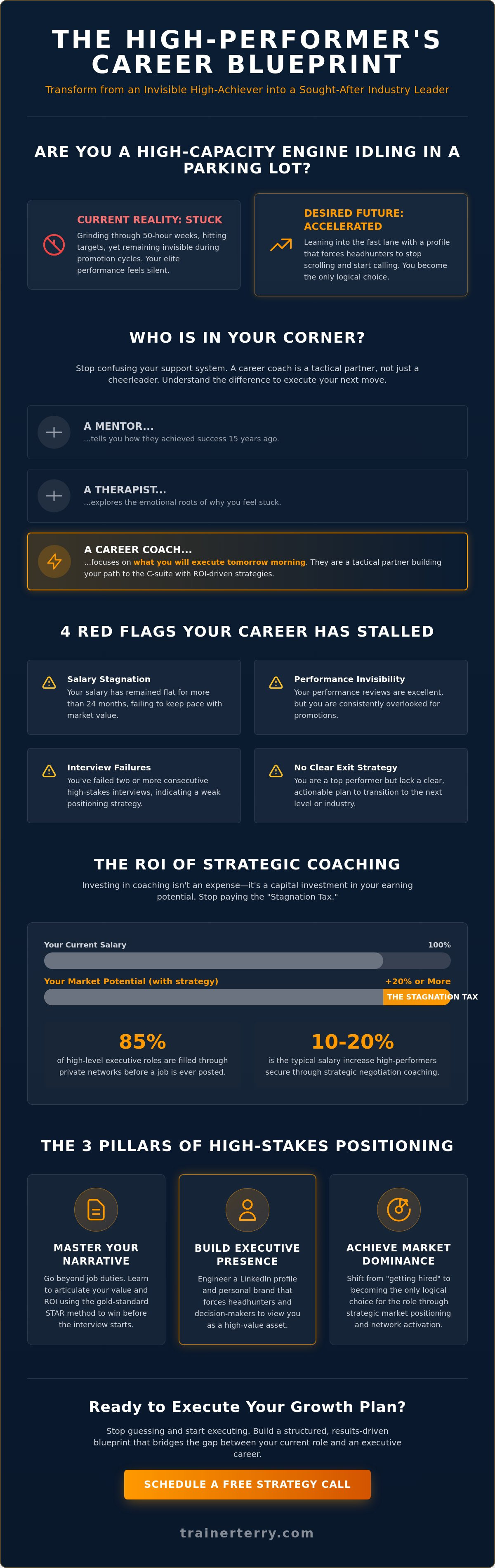
You need to understand the distinctions clearly. A mentor tells you how they achieved success 15 years ago. A therapist explores the emotional roots of why you feel stuck. A professional Coaching partner focuses on what you're going to execute tomorrow morning. This is about "tough love" and tactical precision. If your market positioning is weak, a coach will tell you. If your interview performance is flat, they'll fix it. You aren't paying for a cheerleader; you're paying for an architect who builds your path to the C-suite.
Career Coach vs. Career Strategist
Most professionals think they need a new resume when they actually need a complete market repositioning. A strategist focuses on how the market perceives your value rather than just fixing your grammar. You're moving from the mindset of "getting hired" to "becoming the only logical choice" for the role. This shift is critical because, by 2026, an estimated 85% of high-level executive roles are filled through private networks before a job description is even written. You can dive deeper into this specialized approach in our guide on What is a Career Strategist? to see how the blueprint for high performance has changed.
Who is Executive Coaching For?
This isn't for the unmotivated. This is for the mid-career professional who has hit a ceiling and the senior leader seeking a transition into the C-suite. You need a career coach if you're experiencing any of these red flags:
- Your salary has remained stagnant for more than 24 months.
- Your performance is high, but you remain "invisible" during promotion cycles.
- You've failed two or more consecutive high-stakes interviews.
- You're talented but lack a clear "exit strategy" from your current industry.
Waiting for a promotion is a failing strategy in the 2026 economy. The pace of business is too fast for patience. If you aren't actively managing your trajectory, you're falling behind. It's time to stop guessing and start executing. If you're ready to find the leaks in your professional brand, you should schedule a free strategy call to map out your next level of growth.
The ROI of Coaching: Why High-Performers Invest in Strategy
Stop thinking of professional development as an expense. It's a capital investment in your most valuable asset: your earning potential. High-performers don't wait for "the right time" to level up. They create that time by hiring a career coach to eliminate the guesswork. If you've been in the same role for three years without a significant title change or at least a 15% raise, you aren't just stagnant; you're falling behind the market value of your own potential.
The Hidden Cost of Staying Stuck
The Stagnation Tax is the annual financial deficit between your current salary and the maximum compensation the market is willing to pay for your specific skill set. This isn't just about money; it's about the missed equity, the lost compound interest on your earnings, and the mental burnout that comes from running on a treadmill that's going nowhere. Many professionals believe their internal network will eventually pull them up. In reality, people inside your company often have a fixed image of who you were when you started, not who you've become. This bias makes a major pivot nearly impossible without external intervention.
Don't fall into the trap of thinking that scrolling through LinkedIn for free is a substitute for a battle-tested strategy. Free tools give you noise; a professional Career Coaching approach gives you a signal. Relying on LinkedIn's basic features is like trying to build a championship physique by watching other people lift weights. You need a program, not a feed.
Strategic Negotiation and Offer Optimization
Most executives leave between 10% and 20% of their potential compensation on the table because they don't know how to navigate high-stakes conversations. A career coach doesn't just help you find a job; they help you architect a package that reflects your true worth. This includes base salary, signing bonuses, and performance-based equity. When you walk into an interview with genuine executive presence, the conversation shifts. You stop being an "applicant" hoping for a chance and start being a "recruited leader" who solves problems.
This shift in perspective is how you accelerate your promotion timeline by 18 to 24 months. It's about moving from a reactive state to a proactive one. Before you sign your next offer or head into your annual review, you should schedule a free strategy call to assess your real market value and ensure you aren't leaving money on the table.
The psychological edge is just as vital as the financial gain. Imposter syndrome is usually just a lack of data; once you have an executive VP perspective guiding your moves, that internal doubt disappears. You stop guessing and start executing with the discipline of a pro. This is how you win in 2026. No excuses, just results.
The Core Pillars of Modern Career Positioning
Stop chasing job boards. High-level roles aren't won by clicking a button. They're won through strategic positioning long before the first handshake. If you're reacting to a job post, you're already behind the curve. A top-tier career coach will tell you that executive growth requires a proactive offensive. You need to build a reputation that precedes you. This means shifting your mindset from a seeker to a solution provider. Companies don't hire executives to fill a seat; they hire them to solve a $10 million problem or lead a 20% growth initiative. You aren't looking for work; you're offering a massive return on investment.
Your career narrative isn't a list of dates and titles. It's a record of transformations. Every role you've held must connect to a larger story of growth and capability. Stop listing duties. Start listing the fires you've put out and the empires you've built. A career coach helps you find the thread that connects your past wins to the specific future needs of a CEO. In 2026, the market doesn't care what you did; it cares what you can do next.
Mastering the STAR Method for Executive Interviews
The STAR Method—Situation, Task, Action, and Result—is the bench press of interviewing. It works because it forces clarity. But most candidates fail because they spend 80% of their time on the "Task." That's a rookie mistake. Your interviewers want the "Result." They want to see the 15% increase in efficiency or the $2.4 million saved in annual overhead. You need to lead with the impact. If you want to dominate your next high-stakes meeting, check out my 1:1 Job Interview Prep to master this framework. Don't just tell a story; prove your worth with hard data and clear actions.
LinkedIn Positioning Strategy
Your LinkedIn profile is your personal brand headquarters. It's your digital billboard, not a static resume. In 2026, recruiters look for executive presence before they even read your experience section. Your headline should scream value, not just your current title. Let's talk about the "Open to Work" badge. For an executive, it often signals desperation rather than demand. You want to be the talent that companies have to hunt, not the one begging for a glance. For a deeper dive into these high-level tactics, read about Career Counseling Services 2026. Build a profile that makes the market come to you. Success isn't about being found; it's about being impossible to ignore.
- Positioning: Focus on the ROI you bring to the table.
- STAR Method: Prioritize the Result over the Situation.
- LinkedIn: Use your profile to signal authority and executive presence.
- Narrative: Turn your history into a value-driven success story.
How to Choose the Right Career Coach for Your Goals
You aren't looking for a pen pal. You're looking for a catalyst. A career coach should bring more than just a listening ear to the table; they need scars from the corporate trenches. Look for someone who has sat in the hiring seat for at least 15 years. If they haven't managed a P&L or led a team of 50 people, they can't help you lead yours. They must understand the pressure of a boardroom, not just the theory of a textbook.
Specialization isn't optional. It's the baseline. Generalists give general results. You need someone who understands the nuances of your specific executive level. Avoid the "one-size-fits-all" trap. Standardized templates are the fastest way to look like every other candidate in the pile. Your strategy must be as unique as your DNA. If they can't explain how they adapt their framework to your specific industry, walk away. Results come from precision, not generic checklists.
The chemistry test matters, but not for the reason you think. Don't hire a "yes-man" who nods at your excuses. Hire the mentor who calls out your blind spots. Real growth happens when someone pushes you past your comfort zone. If your career coach doesn't make you a little uncomfortable, you're wasting your money. You need "tough love" to break through the plateaus that have kept you stagnant for the last 18 months. You want an advocate who is more interested in your success than your feelings.
Red Flags in Career Coaching
Be ruthless with your vetting. Beware of "guaranteed job placement." No ethical professional can promise a signature on a contract they don't sign themselves. According to 2024 industry data, the average executive search takes 5 to 7 months. If someone promises a 30-day miracle, they're lying. Avoid transactional resume writers who don't offer strategy. A pretty document won't save a broken career path. Entry-level advice like "just network more" is useless for senior-level problems that require sophisticated political maneuvering.
Questions to Ask During a Strategy Call
- What is your specific experience with high-stakes salary negotiations over the $250,000 mark?
- How do you help clients develop a unique executive presence that commands a room in under 30 seconds?
- Can you explain your specific framework for career transitions in volatile markets?
Stop settling for average results and start demanding the growth you deserve. Schedule your free strategy call today and let's build your executive blueprint.
The Trainer Terry Approach: The Career Change Blueprint
Terry Jones isn't your average career coach. He spent 22 years as a Corporate VP, sitting on the other side of the desk where the real decisions happen. He’s seen exactly why 85% of executive resumes fail to trigger an interview in the first 6 seconds of review. Terry doesn't deal in fluff or "finding your passion" without a plan. He provides a battle-tested curriculum designed for the high-stakes environment of 2026. This isn't a suggestion list; it's a blueprint for professional dominance.
The Career Change Blueprint moves you through a structured sequence that starts with a ruthless assessment of your current market value. Most professionals underestimate their worth by at least 20% because they don't know how to quantify their impact. Terry's approach fixes that immediately. You'll move from assessment into a high-level interview strategy that treats every meeting like a board presentation. You aren't there to answer questions; you're there to solve the company's most expensive problems. This mindset shift is what separates the people who get the job from the people who just "do well" in the interview.
The Career Advancement Blueprint
If you're looking to climb within your current organization, you need the Career Advancement Blueprint. Internal growth requires a different set of muscles than an external job hunt. You have to change how the C-suite perceives you before the promotion cycle even begins. Executive Presence is the intersection of communication and credibility. If you lack either, you'll stay stuck in middle management regardless of your output. Terry’s method focuses on building that presence through tactical communication and high-visibility wins that make your advancement inevitable. Stop being the "reliable worker" and start being the "strategic leader" the company can't afford to lose.
Take the Next Step in Your Career
Waiting for the perfect moment is the biggest risk to your professional legacy. In a 2024 industry survey, 64% of executives admitted that visibility and perceived leadership potential outweighed raw performance when it came to promotions. If you aren't actively managing your trajectory, someone else is managing it for you. You don't have time to waste on "trial and error" when your prime earning years are on the line. Terry’s 1-on-1 job interview prep ensures you never walk into a room unprepared again.
It's time to stop leaving your career to chance. If you need immediate tactical feedback on a specific challenge, join the next session of Office Hours. You’ll get direct, no-nonsense advice that you can implement the same day. The window for executive growth in 2026 is moving fast. Book your free strategy call today. Let’s stop talking about what you want to do and start executing the plan to get you there.
Claim Your Seat at the Executive Table
Success in the 2026 market doesn't happen by accident. You've learned that a career coach isn't just a guide; they're a strategic partner who turns your professional history into a high-value asset. High-performers invest in their growth because they know a plateau is just a slow decline in disguise. You need a system that works, like the specialized STAR method interview preparation, to dominate high-stakes transitions and secure the roles you deserve.
I don't deal in theories. I bring 20+ years of experience as a former Corporate VP to every session. We use a proven Career Change Blueprint to ensure your next move isn't just a change, but a massive level-up. The corporate world is crowded, and "good enough" won't cut it anymore. It's time to stop overthinking and start executing with a plan that has already worked for hundreds of leaders. You've got the drive, and now you have the roadmap to back it up.
Don't let another year pass while you're stuck in the same position. Ready to level up? Schedule your free Career Strategy Call with Trainer Terry today. Let's get to work and build the career you've earned.
Frequently Asked Questions
What exactly does a career coach do for high-level executives?
A career coach acts as your strategic performance partner to identify blind spots and optimize your leadership output. They don't just talk; they build a 90 day execution plan to scale your influence. Think of it as high intensity interval training for your professional trajectory. They audit your current impact, refine your executive presence, and ensure you're hitting the KPIs that matter for C-suite promotion in a competitive market.
How is a career coach different from a recruiter or headhunter?
A recruiter works for the company to fill a seat, while a career coach works exclusively for you to maximize your market value. Headhunters get paid by the employer when they close a deal. In contrast, your coach focuses on your long term career fitness. They help you negotiate a 15% to 20% salary increase based on 2025 industry benchmarks rather than just pushing you into the first available opening.
Is hiring a career coach worth the investment in 2026?
Investing in a coach is essential in 2026 because 85% of executive roles are now filled through private networks rather than public job boards. You wouldn't enter a bodybuilding competition without a trainer, so don't navigate a volatile market alone. Data from the International Coaching Federation shows that 70% of professionals see improved work performance after coaching. It's the difference between stagnant growth and a definitive career breakthrough.
How many sessions do I typically need to see a result?
Most executives see a measurable shift in their leadership clarity within 8 to 12 sessions. The first 4 sessions focus on the warm up phase where we strip away bad habits and define your core objectives. By session 10, you should be executing your new strategy with 100% confidence. If you aren't seeing a tangible ROI by the third month, you're either not doing the work or the strategy needs a pivot.
Can a career coach help me if I want to change industries entirely?
Yes, a career coach specializes in translating your existing muscle memory into a different professional arena. We identify the 5 core transferable skills that make you a threat in any industry. Whether you're moving from Fintech to Green Energy, the goal is to rebrand your experience so you don't lose 30% of your earning power during the transition. We focus on the bridge skills that 2026 employers demand.
What is the STAR method, and why do career coaches emphasize it?
The STAR method is a framework for Situation, Task, Action, and Result that turns vague stories into hard evidence of your success. Coaches emphasize it because it forces you to speak in metrics rather than generalities. Using this structure can increase your interview success rate by 40% because it proves you're a closer. It's the professional equivalent of showing your before and after photos; it makes your progress undeniable and measurable.
Does a career coach write my resume for me or just give advice?
A high level coach provides the architectural blueprint for your resume, but you must own the content. We audit your current document to ensure it passes the 6 second scan used by 90% of executive recruiters. We'll rewrite your bullet points to emphasize Result First language. It's not just advice; it's a total structural overhaul to ensure your profile stands out in a crowded 2026 digital landscape where AI screening is standard.
What should I expect in my first coaching session?
Expect a high intensity diagnostic audit of your current career status and your ultimate goal weight. We won't waste time on small talk; we'll dive straight into your biggest roadblocks. You'll leave the first 60 minutes with at least three actionable reps to perform immediately. It's about setting the baseline. If you're looking for a therapy session, you're in the wrong place; this is about performance, discipline, and results.

Article by
Terry Jones
Terry Jones is the Founder and Chief Career Strategist of the Career Advancement Blueprint and Executive Coach and Lead Consultant at FireBridge Consulting.
As an ICF Certified Accredited Career Coach and Certified Master Career Services professional, he partners with professionals at all levels, including senior leaders and executives, to navigate career transitions, secure new opportunities, and position themselves for advancement. His approach goes beyond surface level coaching, focusing on how individuals think, communicate, and lead so they can operate with clarity, authority, and strategic intent in high stakes environments.
In his work as an executive coach, Terry engages in high impact advisory conversations that help leaders strengthen decision making, elevate their presence, and align their leadership style with organizational expectations. He is known for helping clients translate their experience into influence, ensuring they are not only seen for what they have done, but trusted for what they are capable of leading next.
With over 20 years of corporate experience, including serving as a Vice President and leading Learning and Development functions for three New York City organizations, Terry brings a deep understanding of how companies evaluate talent, develop leaders, and make promotion decisions. This allows him to bridge the gap between individual ambition and organizational reality.
His insights have reached over 630,000 followers and generated more than 70 million video views, where he shares direct, experience driven guidance that helps professionals think differently and take action.