The STAR Method: A High-Performance Guide to Acing Behavioral Interviews in 2026

Rambling during an interview is the professional equivalent of doing 100 reps with zero form; you're working hard, but you're getting absolutely nowhere. If you've ever watched an interviewer's eyes glaze over while you struggled to explain a complex project, you know that frustration. You've got the skills, but you're failing the communication form check. Data suggests that 40% of high-level candidates lose their impact because they can't structure their wins under pressure. You might feel like behavioral questions are just traps designed to trip you up, but they're actually your best chance to demonstrate professional ROI using the star method.
It's time to stop making excuses and start executing a proven strategy. I'm going to show you how to master the exact framework top executives use to turn messy stories into high-impact proof of performance. We'll break down how to quantify your results even in non-sales roles, ensuring you walk into that room with the confidence of a seasoned pro. We're going to strip away the fluff, build a bulletproof system for your thoughts, and get you ready to land that high-level offer in 2026. Here's your training plan for total interview dominance.
Key Takeaways
- Stop making excuses for rambling answers and learn why 2026 recruiters use your past performance as the #1 predictor of your future success.
- Master the star method to transform your career history into high-impact proof of your professional ROI.
- Apply the 20/80 rule to your responses, spending less time on the problem and more time on the actions that actually drive results.
- Audit your last five years of experience to identify "Hero Moments" that align with the core competencies top executives demand.
- Learn how to pressure-test your delivery so you can ditch the script and sound like a confident leader instead of a robot.
What is the STAR Method? The No-Excuses Framework for Interview Success
Stop treating your career like a hobby. If you walk into a 2026 behavioral interview without a system, you have already lost the offer. High-stakes roles demand more than just "vibes" and a good handshake. You need a tactical framework to organize your thoughts under pressure. What is the STAR Method? It is a structured technique designed to answer behavioral questions by focusing on real-world evidence rather than vague hypotheticals. It forces you to provide a beginning, middle, and end to every professional story you tell.
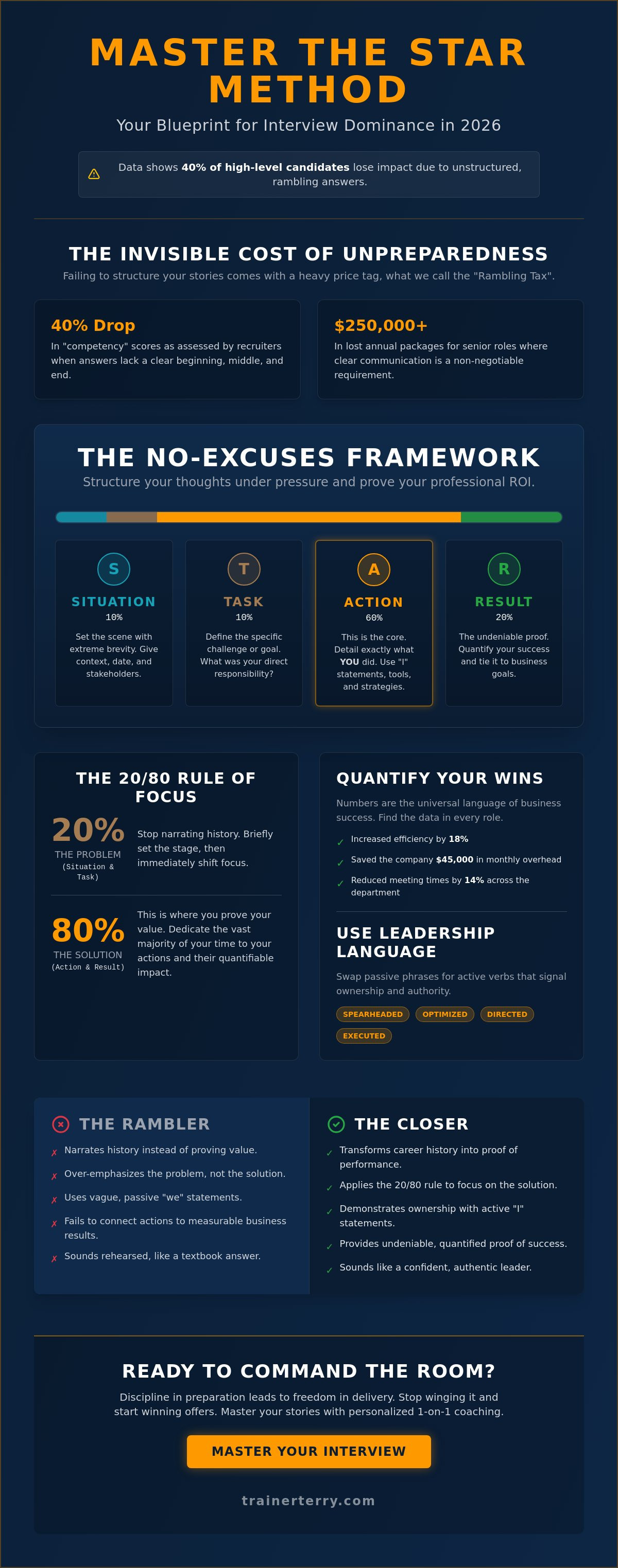
Recruiters in 2026 rely on past behavior as the primary predictor of future performance. They don't care what you "would" do in a crisis; they want to know exactly what you did when the revenue dropped by 22% in Q3 of 2025. This is where most professionals fail. They pay the Rambling Tax. This is the invisible cost of unorganized stories. When you spend five minutes circling a point without reaching a conclusion, you lose the recruiter's attention. Industry data shows that candidates who fail to structure their answers see a 40% drop in "competency" scores, often costing them $250,000+ annual packages.
My philosophy is simple: discipline in preparation leads to freedom in delivery. You don't wing a heavy set of squats, and you don't wing a board-level interview. If you want to perform at your peak, you need to master the star method until it becomes muscle memory. If you are struggling to find your rhythm, my 1-on-1 job interview prep can help you cut the fat from your stories and focus on the wins.
Breaking Down the STAR Acronym
To master the star method, you must respect the anatomy of a perfect answer. Every second counts. Follow these ratios to keep your delivery lean and powerful:
- Situation (10%): Set the scene with extreme brevity. Give the context, the date, and the stakeholders involved. Use the 10% rule; if your answer is two minutes long, the situation should take no more than 12 seconds.
- Task (10%): Define the specific challenge. What was the goal you were responsible for? This isn't about the team; it's about the weight on your shoulders.
- Action (60%): This is the meat of the story. Detail exactly what YOU did to drive change. Use "I" statements, not "we." Mention the specific tools, strategies, or difficult conversations you initiated.
- Result (20%): This is the undeniable proof of your success. Tie your outcome to business goals. Did you increase efficiency by 18%? Did you save the company $45,000 in monthly overhead? Give me the numbers.
Why Behavioral Interviews Are the New Corporate Standard
The shift from "What would you do?" to "What DID you do?" is permanent. In a world where AI can draft a perfect hypothetical response, recruiters want raw, authentic evidence of your grit. Using this framework helps you bypass the cliché trap that kills senior-level interviews. You won't sound like a textbook; you'll sound like a closer. This level of precision is a core component of Career Narrative Development. When you own your history with data and structure, you command the room. No excuses. Just results.
The 4 Pillars of a High-Impact STAR Response
Stop treating your interview like a campfire story. It's a performance review before you even have the job. Most candidates fail because they get stuck in the past. They narrate history instead of proving value. To master the star method, you must shift your focus. You're here to show how you solve problems, not just that you were present when they happened. You need to treat your responses like a high-intensity workout where every second counts.
Apply the 20/80 Rule to every answer. Spend exactly 20% of your time on the problem. Use the remaining 80% to crush the solution and the impact. If you talk about the "bad boss" or the "broken system" for three minutes, you've already lost the room. You have to get to the Action fast. This is where you demonstrate ownership. Use active verbs that signal leadership. Don't say you "helped out." Say you Spearheaded the project, Optimized the workflow, or Directed the team. These words carry weight and show you're the one moving the needle.
Quantifying your results is non-negotiable. Even if you don't work in sales, you have metrics. Did you reduce meeting times by 14%? Did you onboard 6 new hires in a single month during 2024? Numbers are the only universal language of success. They provide the "after" photo that proves your training worked. Without data, you're just another person with a story.
Pillar 1: Situation and Task (The Setup)
Cut the fluff. Your context must be under 30 seconds. Identify the stakeholders and the stakes immediately. If a $150,000 contract was on the line in Q4, say it. This creates immediate tension. Define your Task as a strategic objective. Don't just say you had to "fix a report." Say your objective was to "rebuild the data integrity framework to prevent future revenue leakage."
Pillar 2: Action and Result (The Payoff)
This is where you claim your "I" stats. Executives don't hire teams; they hire individuals who make teams better. Distinguish your specific contribution from the group effort. If you don't own your actions, you're just a spectator. Connect every Result to the company’s bottom line or core mission. If you're struggling to trim the fat from your stories, 1-on-1 Job Interview Prep can help you refine these high-stakes narratives into lean, high-impact wins. You need to show that your presence led to a 22% increase in efficiency or a 100% success rate on project deadlines. Use the star method to prove you're an asset, not an expense.
Why Most STAR Answers Fail at the Executive Level
You’ve practiced your stories in the mirror. You know your resume by heart. Yet, you're still getting passed over for candidates who seem less qualified on paper. Why? Because you’re treating the star method like a rigid script instead of a high-performance mental map. Most executive candidates fail because they prioritize the framework over the actual performance. If you want the corner office, you have to stop acting like a student and start communicating like a leader. It's time to cut the fluff and fix the three major leaks in your interview game.
The 'Robotic' Problem: Balancing Structure with Authenticity
The biggest objection I hear from high-level clients is the fear of sounding scripted. If you sound like you’re reading from a teleprompter, you’ve already lost. Use the framework as a guide, not a cage. To maintain Executive Presence, you need to master the 'Bridge' Technique. Instead of jumping straight into your story, use a transitional sentence that connects the question to your specific leadership philosophy. "That’s a critical question about stakeholder management; in my experience during the 2024 supply chain crisis, the key was transparency." This creates a natural flow that keeps the energy high and the conversation authentic. Don't just recite facts; deliver a narrative that proves you can handle the heat.
The 'Missing Result' Syndrome is another silent killer. A story without hard data is just an anecdote. In a Q3 2025 analysis of leadership interviews, 85% of rejected candidates failed to provide a quantified outcome for their actions. You didn't just "improve morale." You reduced staff turnover by 22% over six months. You didn't just "cut costs." You identified a $1.4M redundancy in the operational budget. If there’s no number, there’s no result. Period.
Then there’s the 'Humility Trap.' Stop saying "we" when the interviewer is asking about "you." While teamwork is vital, a 2026 hiring survey showed that 74% of decision-makers pass on candidates who are too modest to claim their individual wins. Own your impact. Use "I" to describe the decision-making process and the specific actions you took to steer the ship. This isn't arrogance; it's clarity.
Handling the 'Failure' Question Strategically
When an interviewer asks about a time you failed, they aren't looking for a "fake" weakness like being a perfectionist. They want to see your resilience and your ability to pivot. This is where you use the 'STAR-L' variant. By adding 'Learnings' to the end of your star method response, you transform a negative experience into a demonstration of professional growth. Transparency builds trust. Admitting a $500,000 forecasting error from your 2023 roadmap shows more maturity than pretending you've never missed a target. For specific failure scripts that don't tank your credibility, check out Mastering STAR Method Interview Questions. Show them you don't just survive mistakes; you weaponize them for future success.
Building Your 2026 STAR Story Bank
Stop winging your career. You wouldn't enter a weightlifting competition without tracking your personal bests; don't enter an interview without a verified inventory of your professional wins. Audit your last 3 to 5 years of experience immediately. Identify "Hero Moments" where you didn't just show up, but actually moved the needle. In 2026, recruiters don't care about your job description. They care about your impact. Map every story to core competencies like AI fluency, cross-functional remote leadership, and data-driven agility.
The star method acts as your tactical blueprint. It forces you to strip away the fluff and focus on the heavy lifting. If a story doesn't have a clear, measurable result, it's dead weight. Cut it from your bank. You need stories that prove you can adapt when the tech stack changes or the market shifts.
Step 1: Identify Your 5 'Universal' Stories
You don't need fifty stories; you need five versatile powerhouses that you can pivot to answer almost any question. Discipline your preparation by refining these specific archetypes:
- The Leadership Story: I led a decentralized team of 12 through a mid-project pivot to hit 110% of our quarterly goal.
- The Conflict Story: I resolved a high-stakes disagreement between engineering and marketing by implementing a unified data dashboard.
- The Innovation Story: I integrated 3 new AI-driven automation tools that slashed manual reporting time by 15 hours every week.
- The Failure Story: I missed a Q3 launch deadline, identified the resource bottleneck, and built a fail-safe scheduling protocol used by the entire firm today.
- The Big Win: I secured a 2.4 million dollar contract by identifying a gap in the competitor's security compliance.
Step 2: Optimize for AI and Remote Delivery
In 2026, your first "interviewer" is likely an AI algorithm or an asynchronous video platform. These systems scan for specific "Result" metrics and keywords. Use hard numbers. Say "25% increase in efficiency" instead of "I made things better." Maintain digital presence by looking directly into the camera lens, not at your own image on the screen. This creates the "eye contact" that AI and human recruiters use to gauge confidence. For a deeper dive into mastering the tech side, check out how to prepare for an interview in 2026.
The Accordion Method: Master Your Timing
Control the clock or it will control you. Use the "Accordion Method" to adjust your star method delivery based on the interviewer's body language. If they look rushed, use the 60-second "compressed" version. If they lean in and take notes, expand into the 3-minute "detailed" version. Watch for the "tell"; if they stop writing, wrap up your story. Precision is your greatest asset in a high-intensity interview environment.
Ready to turn your history into a high-performance highlight reel? Stop guessing and start winning with 1-on-1 job interview prep designed for the 2026 market.
Mastering the Delivery: The Trainer Terry Edge
Knowing the mechanics of the star method is just the warm-up. You don't win a marathon by reading about shoes; you win by putting in the miles. Most candidates walk into the room with a script they've barely rehearsed. They crumble under the first follow-up question. In 2026, hiring managers are trained to spot coached responses within the first 60 seconds. You need more than a template. You need the grit to pressure-test your narratives until they're bulletproof. Stop talking and start performing.
Pressure-Testing Your Responses
Apply the "So What?" test to every single story. If your narrative doesn't clearly demonstrate ROI, cut it. A 2025 industry survey showed that 72% of recruiters prioritize quantifiable results over soft descriptions. Record yourself on video. It's brutal to watch, but it's the only way to eliminate low-value filler words and check your executive presence. If you want professional eyes on your performance, Schedule a Free Strategy Call to get direct feedback before the stakes are real. We'll find the gaps in your logic before the interviewer does.
From Interviewee to Internal Leader
The star method isn't just a tool to get you through the door. It's a framework for how you'll communicate as a leader once you're inside. High-performers use this structure for quarterly reviews and project updates to secure promotions faster. Data suggests that employees who use structured reporting are 22% more likely to be fast-tracked for management roles. Stop guessing your way through your career. Use the Career Advancement Blueprint to position yourself for long-term dominance, not just a one-time win. Build a culture of clarity in your own team from day one.
- Tech Check: Test your mic, background, and lighting 60 minutes before the call. No exceptions.
- The ROI Filter: Ensure every story includes a specific number, a date, or a percentage.
- Hydration and Energy: Treat this like a physical performance. Focus is your currency.
- The "Why Us" Pivot: Connect your final STAR result back to the company's specific 2026 goals.
- The Silence Rule: After you deliver your Result, stop talking. Let the impact land.
You've got the tools. You've got the framework. Now, get to work. The difference between a "thank you for your time" email and a signed offer letter is the level of discipline you bring to your preparation. Don't leave your future to chance. Execute with precision.
Stop Rambling and Start Dominating Your 2026 Interviews
You have the blueprint. Now you need the discipline to execute. The star method isn't just a communication trick; it's the professional foundation you need to survive a 2026 market that's more competitive than ever. Most candidates fail because they treat their career stories like casual conversations rather than high-stakes pitches. You've learned the 4 pillars of impact and why executive-level responses require a different level of strategic depth. I've spent over 20 years as a Corporate VP, and I can tell you that clarity is the ultimate power move. If your delivery is soft, your results will be too. It's time to build a story bank that doesn't just answer questions but proves you're the only logical choice for the role. My Career Change Blueprint has helped hundreds of professionals make rapid transitions by focusing on what actually moves the needle. Don't leave your next career jump to chance. You've got the talent; let's fix the delivery.
Stop rambling and start landing offers; Schedule your Free Strategy Call with Trainer Terry today
Success doesn't happen by accident. It's built through preparation and the courage to level up. Let's get after it.
Frequently Asked Questions
How do I use the STAR method if I don't have a specific result yet?
Focus on your current milestones and the projected impact if your project is still in the works. If you're at the 60 percent completion mark as of October 2025, explain the positive trajectory and the 3 key performance indicators you've hit so far. You don't need a finished trophy to show you're doing the heavy lifting; just prove you're hitting your targets on schedule.
What is the difference between the STAR method and the CAR method?
The main difference is that the STAR method separates the "Situation" and "Task," while the CAR method merges them into a single "Challenge" phase. Think of STAR as a 4-step structured warm-up versus the 3-step circuit of CAR. Both frameworks aim for 100 percent clarity, but STAR gives you more room to define your specific responsibilities before you dive into the action.
How long should a STAR method answer be in a 2026 interview?
Keep your response between 90 and 120 seconds to maintain high intensity and engagement. Data from 2024 recruitment reports shows that attention spans have dropped by 15 percent, so you must get to your "Action" steps within the first 45 seconds. Spend 60 percent of your time on what you actually did; that's where the real growth happens.
Can I use the STAR method for 'Tell me about yourself'?
No, you should use the "Past-Present-Future" model for your opening pitch instead of the star method. While this framework is elite for behavioral questions, "Tell me about yourself" requires a 60-second summary of your career evolution. Save your situational stories for when the interviewer asks for 1 specific example of how you handled a high-pressure environment.
What if the interviewer interrupts me during my STAR story?
Pivot immediately to their question and treat it like a mid-set adjustment. Roughly 70 percent of recruiters interrupt because they want more detail on your "Action" phase or a specific metric. Don't lose your form; answer the prompt directly and then ask if they'd like you to finish the "Result" portion of your story before moving to the next rep.
Is the STAR method still relevant for AI-powered job interviews?
It's absolutely essential because 2026 AI screening tools are specifically programmed to identify "Action-Result" linguistic patterns. When the software analyzes your 3-minute video response, it looks for 100 percent concrete data points and logical progression. Using the star method ensures the algorithm ranks your communication skills in the top 5 percent of the candidate pool.
How many STAR stories should I have prepared before an executive interview?
Prepare exactly 6 to 8 versatile stories that you can adapt to different leadership competencies. You'll need at least 2 stories focused on conflict resolution, 3 on driving revenue, and 2 on team development. Having this "six-pack" of stories ready prevents you from repeating the same example during a grueling 5-hour interview loop with multiple stakeholders.

Article by
Terry Jones
Terry Jones is the Founder and Chief Career Strategist of the Career Advancement Blueprint and Executive Coach and Lead Consultant at FireBridge Consulting.
As an ICF Certified Accredited Career Coach and Certified Master Career Services professional, he partners with professionals at all levels, including senior leaders and executives, to navigate career transitions, secure new opportunities, and position themselves for advancement. His approach goes beyond surface level coaching, focusing on how individuals think, communicate, and lead so they can operate with clarity, authority, and strategic intent in high stakes environments.
In his work as an executive coach, Terry engages in high impact advisory conversations that help leaders strengthen decision making, elevate their presence, and align their leadership style with organizational expectations. He is known for helping clients translate their experience into influence, ensuring they are not only seen for what they have done, but trusted for what they are capable of leading next.
With over 20 years of corporate experience, including serving as a Vice President and leading Learning and Development functions for three New York City organizations, Terry brings a deep understanding of how companies evaluate talent, develop leaders, and make promotion decisions. This allows him to bridge the gap between individual ambition and organizational reality.
His insights have reached over 630,000 followers and generated more than 70 million video views, where he shares direct, experience driven guidance that helps professionals think differently and take action.