What is the STAR Method? The 2026 Guide to Behavioral Interview Success

Most candidates lose 40% of their interview impact within the first 60 seconds because they lack a disciplined structure. You've been there; your heart races when the recruiter asks "Tell me about a time when...", and you start rambling like a runner who lost the trail. It's painful to watch a high-compensation offer slip away because you couldn't quantify your wins. If you're asking yourself what is the star method, you're already one step closer to fixing the leak in your professional game. You have the talent, but without a repeatable framework, you're just making noise.
I've seen how a lack of preparation kills careers, and I'm here to ensure that doesn't happen to you. You deserve a system that turns your past experiences into a compelling narrative for 2026. This guide will teach you how to master the high-performance storytelling framework used by top executives to dominate behavioral interviews and secure elite offers. We'll break down the exact steps to speak about failures and successes with equal authority, ensuring you walk into that room with the confidence of a pro. Let's level up your interview game right now.
Key Takeaways
- Master the core mechanics of what is the star method to transform your past experiences into a structured, high-performance narrative that commands attention.
- Escape the "Robot Trap" by learning how to pivot your focus away from background context and onto the decisive actions that prove your elite value.
- Audit your career history to extract "Hero Stories" that target the specific competencies top-tier recruiters are hunting for in 2026.
- Level up your interview game by integrating the STAR framework into a comprehensive career advancement blueprint designed for a total professional breakthrough.
The STAR Method Defined: Your Blueprint for High-Stakes Interview Success
You're stepping into the arena. The lights are on, the stakes are high, and the recruiter just dropped the "Tell me about a time" bomb. If you don't have a plan, you're going to fail. That's where the STAR method comes in. It stands for Situation, Task, Action, and Result. It's not just a clever acronym; it's the professional's blueprint for dismantling complex behavioral questions. By 2026, hiring isn't about your vibes. It's about data. Recruiters use this structured technique to strip away the fluff and see if you actually have the muscle to handle the role. If you want to know what is the star method in its purest form, think of it as a delivery system for your professional wins.
Stop talking about what you did and start talking about what you achieved. The psychological shift here is massive. Most candidates treat interviews like a diary entry. They say "I did this, then I did that." That is a losing strategy. High-performers move the needle from "I performed a task" to "I created this specific value." In 2026, 82% of hiring managers prioritize past behavior as the single best predictor of future performance. This is why understanding what is the star method is non-negotiable. If you can't prove you've done it before, they won't trust you to do it now. Professionals at the VP level use STAR to maintain executive presence, ensuring every word serves a purpose and every story leads to a measurable ROI.
Why Behavioral Questions Matter in the 2026 Job Market
Recruiters look for "Give me an example of..." or "Describe a situation where..." because these prompts reveal your true habits. This is the "Predictive Validity" of modern hiring; your past actions are the best data points for your future success. Without a framework, you'll fall into the #1 interview killer: The Unfocused Ramble. It's the career equivalent of skipping leg day; it's messy and shows a lack of discipline. STAR keeps your answers tight, professional, and focused on the win.
The Evolution of STAR: From Entry-Level to Executive
Basic STAR answers won't cut it for six-figure leadership roles. At the executive level, your "Action" must demonstrate strategy and influence, not just technical execution. You aren't just fixing a bug; you're optimizing a global workflow. I use this framework in my Career Narrative Development to help leaders build a story that commands respect. You need to show how you moved the needle, influenced stakeholders, and delivered results that actually matter to the bottom line. Don't just show up. Dominate the conversation with a narrative that proves you're ready for the next level.
Breaking Down the STAR Framework: Situation, Task, Action, and Result
Stop rambling in your interviews. You need a tactical blueprint to dominate the conversation. Understanding what is the star method is the difference between a "thanks for coming" and a signed contract. This framework is a four-step sequence designed to showcase your competence through storytelling. It ensures you provide evidence, not just opinions. If you want to win in 2026, you must master the proportions of this response.
Situation & Task: Setting the Scene Without the Fluff
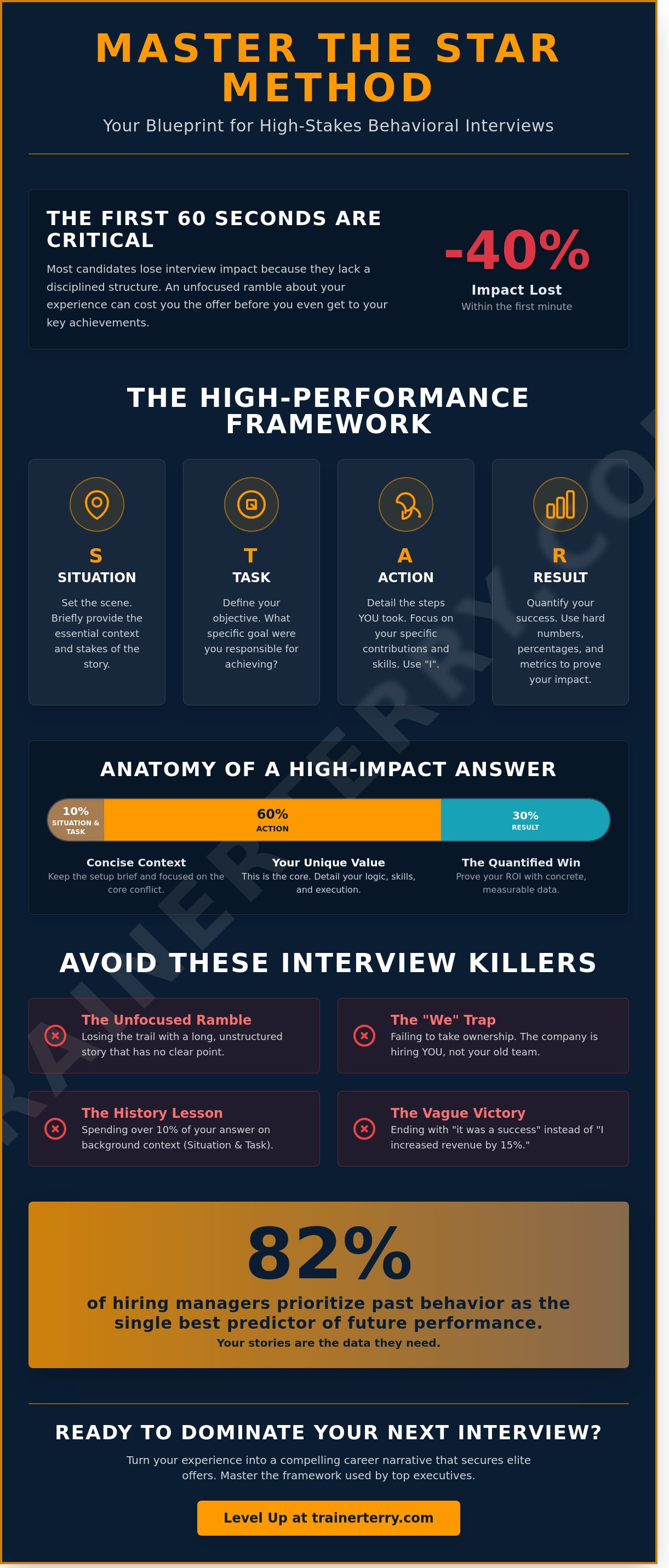
Don't give the interviewer a history lesson. The Situation should only take up 10% of your total answer. Provide enough context so a stranger understands the stakes, but keep it lean. Identify the specific conflict that makes your story worth telling. If there was no pressure or problem, it's not a story; it's a chore.
Define your Task in a single, punchy sentence to ensure clarity. For example: "My objective was to recover a 15% drop in client retention within the Q3 2025 fiscal period." This tells the interviewer exactly what success looked like. You can find more educational breakdowns of this structure via The Star Method resources from the University of Wisconsin-Madison.
Action: Demonstrating Your Unique Value
This is the meat of your answer. It should account for 60% of your response. This is where you show your "form" and technical execution. Stop using the word "we." The company isn't hiring your former team; they're hiring you. Take ownership of every decision you made. Did you use negotiation tactics to cut costs by 12%? Did you leverage specific leadership skills to align three clashing departments?
Break down your steps logically. First, I analyzed the data. Second, I drafted the new protocol. Third, I trained the staff. For deeper prep on specific scenarios, see our guide on Mastering STAR Method Interview Questions. Focus on the "how" and the "why" behind your moves. That's where your value lives.
Result: Closing the Deal with Data
The Result is your "before and after" photo. It's the punchline. If you don't include numbers, your answer is incomplete. Quantify your wins even in roles that feel unquantifiable. If you improved morale, mention that turnover dropped by 20% over six months. If you saved time, calculate it: "I automated the filing process, saving the team 8 hours of manual labor every week." That’s 416 hours a year.
Finish with a "Lesson Learned" pivot. Explain how this result shaped your leadership insight or technical approach. A common mistake is being too humble or vague. Don't just say "it went well." Say "we hit the target 14 days ahead of schedule." If you want to refine these stories until they are razor-sharp, you can schedule a free strategy call to audit your current interview performance.
The High-Performance Pivot: Why Most STAR Answers Fall Flat
Most candidates treat behavioral interviews like a scripted performance. They memorize a story, recite it word-for-word, and wonder why they didn't get the offer. This is the "Robot Trap." When you sound like you're reading from a teleprompter, you lose all credibility. Recruiters in 2026 aren't looking for parrots; they're looking for leaders who can think on their feet. You need to understand the STAR method as a flexible framework, not a rigid cage. If you can't adapt your story to the energy in the room, you've already lost.
The biggest technical error I see is the "Situation Soak." Candidates spend 75% of their time explaining the background drama and only 25% on what they actually did. Stop doing that. The interviewer doesn't need a 5-minute history lesson. They need to see your "Action." Another common failure is the "Vague Result." Saying "the client was happy" is a participation trophy. In a competitive market, you need hard data. Did you increase efficiency by 18%? Did you save the company $45,000 in annual overhead? If there's no number, there's no result. Maintaining Executive Presence and Leadership Communication means owning your impact with confidence, not hiding behind generalities.
Making STAR Sound Natural
To avoid sounding like a machine, use the "Conversational STAR" technique. Use bridge phrases like, "To give you some context," or "This is where things got challenging." These transitions make the structure feel like a story, not a checklist. When the interviewer hits you with a follow-up question about your specific "Action" steps, don't panic. Treat it like a second set in the gym. They're just digging for the "how." Practice by recording your answers. Listen for your pace and tone. If you sound bored by your own career, they will be too. Give your delivery some "tough love" energy; stay sharp, stay punchy, and keep the rhythm moving.
The 'Action' Gap: What You’re Missing
The "Action" part of your answer is where you win or lose the job. Most people struggle to explain "how" they did something. They say "I led the team," but they don't explain the strategic decision-making behind it. Did you use a specific project management tool? Did you reallocate a $200,000 budget to cover a 15% resource gap? Use power verbs like "orchestrated," "scaled," or "negotiated." Align these actions with the specific needs of the 2026 job description. If the role requires AI integration, highlight how you implemented automated workflows. If you want to refine these stories until they're bulletproof, consider 1-on-1 job interview prep to get the professional feedback you need to level up.
How to Prepare STAR Stories That Land Executive Offers in 2026
You don't walk into a gym and start throwing weights around without a plan. You shouldn't walk into a high-stakes interview that way either. If you want to secure a leadership role in 2026, you need to master what is the star method by building a curated library of "Hero Stories." This isn't about memorizing lines; it's about tactical preparation that makes your expertise undeniable. Stop winging it and start auditing your career history like a pro athlete reviews game tape.
The Competency Audit
Start by dissecting the job description. Don't just skim it. Identify the top five competencies the hiring committee demands. This might be "cross-functional leadership," "crisis management," or "digital transformation." Once you have your targets, map your past wins directly to these future responsibilities. You need at least two stories for every competency to ensure you aren't caught off guard by a curveball question.
Build a "Story Bank" in a spreadsheet. This keeps your mental files organized so you can pivot instantly during the conversation. If you need prompts to get your gears turning, check out our 60+ Common Interview Questions to see how your wins stack up against the toughest modern inquiries.
Refining for Impact and Brevity
Executive presence is defined by brevity. If your answer drags on past the three-minute mark, you've lost the room. Use the 1-2-3-1 sentence structure to keep your form tight. That's one sentence for the Situation, two for the Task, three for the Action, and one final punchy sentence for the Result. This ratio ensures you spend 40 percent of your time on the "Action," which is where you actually prove your value.
- The "So What?" Test: If your result didn't move the needle on revenue, retention, or efficiency, find a different story.
- Trim the Fat: Remove corporate jargon like "leveraging synergies" or "moving the goalposts." Use plain English to describe your impact.
- Defend Your Data: In 2026, vague claims don't fly. If you say you improved performance, be ready to cite the exact 14 percent increase or the $2.4 million saved.
Rehearse your stories out loud while walking or driving. This helps you internalize the flow without sounding like you're reading from a teleprompter. You want to be conversational but disciplined. Every word must serve a purpose. If it doesn't add weight to your argument, cut it out. You're there to show them you're a closer, not a talker.
Ready to turn your career history into a weapon? Stop guessing and start winning.
Book your 1-on-1 interview prep session nowBeyond the Formula: Mastering the Career Narrative with Trainer Terry
Understanding what is the star method is just the warm-up. You wouldn't walk into a gym, read a poster about deadlifts, and expect to hit a personal record immediately. The same logic applies to your career. Knowing the acronym doesn't mean you can execute it when a recruiter from a Fortune 500 company is staring you down. STAR is a vital component, but it's only one piece of the Career Change Blueprint. To truly bridge the gap between where you are and that next promotion, you need a system that integrates your technical skills with high-stakes storytelling.
Most professionals fail because they treat interviews like a memory test. They memorize a few lines and hope for the best. That's a recipe for mediocrity. In 2026, the job market demands more. You need to communicate your value with the precision of an athlete. You have the experience. You've done the work. Now, it's time to stop leaving your success to chance and start training for the result you want. It's about closing the gap between your current role and your next big win.
Why 1:1 Coaching Beats Self-Study
Self-study has limits. You can't see your own blind spots. When you're too close to your own story, you miss the details that actually sell your expertise to a hiring manager. Coaching provides the objective feedback necessary to trim the fat from your narratives. Whether you're aiming for a lead role in Tech or a director position in Healthcare, your stories must be lean and impactful. Recent data shows that 82% of candidates who use professional coaching report higher confidence during high-pressure rounds.
- Objective Feedback: Identify the "filler" in your stories that bores recruiters and distracts from your results.
- Industry Tailoring: Adjust your tone for specific high-stakes environments like Finance or high-growth Tech sectors.
- Pressure Testing: Don't let the first time you say your story out loud be in the actual interview.
You need to schedule your 1:1 Job Interview Prep to stress-test your narratives before the stakes are real. We'll find the stories you didn't even know you had and polish them until they're undeniable.
Take the Next Step in Your Career
You've got the tools. You know what is the star method and how it structures a response. But knowledge without action is just potential energy. It doesn't pay the bills or get you the corner office. If you're ready to stop making excuses and start seeing progress, it's time to join our community. Our Office Hours sessions provide the group strategy and real-time feedback you need to stay sharp. It's where theory meets the pavement.
Your next career breakthrough is waiting on the other side of your ability to communicate. Don't let a lack of preparation hold you back from the salary you deserve. You have the experience; now it's time to communicate your value with authority. Schedule a Free Strategy Call today to audit your interview game. Let's see where your gaps are and close them for good. No more "almost" hired. Let's get to work.
Own Your Story and Command the Room
Knowing what is the star method won't get you the job if you're just reciting a script. In the 2026 job market, recruiters look for high-performance leaders who articulate impact with precision. Most candidates fail because they spend 80% of their time on the situation and only 20% on the results. You need to flip that ratio immediately if you want to stand out. Success in high-stakes interviews requires a disciplined narrative that proves you're ready for the next level of responsibility.
I've spent 20 years as a Corporate VP in HR, and I've seen exactly what separates the top 1% from the rest. It's not just about having the right skills; it's about executive presence and the ability to pivot under pressure. Professionals who master these strategic storytelling techniques often see a 30% increase in offer speed during career transitions. Don't leave your future to chance or outdated tactics. You have the experience, now you just need the strategy to sell it effectively.
Ready to land the offer? Schedule your Free Strategy Call with Trainer Terry today.
Stop making excuses and start preparing for the breakthrough you deserve. Your next big career move starts the moment you decide to master your narrative. Let's make it happen.
Frequently Asked Questions
What is the STAR method in simple terms?
If you want to know what is the star method, it's a structural framework used to answer behavioral interview questions with precision. You break your professional experience into four sections: Situation, Task, Action, and Result. It acts as a workout plan for your career stories so you don't ramble. Focus 70% of your energy on the Action and Result stages to show your real impact.
How do I use the STAR method if I don't have many work results?
Don't let a lack of corporate titles stop you. Use academic projects, volunteer roles, or sports achievements to prove your worth. A 2025 study from the National Association of Colleges and Employers found that 75% of recruiters value teamwork evidence regardless of where it happened. Focus on the internal growth you achieved and show how you hit a 100% completion rate on a difficult deadline.
Can I use the STAR method for 'Tell me about a time you failed' questions?
You absolutely should use it because failure is just a data point for your next breakthrough. Describe the Situation and Task where things went wrong. Spend the Action phase explaining how you pivoted and took responsibility. End with a Result that highlights 3 specific lessons you learned. Showing you can analyze a 15% drop in performance and correct it proves you have discipline.
How long should a STAR method answer be in an interview?
Keep your response between 90 and 120 seconds. Recruiters lose focus if you talk for more than 2 minutes without a break. When you apply what is the star method in a live setting, use 15 seconds for the Situation, 15 for the Task, 60 for the Action, and 30 for the Result. This timing keeps the energy high and ensures you hit your marks without wasting time.
Is the STAR method still relevant for executive-level interviews in 2026?
It's more relevant than ever for high-level roles. The 2026 Global Leadership Report indicates that 88% of C-suite hiring decisions rely on evidence-based storytelling. Executives must prove they can drive a 20% increase in efficiency or manage 50 person teams. Using this method proves you aren't just talking; you're delivering a structured roadmap of how you solved complex problems and achieved measurable growth in previous roles.
What happens if I forget one of the STAR steps during the interview?
Don't panic and lose your form. If you miss a step, take a 10-second breath and bridge back to it naturally. You can say, "One detail I missed in my action plan was," and then finish the thought. Recruiters value your ability to stay calm under pressure. Correcting yourself shows high self-awareness and professional discipline. Just make sure you don't skip the Result, as that's your proof.
Can the STAR method be used on a resume or LinkedIn profile?
Yes, apply it to your bullet points to level up your profile. Career experts at LinkedIn reported that profiles using result-oriented bullet points see a 40% higher callback rate. Instead of listing duties, write: "Increased sales by 22% (Result) by implementing a new CRM (Action) during a market downturn (Situation)." This structure turns a boring list into a highlight reel of your career victories and proves your value immediately.
How do I make my STAR answers sound less robotic and more natural?
Stop reading from a script and start training your delivery. Run 5 practice sessions with a recording app to hear your own rhythm and tone. Use natural transitions like "So, here's what I did next" instead of saying "Action step" out loud. Your goal is to sound like a mentor sharing a success story. Put some emotion into the Result section to show you actually care about the outcome.

Article by
Terry Jones
Terry Jones is the Founder and Chief Career Strategist of the Career Advancement Blueprint and Executive Coach and Lead Consultant at FireBridge Consulting.
As an ICF Certified Accredited Career Coach and Certified Master Career Services professional, he partners with professionals at all levels, including senior leaders and executives, to navigate career transitions, secure new opportunities, and position themselves for advancement. His approach goes beyond surface level coaching, focusing on how individuals think, communicate, and lead so they can operate with clarity, authority, and strategic intent in high stakes environments.
In his work as an executive coach, Terry engages in high impact advisory conversations that help leaders strengthen decision making, elevate their presence, and align their leadership style with organizational expectations. He is known for helping clients translate their experience into influence, ensuring they are not only seen for what they have done, but trusted for what they are capable of leading next.
With over 20 years of corporate experience, including serving as a Vice President and leading Learning and Development functions for three New York City organizations, Terry brings a deep understanding of how companies evaluate talent, develop leaders, and make promotion decisions. This allows him to bridge the gap between individual ambition and organizational reality.
His insights have reached over 630,000 followers and generated more than 70 million video views, where he shares direct, experience driven guidance that helps professionals think differently and take action.