Should I Hire a Professional Resume Writer? The Strategic ROI of Executive Positioning in 2026

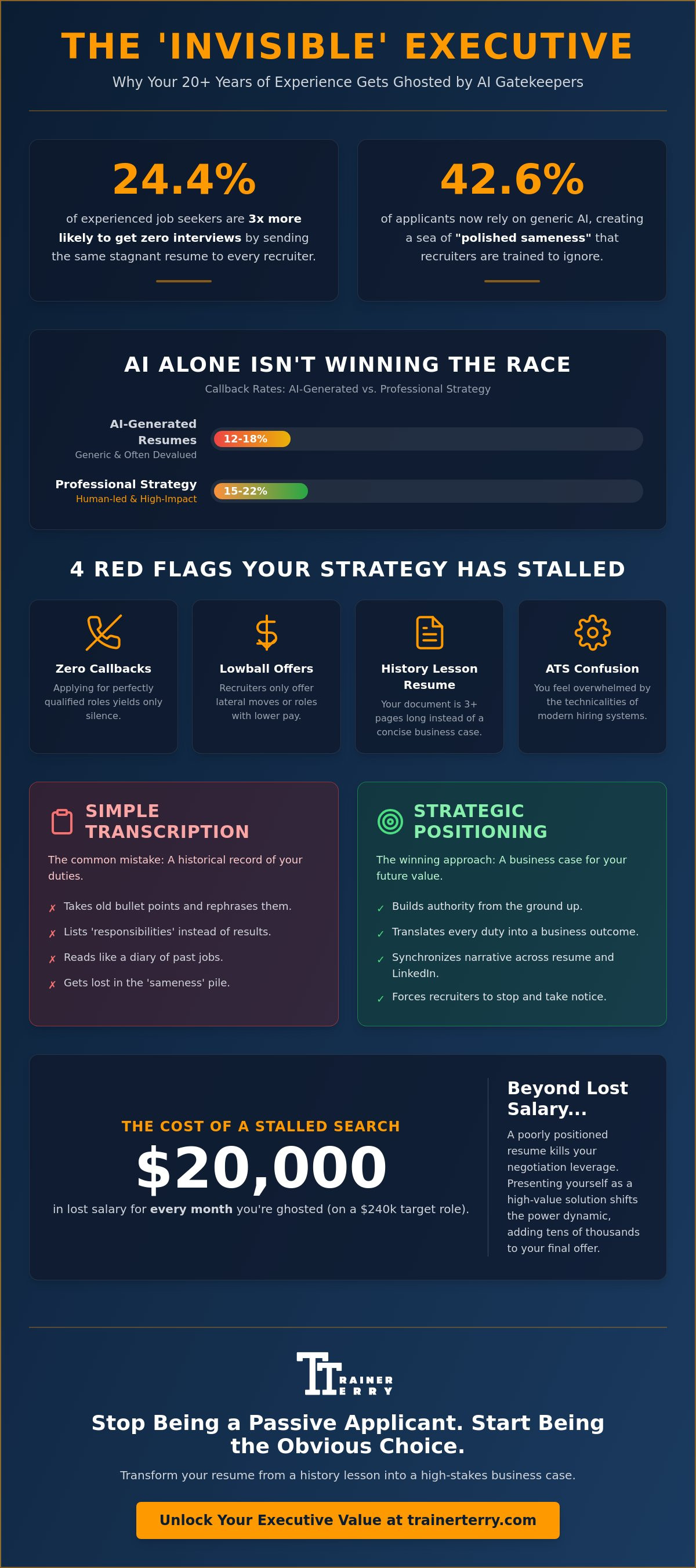
Why are you still being ghosted after two decades of leading teams and smashing targets? It's a bitter pill to swallow when you realize that 24.4% of job seekers are three times more likely to receive zero interviews simply because they're sending the same stagnant document to every recruiter. In a market where 42.6% of applicants rely on generic AI, your 20 years of experience can easily get lost in a sea of "polished sameness." You might be weighing the pros of a resume writer vs career coach to finally break through the noise. You've earned your seat at the table, but if your current resume doesn't scream executive value, the door stays locked.
We agree that your career is too complex to fit into a standard template. This article is your roadmap to discovering if a professional strategist is the missing link between your current role and that next high-stakes promotion. You'll learn how to quantify your impact, bypass the AI gatekeepers, and use strategic positioning to secure the salary offers you actually deserve. It's time to stop being a passive applicant and start being the obvious choice.
Key Takeaways
- Learn why your 20-year career is currently invisible to AI-driven systems and how to flip the script on recruiter ghosting.
- Understand the fundamental difference between a resume writer vs career coach to determine which strategic partner will maximize your ROI in 2026.
- Stop viewing your resume as a history lesson and start treating it as a high-stakes business case for your future executive value.
- Identify the four warning signs of "resume mills" that use generic templates and AI shortcuts at the expense of your professional reputation.
- Discover how to bridge the gap between a powerful document and a winning interview by aligning your narrative with high-performance results.
Why You Are Being Ghosted: The 2026 Reality of Executive Hiring
You have spent two decades building a legacy, leading teams, and hitting targets that would make most people's heads spin. Yet, when you hit "apply," the silence is deafening. It feels personal, but it isn't. You are likely a victim of the "Invisible Candidate" phenomenon. In the current hiring market, having 20 years of experience is no longer a golden ticket; it's a liability if you don't know how to frame it. Your DIY resume is likely triggering low-value signals that tell recruiters you are overqualified, outdated, or simply part of the noise. In 2026, executive recruiters still follow the 6-second rule, but the criteria have shifted. They aren't looking for a list of what you did. They are scanning for a specific narrative of what you can solve. If your profile reads like a jack-of-all-trades, you are effectively telling the market you specialize in nothing.
How do you know if you have reached the limit of your own expertise? Look for these red flags:
- You are getting zero callbacks despite applying for roles you are perfectly qualified for.
- The only recruiters reaching out are offering "lateral moves" or roles with lower pay.
- Your resume is a three-page historical document rather than a two-page business case.
- You feel overwhelmed by the technicalities of Applicant Tracking Systems (ATS).
At this crossroads, the debate of resume writer vs career coach often begins. You need a strategist who understands that a resume isn't a transcript; it's a high-stakes marketing tool designed to win a seat at the table.
The Saturation of AI-Generated Resumes
The rise of generative AI has flooded the market with "good enough" documents. According to data from Novoresume (June 2026), 42.6% of Americans used AI to build their most recent resume. This has created a massive problem of "polished sameness." Recruiters are now trained to filter out generic, ChatGPT-style language. While AI-generated resumes see callback rates in the 12-18% range, professionally written resumes outperform them at 15-22% (ResumeYourWay, February 2026). Human strategy is the only way to beat algorithms that are now specifically designed to detect and devalue automated content.
When Good Enough is Losing You Money
Every month your job search stalls, you are losing a significant portion of your annual income. If you are targeting a $240,000 role, every month of "ghosting" costs you $20,000 in lost salary. Beyond the immediate cash, a poorly positioned resume kills your negotiation leverage. If a company views you as just another applicant, they will offer the bottom of the bracket. When you present yourself as a high-value solution through a Career Advancement Blueprint, the power dynamic shifts. You stop applying for jobs and start offering business outcomes. That shift in perception is worth tens of thousands of dollars in your final offer.
Strategic Positioning vs. Simple Transcription: What Professionals Do Differently
Stop thinking of your resume as a historical record. It's not a diary. It's a high-stakes business case for why a company should invest six or seven figures in your leadership. Simple transcription is what AI does; it takes your old bullet points and makes them sound "professional" without changing the underlying value. Strategic positioning is different. It's the core differentiator when comparing a resume writer vs career coach. While a transactional writer might fix your grammar, a strategist like Terry Jones builds your authority from the ground up. You need more than a document; you need a Career Positioning Strategy that forces recruiters to stop scrolling.
To justify executive compensation, you must translate every duty into a business outcome. If your resume lists "responsibilities," you've already lost the room. High-level leadership demands proof of impact. Don't tell them you "managed budgets." Tell them how you redirected capital to fuel a specific growth in market share. This narrative must extend beyond the page. Your physical resume and your LinkedIn Positioning must be perfectly synchronized. Any gap between these two platforms creates doubt. In the executive market, doubt is the fastest way to end a candidacy.
Developing Your Executive Career Narrative
You need to identify your "Red Thread." This is the core philosophy or specialized skill set that links your first management role to your current C-suite ambitions. A professional strategist helps you communicate this complex value without hiding behind corporate jargon. If your impact isn't immediately clear, a tired recruiter will move on to the next candidate. Your resume must tell a story of intentional growth and problem-solving, not just provide a chronological list of titles. It's about showing where you've been to prove where you can take them.
Beyond Keywords: Optimizing for Human Decision Makers
Keywords might get you past the initial filters, but humans are the ones who sign the offer letters. Structure your document for the F-pattern reading style, placing your most explosive achievements where the eye naturally lands. Use a high-level visual hierarchy to lead the reader's gaze toward your most significant wins. In 2026, Executive Presence in a resume is the art of projecting silent authority through clear, high-impact communication and a decisive visual layout. If you're ready to stop guessing and start leading, the Career Advancement Blueprint can help you transform from a passive applicant into the only logical choice for the role.
DIY, AI, or Professional Strategy? Evaluating Your ROI
You wouldn't perform surgery on yourself. You wouldn't represent yourself in a high-stakes legal battle. Why are you trying to write your own executive story? The DIY Trap is real because you are too close to your own work to see the "Red Thread" clearly. You see the daily grind. A recruiter needs to see the strategic triumph. When you write your own resume, you often downplay your biggest wins because they feel like "just doing your job." This humility is losing you money. Stay in your Zone of Genius, leading your organization, and let a specialist handle the mechanics of your positioning.
The AI Illusion is equally dangerous. A tool can generate text for $0, but if that text triggers a "low-value" signal, it costs you months of executive salary. In 2026, companies see an average ROI of 5.7 times their investment in coaching (WifiTalents, February 2026). Professional strategy isn't a cost. It is an investment in a faster transition and a higher starting offer. If you're weighing the value of a resume writer vs career coach, remember that one provides a document, while the other provides a roadmap to your next hundred-thousand-dollar raise.
The Psychology of Outsourcing Your Brand
Outsourcing your brand provides an objective lens that you simply cannot replicate. A professional strategist acts as a mirror, reflecting your achievements back to you in a way that overcomes imposter syndrome. Professional validation changes how you carry yourself in the room. When you work with a high-level executive advisor, their perspective carries weight that a standard writer cannot match. They know what happens behind the closed doors of a boardroom. They know which metrics actually matter to a CEO because they've been there themselves.
Comparing the Levels of Investment
Not all help is created equal. Transactional writers are fine for entry-level roles where high volume is the goal. However, if you're aiming for a mid-to-senior executive pivot, you need more than a spellcheck. The choice between a resume writer vs career coach often comes down to depth. One builds the tool. The other builds the professional. If you are looking for a total professional overhaul to enter a new industry, you should leverage a Career Change Blueprint to ensure your new path is as profitable as it is fulfilling. Don't settle for a quick fix when your career trajectory is on the line.
The 4 Red Flags: How to Spot a Resume Mill Before You Pay
You are looking for a partner, not a factory worker. Many services operate as "resume mills," churning out documents based on volume rather than value. If you see a "guaranteed interview" badge, run. It's a marketing gimmick. No one can control a third-party hiring decision, and these guarantees often come with fine print that makes them worthless. A real strategist focuses on the quality of the leads you generate, not just the quantity of automated pings. Why settle for a factory-made document when you're a custom-built leader?
Templates are the second red flag. If your resume looks like a generic Canva design, you're signaling that you're a commodity. C-suite leaders are not commodities. You need a bespoke layout that reflects your unique authority. When debating the merits of a resume writer vs career coach, ask yourself: is this person building a document or building my future? A collaborative, strategy-first process is non-negotiable. If they don't want to talk to you, they can't represent you. It's that simple.
Credential Check: Who is Actually Writing?
Don't be afraid to ask who is behind the keyboard. Many premium-priced services farm work out to low-cost freelance copywriters who have never sat in a hiring room. Industry-specific knowledge is a bonus, but hiring knowledge is essential. You want someone who understands the psychology of a recruiter. A former HR leader or executive advisor knows the "unspoken" reasons candidates get rejected. Check their process; if they only ask you to fill out a form without an interview, they are just proofreading your old mistakes. You deserve a mentor who is emotionally invested in your success.
The No Strategy Red Flag
If a service doesn't ask about your target salary, they cannot position you effectively. Positioning is the difference between a $150k offer and a $250k offer. Without a clear goal, you'll receive a pretty document that lacks any real substance. Your resume must be intentionally built to project Executive Presence. It should command respect before you even speak. A resume writer vs career coach comparison often fails because people ignore this psychological layer. If you're tired of being treated like a number, it's time to invest in a Career Advancement Blueprint that treats you like the leader you are. Stop being a passive participant in your own career.
Beyond the Document: Integrating Strategy into Your Career Advancement
A resume is only the ticket to the game. It gets you past the gatekeepers, but the strategy you bring to the table wins the offer. If you view your resume as a static PDF, you are missing its most powerful function: it is the script for your entire interview performance. Every bullet point we've discussed must link directly to the STAR Method. When a recruiter asks about a specific achievement, you shouldn't be searching for an answer. You should be expanding on the narrative already established on the page.
This narrative also solves the most dreaded question in hiring: "Tell me about yourself." Instead of a rambling history of your life, you deliver a punchy, executive summary that mirrors your resume's profile. You are reinforcing your brand at every touchpoint. This consistency is what separates a standard applicant from an in-demand leader. When you compare a resume writer vs career coach, the coach ensures that your verbal delivery is just as sharp as your written word.
Finally, your resume serves as the anchor for high-stakes salary negotiations. If your document clearly communicates executive value and business outcomes, you've already justified a premium price tag. You aren't asking for a raise; you're presenting a bill for the value you've already proven you can deliver. If the recruiter sees a high-performing leader on paper, they expect to pay for one at the offer stage.
From Resume to Interview Strategy
Your resume is your cheat sheet for behavioral questions. If you've mapped out your achievements strategically, you have a library of stories ready to go. Consistency is key here. Your LinkedIn brand must match the resume recruiters see on their screens. If there's a disconnect, you trigger a "risk" signal. To bridge this gap and ensure a complete transition, explore 1:1 Job Interview Prep. Don't leave the final 10% of your search to chance. Precision matters now more than ever.
The Career Advancement Blueprint
Top performers don't wait for a crisis to update their strategy. They view career advancement as a continuous process of growth and refinement. This shift in mindset moves you from being a job seeker to being an in-demand leader who companies fight to hire. It's about being proactive, not reactive. If you're ready to stop being ghosted and start being pursued, schedule a free strategy call to audit your current positioning. Let's find out if the resume writer vs career coach distinction is what's standing between you and your next promotion.
Secure Your Seat at the Table
Your career is too valuable to leave in the hands of a generic algorithm or a template mill. You've seen that the choice between a resume writer vs career coach isn't just about a document; it's about whether you want to be a passive applicant or an in-demand leader. A strategic resume acts as your business case, proving your executive presence before you even walk into the room. By mastering the STAR method and aligning your narrative with high-stakes outcomes, you stop being invisible and start being essential. Every day you wait is a day of lost salary and stalled potential.
Terry Jones brings over 20 years of experience as a former Corporate VP to help you navigate this high-pressure transition. Whether you need the Career Change Blueprint or a total positioning audit, the focus is always on measurable results. Don't let another month of recruiter ghosting drain your confidence. Schedule your free Strategy Call with Terry to audit your career positioning today and turn your complex experience into an offer you can't refuse. Your next promotion isn't going to find itself. It's time to go get it.
Frequently Asked Questions
Is it worth hiring a resume writer if I am mid-career?
Yes, because mid-career is the phase where professionals often hit a "lateral move" ceiling. A strategist helps you pivot from a manager's mindset to an executive's narrative by framing your daily tasks as high-level business outcomes. This shift is essential to stop being viewed as a functional expert and start being seen as a leader who drives organizational growth.
How much should I expect to pay for a professional resume writer in 2026?
Investment levels vary significantly depending on the depth of strategy and the seniority of your target role. Transactional services that offer basic formatting are at the lower end of the market, while premium executive positioning involves a much higher investment. You are paying for the expertise of a strategist who understands boardroom psychology, not just someone to fix your grammar or layout.
Can a resume writer help me transition to a completely different industry?
A resume strategist is vital for industry pivots because they identify your transferable "Red Thread." They strip away sector-specific jargon that confuses outside recruiters and replace it with universal leadership metrics. This ensures that a hiring manager in a new industry can immediately see how your past triumphs will solve their current business challenges.
Will a professional resume pass through the Applicant Tracking System (ATS)?
Yes, every professionally built document is designed to be technically compliant with modern AI filters. However, passing the ATS is only the baseline. The real value lies in creating a document that is strategically persuasive for the human decision-makers who review it after the algorithm. It is about being both technically readable and emotionally compelling to a recruiter.
How long does the process of working with a resume strategist typically take?
The timeline generally ranges from ten days to three weeks. A strategy-first process is not a "quick fix" because it requires deep-dive interviews to extract your unique value proposition. This collaborative approach ensures the final narrative is authentic to your leadership style and ready for the scrutiny of a high-stakes interview process.
Do I really need a LinkedIn makeover if I have a great resume?
Yes, because your digital brand is often the first thing a recruiter sees before they even open your resume. In the current market, your LinkedIn profile and resume must be perfectly synchronized. Any gap in the narrative between these two platforms creates doubt. High-level hiring requires a consistent, professional presence across all digital and physical touchpoints.
Can I use a professional resume for internal promotions?
Absolutely, and you should. Internal competition can be just as fierce as external hiring, and you need to re-introduce yourself to the leadership team. A professional resume formalizes your achievements and signals that you are ready for the next level of responsibility. It forces your current employers to see you as a future leader rather than just a reliable employee.
What is the difference between a resume writer and a career coach?
The debate of resume writer vs career coach comes down to the scope of your needs. A resume writer focuses on creating the marketing document that wins the interview. A career coach provides a broader partnership that includes the resume but also covers interview strategy, leadership development, and long-term career planning. Both are investments in your professional authority and future earning potential.

Article by
Terry Jones
Terry Jones is the Founder and Chief Career Strategist of the Career Advancement Blueprint and Executive Coach and Lead Consultant at FireBridge Consulting.
As an ICF Certified Accredited Career Coach and Certified Master Career Services professional, he partners with professionals at all levels, including senior leaders and executives, to navigate career transitions, secure new opportunities, and position themselves for advancement. His approach goes beyond surface level coaching, focusing on how individuals think, communicate, and lead so they can operate with clarity, authority, and strategic intent in high stakes environments.
In his work as an executive coach, Terry engages in high impact advisory conversations that help leaders strengthen decision making, elevate their presence, and align their leadership style with organizational expectations. He is known for helping clients translate their experience into influence, ensuring they are not only seen for what they have done, but trusted for what they are capable of leading next.
With over 20 years of corporate experience, including serving as a Vice President and leading Learning and Development functions for three New York City organizations, Terry brings a deep understanding of how companies evaluate talent, develop leaders, and make promotion decisions. This allows him to bridge the gap between individual ambition and organizational reality.
His insights have reached over 630,000 followers and generated more than 70 million video views, where he shares direct, experience driven guidance that helps professionals think differently and take action.