How to Manage a Team for the First Time Successfully: The 2026 Leadership Blueprint

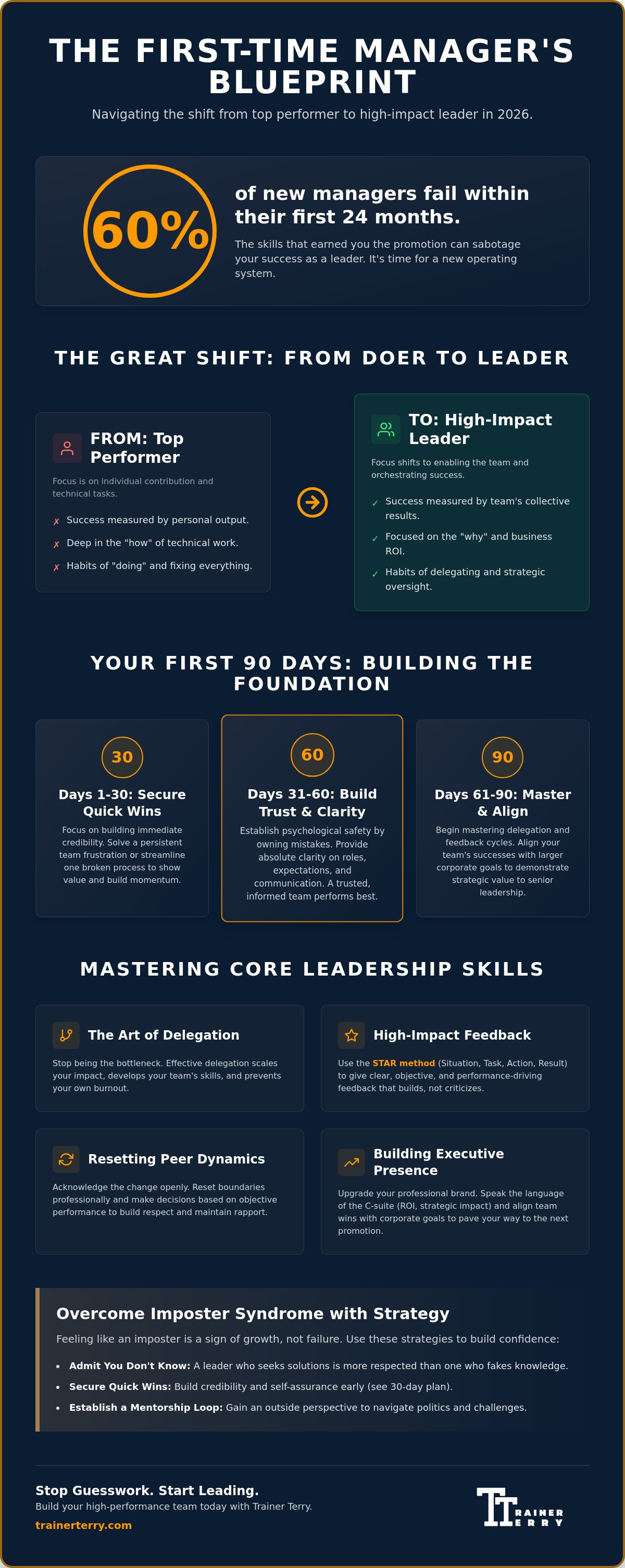
Did you know that 60% of new managers fail within their first 24 months? It's a brutal statistic that highlights a hard truth: the skills that made you a top performer are the same ones that can sabotage you as a leader. If you're struggling with imposter syndrome or the awkwardness of managing former peers, you're not alone. Learning how to manage a team for the first time successfully isn't just a promotion. It's a total career shift that requires a new mental operating system.
We know the fear of your team's failure reflecting on you personally. You want to hit targets without constant hand-holding, and you've earned the right to be respected by senior leadership. This 2026 blueprint gives you the actionable strategies to stop micromanaging and start leading with authority. We'll cover how to master delegation, build deep trust, and cultivate an executive presence that makes your next promotion inevitable. Stop the guesswork. It's time to build your high-performance team today.
Key Takeaways
- Shift your identity from a solo performer to a high-impact leader. Focus on team output instead of individual technical tasks.
- Discover how to manage a team for the first time successfully by resetting boundaries with former peers and establishing professional authority.
- Build a foundation of trust and clarity in your first 90 days. Create a self-sustaining team that hits targets without constant supervision.
- Master the art of delegation and high-impact feedback. Use the STAR method to drive performance and avoid leadership burnout.
- Align your team’s successes with corporate goals. Build executive presence to secure your path to future promotions.
The Great Shift: Navigating the Identity Change from Contributor to Leader
The transition from being the best technical performer to leading a department is often called the "First-Time Manager Gap." It's the psychological and operational space where you stop doing the work and start enabling it. Most people struggle here because they try to keep their hands on the tools. If you want to know how to manage a team for the first time successfully, you must accept that your personal output is no longer the metric of success. Your team's collective results are your new scorecard. This shift is uncomfortable, but it's the only way to scale your impact.
Managing former peers is perhaps the most awkward boundary you'll ever navigate. The dynamic has changed, and pretending it hasn't will only undermine your authority. You don't need to become a corporate robot, but you do need to reset expectations. Start with transparency. Acknowledge the change openly, set clear professional boundaries, and lean on the core principles of team management to ensure every decision is rooted in objective performance rather than past friendships. Consistency is your best tool for maintaining rapport while building respect.
Transitioning from a technical expert to a strategic orchestrator is the single most important milestone in your professional evolution. The moment you accept this role, your internal career positioning strategy must pivot. You aren't just an employee anymore. You're a representative of the company’s vision. Senior leadership is no longer looking at your coding or design skills; they're evaluating how you handle pressure, people, and profits.
Rebranding Your Professional Persona
Your brand needs an immediate upgrade. Audit your LinkedIn and internal directory profiles to highlight leadership achievements rather than just technical proficiencies. You must learn the language of the C-suite. Stop talking about "how" things get done and start focusing on "why" they matter and what the ROI is for the business. Identify and shed "doer" habits immediately. If you're still the one fixing every minor bug or proofreading every email, you're signaling to your boss that you aren't ready for the next level of responsibility.
Overcoming Imposter Syndrome with Strategy
Imposter syndrome is a sign that you're growing, not that you're failing. Accept that you won't have all the answers. A leader who admits they don't know something but knows how to find the solution is far more respected than one who fakes it. Focus on securing "Quick Wins" in your first 30 days. This could be fixing a small but persistent team frustration or streamlining a broken process. These wins build instant credibility. Finally, establish a mentorship loop early. Having an outside perspective helps you see the corporate politics you're too close to notice. This is how you learn how to manage a team for the first time successfully without burning out.
Building the Foundation: Trust, Clarity, and the First 90 Days
Your first 90 days are a high-stakes sprint toward stability. Success during this window depends on the "Trust Dividend." This isn't a soft, corporate buzzword. It's the highest-leverage tool in your kit. When psychological safety exists, your team spends energy on solving problems rather than hiding them. Without it, you'll face a wall of silence that masks brewing failures. To learn how to manage a team for the first time successfully, you must prioritize this emotional infrastructure from day one. Trust isn't earned through a single speech. It's built through consistent, predictable actions.
Clarity is the kindest thing a manager can provide to a team. If your people are guessing what "success" looks like, you've already failed them. You must set non-negotiables immediately. This includes defining specific roles, output expectations, and the exact communication cadences you expect. Don't leave your team in the dark. To master these early steps, referencing a structured New Manager Toolkit can provide the templates you need to stay organized while you find your rhythm.
Establishing Psychological Safety
You must model vulnerability to encourage innovation. If you make a mistake, own it loudly. This signals that risk-taking is safe. Create a "no-blame" culture where the focus is on the "why" of a failure rather than the "who." High accountability doesn't require fear; it requires honesty. Staying calm when things go sideways is a skill you can develop. Many new leaders use executive presence coaching techniques to maintain their composure and project authority during high-pressure moments.
The Anatomy of a Perfect 1-on-1
Stop using your 1-on-1 meetings for status reports. If you're just checking off tasks, you're wasting everyone's time. Use Slack or email for the "what" and "when." Your 1-on-1s should be about the "how" and the "who." This is where you transition from a supervisor to a mentor. Focus your energy on the Big Three questions: What is blocking your progress? Where do you want your career to go? How can I help you get there? Schedule these as non-negotiable "Office Hours" to ensure your team knows they have consistent access to your guidance. If you're feeling overwhelmed by the transition, consider booking a session during our office hours to refine your leadership framework.
Consistency is your greatest ally. When you show up reliably, your team will too. This is the secret to how to manage a team for the first time successfully. You aren't just managing tasks. You're managing the environment where those tasks get done.
Mastering the Art of Delegation and High-Impact Feedback
Many new leaders fall straight into the "Delegation Trap." You think saying "I’ll just do it myself" saves time. It doesn't. It actually signals a failure of leadership. When you refuse to hand over tasks, you become the bottleneck that slows the entire department down. Learning how to manage a team for the first time successfully requires you to stop being the hero and start being the architect. You aren't paid to do the work anymore; you're paid to ensure the work gets done at a high standard by others.
Use the "70% Rule" to guide your decisions. If a team member can perform a task 70% as well as you can, delegate it immediately. Your job is to coach them through the remaining 30%. This isn't about lowering standards. It's about building capacity. When you hold onto tasks because you're the "expert," you're actually stealing growth opportunities from your team. Keep in mind that feedback should be a continuous loop, not an annual surprise that leaves employees feeling blindsided and defensive.
How to Delegate Without Micro-managing
Micro-management kills initiative and trust. To avoid this, delegate the "What" and the "Why," but let your team own the "How." When people have autonomy over their process, they take psychological ownership of the result. Set clear "Check-in Milestones" from the start. This allows you to monitor progress and provide support without hovering over their shoulders every hour. View every delegated task as a strategic investment in your team’s career advancement. You're giving them the repetitions they need to eventually handle even higher stakes.
Delivering Difficult Feedback with the STAR Method
Feedback often feels personal, but it shouldn't. You can keep conversations objective by applying the STAR method to your performance reviews. Break the situation down by Situation, Task, Action, and Result. This framework forces you to focus on data and observable behaviors rather than the employee's personality traits. If someone missed a critical deadline, don't call them "unreliable." Instead, point to the specific Situation, the Action they took (or didn't take), and the Resulting impact on the project's bottom line. Practice active listening during these sessions. Feedback is a two-way street for growth. Listen to their perspective to understand the root cause of the issue. This is the only way to figure out how to manage a team for the first time successfully while maintaining high morale and professional respect.
Strategic Leadership: Aligning Your Team with Corporate Goals
Great leaders don't just look down at their team's tasks; they look up toward the company’s vision and sideways at their peers. Managing up is about more than just reporting status. It's about translating your team's daily grind into the specific language your boss cares about: revenue, efficiency, and risk mitigation. If you want to know how to manage a team for the first time successfully, you must become an expert at visibility. If your team does great work but no one in the C-suite knows about it, you haven't fully succeeded as a leader.
Strategic alignment is the bridge between team effort and company profit. Every project your team touches should have a direct line to a corporate goal. When you can prove that line exists, you stop being a cost center and start being a value driver. This is also how you build loyalty. By identifying internal advancement opportunities for your high performers, you show them that their growth is tied to the company’s success. Loyalty isn't bought with coffee; it's earned by being the manager who paves the way for their next promotion.
Managing Up and Sideways
Don't just bring problems to your manager. Present team roadblocks as strategic choices. Instead of saying "we're behind," say "to hit the Q3 target, we need to prioritize X over Y." This shows you're thinking like an executive. Build alliances with other first-time managers. Sharing resources and insights makes everyone faster. You can also use LinkedIn makeover principles to showcase your team’s thought leadership. When your team looks like experts to the outside world, your own internal stock rises. It signals that you can attract and retain top-tier talent.
The ROI of Leadership
Measure team performance through metrics that actually move the needle. Stop tracking "hours worked" and start tracking "outcomes delivered." This data-backed narrative is your best weapon when you need to justify budget increases or new hires. Position yourself as a "Talent Developer" rather than a "Task Manager." Task managers are replaceable. Talent developers who build high-performance engines are indispensable. This is the core of how to manage a team for the first time successfully in a competitive corporate environment. You are building a legacy, not just checking boxes.
If you're ready to stop guessing and start leading with a proven strategy, it’s time to look at the Career Advancement Blueprint to secure your next promotion and master the politics of the C-suite.
Accelerating Your Leadership Growth with the Career Advancement Blueprint
Your first six months in a management role are the most critical period of your professional life. This window dictates your trajectory for the next five years. If you spend this time just trying to keep your head above water, you'll likely plateau as a mid-level manager. But if you use this period to establish a reputation as a high-performance leader, you're setting the stage for rapid executive growth. Learning how to manage a team for the first time successfully is only the first step. The second step is ensuring that your success is visible, documented, and scalable.
Navigating high-stakes corporate politics isn't something you can learn from a generic textbook. It requires a strategic perspective that most first-time managers lack. This is where an executive career coach becomes your secret weapon. They help you decode the unwritten rules of the boardroom and ensure you aren't blindsided by internal power shifts. Our Career Advancement Blueprint is specifically designed to help you secure your next promotion before you've even finished mastering your current one. It turns your daily management tasks into a documented track record of executive readiness.
Stop procrastinating on your own development. You might think you're too busy with your team's needs to focus on your own growth. That's a dangerous trap. Your team deserves a leader who is also evolving. If you aren't growing, your team will eventually outpace you or grow stagnant under your direction. True mastery of how to manage a team for the first time successfully is about being proactive, not reactive. You must invest in yourself with the same intensity you invest in your team's targets.
Investing in Your Leadership Toolkit
Personalized 1:1 coaching is the fastest way to solve complex "people problems" that don't fit into neat categories. Whether it's a difficult direct report or a challenging relationship with your own boss, tailored advice is far more effective than generic tips. As you grow, you'll need to prepare for your first executive-level interview. This requires a specialized strategy that focuses on high-level decision-making and organizational impact rather than just technical proficiency. You need to speak the language of the C-suite long before you arrive there.
Don't leave your career to chance. You have the ambition, but you need the roadmap. The primary difference between a permanent manager and a future executive is the quality of their strategy. Schedule a free strategy call today to map out your leadership path and ensure your first management role is the springboard to the executive level. The work starts now.
Take Command of Your Leadership Legacy
Management isn't just a new job title; it's an entirely new profession. You've now seen that learning how to manage a team for the first time successfully requires a complete identity shift from contributor to orchestrator. By building a foundation of trust in your first 90 days and mastering the art of delegation, you've already separated yourself from the 60% of managers who fail within their first two years. You have the tools to turn your team's daily efforts into high-level corporate ROI.
Don't stop here. Your growth should be as consistent as the targets you set for your team. Our programs are led by a former Corporate VP with over 20 years of leadership experience. We don't just give you theories; we provide a proven framework including personalized 1:1 executive coaching and the high-performance STAR method for leadership. It's time to stop reacting to problems and start driving strategy. Secure your leadership future with the Career Advancement Blueprint. You've earned this role. Now, it's time to master it.
Frequently Asked Questions
What is the most important skill for a first-time manager?
Emotional intelligence is the most critical skill for any new leader. You must understand the motivations and fears of your team members before you can drive results. Active listening allows you to identify roadblocks that aren't visible on a spreadsheet. Without high EQ, you're just a supervisor; with it, you're a leader who inspires action.
How do I manage a team member who is older or more experienced than me?
Acknowledge their expertise immediately and position yourself as an enabler rather than a technical superior. Ask for their input on complex problems to show you value their tenure. Your role is to provide the strategic direction and resources they need to excel. They don't need a teacher; they need a partner who clears the path for them to do their best work.
How do I deal with a former peer who is now my direct report?
Address the shift in dynamics through a transparent, one-on-one conversation during your first week. Acknowledge that the relationship has changed and that your priority is now the team's collective success. Setting clear professional boundaries early prevents future resentment. Consistency in how you apply rules to everyone is the only way to maintain authority while keeping the rapport you've built.
What should I do in my first week as a new manager?
Spend your first week on a listening tour rather than making sweeping changes. Schedule individual meetings with every team member to understand their current projects and personal career goals. This is your chance to learn how to manage a team for the first time successfully by identifying the cultural nuances and hidden bottlenecks of the group. Avoid the urge to "fix" everything immediately.
How can I delegate tasks without feeling like I am losing control?
Establish clear check-in milestones at the start of every project to maintain visibility. This allows you to monitor progress without hovering over every detail or micromanaging the process. You maintain control by defining the expected outcome and the deadline while giving the team the freedom to choose their own path. Trust the systems you've built rather than trying to control every individual action.
When should I seek professional career coaching for management skills?
You should seek professional coaching the moment you feel overwhelmed by corporate politics or people problems that aren't in the handbook. If you're struggling to move from a "doer" mindset to a strategic one, external guidance is essential. Professional coaching provides the outside perspective needed to navigate high-stakes environments before your mistakes become permanent habits.
How do I give negative feedback without demotivating my team?
Deliver feedback using the STAR framework to keep the conversation focused on objective data. By highlighting the Situation, Task, Action, and Result, you remove the personal sting from the critique. Focus on how the specific behavior impacted the team's goals rather than attacking the person's character. This is a core part of how to manage a team for the first time successfully while keeping morale high.
Is it possible to be "friends" with my direct reports?
You can be friendly, but being social "friends" often creates dangerous conflicts of interest. Leadership requires a level of objectivity that personal friendships can undermine during tough moments. You must be able to make objective decisions about performance or promotions without emotional bias. Aim for a relationship built on deep mutual respect and professional support rather than social intimacy.

Article by
Terry Jones
Terry Jones is the Founder and Chief Career Strategist of the Career Advancement Blueprint and Executive Coach and Lead Consultant at FireBridge Consulting.
As an ICF Certified Accredited Career Coach and Certified Master Career Services professional, he partners with professionals at all levels, including senior leaders and executives, to navigate career transitions, secure new opportunities, and position themselves for advancement. His approach goes beyond surface level coaching, focusing on how individuals think, communicate, and lead so they can operate with clarity, authority, and strategic intent in high stakes environments.
In his work as an executive coach, Terry engages in high impact advisory conversations that help leaders strengthen decision making, elevate their presence, and align their leadership style with organizational expectations. He is known for helping clients translate their experience into influence, ensuring they are not only seen for what they have done, but trusted for what they are capable of leading next.
With over 20 years of corporate experience, including serving as a Vice President and leading Learning and Development functions for three New York City organizations, Terry brings a deep understanding of how companies evaluate talent, develop leaders, and make promotion decisions. This allows him to bridge the gap between individual ambition and organizational reality.
His insights have reached over 630,000 followers and generated more than 70 million video views, where he shares direct, experience driven guidance that helps professionals think differently and take action.