Optimizing LinkedIn Profile for Executive Search Firms: The 2026 Strategy

What if your LinkedIn headline is now three times more valuable than your entire experience section? With the Q1 2026 algorithm update, optimizing linkedin profile for executive search firms has shifted from a simple resume upload to a high-stakes engineering project. You've likely felt the frustration of being a top-tier leader who remains invisible to elite headhunters. You want the reach without looking desperate to your current employer, but the mystery of how recruiters actually find talent feels like a moving target.
I understand that it's exhausting to lead at a high level while feeling like a ghost in the digital market. You deserve a profile that reflects your true leadership value and commands attention from Tier-1 firms. This guide will show you exactly how to transform your profile into a high-performance magnet for executive recruiters. We'll explore the new Semantic Skill Graph, the critical importance of your first 300 characters, and the 2026 strategies that secure your status as an elite passive candidate.
Key Takeaways
- Understand how headhunters use LinkedIn Recruiter spotlight filters to find candidates who are ready to move before they even apply.
- Master the art of optimizing linkedin profile for executive search firms by turning your headline into a high-impact value proposition that hooks recruiters in seconds.
- Learn how to use the STAR method to transform your experience section from a list of tasks into a powerful narrative of leadership results.
- Discover how to signal your availability to top-tier firms using private settings without triggering red flags for your current employer.
- See why profile optimization is just the beginning and how a broader career strategy ensures you're ready for the elite C-suite roles you actually want.
How Executive Search Firms Use LinkedIn Recruiter in 2026
Recruiters don't browse. They filter. When a search firm pays upwards of $10,000 per seat for LinkedIn Recruiter Corporate, they aren't looking for a casual chat; they're looking for a specific solution to a multi-million dollar problem. To master this platform, you must first understand how executive search firms operate from the inside out. They use a powerful, data-heavy interface that looks nothing like the standard LinkedIn feed you see every day. LinkedIn SEO is the strategic alignment of your profile with recruiter filter criteria. If your profile doesn't speak the language of their search bars, you don't exist in their world.
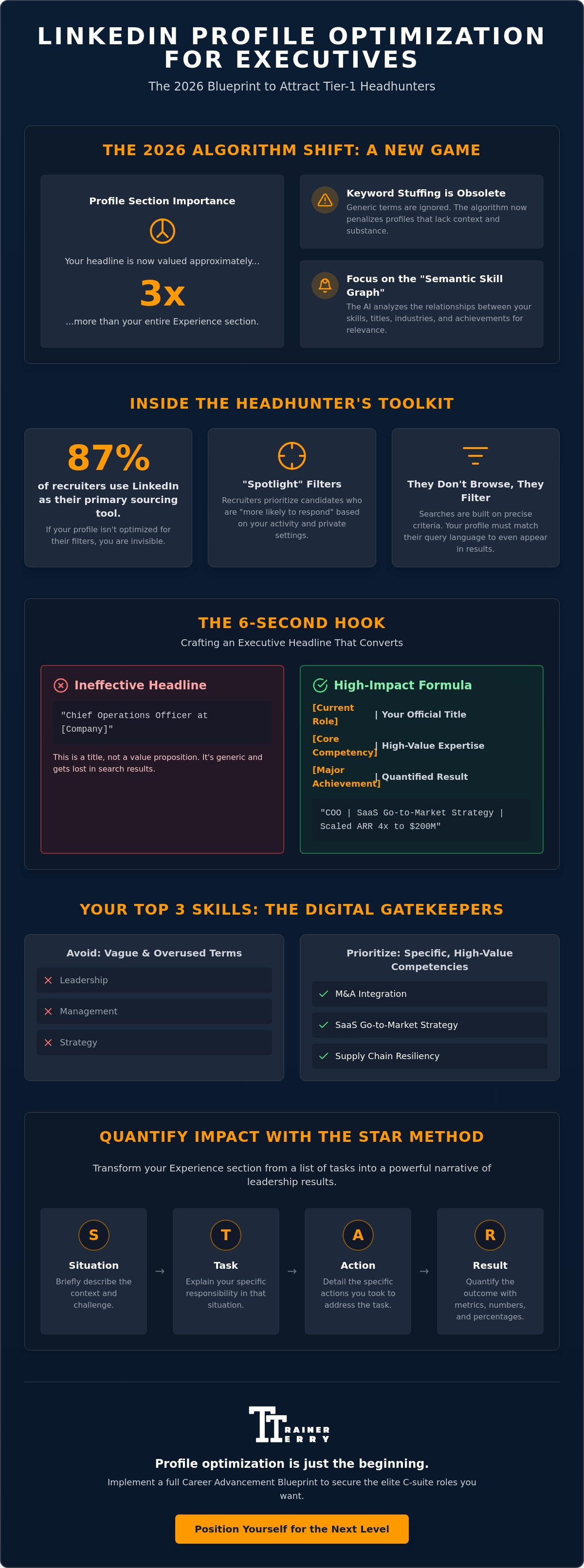
The 2026 algorithm has evolved into a "Semantic Skill Graph." This means simple keyword stuffing is dead. The system now prioritizes "Skill Density" and professional context. It looks for how your skills relate to your titles, industries, and even the companies you've transformed. With 87% of recruiters using LinkedIn as their primary sourcing tool, you cannot afford to be a "maybe." You need to be the definitive answer to their search query. Stop waiting for a phone call that isn't coming and start engineering your visibility.
The Power of the Skills & Endorsements Section
Your top three skills act as the primary gatekeeper. In 2026, generic terms like "Leadership" or "Management" are wasted space. They're too broad to be useful filters for a headhunter. You must shift toward specific, high-value competencies such as "M&A Integration," "SaaS Go-to-Market Strategy," or "Supply Chain Resiliency." Audit your skills against current 2026 executive job descriptions. If your top endorsements don't match the specific problems your target companies are facing, you'll be filtered out before a human ever sees your face. It's about precision, not volume.
The "Spotlight" Filter: Are You a Passive Candidate?
Recruiters spend an average of 7.3 hours per week searching for candidates, and they prioritize efficiency. They use "Spotlight" filters to find people who are "more likely to respond." This isn't just about your settings; it's about your behavior. Your engagement with search firm employees and your history of responding to InMails directly impacts your ranking. If you ignore messages, the algorithm deprioritizes you as an "inactive" lead. Maintaining a high response rate and a clean, active profile keeps you in the top tier of passive candidates. If you're ready to move beyond just being found and want to dominate the selection process, it's time to implement a full Career Advancement Blueprint to secure that next-level role.
The 6-Second Hook: Headline and About Section Strategy
Recruiters at top-tier firms don't read; they scan. You have exactly six seconds to prove you're the solution to their problem. If your headline currently reads "Chief Operations Officer at [Company]," you're wasting the most valuable real estate on the platform. Following the 2026 algorithm update, keywords in your headline are now valued approximately three times more than those in your experience section. This makes optimizing linkedin profile for executive search firms a matter of precise positioning rather than just listing facts.
Your headline must move beyond a simple title to a combination of value proposition and expertise. Think of it as your digital elevator pitch. You want to signal exactly what you deliver, not just where you sit. For a deeper dive into these platform changes, check out this guide on How to Use LinkedIn in 2026. The goal is to stop the scroll and force the recruiter to click "See More."
Drafting an Executive Headline That Converts
The winning formula for 2026 is: [Current Role] | [Core Competency] | [Major Achievement or Value]. If you're targeting Private Equity, focus on EBITDA growth and exit strategies. If you're looking at Fortune 500 roles, emphasize scale and organizational transformation. Avoid "Buzzword Bingo." Terms like "Synergy," "Guru," or "Disruptor" are search-killers that signal a lack of executive presence. Use the LinkedIn Profile Checklist from Iowa State University to ensure you haven't missed any foundational elements before you start refining your specific executive narrative.
The Leadership Narrative: Structuring Your About Section
Your About section is your digital executive summary. It's not a place to dump your career history. The first two lines are critical because they appear before the "See More" button. Use this space to address a recruiter's biggest pain point directly. Start with a "Hook" paragraph that defines your unique value proposition in 30 words or less. This is where optimizing linkedin profile for executive search firms becomes a human-to-human connection.
Follow this with a "Competency" section, listing 5-7 strengths like "Global Supply Chain Optimization" or "Digital Transformation Leadership." Finally, include a "Philosophy" paragraph. Tell them what it's actually like to lead with you. Do you build high-trust cultures? Are you a turnaround specialist? This human element is what converts a profile view into an InMail. If you're struggling to articulate this narrative, my Career Advancement Blueprint can help you define your professional brand for the highest-level roles.
Quantifying Impact: Using the STAR Method on Your Profile
Stop listing your duties. Start proving your worth. Executive recruiters don't care about what you were supposed to do; they care about the specific problems you've solved. When you're optimizing linkedin profile for executive search firms, your experience section must function as a high-performance scoreboard. Recruiters pay for premium search tools to find evidence of impact, not a digital version of a boring job description. If your profile reads like a list of chores, you're signaling that you're a doer, not a leader. You need to show them you can deliver results before they even pick up the phone.
The most effective way to do this is by using the STAR method (Situation, Task, Action, Result). While many use this in interviews, the 2026 strategy requires you to bake it directly into your profile. Flip the script and focus on the "R" first. Lead every bullet point with the measurable result. This captures attention immediately and forces the recruiter to look at the scale of your achievements. If you want to master this technique for your next high-stakes conversation, check out my guide on high-performance interview strategy.
Translating Responsibilities into Results
Don't just say you "Managed a team of 50." That's passive. Instead, write: "Led a 50-person cross-functional team to deliver $2M in savings through supply chain restructuring." This tells a story of leadership and efficiency. If you're handling confidential data, use percentages or relative scale to protect sensitive information. You can say you "Increased regional EBITDA by 12% in 18 months" without revealing exact dollar amounts. Your LinkedIn experience section should be a tight, strategic mirror of your executive positioning strategy, ensuring that every word earns its place on the page.
Showcasing Your "Executive Presence" Digitally
Executive presence is the digital perception of your authority and composure. It's not just about what you say, but how you present your expertise. Use the "Featured" section to host white papers, keynote recordings, or industry interviews. This provides visual proof of your "command presence" before a recruiter ever meets you. Additionally, audit your recommendations. You need 2-3 testimonials from superiors or board members, not just peers. Recruiters look for these as a form of social proof to de-risk their hiring decisions. When you combine quantifiable results with a strong digital presence, you move from being a candidate to being the only logical choice.
The "Open to Work" Debate: Signaling Without Desperation
The green "Open to Work" photo frame is the most debated feature on LinkedIn. For entry-level roles, it's a helpful signal. For C-suite leaders and senior VPs, it's often a neon sign of desperation. High-value executive talent is typically perceived as being "plucked" from one success to another, not standing on the digital street corner with a sign. When optimizing linkedin profile for executive search firms, your goal is to appear as a high-performance passive candidate, even if you're ready to leave yesterday. You want to be the prize, not the petitioner.
Discretion is your greatest currency in a high-stakes career transition. You can signal your availability to the right people without alerting your current board or peers. This requires a surgical approach to the platform's back-end settings. If you're unsure how to handle a delicate exit while staying on the radar of top headhunters, it's time to schedule a strategy call to map out your specific move.
Setting Up Your "Open to Work" (Private Edition)
LinkedIn allows you to toggle your "Job Seeking Preferences" so they're only visible to people using LinkedIn Recruiter. This is the professional standard for executive searches. When selecting job titles, don't just list what you do now; list the titles you're targeting next. Precision here triggers the right filters. Be careful with the "Start Date" setting. Selecting "Immediately" can be a red flag for elite roles, as it suggests you've already been pushed out or have no notice period. Choosing "Flexible" or "I'm casually looking" maintains your leverage and professional mystique.
Engaging with Executive Search Firms Directly
Don't wait for the algorithm to do all the work. You need to identify the "Big Five" firms and the boutique players in your specific niche. Start by following the managing partners and practice leaders at these firms. When you follow a recruiter, LinkedIn's algorithm often moves your profile higher in their future search results for relevant roles. It's a subtle "ping" that says you're interested in their orbit.
Use the "Thought Leadership" hack to stay top-of-mind. Comment on a recruiter’s post with a high-value insight. This isn't about flattery; it's about demonstrating your expertise in their feed. Whatever you do, never click the "Apply" button on a public LinkedIn job posting for a C-suite role. That's the fast track to the bottom of an automated pile. Instead, use your optimized profile to bridge the gap toward a direct conversation with the search partner. If you want to move beyond these tactics and secure a promotion strategy that works, my Career Advancement Blueprint provides the full execution plan.
Positioning for the Next Level: The Trainer Terry Blueprint
Let's get one thing straight: optimizing linkedin profile for executive search firms is only 20% of the battle. You can have the most polished profile on the platform, but if you don't have a strategy to back it up, you're just a well-dressed candidate standing in the wrong room. You need to move from a "Job Seeker" mindset to a "High-Value Asset" mindset. Recruiters aren't looking for someone who needs a job. They're looking for a leader who can solve a specific, high-stakes problem for their client. They want to buy your results, not your time.
I use my corporate VP experience to vet your profile against the actual standards used by top-tier search firms. I've been in the rooms where these hiring decisions happen. I know exactly what makes a headhunter pause and what makes them click away. True executive visibility requires a multi-channel approach. Your LinkedIn, your resume, and your network must all sing the same high-performance song. If you're ready to stop guessing and start executing, my Career Advancement Blueprint is the roadmap you've been looking for.
Beyond the Profile: Preparing for the Call
What happens when the headhunter actually calls? Your profile got you the "at-bat," but your narrative closes the deal. You must be prepared to articulate your value proposition without hesitation. This includes handling early-stage salary discussions with authority. You don't want to price yourself out, but you certainly don't want to leave money on the table. If you want to refine your delivery and command the room, my 1-on-1 Interview Prep will give you the edge you need to turn an inquiry into an offer.
Your Next Steps to Executive Visibility
Don't let this information sit. Take action now. I challenge you to make three changes to your profile in the next 48 hours based on what you've learned today. Audit your skills, sharpen your headline, and rewrite your first two lines of the About section. Even if you aren't looking for a move right now, you should audit your profile every six months. The market moves fast, and your digital presence needs to keep up. If you want a second pair of eyes on your work, join me for Office Hours for a live profile review. Let's make sure you're positioned as the elite asset you are.
Take Command of Your Executive Visibility
The landscape of executive search has moved beyond simple networking. It's now a game of digital precision. You've learned that optimizing linkedin profile for executive search firms requires more than just a list of titles; it demands a strategic blend of algorithm-friendly keywords and a high-impact leadership narrative. By mastering the 2026 Skill Density filters and quantifying your wins with the STAR method, you've moved from being a passive viewer to a high-value asset that headhunters can't ignore.
I bring over 20 years of experience as a former Corporate VP to every strategy I build. My specialized STAR-method approach has a global reach, helping senior leaders transition into elite roles with confidence and authority. You don't have to navigate this transition alone. Stop waiting for the right call and start engineering the outreach you deserve. Your next level is waiting for you to claim it.
Ready to be headhunted? Get your personalized Career Advancement Blueprint today.
The market is moving fast, and the best roles are filled before they ever hit a job board. Take the first step today and turn your profile into a recruiter magnet. You've got the experience; let's make sure the world sees it.
Frequently Asked Questions
Should I use the LinkedIn "Open to Work" banner for executive roles?
No, you should generally avoid the public green banner for high-level executive roles. While it increases message volume for mid-level positions, C-suite leaders often find it dilutes their professional brand and "passive candidate" status. Use the private "Recruiters Only" setting instead. This signals your availability to headhunters without looking like you're standing on a digital street corner with a sign.
How many keywords should I include in my LinkedIn headline?
Aim for 3 to 5 high-impact keywords that align with your specific leadership expertise. Since the 2026 algorithm values headline keywords three times more than other sections, focus on precision rather than volume. Don't turn your headline into a messy list; maintain a clean, professional narrative that highlights your unique value proposition. Quality always beats quantity when you're targeting elite firms.
Do executive recruiters really read the "About" section?
Yes, recruiters definitely read your "About" section to gauge your executive presence and leadership philosophy. While filters get them to your profile, the narrative in this section is what convinces them to reach out. Focus on the first 300 characters to hook them immediately. This is a critical step when you are optimizing linkedin profile for executive search firms to ensure you convert views into real conversations.
How can I hide my job search from my current employer on LinkedIn?
You can protect your current role by selecting the "Recruiters Only" visibility setting in your job-seeking preferences. LinkedIn also attempts to filter out recruiters from your own company to prevent them from seeing your status. Additionally, turn off "Share profile updates" in your settings before making major changes to your profile. This prevents your current network from getting alerts about your sudden activity.
What is the most important section of a LinkedIn profile for headhunters?
The headline and the "Skills" section are the most critical areas for being discovered by headhunters. These fields act as the primary filters in the LinkedIn Recruiter interface. If these sections don't match the search firm's specific criteria, your profile won't even appear in their results. Precision here is non-negotiable for anyone serious about optimizing linkedin profile for executive search firms in 2026.
How often should I post on LinkedIn to get noticed by recruiters?
Post high-value content 1 to 2 times per week to stay active in the algorithm without overwhelming your network. Activity signals are more important in 2026, but recruiters look for quality over quantity. Share a brief insight on an industry trend or a leadership lesson to demonstrate your expertise. This keeps your profile at the top of recruiter search results without looking like a full-time influencer.
Can I optimize my LinkedIn profile for multiple different executive roles?
No, you should pick one primary professional "lane" to avoid confusing both the algorithm and human recruiters. A profile that tries to appeal to both "Chief Technology Officer" and "Head of Sales" roles looks unfocused and lacks authority. If you have diverse skills, use your "About" section to weave them into a single, cohesive leadership narrative that supports one clear, high-value target.
Is it worth paying for LinkedIn Premium for an executive job search?
Yes, LinkedIn Premium is worth the investment for a serious executive search. It gives you access to competitive insights on job postings and allows you to see exactly who has viewed your profile. This is vital for identifying interested search firms. The ability to send InMails directly to recruiters also allows you to bypass gatekeepers and start high-level conversations that lead to interviews.

Article by
Terry Jones
Terry Jones is the Founder and Chief Career Strategist of the Career Advancement Blueprint and Executive Coach and Lead Consultant at FireBridge Consulting.
As an ICF Certified Accredited Career Coach and Certified Master Career Services professional, he partners with professionals at all levels, including senior leaders and executives, to navigate career transitions, secure new opportunities, and position themselves for advancement. His approach goes beyond surface level coaching, focusing on how individuals think, communicate, and lead so they can operate with clarity, authority, and strategic intent in high stakes environments.
In his work as an executive coach, Terry engages in high impact advisory conversations that help leaders strengthen decision making, elevate their presence, and align their leadership style with organizational expectations. He is known for helping clients translate their experience into influence, ensuring they are not only seen for what they have done, but trusted for what they are capable of leading next.
With over 20 years of corporate experience, including serving as a Vice President and leading Learning and Development functions for three New York City organizations, Terry brings a deep understanding of how companies evaluate talent, develop leaders, and make promotion decisions. This allows him to bridge the gap between individual ambition and organizational reality.
His insights have reached over 630,000 followers and generated more than 70 million video views, where he shares direct, experience driven guidance that helps professionals think differently and take action.