What Does an Executive Career Coach Do? Architecting Your Personal Board of Directors in 2026

The higher you climb, the less you actually hear the truth. It's a lonely reality at the top where feedback becomes polite, politics get messy, and your next move feels like a high-stakes gamble you're forced to take alone. You're likely asking: what does an executive career coach do that my own experience hasn't already covered? It isn't about polishing a resume or practicing handshakes. In 2026, it's about shifting from a solo operator to the chairman of your own career.
You already know that relying on internal HR or a single mentor isn't enough to secure a C-suite promotion in a market currently growing at over 9% annually. This article shows you how a high-level coach moves beyond basic tips to help you architect a Personal Board of Directors that provides the intellectual capital and political air cover you need. You'll learn how to turn vague feedback into a clear strategy for high-stakes career shifts. We're breaking down the exact framework for building executive presence through external validation and curated advisory. It's time to stop guessing and start executing your advancement with surgical precision.
Key Takeaways
- Stop relying on transactional networking and start architecting a curated Personal Board of Directors to provide the political air cover needed for C-suite moves.
- Understand what does an executive career coach do by seeing how they help you recruit high-level Sponsors who advocate for your promotion in closed-door meetings.
- Master the relationship hierarchy to distinguish between mentors who offer advice and sponsors who take action on your behalf.
- Follow a structured assembly blueprint to define your 12-month career objective and identify the specific intellectual capital required to reach it.
- Activate your board by presenting a Career Business Case to simulate high-stakes interview scenarios and pressure-test your strategy before the real transition.
What is a Personal Board of Directors and Why Networking is Obsolete in 2026?
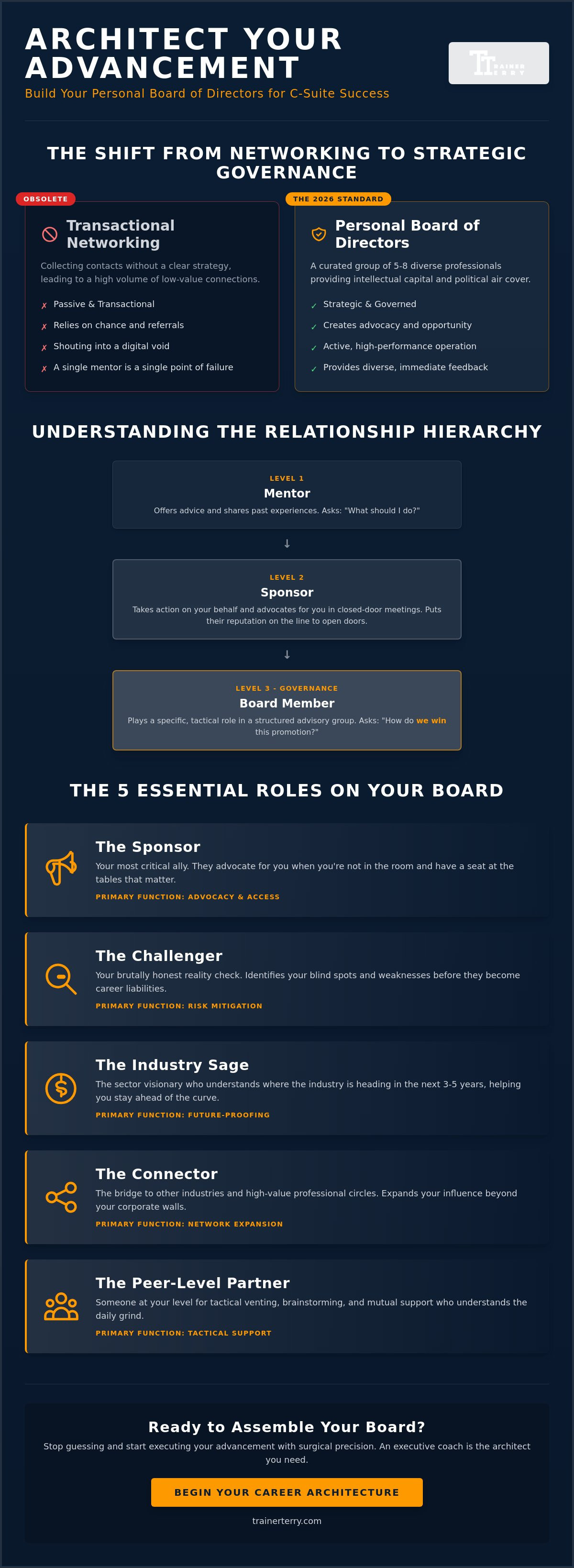
Stop collecting business cards. In 2026, traditional networking is a waste of your most valuable resource: time. It feels transactional because it is. Most professionals are shouting into a digital void, hoping for a referral that never comes. If you're aiming for the C-suite, you don't need more connections. You need a Personal Board of Directors (PBoD). This is a curated group of 5-8 diverse professionals who provide the intellectual capital and political air cover you can't find on LinkedIn.
So, what does an executive career coach do in this context? They act as the architect and manager of this board. They don't just give you advice; they help you identify the specific power players you need in your corner. They then teach you how to manage those relationships with the same discipline you apply to your P&L. When you ask what does an executive career coach do, the answer starts with the construction of this elite circle. This shifts your career from a series of lucky breaks to a governed, high-performance operation.
The Shift from Mentorship to Strategic Advisory
Traditional mentors are great for sharing stories about the past. However, a single mentor often becomes a single point of failure. If their influence wanes or their perspective is limited, your strategy stalls. You need to understand the fundamental difference between a Mentor vs. Sponsor; one gives you advice, while the other puts their reputation on the line to open doors for you.
Your executive coach ensures your board is future-focused. While a mentor might ask "What should I do?", your board asks "How do we win this promotion?" It's a move from passive observation to active, strategic execution. This transition is vital when the digital noise of 2026 makes it harder than ever to stand out through traditional channels.
The ROI of a High-Performance Board
A well-constructed board pays dividends through accelerated decision-making. When you're navigating politically charged corporate environments, you don't have weeks to weigh your options. You need immediate, diverse feedback from people who have survived similar battles. This speed is your competitive advantage.
This group grants you access to hidden job markets that never reach a recruiter's desk. They provide high-level referrals that carry actual weight in the boardroom. Your Personal Board of Directors is a strategic asset class designed specifically for exponential executive growth.
The 5 Essential Roles: Architecting Your Strategic Advisory Group
You can't lead a multi-million dollar division with a group of "yes-men" and old college buddies. High-level leadership requires a structured Strategic Advisory Group where each member serves a specific tactical purpose. If you don't know exactly who is in which seat, you don't have a board; you just have a contact list. Success in 2026 depends on having these five archetypes in your corner:
- The Sponsor: This is your most critical ally. They have a seat at the table where your name is mentioned in closed-door meetings. They don't just advise you; they advocate for you when you aren't in the room.
- The Challenger: This person is your reality check. They are the brutally honest advisor who identifies your blind spots and weaknesses before they become liabilities.
- The Industry Sage: Think of them as your sector's visionary. They understand where your industry is heading in the next five years and help you stay ahead of the curve.
- The Connector: They are the bridge to other industries and high-value professional circles. They expand your influence beyond your current corporate walls.
- The Peer-Level Partner: Someone at your level for tactical venting and mutual support. They understand the daily grind because they're living it too.
Identifying the Gaps in Your Current Circle
Most executives suffer from an echo chamber. They have too many Industry Sages and not enough Challengers. This is exactly where the real work begins. So, what does an executive career coach do during this phase? They perform a rigorous social capital audit to see which roles are currently vacant in your network. Without a Challenger to sharpen your executive presence, your growth will eventually plateau. Don't let a lack of honest feedback stall your trajectory.
Diverse Perspectives as a Competitive Advantage
Your board must include people outside your immediate company. Relying only on internal voices is a recipe for political blindness. An executive career coach acts as the board's "Chairman," ensuring these diverse perspectives are synthesized into a coherent strategy. They keep the board focused on your 12-month career objective rather than getting bogged down in minor tactical details. If you're ready to stop playing small, our Career Advancement Blueprint can help you identify and fill these empty seats with precision.
Mentor vs. Sponsor vs. Board Member: Navigating the Relationship Hierarchy
Advice is cheap. Action is expensive. Most leaders fail to reach the next level because they have a room full of mentors but zero sponsors. Mentors talk to you; sponsors talk about you in rooms where decisions are made. A Personal Board of Directors governs your entire trajectory. When you dig into what does an executive career coach do, you realize they are the ones who draw the line between these roles. They ensure you aren't wasting time on passive support that feels good but moves nothing.
Your direct manager should rarely be the primary member of your board. It sounds counterintuitive, but your boss has a fundamental conflict of interest. They need you to stay exactly where you are to keep their team running smoothly. Your board needs advisors who have no stake in your current role. They should be invested in your long-term win, not the company's quarterly headcount. This independence allows for the brutal honesty required for real growth. It forces you to build a career narrative that appeals to high-level governance rather than just satisfying a job description.
The Sponsorship Gap: Why Advice Isn't Enough
Mentorship is safe. Sponsorship is risky. A sponsor is someone who spends their own political capital to vouch for you during high-stakes promotion strategy discussions. If you've been mentored for years without a title change, you have a sponsorship gap. Your coach helps you bridge this. They teach you how to present a business case that makes it easy for a board member to advocate for you. You need internal sponsors to navigate the local politics and external sponsors to provide the leverage for a shift out of your current environment.
Maintenance and Reciprocity
High-level relationships aren't a one-way street. You aren't just taking; you're offering. Your board members are often just as hungry for fresh intel and diverse perspectives as you are. What do you see on the front lines that they don't? Sharing that value is how you professionalize the bond. Don't let these relationships go cold. Set a strict cadence. While you might have monthly 1:1s with individual members, your coach can help facilitate quarterly Board Meetings to keep your entire advisory group aligned with your 12-month objective. This keeps the momentum high and prevents your career strategy from becoming a series of disconnected coffee chats.
The Assembly Blueprint: How to Recruit and Manage Your Board Members
Building a high-performance board isn't a weekend project. It's a surgical operation. You're not just looking for "nice" people; you're recruiting specific assets to fill the gaps in your strategic arsenal. What does an executive career coach do during this assembly phase? They act as your head of recruitment. They help you vet potential members to ensure they have the exact intellectual capital required to move the needle on your specific goals. Follow this five-step blueprint to build your board from the ground up.
- Step 1: Define your 12-month career objective. Be specific. Don't just say "growth." Aim for "VP to SVP transition" or "moving from a regional lead to a global operations role."
- Step 2: Identify the specific Intellectual Capital needed. What knowledge or influence are you missing? If you're moving into a global role, you need someone who understands cross-border regulatory shifts in 2026.
- Step 3: Leverage digital positioning. High-level advisors will audit you before they agree to help. Use LinkedIn positioning to ensure your profile reflects the caliber of leader you are becoming.
- Step 4: The Outreach. Craft a value-first invitation. This isn't about what they can do for you. It's about why their specific perspective is uniquely relevant to a challenge you're solving.
- Step 5: The Inaugural Meeting. Set the rules of engagement. Define the cadence, the expectations, and the specific areas where you'll seek their governance.
The Art of the Ask
Never ask: "Will you be on my personal board of directors?" It sounds like a heavy, unpaid part-time job. Instead, use the "Specific Advice" technique. High-level executives love to share their expertise when the request is surgical and time-bound. This is exactly what does an executive career coach do: they help you script these interactions so they feel like a natural evolution of a professional relationship rather than a desperate plea for help.
Your outreach should look like this: "I noticed your approach to global supply chain restructuring at [Company] last year. I'm currently facing a similar hurdle with our EMEA integration and would value 15 minutes of your perspective on navigating [Specific Detail]." This shows you've done your homework and respect their time. Momentum is a magnet; people want to invest in a leader who is already moving.
Optimizing Your Digital Presence for Recruitment
Advisors want to associate with winners. If your LinkedIn profile looks like a digital resume from 2015, you've already lost the recruitment battle. Your digital footprint must align with the caliber of board you want to build. It needs to scream executive presence before you even hit "send" on an invite. If you aren't sure how you're being perceived, schedule a strategy call to audit your current positioning and ensure you're ready to attract top-tier advisors.
Activating Your Board for Promotion and High-Stakes Career Shifts
A board that doesn't act is just a social club. You've recruited these power players for a reason. Now, you must put them to work. This starts by presenting your "Career Business Case" for brutal, unfiltered feedback. Don't ask them if they like your plan. Ask them where it's going to fail. This is the moment where the "Challenger" you recruited earlier earns their seat. If your strategy can survive a board review, it can survive the boardroom.
When you ask what does an executive career coach do during this phase, the answer is facilitation. They help you synthesize the feedback into a "Board-Approved" Career Narrative. This story must be consistent across every channel, from your LinkedIn profile to the way your Sponsors talk about you behind closed doors. Consistency builds trust. Trust leads to the high-stakes interview preparation sessions where your board members simulate the pressure of a C-suite selection committee. They know the questions because they're the ones usually asking them.
The Board as a Promotion Engine
Your board is your most powerful promotion engine. During performance review cycles, your coach helps you coordinate your Sponsors. This isn't about manipulation. It's about ensuring that when your name comes up, the right people are ready with the right data points. You might receive conflicting advice from different board members. That's a feature, not a bug. Different perspectives prevent blind spots. Your coach helps you filter this noise so you don't lose momentum.
Use your board to benchmark your market value. They have access to compensation data and internal budget realities that you'll never find on a public website. This intel is your leverage for upcoming salary negotiations. If you're currently in a career change blueprint phase, your board provides the political air cover needed to transition industries without losing your seniority or your mind.
Next Steps: Professionalizing Your Career Growth
DIY board building often fails. It's easy to start, but hard to maintain. Life gets in the way, and your advisory group eventually goes cold. What does an executive career coach do to prevent this? They provide the structured framework and accountability needed to keep the engine running. They integrate every piece of board feedback into your Career Advancement Blueprint, turning advice into a tactical roadmap.
Stop leaving your executive trajectory to chance. You've spent years building your expertise; now build the infrastructure to support it. Take control of your career path today. You've seen the blueprint. Now, execute it.
Take Command of Your C-Suite Legacy
Passive networking is a relic of the past. If you want to break through the isolation of the top tier, you must stop operating as a solo agent. You've seen that a Personal Board of Directors isn't a luxury; it's a requirement for navigating the political minefields of 2026. Shifting from simple mentorship to active sponsorship is the only way to radically accelerate your trajectory. When you truly grasp what does an executive career coach do, you realize they are the architect of your most valuable professional asset: your reputation in rooms you haven't even entered yet.
Don't let another promotion cycle pass you by while you wait for polite feedback that doesn't help you grow. Terry Jones, a former Corporate VP with over 20 years of high-stakes executive experience, developed a proven framework for internal promotions and career pivots. Stop guessing and start executing with a strategic partner who has actually sat at the table. Secure your executive future with the Career Advancement Blueprint today. Your next move is a high-stakes play. Make sure you have the right board behind you.
Frequently Asked Questions
How many people should be on my personal board of directors?
You should aim for a curated group of 5 to 8 diverse professionals. This range is the sweet spot for balanced perspectives without creating a management burden that slows your progress. A smaller group lacks the necessary diversity of thought, while a group larger than eight becomes impossible to manage with the surgical precision required for executive growth.
Is a personal board of directors the same as a group of mentors?
No, a personal board is a governed, results-oriented structure, while mentorship is often a casual and reactive relationship. Mentors usually look at your past or provide general guidance. A board is built to hit a specific 12-month objective. This distinction is central to what does an executive career coach do; they help you shift from passive advice-seeking to active, strategic governance of your career.
How do I ask someone to be on my personal board without it being awkward?
You don't actually use the term "personal board" during your initial outreach. Instead, you ask for a brief, 15-minute consultation regarding a specific challenge where they have proven expertise. This keeps the interaction professional and low-pressure. Once the relationship delivers value, you can gradually increase the cadence of your check-ins to formalize their advisory role.
Can my current boss be on my personal board of directors?
Your current boss should rarely be a primary member of your board due to their inherent conflict of interest. Their priority is often keeping their best talent exactly where they are to ensure team stability. Your board members must be invested in your long-term win, even if that win involves moving to a different division or a competitor. Independence is a requirement for honest governance.
How often should I meet with my personal board?
You should meet with individual members once a month or once a quarter, depending on the intensity of your current career phase. While these 1:1 sessions keep the relationships warm, you should also have your coach facilitate a broader board review every six months. This ensures your entire advisory group stays aligned with your high-stakes promotion strategy and doesn't provide fragmented advice.
What should I do if a board member gives me bad advice?
You must treat all board feedback as a data point rather than a command. You are the CEO of your own career, and you hold the final vote on every decision. If advice feels wrong, pressure-test it against the perspectives of your Challenger or your coach. Understanding what does an executive career coach do involves seeing how they help you filter noise and synthesize conflicting opinions into a coherent move.
How do I provide value back to my board members if they are more senior than me?
Provide them with fresh market intel or ground-level perspectives they no longer see from their senior positions. High-level executives are often hungry for unfiltered information about emerging trends, competitor moves, or cultural shifts within the workforce. Your value lies in being their "eyes and ears" on the front lines, which creates a powerful, reciprocal relationship built on mutual benefit.
Should I tell my board members who else is on the board?
Yes, transparency about your board's composition usually increases the commitment of the members. High-caliber leaders enjoy being in the company of other top-tier professionals. When they see the quality of the other advisors you've recruited, it validates your executive presence and makes them more willing to put their own political capital on the line for your next promotion.

Article by
Terry Jones
Terry Jones is the Founder and Chief Career Strategist of the Career Advancement Blueprint and Executive Coach and Lead Consultant at FireBridge Consulting.
As an ICF Certified Accredited Career Coach and Certified Master Career Services professional, he partners with professionals at all levels, including senior leaders and executives, to navigate career transitions, secure new opportunities, and position themselves for advancement. His approach goes beyond surface level coaching, focusing on how individuals think, communicate, and lead so they can operate with clarity, authority, and strategic intent in high stakes environments.
In his work as an executive coach, Terry engages in high impact advisory conversations that help leaders strengthen decision making, elevate their presence, and align their leadership style with organizational expectations. He is known for helping clients translate their experience into influence, ensuring they are not only seen for what they have done, but trusted for what they are capable of leading next.
With over 20 years of corporate experience, including serving as a Vice President and leading Learning and Development functions for three New York City organizations, Terry brings a deep understanding of how companies evaluate talent, develop leaders, and make promotion decisions. This allows him to bridge the gap between individual ambition and organizational reality.
His insights have reached over 630,000 followers and generated more than 70 million video views, where he shares direct, experience driven guidance that helps professionals think differently and take action.