What to Post on LinkedIn When Looking for a Job Discreetly: The 2026 Stealth Strategy

What if the secret to your next big career move isn't a loud announcement, but a strategic whisper? You know you're worth more, but the thought of your current boss catching you "window shopping" for roles is enough to keep your profile frozen. It's a valid fear. With 52% of the global workforce looking for new roles in 2026, the competition is fierce and the stakes for your reputation are high. Learning what to post on linkedin when looking for a job discreetly is no longer just a "nice to have" skill. It's your survival strategy for a market that demands authority without a hint of desperation.
I understand the anxiety of trying to stay visible to recruiters while remaining invisible to your colleagues. You don't need that "Open to Work" badge to get noticed. In fact, you're better off without it. This guide will show you how to leverage the new 360Brew algorithm to build a personal brand that attracts inbound offers. We'll explore how to share high-value insights that position you as an industry leader, giving you the perfect professional cover for your increased activity. You're about to learn how to transform your presence into a magnet for high-paying opportunities while keeping your current bridge fully intact.
Key Takeaways
- Understand why relying on LinkedIn's "Recruiters Only" setting is a safety net, not a strategy for high-performance professionals.
- Learn the art of Stealth Career Positioning to attract inbound recruiter messages without ever looking like an active applicant.
- Discover exactly what to post on linkedin when looking for a job discreetly to build authority while maintaining your professional cover.
- Master the "Second Degree" networking technique to engage with key decision-makers without alerting your current colleagues.
- Utilize the Career Change Blueprint to transition into your next role while protecting your reputation and executive presence.
The Stealth Job Search Dilemma: Why Settings Alone Are Not Enough
Most professionals think a few clicks in the settings menu will hide their intentions. It's a dangerous assumption. While LinkedIn tries to filter out your current employer, it can't account for the human element. Recruiters talk. Your boss's college roommate might be the one looking at your "Open to Work" status. For senior leaders, that green badge doesn't signal availability; it signals a lack of leverage. It looks desperate. You need a strategy that relies on psychology, not just privacy toggles. Moving from a "job seeker" mindset to an "industry authority" is the only way to stay safe.
The Myth of Total Privacy on LinkedIn
Recruiter licenses are powerful tools. They allow headhunters to see who is looking, but they don't offer a 100% guarantee of anonymity. If your company uses a third-party agency, those recruiters might see your status. Beyond technicalities, there's the "Friend of a Friend" risk. Professional circles are small. Success in your career depends on solid business networking principles, but those same networks can leak information if you aren't careful. Paradoxically, the biggest risk isn't being seen; it's being invisible. If you stop posting entirely, you vanish from the 360Brew algorithm. You become a "quiet profile," and top-tier executive recruiters rarely hunt for ghosts.
Disguising Your Search as Professional Growth
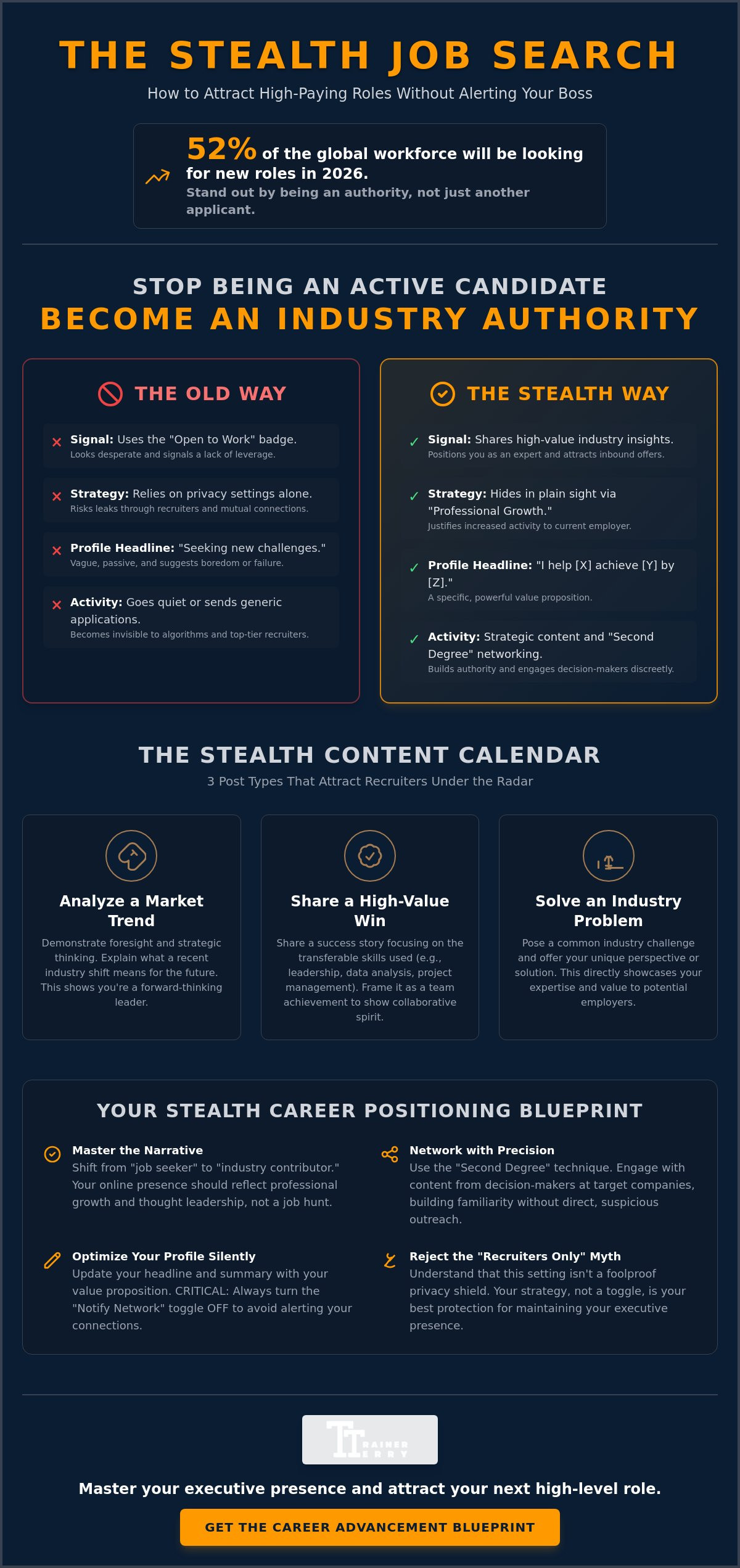
The key is to hide in plain sight. Instead of asking for a job, you must demonstrate why you are the best at what you do. This is the core of what to post on linkedin when looking for a job discreetly. You aren't "looking for a new role"; you are "expanding your industry footprint." When you start sharing insights, your current employer sees a motivated team member representing the brand. Recruiters, however, see a high-value asset who is ready for a bigger stage. This "Career Refresh" justifies your new visibility without raising a single red flag.
Frame your activity as a commitment to excellence. Analyze a market trend. Share a win that highlights your transferable skills. By establishing this high-performance narrative, you create a professional cover that is impossible to criticize. You aren't a job seeker; you are an authority. This shift is what separates those who wait for a pink slip from those who receive unsolicited executive offers. If you want to master this transition, our Career Advancement Blueprint provides the exact framework for high-level positioning. It's time to stop hiding and start leading.
Shifting the Narrative: From "Active Candidate" to "Industry Authority"
Stop thinking like an applicant. High-performance career moves in 2026 don't happen through crowded job boards. They happen through Stealth Career Positioning. This is the art of attracting elite opportunities by demonstrating your value publicly without ever actually requesting them. It's the difference between chasing a goal and becoming the goal itself. Recruiters are increasingly wary of "active" candidates who flood the market with generic resumes. They prioritize "passive" talent because these individuals appear successful, stable, and focused on results. When you look like you don't need a job, you become the most desirable person in the room.
The 2026 360Brew algorithm has fundamentally changed the game. It no longer cares about who you know; it cares about what you know. Knowledge-sharing is the new signal for talent. The algorithm prioritizes "dwell time" and meaningful comments over superficial likes. If you provide deep, actionable insights into your niche, the system flags you as a subject matter expert. This is your primary search tool. Executive presence isn't just about a professional headshot. It's about how you think and communicate. If you're struggling to define that value, our Career Advancement Blueprint helps you build this narrative without the "job seeker" stigma.
The 2026 Executive Career Narrative
Your profile needs a pivot. Stop saying you're "looking for new challenges." That sounds like you're bored or failing. Start "solving industry problems." Your unique value proposition must be a single, punchy sentence. For example: "I help scale fintech startups by optimizing cross-border payment architecture." Notice there's no mention of a job search. When you update your headline, ensure the "Notify Network" toggle is turned OFF. This prevents "Profile Change" alerts from hitting your boss's feed while still updating the data points recruiters use for filtering. You're changing the bait, not the fishing spot.
Leveraging "Knowledge-Based" Content
Sharing industry insights is the perfect professional cover. When people ask why you're more active, you're simply "building the company's brand" or "mentoring the next generation." It's a bulletproof excuse. This is exactly what to post on linkedin when looking for a job discreetly to stay safe. Curate content that signals your seniority. Share high-level whitepapers or comment on regulatory changes that impact your sector. If you position yourself as a mentor to others, you attract executive headhunters who are looking for leaders, not just executors. You aren't hunting for a role; you're cultivating an audience that includes your next employer.
The Stealth Content Calendar: 3 Types of Posts That Attract Recruiters
Random activity is a massive red flag. If you suddenly start liking every post in your feed, your colleagues will notice the shift. You need a structured approach that looks like professional growth but functions as a recruiter magnet. This is the "front-end" strategy that most guides ignore. By following a specific rhythm, you maintain your cover while proving your value. Consistency beats intensity every time. Don't post five times in one day; post twice a week with purpose. This is exactly what to post on linkedin when looking for a job discreetly without triggering a single internal alarm.
The "Insight" Post: Demonstrating Strategic Thinking
Recruiters want to see how you think. An "Insight" post analyzes a trend without leaking company secrets. Use the 2026 high-engagement formula: Hook, Insight, and Question. Start with a bold statement about your industry. Follow it with a unique observation that shows you understand the macro-level changes in your sector. End by asking your network for their perspective. This tells headhunters you aren't just doing the work; you're leading the conversation. It proves you understand the "why" behind the "what," which is a prerequisite for any senior-level role.
The "Milestone" Post: The Subtle Brag
Celebrating a win is the perfect way to highlight your leadership. Frame it as a team achievement to keep the focus on collective success while still showcasing your management skills. Use the STAR method to structure these stories. Focus on the Situation, Task, Action, and Result. When you describe the "Action," emphasize your strategic decisions. This is also the perfect time to optimize your professional LinkedIn profile so it backs up the success stories you're sharing in the feed. You aren't bragging; you're documenting excellence.
The "Curated" Post: Building Your Network Cover
You don't always have to create original content. Sharing a high-level article from an industry leader is a great way to stay visible. Tag the author or a peer to expand your reach into their network. Frame your activity as part of your ongoing professional development. If anyone asks, you're simply using Office Hours to stay sharp and bring fresh ideas back to your current team. Use this template: "I've been following [Author's Name]'s work on [Topic]. Their recent take on [Specific Point] is a game-changer. How are you all adapting to this shift?" It's simple, effective, and completely discreet.
Strategic Engagement: How to Network Under the Radar
Posting high-value content is only half the battle. If you want to move the needle without alerting your current employer, you must master the art of strategic engagement. Networking in 2026 isn't about broadcasting your availability to the world. It's about being a "ghost" in the machine. You need to show up in the right places, talk to the right people, and stay completely invisible to those who shouldn't see you. The real magic happens in the second-degree connections. These are the people who know the people you want to work for, but they don't share an office with your current boss.
Your goal is to be seen as a peer by decision-makers before they ever see you as a candidate. This requires a "Value-First" approach. Don't send a DM asking for a referral. Instead, share a resource or offer a perspective on a challenge they recently mentioned. LinkedIn Groups and private Events are perfect for this. These spaces offer a level of privacy that the main feed lacks. You can engage in deep industry discussions with hiring managers while keeping your activity away from the prying eyes of your colleagues. It's about building a bridge while you're still standing on the old one.
The "Ghost" Engagement Strategy
Your comments are often more important than your original posts. When you leave a thoughtful comment on an industry leader's post, you appear in the "People Also Viewed" sidebar of everyone reading that thread. This is a crucial part of what to post on linkedin when looking for a job discreetly. You aren't creating a new "alert" for your network, but you are building authority with a targeted audience. Be careful with your "Activity" tab, though. Your boss can see every "Like" you give. Focus on high-quality comments that look like professional development rather than a desperate search for attention.
Targeted Networking for Executives
Executive moves require a different level of finesse. You shouldn't be looking for a job interview; you should be looking for a "Career Strategy Chat." This subtle shift in language changes the entire dynamic of the conversation. It positions you as a high-performance professional who is curious about the market, not someone who is unhappy. Identify the specific recruiters who dominate your niche and engage with their content consistently. Once you've established rapport, move the conversation to a private channel. If you want to ensure you're ready for these high-stakes meetings, you need a high-level interview strategy that protects your executive presence.
Success in a stealth search comes down to how you position your value before the opportunity even exists. If you're ready to stop guessing and start executing a proven plan, schedule a free strategy call today to discuss your career positioning.
Master Your Executive Presence with Trainer Terry’s Career Positioning
Generic career advice is a trap for high-performance professionals. If you're aiming for a C-suite role or a senior directorship, following entry-level tips will only dilute your brand. You don't need "resume hacks" or basic networking tricks. You need a surgical approach to your reputation. At this level, the goal isn't just to find a job; it's to be hunted by the right people. This requires a total shift in how you present your value. Most people fail because they treat their LinkedIn profile like a static resume rather than a living piece of executive presence. They guess at what to post on linkedin when looking for a job discreetly, hoping something sticks. Hope is not a strategy.
True career positioning is about control. It's about ensuring that every digital touchpoint reinforces your target salary and seniority. When you work with a career coach who understands high-stakes transitions, you stop being a candidate and start being a solution. Our Career Advancement Blueprint is designed to strip away the "job seeker" stigma. We help you move from the exhausting cycle of applying to the elite circle of being recruited. It's time to stop playing defense and start building the narrative that justifies your next big move.
The Career Positioning Strategy
We don't just "fix" profiles. We conduct a full audit of your digital footprint to ensure it matches the expectations of top-tier executive recruiters. If your content doesn't scream leadership, you're leaving money on the table. We help you develop a unique Career Narrative that explains your wins, your methodology, and your future value. This narrative is the "cover" that allows you to be active on LinkedIn without looking like you're halfway out the door. Our clients often secure high-level offers without ever hitting "Apply Now" because their positioning does the heavy lifting for them. They become the obvious choice before the first interview even starts.
Take the Next Step in Your Stealth Search
Stop guessing. Every day you spend without a clear positioning strategy is a day you're invisible to the roles you actually want. The 2026 market doesn't reward the quiet; it rewards the strategically visible. Are you ready to execute a high-performance career plan that protects your reputation while accelerating your growth? It's time to take action. Don't wait for your current situation to become unbearable. Schedule your free strategy call with Trainer Terry today and let's map out your transition. Your next role shouldn’t be a lucky break; it should be the logical result of your positioning.
Take Command of Your Professional Future
You now have the blueprint to navigate the 2026 job market with total confidence. Privacy settings are just a baseline; true security comes from establishing an authority that makes you untouchable. By mastering what to post on linkedin when looking for a job discreetly, you transform your profile from a static resume into a high-performance recruiter magnet. You're no longer just looking for a role. You're demonstrating the leadership that makes you the only logical choice for your next promotion.
Don't let fear or hesitation stall your progress. With over 20 years of experience as a Corporate VP, I've refined the Career Change Blueprint to help executives transition without ever risking their current reputation. We'll use the STAR method to frame your success and build a narrative that commands a higher salary. It's time to stop hiding and start positioning yourself for the role you deserve. Secure your next executive role discreetly—Schedule a Free Strategy Call. Your transformation starts with a single, decisive action. Let's make it happen.
Frequently Asked Questions
Is it safe to use the "Open to Work" feature if I am currently employed?
No, it's a significant risk for senior professionals. While LinkedIn attempts to hide this status from your current employer, it doesn't account for third-party recruiters or mutual connections who might leak the information. Beyond the privacy risk, that green badge can signal a lack of leverage to executive headhunters. You're better off building a profile that attracts inbound interest through authority rather than a public request for employment.
How often should I post on LinkedIn to stay relevant but discreet?
Aim for two high-quality posts per week. This frequency is enough to satisfy the 360Brew algorithm without creating a sudden, suspicious spike in activity that alerts your manager. Focus on consistency rather than volume. A steady rhythm of professional insights looks like natural career growth, whereas posting daily after months of silence is a major red flag to your current team.
Should I tell my current colleagues I am looking for a new job?
No, you should keep your search strictly private until you have a signed offer in hand. Even the most trusted colleagues can accidentally mention your plans in a meeting or to a mutual connection. Professional circles are smaller than you think. Use your increased activity as a way to "represent the brand" instead of explaining your real motivations to anyone in your current office.
What is the best time of day to post on LinkedIn for maximum recruiter visibility?
Tuesday through Thursday between 8:00 AM and 10:00 AM is the peak window for engagement. This is when recruiters are most active, checking their feeds for industry news and potential talent. Posting during these hours increases your dwell time and ensures your content is seen by decision-makers while they're in a professional mindset. Avoid weekends, as executive reach drops significantly during those times.
Can my boss see if I update my LinkedIn profile?
Yes, they can see every change if you don't disable your activity broadcasts. Before you make any edits to your headline or experience, go to your settings and toggle off "Share profile updates with your network." This prevents LinkedIn from sending a notification to your boss every time you tweak your positioning. It's the most basic step in managing what to post on linkedin when looking for a job discreetly.
How do I respond if my manager asks why I am more active on LinkedIn lately?
Frame your activity as a commitment to the company's external brand and your own professional development. Tell them you're staying sharp on industry trends to bring fresh perspectives back to the team. You can also mention that you're mentoring others or building a network that could lead to future partnerships. When you position your activity as a benefit to your current employer, they'll see it as an asset rather than a threat.
What should I do if a recruiter from a competitor reaches out to me?
Stay professional and move the conversation to a private channel immediately. Don't use your work email or office computer for these discussions. Acknowledge their reach-out with a brief, polite message and suggest a "career strategy chat" over a personal call. This protects your current role while allowing you to explore the opportunity with full confidentiality. Never burn a bridge, even if you don't intend to take the role.
How do I change my LinkedIn headline without alerting my current network?
Disable your "Notify Network" setting before you type a single character. This is found in the "Visibility" section of your privacy settings. Once this is off, you can update your headline to reflect your new Career Narrative without triggering an automated post. This allows you to test new keywords and executive positioning in total silence. It's the most effective way to pivot your brand without raising any internal alarms.

Article by
Terry Jones
Terry Jones is the Founder and Chief Career Strategist of the Career Advancement Blueprint and Executive Coach and Lead Consultant at FireBridge Consulting.
As an ICF Certified Accredited Career Coach and Certified Master Career Services professional, he partners with professionals at all levels, including senior leaders and executives, to navigate career transitions, secure new opportunities, and position themselves for advancement. His approach goes beyond surface level coaching, focusing on how individuals think, communicate, and lead so they can operate with clarity, authority, and strategic intent in high stakes environments.
In his work as an executive coach, Terry engages in high impact advisory conversations that help leaders strengthen decision making, elevate their presence, and align their leadership style with organizational expectations. He is known for helping clients translate their experience into influence, ensuring they are not only seen for what they have done, but trusted for what they are capable of leading next.
With over 20 years of corporate experience, including serving as a Vice President and leading Learning and Development functions for three New York City organizations, Terry brings a deep understanding of how companies evaluate talent, develop leaders, and make promotion decisions. This allows him to bridge the gap between individual ambition and organizational reality.
His insights have reached over 630,000 followers and generated more than 70 million video views, where he shares direct, experience driven guidance that helps professionals think differently and take action.