LinkedIn Content Strategy for Executives 2026: The High-Performance Authority Blueprint

What if your LinkedIn profile wasn't just a static digital resume, but a high-performance engine that secured your next board seat while you were actually doing your job? With over 10 million C-level executives now competing for attention, the old "post and pray" method is dead. You're likely busy, skeptical of the ROI, and frankly tired of chasing algorithm changes that feel like a moving target. It's time to stop acting like a content creator and start leading like an authority. Implementing a focused linkedin content strategy for executives isn't about becoming an influencer; it's about reinforcing a narrative that makes your next career move inevitable.
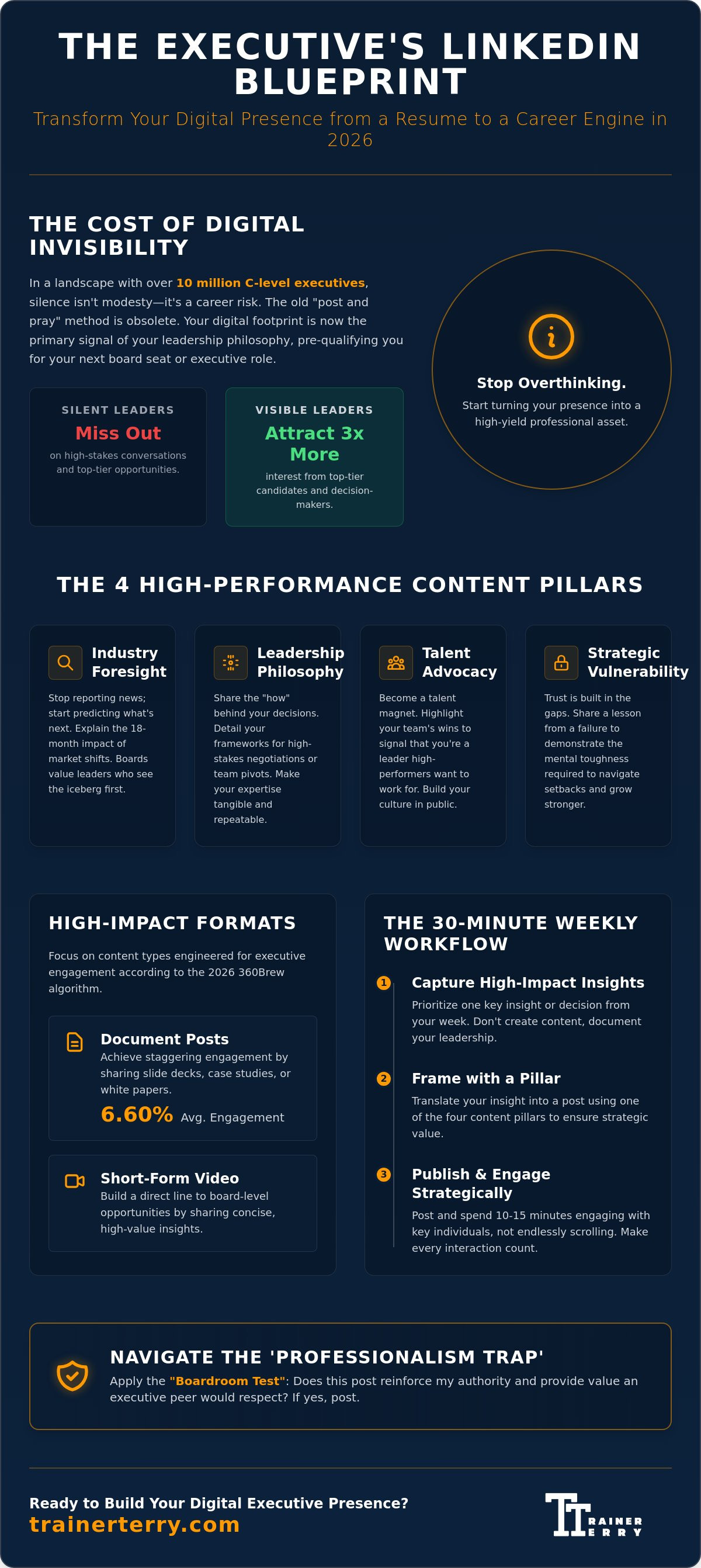
I know you don't have hours to waste on vanity metrics or complex posting schedules. You need a framework that works as hard as you do. This guide shows you how to command respect and attract top talent using the 2026 360Brew algorithm to your advantage in less than 30 minutes a week. We'll break down why document posts are hitting 6.60% engagement rates and how to leverage short-form video to build a direct line to board-level opportunities. It's time to stop overthinking and start turning your presence into your most valuable professional asset.
Key Takeaways
- Understand why digital invisibility is your biggest career risk in 2026 and how to turn your profile into a powerful manifestation of your leadership philosophy.
- Master the four high-performance content pillars to demonstrate industry foresight and share the "how" behind your most critical executive decisions.
- Build a sustainable linkedin content strategy for executives using a 30-minute weekly workflow that prioritizes high-impact insights over constant scrolling.
- Learn to navigate the professionalism trap by applying the "Boardroom Test" to ensure every post reinforces your authority without oversharing.
- Discover how to use your content as a strategic tool to warm up hiring managers and fuel your broader career advancement goals.
Why Your LinkedIn Content Strategy is Your Digital Executive Presence in 2026
In 2026, staying silent isn't being "modest"; it's being invisible. If you're a senior leader, your absence from the digital conversation is a massive career risk. Think about it. When a board of directors or a VC firm looks for their next leader, they don't just check your resume. They check your digital footprint. They want to see how you think. A robust linkedin content strategy for executives isn't a vanity project. It's the digital manifestation of your leadership philosophy. It's how you signal your value before you ever step into the room. You're moving from broad broadcasting to strategic signaling. You aren't posting for the masses. You're posting for the three people who can change your career trajectory.
Data consistently shows that leaders who share insights attract talent more effectively. Some industry reports suggest these executives see up to 3x more interest from top-tier candidates compared to their "silent" peers. Why? Because high-performers want to work for thinkers, not just title-holders. They want to see your vision in action. This is the core of the strategic process of personal branding. It's about taking control of how you are perceived in a crowded, noisy market. Stop letting others define your professional value. Start defining it yourself through consistent, high-impact communication.
The Cost of Digital Invisibility
Silent leaders lose out on high-stakes industry conversations. If you aren't part of the dialogue, you're an outsider. This invisibility also impacts internal promotion perception. If your own board doesn't see you as a thought leader in the wider industry, they'll hesitate to give you the top seat. Your team needs to see you leading out loud. It builds confidence and sets the standard for the entire organization. Invisibility is a luxury you can no longer afford.
Content as a Leadership Asset
Shift your perspective. Move beyond the "Open to Work" mindset and embrace an authority mindset. Your LinkedIn activity serves as a continuous pre-interview for your next executive role. It qualifies your expertise before you even shake a hand. This approach is a pillar of the Executive Career Coach framework. We treat your content as a high-yield asset that builds equity over time. When you post, you aren't just "sharing"; you're building a fortress around your career. You're making your next promotion a logical conclusion rather than a lucky break.
The 4 High-Performance Content Pillars for Executives
Developing a linkedin content strategy for executives requires more than just sharing corporate press releases. You need a foundation that projects authority while maintaining human connection. Think of your content as a portfolio of your intellectual capital. You aren't just filling a feed; you're building a case for your next promotion or board seat. To do this effectively, you must balance four specific pillars that signal different aspects of your leadership capability.
- Pillar 1: Industry Foresight. Stop reporting the news. Start predicting what's next. If a market shift happens, don't just link to the article. Explain how it will impact your sector in 18 months. Boards value leaders who see the iceberg before the ship hits it.
- Pillar 2: Leadership Philosophy. Share the "how" behind your decisions. How do you handle a team pivot? What framework do you use for high-stakes negotiations? This makes your success repeatable and your expertise tangible.
- Pillar 3: Talent Advocacy. Be a talent magnet. When you highlight your team's wins, you signal that you're a leader people want to work for. It's the most effective way to build a high-performance culture in the public eye.
- Pillar 4: Strategic Vulnerability. Trust is built in the gaps. Share a lesson from a failure. This isn't about oversharing; it's about showing the mental toughness required to navigate setbacks and come out stronger.
Translating Corporate Wins into Public Value
You don't want to sound like a PR bot. When your company wins, your job is to provide the "Executive Insight." Don't just say the company grew; explain the strategic maneuver that made it possible. You can use the STAR method to frame these stories. By focusing on the Situation, Task, Action, and Result, you turn a generic update into a compelling narrative of your leadership impact. If you need help refining this narrative, our Career Advancement Blueprint provides a structured way to align your wins with your long-term goals.
Building a Sustainable Content Mix
Consistency beats intensity every time. Use the 70/20/10 rule to maintain your authority without burning out. Dedicate 70% of your posts to industry foresight and leadership philosophy. Use 20% for talent advocacy and company updates. Reserve the final 10% for strategic vulnerability. Curation is your secret weapon here. You don't always need to create from scratch. Sharing a relevant article with two sentences of high-level commentary is often more valuable to a busy VP than a long-form essay. It shows you're dialed into the industry pulse without wasting time on fluff.
The 30-Minute Executive Content Workflow
You're busy. I get it. Between board meetings and leading your team, you don't have four hours a week to spend on social media. If your current approach feels like a second job, you're doing it wrong. A successful linkedin content strategy for executives isn't about volume. It's about high-intensity, focused execution. Think of this as the "HIIT" of professional branding. You need a system that delivers maximum authority with minimum time investment. Stop wandering around the platform. Execute this 30-minute weekly workflow instead.
- Step 1: The 'Insight Capture' (5 Minutes). Don't wait for inspiration. Record a voice note during your commute or immediately after a high-stakes meeting. Capture the raw lesson while the adrenaline is still there.
- Step 2: Curation Batching (10 Minutes). Set a timer. Find three relevant industry articles or reports. This isn't about reading every word. It's about identifying what matters to your peers and your board.
- Step 3: The 'Boardroom Polish' (10 Minutes). Use AI to turn your voice notes into drafts. But don't stop there. You must add the "grit." AI can't replicate your experience or your unique leadership voice. Refine the draft until it sounds like something you'd actually say in a meeting.
- Step 4: Strategic Engagement (5 Minutes). Forget the "like" button. Leave insightful comments on five posts from "power players." This includes board members, VCs, and key industry rivals. This is high-level networking, not aimless scrolling.
Voice-to-Text: The Secret of High-Output Leaders
High-output leaders don't type; they speak. Use your phone's native voice-to-text or a dedicated capture tool to record post-meeting reflections. This captures the emotional weight and the specific language that makes your content feel authentic. It's the fastest way to move from a thought to a high-impact post without looking at a screen. For executive content, done is better than perfect because consistency is the only language the 2026 algorithm understands.
The Power of Curation
Curation is leading by highlighting the brilliance of others. When you share a report with your "Executive Lens," you're providing a shortcut for your network. You're telling them why this data matters for the next fiscal year. This positions you as an aggregator of value. It's also a powerful networking tool. Tagging a peer to ask for their take on a curated article builds high-level connections faster than a cold message ever could. If you're struggling to find your rhythm, join us for Office Hours to refine your workflow in real-time.
Navigating the 'Professionalism' Trap: Avoiding Content Pitfalls
Authenticity is a buzzword that gets many leaders in trouble. You aren't a lifestyle influencer; you're a decision-maker. A successful linkedin content strategy for executives requires a high-performance filter. I call this the Boardroom Test. Before you hit publish, ask yourself if you'd say those exact words to your board of directors. If the answer is no, delete the draft. This isn't about being stiff or robotic. It's about being intentional. You can be human without being unhinged. Your profile should reflect the same level of discipline you bring to your quarterly reviews.
Managing political and social commentary requires surgical precision. Unless a topic directly impacts your industry's bottom line or your organization's core values, stay out of the fray. When critics arrive, and they will, maintain your executive presence. Don't get dragged into comment section wars. A professional, data-backed response or a simple "Thank you for the perspective" is usually enough. Your silence on a trivial debate often speaks louder than a defensive paragraph. Every interaction is a public record of your temperament under pressure. Don't waste your reputation on a high-emotion, low-value argument.
The Strategic Vulnerability Framework
Vulnerability is a leadership tool, not a therapy session. The secret is sharing the lesson, not the wound. Don't post while you're still "bleeding" from a professional setback. Wait until you have the scar and the insight that comes with it. I once worked with a VP who shared a detailed post about a failed market expansion. Instead of focusing on the disappointment, he broke down the three strategic pivots he made to save the department. That post didn't just get likes. It secured him a seat on a major tech board because it proved he could lead through a crisis without losing his head. This is how you humanize your leadership while reinforcing your authority.
Avoiding the 'Influencer' Aesthetic
Flashy graphics and clickbait headlines hurt your credibility. You don't need a neon thumbnail or a dozen emojis to be heard. Plain-text authority often carries more weight in the C-suite. In 2026, the 360Brew algorithm favors depth over viral metrics. Focus on being the most useful person in the room, not the loudest. High-quality document posts or simple, well-structured text updates are the gold standard for engagement. They provide value without the influencer fluff. If you're unsure where your current personal brand sits on this line, schedule a free strategy call to audit your digital positioning.
Integrating Content into Your Career Advancement Blueprint
Your content isn't a side project or a hobby. It's the high-octane fuel for your Career Advancement Blueprint. If you aren't using your posts to actively move the needle on your next promotion or board seat, you're just making noise. A strategic linkedin content strategy for executives does the heavy lifting for you. It "warms up" hiring managers and decision-makers before you ever send a direct message. By the time you reach out, you aren't a stranger; you're a recognized authority they've already been learning from for months.
Stop checking your notifications for "likes" and start tracking Relationship ROI. Vanity metrics won't pay your next bonus. Instead, look at who is viewing your profile and engaging with your insights. Are they recruiters at your target firms? Are they board members at the companies you want to join? These are the only views that matter. When these power players engage, your next step is turning that digital interest into 1-on-1 strategy sessions. Move the conversation from the public feed to a private dialogue where real career moves happen.
The Content-to-Promotion Pipeline
You can use LinkedIn to signal you're ready for the next level long before a role officially opens. This is about educating your internal stakeholders through external authority. When your current CEO or board sees you being cited as an industry expert by external peers, your internal stock rises immediately. You're building a "Portfolio of Authority" that serves as undeniable evidence of your impact. Don't just tell them you're a leader during your performance review. Show them the data and the industry reach you've cultivated. It's much harder to deny a promotion to a leader who the market already recognizes as a top-tier asset.
Your Next Steps for Executive Authority
Transformation doesn't happen by reading; it happens by doing. You have the blueprint, now you need the discipline to execute. Start by auditing your current profile against the four pillars we've established. Commit to the 30-minute workflow for the next 21 days without fail. Consistency is where most leaders stumble, but it's where you will win. If you're ready to stop guessing and start dominating your space, book a free strategy call. We'll align your content directly with your career goals and ensure your digital presence is working as hard as you do.
Take Command of Your Executive Narrative
Invisibility is a choice you can't afford to make. You've seen how a focused linkedin content strategy for executives transforms your profile from a static resume into a high-performance authority engine. By mastering the four pillars and sticking to a disciplined 30-minute workflow, you're no longer just reacting to the market; you're leading it. You've learned how to bypass the influencer noise and focus on the strategic signaling that actually catches the eye of board members and top-tier talent.
Execution is what separates the thinkers from the leaders. I've spent over 20 years as a Corporate VP refining these exact methods to help senior professionals claim their space at the top. We don't do fluff. We use proven frameworks like the STAR method to ensure your career narrative is bulletproof. It's time to stop overthinking and start positioning yourself for the level of success you've earned. Your next move is waiting. Ready to command the room and the feed? Schedule your Free Executive Strategy Call today.
Success isn't a destination; it's a series of intentional actions. Take the first one today and build the legacy your career deserves. You have the blueprint; now it's time to execute.
Frequently Asked Questions
How often should an executive post on LinkedIn in 2026?
Consistency is your most powerful tool; you should aim for three to five high-quality posts per week. The 2026 360Brew algorithm prioritizes depth and expertise over daily volume. Posting more than once a day actually dilutes your authority and can lead to diminishing returns in reach. Focus on delivering one high-impact insight that reinforces your linkedin content strategy for executives rather than filling the feed with noise.
Should I use a ghostwriter for my LinkedIn content?
You can use a strategist to handle the heavy lifting, but your "grit" must remain in every word. A partner can help structure your industry foresight and polish your drafts; however, the core insights must come from your actual experience. If a post doesn't sound like you in a boardroom, it will fail the authenticity test. Use a collaborator to save time, but always perform a final review to ensure the tone is yours.
What is the best time for a busy leader to engage on the platform?
The best time is whenever you can be fully present for five minutes of high-value interaction. While early mornings often align with other decision-makers' habits, the exact hour is less critical than the quality of your engagement. Use your 30-minute weekly workflow to comment on posts from power players when you're mentally sharp. This ensures your contributions are insightful rather than reactive.
Is it okay for an executive to share personal or family photos?
Yes, but only if the photo serves as a bridge to a leadership lesson. Use the Strategic Vulnerability Framework to ensure you aren't just "vacation spamming." A photo of a family hike can illustrate a point about mental resilience or perspective; this humanizes your leadership. If the image doesn't add weight to your professional narrative, keep it for your private circles to maintain your executive presence.
How do I handle negative comments on my posts as a leader?
Maintain your composure and respond with professional humility or data-backed logic. If a comment is a valid critique, acknowledge the perspective; this shows the mental toughness required of a senior leader. If the comment is purely disruptive, a short, neutral closing statement is enough. Never get dragged into an emotional debate; your response is a public record of your temperament under pressure.
What are the best metrics for an executive to track on LinkedIn?
Relationship ROI is the only metric that truly impacts your career trajectory. Ignore vanity "likes" and focus on who is viewing your profile and saving your content. In 2026, "saves" are a primary indicator of high-value authority. Track how many direct inquiries you receive from board members, VCs, or top-tier talent. These interactions prove your linkedin content strategy for executives is actually working.
Can LinkedIn content help me get a board seat?
Your content acts as a public portfolio of your intellectual capital and industry foresight. Nominating committees look for leaders who can signal authority and navigate complex market shifts. By consistently sharing your leadership philosophy and trend predictions, you prove your readiness for a board seat before the first interview. It makes your expertise tangible and your reputation undeniable to those who hold the keys to the boardroom.
How do I talk about my company without sounding like a salesperson?
Shift your focus from the product to the strategic "why" behind the success. Instead of announcing a new launch, explain the market gap you identified and the leadership maneuvers required to fill it. This provides value to your peers and positions you as a thinker rather than a promoter. When you educate your network about the industry's evolution, the company's win becomes a natural part of a larger, more interesting story.

Article by
Terry Jones
Terry Jones is the Founder and Chief Career Strategist of the Career Advancement Blueprint and Executive Coach and Lead Consultant at FireBridge Consulting.
As an ICF Certified Accredited Career Coach and Certified Master Career Services professional, he partners with professionals at all levels, including senior leaders and executives, to navigate career transitions, secure new opportunities, and position themselves for advancement. His approach goes beyond surface level coaching, focusing on how individuals think, communicate, and lead so they can operate with clarity, authority, and strategic intent in high stakes environments.
In his work as an executive coach, Terry engages in high impact advisory conversations that help leaders strengthen decision making, elevate their presence, and align their leadership style with organizational expectations. He is known for helping clients translate their experience into influence, ensuring they are not only seen for what they have done, but trusted for what they are capable of leading next.
With over 20 years of corporate experience, including serving as a Vice President and leading Learning and Development functions for three New York City organizations, Terry brings a deep understanding of how companies evaluate talent, develop leaders, and make promotion decisions. This allows him to bridge the gap between individual ambition and organizational reality.
His insights have reached over 630,000 followers and generated more than 70 million video views, where he shares direct, experience driven guidance that helps professionals think differently and take action.