Personal Branding Strategy for Tech Leaders: The 2026 Executive Roadmap

What if your technical brilliance is the exact reason you’re being overlooked for the C-suite? You’ve built the architecture, scaled the teams, and delivered the results, yet you still feel invisible when high-stakes executive opportunities arise. It’s a common trap for those who let their work speak for itself. Adopting a modern personal branding strategy for tech leaders is the only way to bridge the gap between technical depth and business influence. It’s not about being a "creator" for the sake of it; it’s about building a strategic operating system for your reputation.
You probably believe that maintaining a consistent presence takes too much time or feels like empty self-promotion. I get it. Your schedule is already at capacity. But here’s the truth: in 2026, your digital footprint is your most powerful career leverage. I promise that you can command authority and unlock elite roles without a second full-time job on social media. This roadmap will show you how to navigate the 360Brew algorithm shifts, master data storytelling, and transform your expertise into a narrative that resonates in the boardroom.
Key Takeaways
- Learn how to close the gap between your technical output and your perceived executive value to stop being overlooked for C-suite roles.
- Discover a high-leverage personal branding strategy for tech leaders that balances deep technical credibility with a commanding executive presence.
- Shift your LinkedIn profile from a static resume to a dynamic portfolio of impact that acts as your 24/7 digital ambassador.
- Master a content batching system that builds consistent industry authority in just one hour a week; protect your time for high-level leadership.
- Align your personal narrative with the Career Advancement Blueprint to turn your professional reputation into a magnet for high-stakes executive opportunities.
What is Personal Branding for Tech Leaders in 2026?
Personal branding isn't about being famous. It's about being known for the right things by the right people. In the high-stakes world of technology, your brand is the delta between your actual impact and your perceived value. If you've delivered a massive cloud migration but the board only sees you as "the person who handles the IT budget," your brand is failing you. A successful personal branding strategy for tech leaders bridges this gap. It ensures your reputation accurately reflects your ability to lead, not just your ability to build.
In 2026, tech leadership requires a dual-track brand. You need technical depth to maintain the respect of your engineers, but you also need executive presence to win the trust of the C-suite. Most leaders fail because they lean too hard into one side. You aren't an "influencer" chasing vanity metrics or likes. You are an executive building leverage. This starts with a solid Career Positioning Strategy. This strategy dictates how you are evaluated before you even enter the room. It’s the foundation that turns your history of delivery into a narrative of future potential.
The Shift from Subject Matter Expert to Visionary Leader
Being the smartest person in the room is a career trap. It keeps you stuck in tactical execution. If you're always the one fixing the architecture, you aren't the one setting the vision. To break through the C-suite ceiling, your brand must transition from "the expert" to "the advisor." This shift is essential for organizational trust. In a volatile 2026 market, stakeholders don't just want a builder; they want a leader who understands how tech trends impact the bottom line. Your brand should move you from the server room to the boardroom.
Personal Brand as Career Resilience
Market volatility is the new normal. Relying solely on your current employer for your professional identity is a massive risk. Your reputation must exist independently of your company's stock price or headcount shifts. Think of your brand as a "Blueprint" for long-term security. An industry-wide authority makes you "unlayoffable." It transforms you from a job seeker into a sought-after asset. When you command authority, opportunities find you. If you're ready to define that narrative, it's time to book a free strategy call to map out your next move.
- Influence vs. Authority: Influencers want attention; leaders want impact.
- Visibility vs. Value: Being seen isn't enough; you must be seen as a problem solver.
- Consistency vs. Frequency: You don't need to post daily, but you must be reliable in your messaging.
The 3 Pillars of a High-Performance Tech Brand Strategy
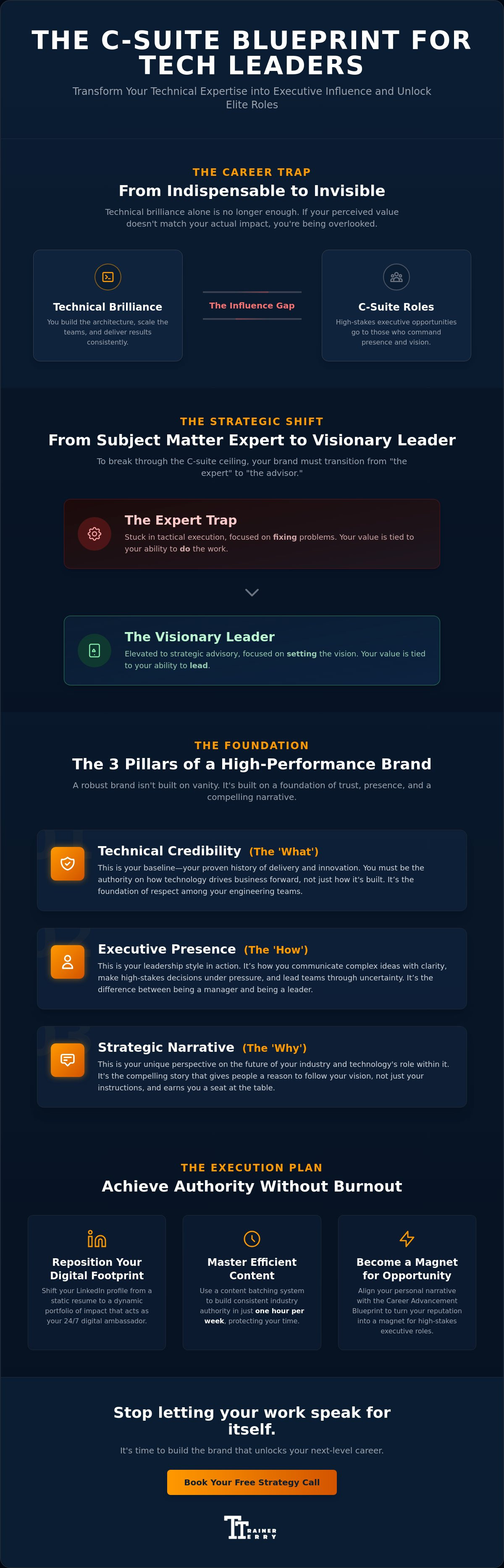
A high-performance brand isn't built on vanity metrics or viral posts. It's built on a foundation of trust and authority. For an elite personal branding strategy for tech leaders, you must master three specific pillars. These pillars work together to transform you from a technical manager into a strategic asset. Without this structure, your efforts will just be noise. When you align these pillars, you create the momentum needed for the Career Advancement Blueprint to take full effect.
- Pillar 1: Technical Credibility (The 'What'). This is your baseline. It's your history of delivery and innovation. You don't need to be the person writing the code, but you must be the authority on how that code drives the business forward.
- Pillar 2: Executive Presence (The 'How'). This is your leadership style. It covers how you communicate, how you make high-stakes decisions, and how you lead teams through uncertainty. It's the difference between being a boss and being a leader.
- Pillar 3: Strategic Narrative (The 'Why'). This is your unique perspective. It’s your take on the future of technology and how it will reshape your industry. It gives people a reason to follow your vision, not just your instructions.
Developing Your Career Narrative
Stop presenting a list of technologies. Nobody in the C-suite cares about your proficiency in specific frameworks. They care about business transformation. Your career narrative should focus on the outcomes you've engineered. Start by identifying your Signature Problem. This is the specific, high-value challenge that you are the best in the world at solving. Are you the leader who rescues failing digital transformations? Or the one who scales engineering cultures from 10 to 500? Once you know this, write your leadership thesis. It should be a single, punchy sentence that acts as your brand North Star. For example: "I build resilient engineering organizations that turn technical debt into competitive market advantages."
Cultivating Executive Presence for Tech Leaders
You must bridge the gap between the server room and the boardroom. Most tech leaders fail here because they speak "technical" to people who speak "business." Executive presence is about translation. You need to stop talking about technical risk and start talking about business opportunity or financial exposure. When you frame a security patch as "protecting $50M in quarterly revenue," the board listens. This level of leadership communication is a skill you can develop. If you're struggling to articulate your value at this level, it might be time to book a free strategy call to refine your executive positioning.
Your presence is also defined by your decisiveness. In 2026, the market moves too fast for hesitation. High-performance leaders use their technical depth to inform fast, confident decisions that others are too afraid to make. That confidence is what commands authority and unlocks elite opportunities.
Audit Your Digital Footprint: LinkedIn and Beyond
Your digital footprint isn't a trophy case. It's a dynamic engine that either accelerates your career or acts as a drag on your progress. In 2026, LinkedIn has evolved into the "operating system" of professional reputation. If your profile still looks like a digital resume, you’re losing. You must transition to a "Portfolio of Impact" profile. This means moving away from a list of responsibilities and toward a documented history of business transformation. A robust personal branding strategy for tech leaders demands that every pixel on your screen serves a strategic purpose.
While LinkedIn is the primary hub, secondary platforms provide the evidence. Use GitHub to anchor your technical depth; it proves you still understand the "how." Use platforms like Medium or Substack to showcase your "why" through thought leadership. This multi-channel approach ensures that when a board member or VC Googles your name, they see a cohesive, high-authority leader. For a step-by-step tactical setup, check out the How to Use LinkedIn in 2026 guide.
LinkedIn Positioning for the C-Suite
Your headline is your billboard. Don't waste it on a job title. Instead, focus on the future value you provide. A headline like "VP of Engineering at TechCorp" is passive. A headline like "Scaling Global Engineering Teams for $500M+ Market Leaders | VP of Engineering" is active. It tells the reader exactly what problem you solve. Your 'About' section should follow this lead. It’s your executive summary. Use it to tell your story, highlight your biggest wins, and include a clear call to action. Finally, curate your recommendations. High-value testimonials should validate your leadership, strategic vision, and ability to drive revenue, not just your ability to debug code.
Measuring Your Digital Authority
Stop chasing vanity metrics. A thousand likes from people who can't hire you is a waste of energy. In 2026, authority is measured by who is engaging with you. Check your profile views. Are you seeing titles like "Managing Director," "Board Member," or "Partner"? If not, your content isn't hitting the mark. The ultimate metric is the "Inbound Opportunity" test. If your inbox isn't regularly filled with high-stakes executive roles or advisory requests, your brand isn't working hard enough. Use these insights to fuel your Career Positioning Strategy. Real authority translates into direct access to elite opportunities.
- Quality over Quantity: Ten views from C-suite executives are worth more than ten thousand from entry-level peers.
- The Google Test: Search your name in an incognito window. Do you like what you see?
- Evidence-Based Branding: Back up every claim with a link, a repo, or a testimonial.
5 Steps to Execute Your Strategy Without Burning Out
Execution is the graveyard of good intentions. You don't need more work on your plate; you need a high-leverage system. A successful personal branding strategy for tech leaders isn't a full-time job. It’s a series of disciplined habits that turn your expertise into industry authority. Follow these five steps to build your brand without sacrificing your technical output or your sanity.
- Step 1: Define your target audience. Stop trying to impress everyone. Are you talking to VCs for your next round, board members for a C-suite seat, or elite talent you want to hire? Pick your target and speak only to them.
- Step 2: Content Batching. Dedicate exactly 60 minutes a week to draft your insights. Use this time to write three punchy posts. Schedule them. You’re done for the week.
- Step 3: Strategic Networking. Move beyond "connecting." Build high-stakes alliances with three to five key industry peers who can advocate for you in closed-door sessions.
- Step 4: Public Speaking and Industry Contributions. Validating your brand off-platform is essential. One keynote or one guest appearance on a top-tier tech podcast is worth a hundred generic LinkedIn posts.
- Step 5: Iterative Refinement. Your brand must evolve. The narrative that got you to Director won't get you to CTO. Review your positioning every six months to ensure it reflects your current level of influence.
Content Strategy for the Time-Poor Leader
You don't have to be a professional writer. Use the "Curate, Don't Create" method. Share a relevant industry report and add two sentences on why it matters to the bottom line. Share "Lessons from the Trenches." People trust scars more than trophies. A story about a failed deployment and the three things you learned builds more credibility than a generic win. If you need a sounding board for these stories, you can schedule a session here to refine your message.
The STAR Method in Branding
The same logic that wins interviews wins at branding. Use the STAR Method to structure your social posts and bio entries. Situation, Task, Action, Result. This framework keeps your content focused and results-oriented. Quantify everything. Don't say you "improved performance." Say you "reduced system latency by 35% while cutting infrastructure costs by $200k annually." Apply this to your LinkedIn "Featured" section to give visitors immediate, undeniable proof of your impact. If you’re ready to stop guessing and start executing, book a free strategy call to map out your executive positioning.
Scaling Your Impact with the Career Advancement Blueprint
Visibility is not the goal. Impact is. You can have thousands of followers and still be stuck in a mid-level role. A brand without a strategy is just noise. To win in 2026, your reputation must be an engine for growth. This is where the Career Advancement Blueprint becomes your unfair advantage. It integrates your personal branding strategy for tech leaders directly into a structured plan for promotion or transition. It’s the difference between being "seen" and being "hired."
My methodology bridges the gap between digital presence and real-world authority. We don't build brands for vanity. We build them for leverage. When your brand is aligned with your goals, you stop chasing opportunities. They start chasing you. It’s about creating a narrative so compelling that your next move feels like a natural progression, not a desperate leap. You’ve done the hard work of building technical depth. Now, let’s make sure the market pays you what you’re worth.
Internal Advancement and Promotion Strategy
Don't wait for a performance review to prove your worth. Use your external brand to influence internal stakeholders today. When your CEO sees you quoted in industry publications or leading critical discussions on LinkedIn, your internal stock rises. You become the obvious choice for the next leadership opening because your authority is already validated by the market. For a deep dive into promotion planning, refer to the Career Advice 2026 pillar. Stop being "just the tech guy" and start being the strategic leader your company can't afford to lose.
Ready for a Career Change?
The standard application process is broken for executives. In 2026, the best roles aren't found on job boards. They are filled through referral and reputation. A strong personal branding strategy for tech leaders short-circuits the traditional path. It allows you to enter high-stakes conversations with built-in trust. Headhunters and peers should already know your name before you ever hit "apply."
Reputation is your most valuable asset. If your current path has hit a ceiling, it's time to change the game. Book your Free Strategy Call now to build your 2026 roadmap. Strategy is useless without execution. Let's get to work and turn your technical expertise into executive power.
- Strategic Alignment: Every post and every meeting must serve your ultimate career goal.
- Proof of Concept: Use your brand to show, not just tell, what you are capable of delivering.
- Decisive Action: The market rewards those who move fast and lead with confidence.
Command Your Future: The Time for Strategy is Now
Your technical expertise built your career; now your brand must scale it. We've covered how to move from being the smartest person in the room to being the visionary leader the board trusts. By mastering the three pillars of credibility, presence, and narrative, you transform your reputation into a high-leverage asset. Remember, in 2026, a static resume is a liability. You need a portfolio of impact that works while you sleep.
Executing a personal branding strategy for tech leaders shouldn't be a burden. It’s about using the right systems to amplify your value without burnout. Terry Jones brings over 20 years of experience as a former Corporate VP to help you navigate these high-stakes transitions. Using the proven "Career Change Blueprint" methodology, we specialize in positioning tech executives for the elite roles they deserve. Don't leave your next promotion to chance.
Take the first step toward your next breakthrough. Secure your next leadership role with a Free Strategy Call. You have the skills; it's time to make sure the world knows it. Let's build your roadmap together.
Frequently Asked Questions
Is personal branding for tech leaders just self-promotion?
No, it's a strategic operating system for your professional reputation. Self-promotion is about "me," but a personal branding strategy for tech leaders is about "value." It signals to the market that you solve high-stakes problems. Think of it as documenting your leadership thesis so the right opportunities find you without you having to hunt them down.
How much time does a personal branding strategy actually take?
You can maintain a high-authority presence in just 60 minutes a week. Most leaders fail because they think they need to be on social media all day. By using a content batching system, you draft your insights once and schedule them. This protects your time for high-level technical execution while ensuring your digital footprint stays active and relevant 24/7.
Should I share my technical failures as part of my brand?
Yes, because people trust scars more than trophies in 2026. Sharing a failed deployment or a project that went sideways shows professional maturity and resilience. It proves you've faced technical risk and learned how to mitigate it. These "lessons from the trenches" build far more credibility with board members and VCs than a sanitized list of wins ever could.
How do I balance my personal brand with my company's brand?
Your brand should complement your employer's goals while remaining independent. You are a representative of your company, but your reputation is your own asset. Focus on industry-wide problems and leadership philosophies that align with your current mission. This creates a win-win where your authority elevates the company's status while securing your own career resilience.
Do I need to be on every social media platform to have a brand?
Absolutely not. Focus on the platforms where your target audience lives. For most tech executives, LinkedIn is the primary "operating system" for professional networking. You might add GitHub for technical proof or a Substack for deeper thought leadership, but trying to be everywhere leads to burnout. Master one high-leverage channel before even considering another.
Can an introvert successfully build a personal brand in tech?
Yes, because branding is about expertise, not extroversion. You don't need to be loud; you need to be insightful. Many of the most successful tech leaders are introverts who build authority through written content, data storytelling, and strategic networking. A quiet, consistent voice that solves complex problems often carries more weight in the boardroom than a loud influencer.
What is the #1 mistake tech leaders make with their LinkedIn profiles?
Treating your profile like a static resume instead of a dynamic portfolio of impact is the biggest error. Most leaders list their responsibilities like a job description. Instead, you must quantify your results and articulate your future value. Your profile shouldn't just say what you did; it should explain the business transformation you’re capable of leading next.
How do I know if my personal branding strategy is working?
Look at the quality of your inbound opportunities. If recruiters, VCs, or peers are reaching out with high-stakes roles that match your goals, your strategy is working. You'll also notice a shift in how you’re perceived internally. When you become the "obvious choice" for strategic advisory roles, you know your brand has successfully bridged the gap between technical depth and executive presence.

Article by
Terry Jones
Terry Jones is the Founder and Chief Career Strategist of the Career Advancement Blueprint and Executive Coach and Lead Consultant at FireBridge Consulting.
As an ICF Certified Accredited Career Coach and Certified Master Career Services professional, he partners with professionals at all levels, including senior leaders and executives, to navigate career transitions, secure new opportunities, and position themselves for advancement. His approach goes beyond surface level coaching, focusing on how individuals think, communicate, and lead so they can operate with clarity, authority, and strategic intent in high stakes environments.
In his work as an executive coach, Terry engages in high impact advisory conversations that help leaders strengthen decision making, elevate their presence, and align their leadership style with organizational expectations. He is known for helping clients translate their experience into influence, ensuring they are not only seen for what they have done, but trusted for what they are capable of leading next.
With over 20 years of corporate experience, including serving as a Vice President and leading Learning and Development functions for three New York City organizations, Terry brings a deep understanding of how companies evaluate talent, develop leaders, and make promotion decisions. This allows him to bridge the gap between individual ambition and organizational reality.
His insights have reached over 630,000 followers and generated more than 70 million video views, where he shares direct, experience driven guidance that helps professionals think differently and take action.