LinkedIn Summary Examples for Senior Executives: The 2026 Narrative Strategy

Stop treating your LinkedIn About section like a digital filing cabinet for your old resumes. In 2026, with over 1.2 billion members on the platform, searching for generic linkedin summary examples for senior executives won't help you stand out. You've spent two decades building a legacy, yet your current profile likely makes you look like just another manager hunting for a paycheck. It's frustrating to have massive career wins that nobody notices because you're struggling to articulate your value. You need a profile that commands C-suite attention without looking like you're desperately job hunting.
I understand that it's difficult to translate complex leadership skills into a narrative that justifies a premium salary. This guide will show you how to transform your summary from a boring recap into a strategic signal of your future trajectory. We'll analyze proven narrative strategies that leverage the 2026 algorithm shifts toward authority and expertise. You'll walk away with a clear personal brand strategy and the confidence to own your digital executive presence.
Key Takeaways
- Learn how to treat your profile as a "digital lobby" that signals your future leadership trajectory rather than just documenting your past.
- Explore high-performance linkedin summary examples for senior executives to identify which narrative framework best fits your current career stage and goals.
- Master the 5-step process to audit your signature wins and articulate a clear vision statement that solves high-stakes problems.
- Discover how to align your summary with your Featured and Experience sections to build a cohesive brand that commands C-suite attention.
- Shift your digital presence from a passive resume to a proactive leadership narrative that attracts board-level and high-value inquiries.
The Digital Lobby: Why Executive LinkedIn Summaries Matter in 2026
Think of your LinkedIn profile as a physical space. It's the digital lobby of your professional life. This is the first room an investor, a CEO, or a board member enters before they ever shake your hand or hear your pitch. If that room is cluttered with old bullet points and generic buzzwords, they'll leave before the conversation begins. By 2026, the game has changed entirely. With LinkedIn surpassing 1.2 billion members, simply existing on the platform isn't enough. You must command it.
Your summary has to exceed your resume. A resume is a historical document that looks backward at what you did; a strategic summary looks forward at what you'll solve. Studying the best linkedin summary examples for senior executives reveals a common thread: they don't just recap the past. They articulate a personal branding strategy that justifies a seat at the table. The 2026 algorithm now prioritizes "Topic DNA" and expertise over viral fluff. If your narrative doesn't scream authority, the system won't even show your profile to the decision-makers who matter most.
The hidden job market now runs on narrative cues. Executive search firms use AI to scan for specific leadership signals and vision statements, not just keywords. In this environment, your "Executive Presence" is the primary ranking factor. It's the difference between being a commodity and being a category of one. You aren't just looking for a job. You're positioning yourself as the only logical solution to a high-stakes problem.
The ROI of a High-Performance Profile
A strategic summary shortens the trust cycle for board-level appointments. When your narrative is clear, it removes the friction of doubt. This clarity directly impacts your negotiation leverage. Executives with a defined digital presence often secure higher salary benchmarks because their value is proven before the first interview. To master this transition, you need a structured approach like our Career Advancement Blueprint, which aligns your digital footprint with your actual leadership impact. Stop leaving your reputation to chance. Own the narrative and the results will follow.
Common Executive Pitfalls to Avoid
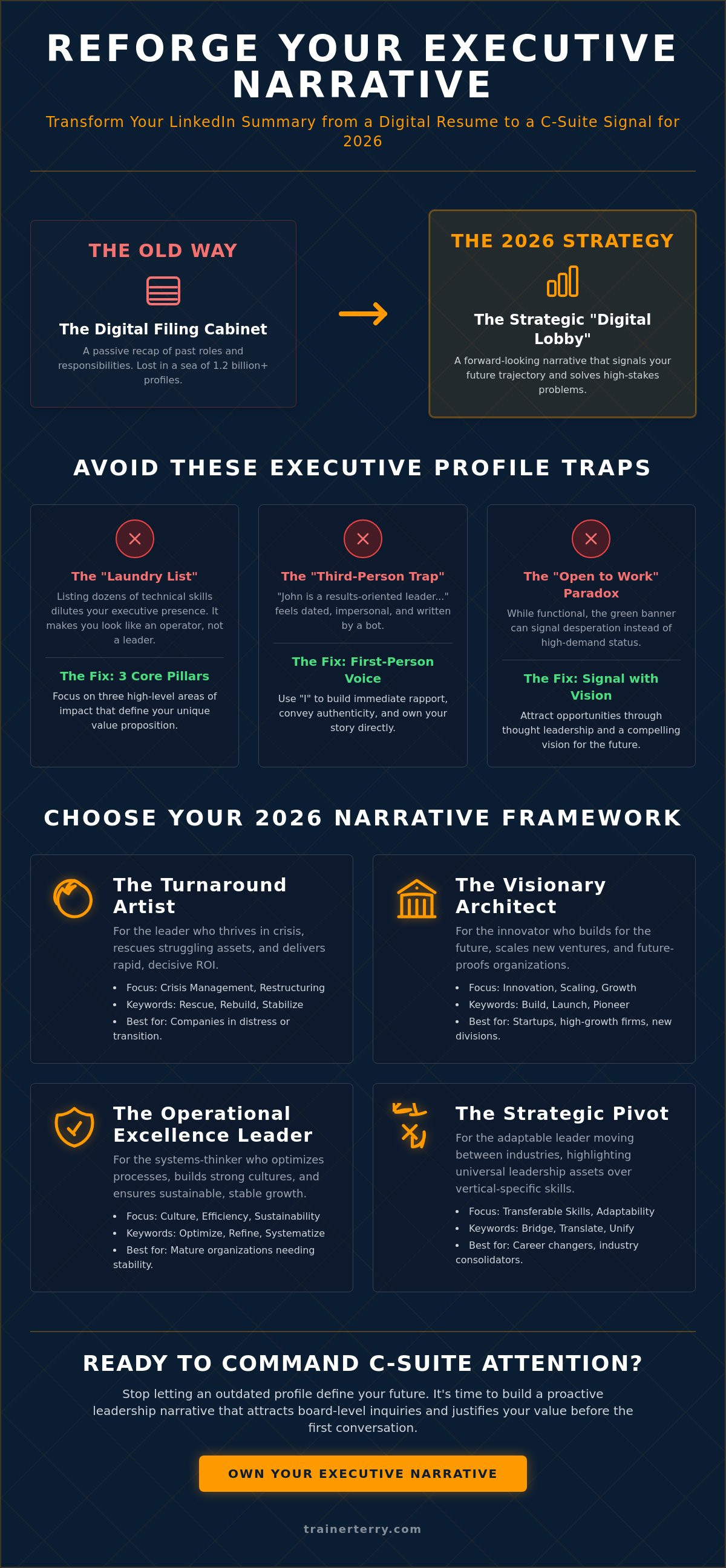
Don't fall into the "Laundry List" error. Listing 50 technical skills kills your executive presence. It makes you look like a tool, not the person who wields the tool. Focus on three core pillars of impact instead. Another major mistake is the "Third-Person Trap." Writing "John is a results-oriented leader" feels dated and disconnected in 2026. It sounds like a corporate bot wrote it. Use the first person to build immediate rapport. Finally, be wary of the "Open to Work" paradox. You want to signal availability through vision and thought leadership, not through a badge that suggests desperation. High-value leaders are always "in demand," never just "available."
The 4 Executive Narrative Frameworks for 2026
You can't just throw a list of achievements at a screen and hope they stick. To stand out in a sea of 10 million C-level peers, you need a story archetype. A narrative framework acts as the skeletal structure of your profile; it gives your career wins a sense of direction and purpose. Without one, you're just a collection of data points. With one, you become a strategic solution. When you look at high-performing linkedin summary examples for senior executives, you'll notice they all follow a specific "DNA" that aligns with their future goals.
There are four primary frameworks that dominate the executive landscape in 2026:
- The Turnaround Artist: This is for the leader who thrives in high-pressure environments. Your narrative focuses on crisis management, rapid ROI, and the "firefighter" mentality. You don't just manage; you rescue and rebuild.
- The Visionary Architect: Use this if your strength lies in innovation and scaling. You focus on future-proofing organizations and building the infrastructure for the next decade of growth.
- The Operational Excellence Leader: This archetype centers on culture, efficiency, and sustainable systems. You're the one who ensures that growth doesn't come at the cost of stability or employee well-being.
- The Strategic Pivot: Essential for those moving between industries. This framework highlights transferable leadership assets, proving that your ability to lead is a universal currency that works regardless of the vertical.
Choosing Your Framework Based on Career Goals
Your archetype must align with your target company's current pain points. If a firm is restructuring, they don't want a "Visionary Architect"; they need a "Turnaround Artist." We use this alignment as a core part of our Career Advancement Blueprint to ensure your profile isn't just "good," but specifically relevant to the role you want next. If you're struggling to identify your primary archetype, it might be time to schedule a strategy call to map out your leadership narrative.
The Anatomy of an Executive Hook
The "Hook" is the specific string of text consisting of the first three lines of your summary that appear before a user has to click the "See More" button. In 2026, you have roughly 210 characters to stop the scroll of a busy CEO. A great hook doesn't just state your title; it offers a "Double-Whammy" by combining a massive metric with a core leadership philosophy. For example, a Turnaround Artist might open with: "I've recovered $400M in lost revenue by treating operational friction as a cultural problem, not just a technical one." This tells the reader exactly what you do, how well you do it, and why you do it. Crafting a great LinkedIn summary starts with this immediate value proposition. It forces the reader to engage with your expertise before they even see your job history.
Analyzing High-Performance Executive LinkedIn Examples
Generic templates won't cut it when you're playing for seven figure stakes. To truly understand what works, we have to look at the anatomy of profiles that actually convert. Effective linkedin summary examples for senior executives in 2026 all share a common trait: they replace vague adjectives with high-velocity evidence. Whether you're a Growth-Stage CEO or a Fortune 500 VP, your narrative must prove you can handle the scale of the problems your target organization faces.
A Growth-Stage CEO summary should read like a pitch deck. It focuses on fundraising milestones, market capture, and capital efficiency. In 2026, investors look for leaders who can scale without burning through cash. Conversely, a Fortune 500 VP needs a narrative centered on cross-functional alignment and managing complex stakeholder ecosystems. If your goal is to advance to the C-suite, your summary must bridge the gap between operational excellence and long-term board strategy. Even for Non-Profit Executives, the tone has shifted. It's no longer just about "mission"; it's about measurable advocacy and policy influence that creates systemic change.
Framework Comparison: What Works and Why
The difference between a "good" profile and a "high-performance" profile often comes down to the archetype you choose. Modern tech environments currently favor the "Scale-Up" archetype because it signals velocity. Meanwhile, HR and Operations leaders are finding massive success with the "Culture Champion" framework, as retention and internal talent development have become top-tier business metrics.
- Senior Director (Generic): "Experienced leader with 15 years in finance and team management."
- Senior Director (Strategic): "Architect of $50M cost-saving initiatives across EMEA, specializing in lean financial restructuring."
Deconstructing the 'Proof' Paragraph
You don't need to violate NDAs to show your worth. Instead of quoting exact revenue numbers that might be sensitive, focus on percentages, relative growth, or the complexity of the turnaround. You aren't a ledger; you're the engine that drives the numbers. Use the STAR method to condense your biggest wins into two punchy sentences. State the Situation, the Task you faced, the Action you took, and the Result you delivered. This approach keeps your summary lean and prevents it from becoming a wall of text. It forces the reader to acknowledge your impact immediately, leaving no room for doubt about your leadership capacity.
The 5-Step Executive Summary Writing Process
Stop guessing what recruiters want to see. A high-stakes career requires a structured drafting method, not a "best guess" approach. When you study the best linkedin summary examples for senior executives, you'll see they aren't written in one sitting; they're engineered through a specific, repeatable process. You've done the hard work of building a career. Now, you must do the strategic work of communicating it.
- Step 1: Audit your 'Signature Wins'. Don't just list every project you've ever touched. Select the three most impactful wins that align directly with your 2026 career target. If you're aiming for a Board seat, focus on governance and long-term fiscal oversight.
- Step 2: Draft your 'Vision Statement'. What is the one specific problem that only you can solve? This is your unique value proposition. It needs to be punchy and undeniable.
- Step 3: Integrate the 'Human Element'. This is where you weave in your leadership philosophy. Why do you lead the way you do? This builds the "dwell time" that the 2026 algorithm loves.
- Step 4: SEO Optimization. Incorporate "intent-based" keywords. Don't just use generic titles; use the terms executive recruiters actually type into their search bars, like "M&A Integration" or "Digital Transformation Lead."
- Step 5: Define the Call to Action (CTA). Tell the reader exactly what to do next. Whether it's a Board inquiry, a speaking request, or a networking invitation, don't leave them wondering how to reach you.
The 'Human-to-Metric' Ratio
In 2026, the sweet spot for executive profiles is the 70/30 rule. This means 70% of your summary focuses on hard results and metrics, while 30% focuses on your philosophy and EQ. You must talk about "soft skills" like empathy and emotional intelligence as strategic business drivers. These aren't just "nice to have" traits; they're the assets that prevent turnover and drive high-performance cultures. Your career narrative should connect your disparate roles into a single, logical progression that makes your next move feel inevitable.
AI Proofing Your Summary
You can use AI for brainstorming, but don't let it write your final draft. AI often produces "corporate-speak" that feels hollow and lacks executive presence. Use the "Un-Bot" test: read your summary aloud. If it sounds like something a generic bot would say, start over. Your voice is your most valuable asset. Ready to stop blending in? If you want a profile that actually works, schedule a free strategy call to optimize your executive positioning today.
Positioning for the C-Suite: Beyond the Summary
A high-stakes summary is your engine, but it won't get you far if the rest of your profile is stalled. Total alignment is non-negotiable. If your summary positions you as a "Visionary Architect," your Featured section must provide the blueprints. Your Experience descriptions shouldn't just repeat your resume; they should validate the narrative you've established. When you analyze the best linkedin summary examples for senior executives, you'll see a seamless thread from the first line of the About section to the last recommendation. This consistency is what builds the authority needed to command a premium salary.
Executive presence isn't a passive trait; it's an active engagement strategy. Only 3% of LinkedIn users post more than once a week, which gives you a massive visibility advantage if you share substantive insights. Your activity, including the posts you like, the comments you write, and the content you share, must reinforce your "Topic DNA." Every interaction is a signal to the 180 million senior-level executives on the platform that you are a thought leader, not just a spectator. This integrated approach is the foundation of our Career Advancement Blueprint. It's about building a digital legacy that works for you even when you're offline.
Strategic Networking for Leaders
Your updated summary acts as a "warm" entry point for high-level outreach. When you reach out to a peer or a board member, they'll check your profile immediately. A sharp, results-driven narrative makes that first impression for you. If you're unsure if your positioning is hitting the mark, don't leave it to guesswork. Leverage our Office Hours for immediate, expert feedback on your linkedin summary examples for senior executives. It's a chance to refine your narrative before you take it to the market. Stop wondering if your profile is effective and start knowing it is.
Next Steps: From Profile to Promotion
The transition from a winning profile to a winning interview is where most leaders stumble. You've used the STAR method in your summary; now you must bring those stories to life in the boardroom. A great profile gets you the meeting, but your ability to articulate that value face-to-face closes the deal. Even after you secure the role, maintain a "maintenance" mindset. Your profile is a living document of your leadership legacy. It should evolve as your impact grows. Don't let your digital presence stagnate once you've reached the top. Ready to own your trajectory? Book your 1:1 Executive Strategy Session today and let's turn your digital presence into your greatest career asset.
Own Your Leadership Narrative
Your LinkedIn profile isn't just a placeholder; it's the most powerful tool in your executive arsenal. You've learned how to treat your About section as a digital lobby and why choosing the right narrative framework is essential for 2026. By analyzing high-performance linkedin summary examples for senior executives, you now have the blueprint to move beyond a boring resume recap. It's time to stop being invisible and start commanding the attention your career wins deserve.
I've spent over 20 years as a Corporate VP, and I've seen firsthand how the right positioning opens doors to the boardrooms you want to enter. As the creator of the Career Change Blueprint, I specialize in the STAR method and strategic executive presence. Don't let another high-value inquiry pass you by because your profile looks like you're still hunting for a mid-level role. Take the lead today and transform your digital footprint into a high-stakes leadership signal.
Secure your C-suite future with a Free Strategy Call
The next chapter of your leadership legacy starts with a single, strategic decision. You've got the experience; now let's make sure the world sees it. Let's build it together.
Frequently Asked Questions
How long should a senior executive LinkedIn summary be in 2026?
Aim for a length that maximizes the 2,600-character limit without adding fluff. You want to provide enough substance to increase "dwell time" for the algorithm while keeping the reader engaged. Most high-performance linkedin summary examples for senior executives use 300 to 500 words to tell a complete story. Focus on making those first 210 characters count so the reader actually clicks the "See more" link.
Should I write my LinkedIn summary in the first or third person?
Always write in the first person. Using "I" builds immediate rapport and signals that you're an accessible, modern leader. Third-person narratives feel like a disconnected corporate press release and can actually hurt your executive presence. In 2026, authenticity is the primary currency for trust, so speak directly to your audience as if you're already in the room with them.
How many keywords should I include in my executive summary?
Focus on five to seven intent-based keywords that reflect your specific leadership DNA. Don't engage in keyword stuffing, as the 2026 AI-driven algorithm now prioritizes context and authority over simple word counts. Integrate these terms naturally into your "Signature Wins" and your "Vision Statement." This ensures you rank for executive searches without losing your unique professional voice.
Is it okay to mention personal interests in a C-suite LinkedIn profile?
Yes, personal interests add a human element that helps you stand out from generic corporate profiles. Use the 70/30 rule mentioned earlier: 70% results and 30% philosophy or personal story. Mentioning interests like endurance sports or board service can signal discipline and community commitment. Just ensure every personal detail reinforces your overall leadership narrative and doesn't distract from your core value.
How often should an executive update their LinkedIn summary?
Audit your profile every six months or immediately following a significant career milestone. Your summary is a living document of your leadership legacy, not a static archive. Regular updates ensure your narrative stays aligned with current market demands and your own professional growth. If you wait until you're job hunting to update it, you'll look reactive rather than proactive.
What is the best way to handle a career gap in an executive summary?
Frame the gap as a strategic choice for professional or personal development. Don't apologize for time away; instead, highlight any consulting, advisory work, or specialized training you completed during that period. Focus on the value you gained and how it makes you a more effective leader today. A gap is only a weakness if you fail to give it a purposeful narrative.
Can I use bullet points in my LinkedIn 'About' section?
Use bullet points to break up your "Signature Wins" and make your impact easy to scan. Large walls of text are the fastest way to lose a busy CEO's attention. Keep your bullets concise and results-focused, using the STAR method to show the direct outcome of your actions. This creates a clean, professional look that respects the reader's time and improves readability.
How do I show 'Executive Presence' through text alone?
Demonstrate executive presence by using strong, active verbs and eliminating weak qualifiers like "I think" or "I helped." Focus on the high-stakes problems you solve and the vision you have for your industry. When you review linkedin summary examples for senior executives, notice how the best ones project confidence through clarity and specific metrics. Own your results without sounding arrogant or desperate.
Article by
Terry Jones
Terry Jones is the Founder and Chief Career Strategist of the Career Advancement Blueprint and Executive Coach and Lead Consultant at FireBridge Consulting.
As an ICF Certified Accredited Career Coach and Certified Master Career Services professional, he partners with professionals at all levels, including senior leaders and executives, to navigate career transitions, secure new opportunities, and position themselves for advancement. His approach goes beyond surface level coaching, focusing on how individuals think, communicate, and lead so they can operate with clarity, authority, and strategic intent in high stakes environments.
In his work as an executive coach, Terry engages in high impact advisory conversations that help leaders strengthen decision making, elevate their presence, and align their leadership style with organizational expectations. He is known for helping clients translate their experience into influence, ensuring they are not only seen for what they have done, but trusted for what they are capable of leading next.
With over 20 years of corporate experience, including serving as a Vice President and leading Learning and Development functions for three New York City organizations, Terry brings a deep understanding of how companies evaluate talent, develop leaders, and make promotion decisions. This allows him to bridge the gap between individual ambition and organizational reality.
His insights have reached over 630,000 followers and generated more than 70 million video views, where he shares direct, experience driven guidance that helps professionals think differently and take action.