How to Address a Career Gap on Your Resume: Strategic Moves for 2026

What if the "missing" months on your timeline weren't a liability, but your strongest selling point? In 2026, 47% of workers have experienced a career break, yet many still feel a deep anxiety about how to address a career gap on your resume. You probably worry that automated screening systems will toss your application aside or that hiring managers will see you as "outdated." It is a common fear; it is also a massive opportunity to stand out.
We agree that the traditional job market can feel rigged against anyone who doesn't follow a perfectly linear path. This article promises to change that. You will learn how to transform that employment gap into a strategic asset that proves your leadership maturity and intentionality. We are moving beyond excuses and into high-level positioning.
We will break down the exact resume structures that pass ATS filters despite gaps. You will also get a clear plan to build a narrative that commands respect during interviews. It is time to stop hiding your history and start using it to re-enter the workforce at a high level.
Key Takeaways
- Stop viewing your time off as a liability and start framing it as a strategic pivot that demonstrates leadership maturity.
- Master the hybrid resume layout to lead with your high-impact skills while keeping your professional timeline clean and ATS-friendly.
- Learn exactly how to address a career gap on your resume by developing a confident 30-second script that connects your break to your future goals.
- Leverage LinkedIn’s "Career Break" feature with keyword-rich descriptions to ensure your profile stays visible and professional during transitions.
- Discover why a career gap can actually be an executive secret weapon, signaling financial literacy and a fresh perspective to top-tier employers.
Redefining the Career Gap: Why the Narrative Matters in 2026
Stop thinking of your break as a hole in your history. It is time to drop the "unemployed" label and start seeing your time away as a strategic pause. In 2026, the corporate world has shifted away from the old "gold watch" mentality. If you are currently figuring out how to address a career gap on your resume, the first step is a mental shift. You haven't just been sitting still; you've been in a phase of professional evolution. Whether you were caregiving, upskilling, or traveling, that time has shaped your perspective in ways a standard office job never could.
Trying to hide a gap is a high-risk strategy that almost always backfires. Executive recruiters in 2026 have seen every trick in the book. If they spot an unexplained timeline, they don't just wonder what you were doing; they wonder if you are hiding a lack of discipline or a performance issue. This erodes trust before you even get a chance to speak. A deep dive into understanding the modern résumé shows that while formats change, the need for a transparent, cohesive story remains constant. Own your path. When you lead with authority, you turn a potential question mark into a statement of confidence.
The 'New Normal' of Non-Linear Careers
Corporate culture in 2026 finally values diverse life experiences. High performers now regularly take sabbaticals to prevent burnout or "upskilling pauses" to master emerging technologies. These aren't signs of weakness anymore. They are the marks of a professional who manages their career like a high-growth business. If you've taken time off, you likely have a broader perspective and a refreshed drive that "desk-lifers" simply lack. Transparency isn't just about being honest. It is the foundation of your executive presence. If you need to refine how this looks for your specific situation, you can schedule a strategy call to align your history with your future goals.
ATS vs. Human Perception
Modern Applicant Tracking Systems are smarter than they used to be. By mid-2026, most ATS platforms are programmed to recognize skills-first hiring patterns, but they still flag significant date gaps if the narrative is missing. When a human eventually reviews your file, their first impression is purely psychological. They want to see intentionality. If your resume doesn't bridge that gap immediately, the reader will fill in the blanks with their own assumptions. You have to learn how to address a career gap on your resume by taking control of that story from the very first line. Don't wait for them to ask the question; answer it with a narrative of growth and readiness.
Strategic Resume Layouts to Bridge the Employment Gap
Your resume layout isn't just a container for your history; it's a marketing tool. In 2026, the standard chronological format is often the worst choice for someone returning to the workforce. It shines a spotlight on the very dates you're worried about. Instead, you need a layout that prioritizes your expertise. Choosing the right framework is the most effective way to manage how to address a career gap on your resume without sounding defensive. You want the recruiter to see your value before they ever notice a date.
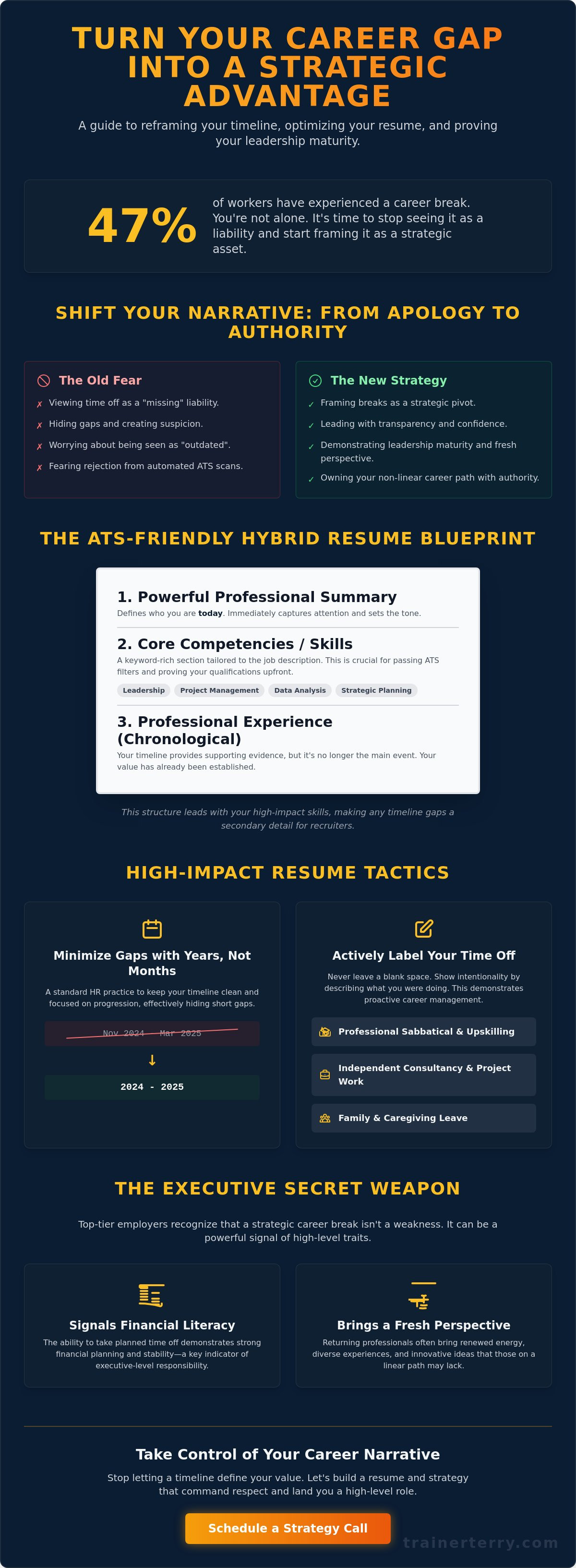
One of the most effective moves is to use years instead of months for your roles. If you left a position in November 2024 and started a new one in March 2025, listing only the years (2024, 2025) completely eliminates the appearance of a gap. This is a standard HR practice in 2026 for older roles. It keeps the document clean and focused on your progression. If you're struggling with the technical side of this, our Resume Strategy and Executive Resume Development services can help you build a high-performance document that passes every test.
The Hybrid Resume Framework
The Hybrid (or Combination) format is your secret weapon. It starts with a powerful Professional Summary that defines who you are today, not who you were five years ago. Directly below that, you'll place a "Core Competencies" section. This area should be packed with high-impact keywords that match the job description. By the time the reader reaches your chronological history, you've already proven you're a top-tier candidate. This structure ensures that your skills overshadow any timeline pauses. It’s about leading with your strengths and letting the dates provide the supporting evidence.
Filling the Gap with Active Value
Never leave a blank space on your timeline. If you weren't in a traditional role, you were still active. Create an entry labeled "Professional Sabbatical" or "Consultancy" to fill the gap. Under this heading, list freelance projects, pro-bono work, or even board memberships. Even if these weren't your primary focus, they show you remained engaged with your industry. If you spent the time learning, frame your continuing education and certifications as a full-time commitment to professional evolution.
When you're figuring out how to explain employment gaps, remember that brevity is your friend. You can define your gap in a single, punchy sentence: "Dedicated 12 months to a period of intensive leadership development and strategic upskilling." This tells the recruiter that the time off was a choice, not an accident. If you want to ensure your narrative is bulletproof before your next big talk, consider our High-level Interview Strategy to practice your delivery.
Crafting Your Career Narrative: From Apology to Authority
Stop apologizing for your timeline. When you explain a break with hesitation, you signal to recruiters that you're a "risky hire." In 2026, authority comes from intentionality. You need to identify the "Transferable Growth" you achieved while away from the traditional 9-to-5. If you're wondering how to address a career gap on your resume, the answer lies in your ability to connect your past to their future. You aren't just returning; you're arriving with a fresh perspective that makes you a more sustainable leader. Own your story. Recruiters value resilience. They want to see that you didn't just "take time off" but that you invested in yourself. This isn't about spin; it's about accurate professional positioning.
Maintain your professional boundaries. You don't owe anyone a deep dive into your personal life. Over-explaining personal details erodes your executive presence and makes you look defensive. Instead, position the gap as a recharging phase. It proves you understand that peak performance requires periods of recovery. You are coming back with more focus and higher energy than someone who has been grinding on autopilot for a decade.
The Three-Part Narrative Pivot
Success requires a scripted, confident response. Use this three-step framework to bridge the gap during networking or initial screenings:
- Step 1: The Brief Reason (The 'Why'). Keep it high-level and neutral. "I took a strategic pause to manage a family transition."
- Step 2: The Growth Activity (The 'What'). What did you do to stay sharp? "During this time, I completed an executive leadership program and consulted for two startups."
- Step 3: The Re-entry Readiness (The 'So What'). Why are you the right choice now? "With those projects successfully closed, I'm now fully focused on applying these sharpened strategic skills to a high-impact role."
This structure moves the conversation from your past to your current value. Our Career Narrative Development program specializes in refining these scripts for senior professionals who need to command the room.
Addressing Specific Gap Scenarios
If you were caregiving, frame it as "Operations and Logistics Management." You managed complex schedules, budgets, and stakeholders under high pressure. If you traveled, you gained "Global Market Exposure and Cultural Competency." You weren't just a tourist; you were observing international business trends and expanding your adaptability. Health-related gaps require professional brevity. Use phrases like "I took time to resolve a medical matter and have since made a full recovery." This signals you're ready for the intensity of a high-level role. If you want to master this delivery before your next big meeting, check out our High-level Interview Strategy. You'll learn to maintain your executive presence even when the questions get tough. Stop looking back. Start leading the conversation.
Beyond the Resume: LinkedIn Strategy and Interview Prep
Your resume is the blueprint, but your digital footprint is the finished structure. Even if you've mastered how to address a career gap on your resume, you can't leave your online presence in the past. Recruiters in 2026 will validate your document against your LinkedIn profile within seconds. Your 'About' section is the perfect space to tell the story that a standard PDF cannot hold. It is where you explain your "why" and, more importantly, your "what's next." Stop hiding. Take control of your narrative by aligning your digital brand with your new career goals.
LinkedIn's "Career Break" feature, which allows you to choose from 13 different reasons like professional development or caregiving, is now a standard industry tool. Don't just tick the box. Use the description area to inject keyword-rich details about your growth. If you spent your break upskilling, list the specific technologies or methodologies you mastered. This ensures that even when you aren't actively working, your profile is still working for you. It keeps you visible in search results and signals that your knowledge is current.
LinkedIn Positioning for Returners
To truly signal that you are "hiring-ready," you need a complete LinkedIn Makeover. This isn't just about a new headshot. It is about active engagement. Start commenting on industry reports, sharing insights on new market trends, and connecting with leaders in your target field. This proves you haven't lost your edge. Regarding the "Open to Work" badge, use it strategically. In 2026, it is best used when you have a clear, focused narrative already in place. Without that story, it can sometimes signal desperation rather than readiness. Stay disciplined with your brand.
Interviewing with Confidence
The interview is where your preparation meets the real world. Don't wait for the recruiter to find the gap and ask about it. Pre-empt the question. Bring it up early and describe it as a deliberate choice. When they ask for specifics, apply the STAR method to describe a project, a course, or a volunteer role you handled during your time off. Focus on the Result. Did you manage a budget? Did you lead a community initiative? Show them the data.
Once you've answered the question, pivot immediately. Shift the focus back to your Career Advancement Blueprint and the specific contributions you will make in the first 90 days. You aren't there to talk about the past; you're there to build the future. If you want to ensure your delivery is flawless, Book a 1:1 Interview Prep session to refine your story. We will pressure-test your narrative so you can walk into that room with absolute authority. Knowing how to address a career gap on your resume is only half the battle. Winning the interview is how you cross the finish line.
The Executive Strategy: Why a Gap Can Be Your Secret Weapon
A career gap isn't just a pause; it's a demonstration of high-level financial literacy. If you can afford to step away from the workforce, you've shown the world you can manage resources and plan for the long term. This is a core executive trait. In 2026, top-tier firms aren't looking for "grinders" who are one bad week away from a collapse. They want disciplined professionals who manage their energy with the same precision they manage a P&L statement. When you stop worrying about how to address a career gap on your resume, you start seeing it as proof that you aren't a burnout risk. You are a sustainable leader who understands the value of recovery.
This intentionality aligns perfectly with the philosophy behind our Career Advancement Blueprint. Conscious growth requires moments of reflection. A gap allows for a "Fresh Perspective" that those who have stayed in the same lane for twenty years simply don't have. You've seen the world outside the corporate bubble. You bring back insights, cultural competency, and a hunger for results that only comes after a period of rest. You aren't just filling a seat; you're bringing a new level of leadership maturity to the table. This is how you win in 2026.
The Power of Intentionality
Top-tier firms recognize that the best leaders aren't always the ones who stayed the longest. They look for professionals who had the courage to hit the "reset" button. Whether you were pivoting industries or refining your executive presence, that pause was a strategic investment in your future. It allowed you to shed old habits and prepare for a higher level of impact. If you're ready to turn your history into a launchpad, Schedule a Free Strategy Call to map your re-entry. We'll help you align your story with the demands of the modern C-suite and ensure your narrative is bulletproof.
Final Checklist for Your Gap-Friendly Resume
Before you hit send on that application, do a final audit. Your resume must be tight, confident, and free of any "apologetic" tones. Use this checklist to ensure you've mastered how to address a career gap on your resume:
- Audit your dates: Ensure consistency across your resume and LinkedIn. Use years for older roles to soften the timeline and remove unnecessary focus on short breaks.
- Check your narrative: Scan for weak verbs or defensive explanations. Replace "I had to take time off" with "I dedicated time to a professional sabbatical."
- Front-load your skills: Make sure your most relevant, active skills are the first thing a recruiter sees. Use the hybrid format we discussed to lead with your expertise.
Stop looking at the gap as a void. It is the space where you built the strength for your next big move. You have the strategy. You have the narrative. Now, get back in the game and lead.
Own Your Narrative and Re-enter the Workforce with Authority
Your career gap is not a weakness. It is the fuel for your next high-level move. We have seen that the right hybrid layout can bypass ATS filters and that a confident narrative turns a "pause" into proof of leadership maturity. Mastering how to address a career gap on your resume is about more than just dates. It is about proving you are a disciplined professional who manages your career with intention. You are not just returning; you are arriving with a perspective that your competitors lack.
You don't have to navigate this transition alone. Our approach is led by a former Corporate VP with 20+ years of executive experience. We provide specialized STAR method interview coaching and a tailored Career Change Blueprint designed specifically for high-level transitions. Stop hesitating and start positioning yourself for the role you deserve. The market in 2026 values results and resilience over a perfectly linear timeline.
Take the next step in your career with a Free Strategy Call.
The corporate world is ready for your fresh perspective. It's time to stop looking back and start leading. You have the strategy; now take the action and secure your next big win.
Career Gap Strategy: Frequently Asked Questions
Is a 2-year career gap too long for an executive resume in 2026?
A two-year gap is perfectly acceptable in 2026 as long as you frame it with intentionality. With nearly half of the workforce experiencing non-linear paths, recruiters care more about your re-entry readiness than the dates themselves. Focus on your "Transferable Growth" and the fresh perspective you bring back to the table. Don't hide the time; own the results you achieved during that period.
Should I explain my career gap in the cover letter or on the resume?
You should address it in both places to ensure total transparency. Use the resume for the structural "what" by including a Professional Sabbatical entry. Use the cover letter for the "why" to provide the human context that a document can't always convey. Learning how to address a career gap on your resume effectively means ensuring both documents tell a consistent, high-performance story.
How do I handle a gap caused by a layoff versus a voluntary break?
Treat a layoff as a neutral market event and a voluntary break as a strategic choice. For a layoff, state the reason briefly and pivot immediately to the upskilling you've done since. For a voluntary break, emphasize the intentionality behind the pause. Both scenarios require the same result: proving you are recharged, current, and ready to deliver immediate value to your next organization.
Can I list 'Stay-at-Home Parent' as a job title on my resume?
It is better to use a professional title like "Professional Sabbatical" or "Family Operations Manager" to maintain executive presence. While caregiving is vital, your resume is a business document. Frame the experience by highlighting the high-level logistics, budgeting, and stakeholder management you handled. This keeps the focus on your professional capabilities while being honest about your time away from the office.
Do I need to include months on my resume if I have a small gap?
No, you don't need to include months for roles that aren't your most recent position. Using only years (e.g., 2022 to 2024) is a standard HR practice in 2026 that naturally softens short gaps. It keeps the reader's eyes on your achievements rather than the calendar. Only use months for your current or most recent role to provide necessary clarity for background checks.
What if my career gap was due to a failed business venture?
A failed business venture isn't a gap; it is "Entrepreneurial Leadership" experience. List it as a job with a clear title and dates. Highlight the strategic decisions you made, the market analysis you performed, and the leadership lessons you learned. Top-tier firms value the grit and financial literacy required to start a venture, regardless of the final outcome.
How do I show I've kept my skills current during a long break?
Create a dedicated "Professional Development" or "Consulting" section to showcase your active engagement. List specific certifications, pro-bono projects, or industry conferences you attended. This is a critical part of how to address a career gap on your resume because it proves your knowledge hasn't stalled. It signals to recruiters that you've remained a "student of the game" even without a traditional paycheck.

Article by
Terry Jones
Terry Jones is the Founder and Chief Career Strategist of the Career Advancement Blueprint and Executive Coach and Lead Consultant at FireBridge Consulting.
As an ICF Certified Accredited Career Coach and Certified Master Career Services professional, he partners with professionals at all levels, including senior leaders and executives, to navigate career transitions, secure new opportunities, and position themselves for advancement. His approach goes beyond surface level coaching, focusing on how individuals think, communicate, and lead so they can operate with clarity, authority, and strategic intent in high stakes environments.
In his work as an executive coach, Terry engages in high impact advisory conversations that help leaders strengthen decision making, elevate their presence, and align their leadership style with organizational expectations. He is known for helping clients translate their experience into influence, ensuring they are not only seen for what they have done, but trusted for what they are capable of leading next.
With over 20 years of corporate experience, including serving as a Vice President and leading Learning and Development functions for three New York City organizations, Terry brings a deep understanding of how companies evaluate talent, develop leaders, and make promotion decisions. This allows him to bridge the gap between individual ambition and organizational reality.
His insights have reached over 630,000 followers and generated more than 70 million video views, where he shares direct, experience driven guidance that helps professionals think differently and take action.