Is a Two-Page Resume Acceptable for Executives in 2026? The Strategic Truth

Trying to squeeze twenty years of high-impact leadership into a single page isn't being concise; it's a strategic mistake. You're selling yourself short and leaving money on the table. Many senior leaders still lose sleep over one specific question: is a two-page resume acceptable for executives in 2026? You worry that going over a single page makes you look "too old" or long-winded. You fear that an extra page will trigger an immediate rejection from an ATS filter. It's time to stop playing small and start owning your executive presence.
I know the frustration of trying to condense a lifetime of wins into a tiny, cramped box. You want a document that reflects your authority, not just a list of daily tasks. In this guide, you'll discover why the two-page resume is the gold standard for senior leaders and how to use that space to command a higher salary. We'll look at how to balance skimmability with depth. You'll learn to build a narrative that passes the AI test while proving you're the only logical choice for the role.
Key Takeaways
- Learn why is a two-page resume acceptable for executives and how cutting back to a single page can actually signal a lack of leadership depth.
- Master the "Prime Real Estate" strategy to hook recruiters on page one and provide undeniable proof of your value on page two.
- Shift from listing responsibilities to showcasing results by applying the STAR method to quantify your high-level business impact.
- Optimize your document for 2026 ATS filters by distributing key industry terms across both pages while maintaining a clean, skimmable layout.
- Discover how to align your resume with your LinkedIn profile to build a powerful executive presence that justifies a premium salary.
The Seniority Threshold: Why the One-Page Rule Fails Executives
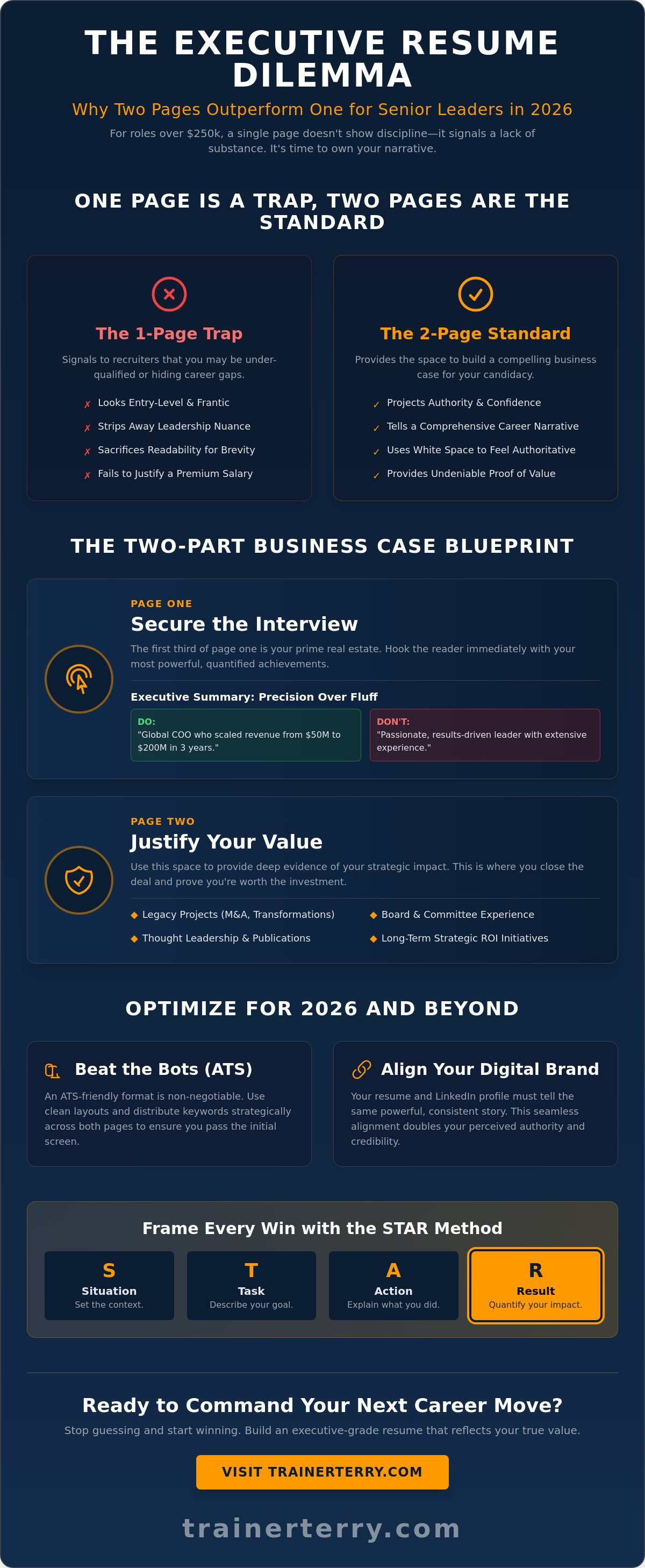
Stop trying to squeeze twenty years of global leadership into a single sheet of paper. It doesn't show discipline; it shows a lack of substance. For those moving into senior roles, the old one-page rule is a relic of the past. If you're asking yourself, is a two-page resume acceptable for executives in the current market, the answer is a resounding yes. In fact, sticking to one page often does more harm than good when you're competing for $250k+ roles. You aren't an entry-level graduate anymore. Don't use a document that suggests you are.
Recruiters and board members aren't looking for a quick scan of your daily tasks. They're looking for a comprehensive Career Narrative. They need to see how you've handled complexity, led through crises, and delivered massive ROI. Looking back at the evolution of the modern resume, we see a clear shift from simple task lists to sophisticated business cases. In 2026, your resume isn't just a bio. It's a strategic document that justifies your premium price tag. It must provide the impact evidence that today's decision-makers demand before they even grant you an interview.
Brevity vs. Density in Executive Branding
Short resumes focus on duties. High-level leadership requires a focus on strategic outcomes. Don't fear the second page. Using two pages allows you to incorporate white space, which actually makes your document more readable and professional. A cramped one-page document feels frantic and small. A well-paced two-page document feels authoritative. There's a psychological link between the 'weight' of your career story and your perceived professional authority. If you want to be seen as a heavy hitter, you need the space to prove it. Every inch of that second page is an opportunity to reinforce your brand.
When One Page is Actually a Red Flag
For a C-suite candidate, a one-page resume can look like you're hiding something. Are there gaps you're trying to mask? Are you under-qualified? Over-editing leads to losing the nuances of your leadership style. You end up stripping away the very details that demonstrate your Executive Presence. If your career transition involves moving industries or scaling up, you need that extra real estate to explain the 'why' behind your moves. If you're ready to stop guessing and start winning, our Career Advancement Blueprint provides the exact structure needed to position your value correctly. Don't let a fear of length hold back your next big promotion.
The 2026 Executive Resume Strategy: Quality Over Quantity
Efficiency isn't about how little you say. It's about the weight of what you include. While you now know that is a two-page resume acceptable for executives, you can't just double the length with filler. You need a strategy that treats every line like a high-stakes investment. Think of your resume as a two-part business case. Page one is your hook; it's designed to grab attention and spark interest. Page two is your proof; it's where you provide the deep evidence that justifies your leadership premium. Don't just fill space. Own it.
Your Executive Summary acts as the anchor for this entire document. It shouldn't be a generic list of adjectives. It must be a punchy, three-sentence statement of your unique value proposition. If a recruiter only reads these lines, they should already want to hire you. Avoid "fluff" like "passionate leader" or "hard worker." Replace those with "Global COO who scaled revenue from $50M to $200M." Precision beats personality every single time. This clarity sets the tone for the rest of the document, ensuring the reader stays engaged through both pages.
The 'Above the Fold' Hook for Leaders
The first third of your document is the most valuable real estate you own. This is where your biggest wins must live. If you've led a $100M digital transformation, don't bury it on page two. It belongs right under your header. Your value proposition needs to be undeniable. It should align perfectly with your LinkedIn Personal Brand Strategy to create a seamless professional image. When your resume and LinkedIn tell the same powerful story, your authority doubles instantly. Use key metrics here that prove you understand the bottom line.
Strategic Use of Page Two
Once you've hooked them, use the second page to close the deal. This is the place for Legacy Projects. Detail your cultural transformations, M&A integrations, or long-term ROI initiatives. These are the complex wins that a single page simply cannot hold. Include your board experience and thought leadership here. These elements prove you operate at a higher strategic level than your peers. Save the end of page two for Professional Development and Awards. They're important, but they don't drive the initial hiring decision. They are the final evidence that reinforces your commitment to growth. If you're struggling to decide what stays and what goes, you can schedule a free strategy call to refine your narrative.
Impact Over Activity: Applying the STAR Method to Two Pages
Stop listing your responsibilities. Start claiming your victories. For an executive, "responsible for" is a passive phrase that kills momentum and hides your true value. When you ask is a two-page resume acceptable for executives, you must understand that the extra space isn't for more duties. It's for more results. You need to move from "responsible for the sales team" to "achieved a 40% increase in regional revenue by restructuring the sales incentive program." This shift is the difference between being just another candidate and being the definitive solution to a company's problems.
The STAR Method is your secret weapon for filling those two pages with high-octane proof. Situation, Task, Action, Result. This framework turns a dry bullet point into a compelling narrative. On a two-page document, you have the luxury to include 3-5 "Hero Stories." These are the defining moments of your leadership that prove you can handle high-stakes pressure. Don't just mention these wins; link them directly to the company's strategic vision or the bottom line. If you saved $10M in operational costs, explain exactly how that capital was redeployed to fuel R&D or market expansion. You're showing them you think like an owner, not an employee.
Converting Duties into Executive Outcomes
Apply the "So What?" test to every single line. If a bullet point doesn't justify its place by showing a clear impact, cut it immediately. You might think leadership, culture, or innovation are hard to quantify, but they aren't. Did employee retention improve by 15% under your watch? Did you reduce time-to-market for new products by three months? Here is an example of a 2025 Impact Win: "Spearheaded a cross-functional AI integration that reduced manual reporting time by 60% while increasing data accuracy for board-level decision-making." Every word serves a purpose. Every number proves your worth.
Interview Preparation Starts on the Resume
Your resume is the script for your future interview. A strategic two-page layout allows you to plant "hooks." These are brief, intriguing mentions of success that practically force the recruiter to ask for the full story. This is where your high-level interview strategy begins. You're controlling the conversation before you even step into the room. By aligning your written narrative with your Executive Presence and Leadership Communication, you create a consistent, powerful brand. You aren't just showing up to an interview; you're stepping into a leadership role you've already proven you can master.
The 2026 Technical Blueprint for Multi-Page Resumes
Your strategy is only as good as your technical execution. You now know that is a two-page resume acceptable for executives, but if your formatting breaks the scanner, you remain invisible. The World Economic Forum reports that 88% of companies now use AI for initial candidate screening. Your two-page document must be a technical masterpiece. Distribute your core keywords across both pages. Don't front-load every skill onto page one. The AI reads the entire file; use that extra space to build a high-density keyword map that proves your expertise in every leadership role you've held.
Visual hierarchy is your next priority. Use bolding and subheadings to guide the human eye. Most recruiters spend only a few seconds on their first scan. If they can't find your biggest wins, they won't bother with page two. Stick to a clean, reverse-chronological format. PDF is still the gold standard for file formats. It preserves your layout exactly as you intended. Just ensure it's a "clean" PDF. Avoid complex columns or text boxes. These often confuse ATS systems and lead to your data being ignored or misread.
Formatting for the Human Eye and the AI Bot
Stop using charts and graphs. They might look sleek, but they often break ATS parsing. This leaves your data unreadable and your application in the trash. Choose modern fonts like Roboto, Arial, or Helvetica. These signal a "Modern Executive" rather than a "Dated Manager." Never drop below a 10-point font size. If you have to shrink the text to fit your content, you're talking too much. Readability is more important than length. Use clear section headers to keep the machine and the human on the same page.
The 'Page One' Continuity Test
Page one must stand alone as a complete narrative. If a recruiter never flips to page two, they should still understand your core value. Avoid using "Continued on next page" at the bottom of the first sheet; it's a waste of valuable space. Instead, ensure your contact info and name appear in a subtle footer on page two. This continuity is vital when answering if is a two-page resume acceptable for executives, as it proves you can manage complex information without losing the reader. It keeps your identity attached to your results if the pages are viewed separately in a digital portal.
If your current document feels cluttered or outdated, it's time to refine your approach. Let's build a document that commands respect and passes every filter. Join our Office Hours to get direct feedback on your executive positioning and technical layout.
Beyond the Document: Positioning Your Executive Value
A great resume is your ticket to the game, but it's not the win itself. It's only 20% of the Career Change Blueprint. If you've been obsessing over whether is a two-page resume acceptable for executives, you've finally mastered the technical foundation. Now you must master the perception. Your document has to align perfectly with your LinkedIn "Executive Presence." In 2026, recruiters cross-reference your resume with your digital footprint in seconds. If your paper narrative and your digital brand don't tell the same story of high-stakes success, you lose credibility before the first call.
Think of your resume as a "Leave-Behind" after a networking conversation. It shouldn't just repeat what you said; it should reinforce it with hard data. When you hand over a document that is clean, strategic, and result-heavy, you're turning that document into a promotion strategy. You aren't just an applicant anymore. You are a solution. This shift in positioning is what allows you to stop chasing roles and start being recruited for them.
The Holistic Executive Brand
Your narrative must be consistent from the first bullet point to the final handshake. This consistency is what fuels your Salary and Offer Negotiation Strategy. When you transition from "Applicant" to "Consultant" in the recruiter's mind, your market value changes. Use your two-page document to justify that higher title or compensation package. It’s not just a record of where you've been; it’s the business case for your next $100k raise. Every win you've documented is a chip you bring to the bargaining table.
Take Action on Your Career Blueprint
DIY resume writing is a dangerous game at the executive level. You're too close to your own story to see the patterns of excellence that a recruiter values most. High-performers don't guess; they invest in Executive Coaching and Advisory to ensure their narrative is bulletproof. Before you send that next application, run through this final checklist. Is your document just a list of tasks, or is it a legacy of leadership? Does it answer the question is a two-page resume acceptable for executives by proving you have too much value to fit on one page?
- The Hook: Does the first third of page one prove you can solve their #1 problem?
- The Proof: Does page two provide the STAR stories that justify a premium salary?
- The Tech: Is it clean, ATS-optimized, and free of "chart traps"?
- The Narrative: Does it sound like a leader, or does it sound like a manager?
Your career is an asset. Stop managing it like a chore and start leading it like a business. The transition starts with a document that reflects who you are becoming, not just where you've been.
Own Your Narrative and Command the Room
You've seen the truth. The question isn't just whether is a two-page resume acceptable for executives; it's whether you're brave enough to own the space your career deserves. We've covered the technical blueprint, the STAR method for quantifying wins, and the shift from applicant to consultant. You now have the tools to build a document that doesn't just list jobs but defines a legacy. Stop playing small with your career history and start treating your experience like the high-value asset it is.
Don't let a cramped, one-page document hold back your earning potential or your executive presence. I've spent over 20 years as a Corporate VP seeing exactly what makes a board-level candidate stand out. My structured Career Change Blueprint is designed specifically for senior leaders who need a document that justifies a premium salary. We specialize in high-level interview strategy to ensure your narrative is consistent from the first page to the final offer. It's time to stop guessing and start executing with precision.
Schedule your free Strategy Call to audit your executive resume today. Your next big career win is waiting for you to claim it. Let's get to work.
Frequently Asked Questions
Is a three-page resume ever acceptable for executives?
Yes, a three-page resume is becoming a strategic choice in 2026 for executives with complex, multi-organization histories. If you've managed global operations across several decades, don't sacrifice clarity for brevity. The key is ensuring every page adds unique value. Avoid listing minor tasks or repeating yourself. If the third page contains high-level board experience or significant industry awards, it reinforces your authority rather than diluting it.
Should I include my early-career experience on the second page?
Include early-career experience only if it directly supports your current leadership narrative. Instead of listing every role from twenty years ago, use a "Prior Professional Experience" section to summarize titles and companies. This saves space for your most recent, high-impact wins. Focus on the progression of your career. Show how your early foundations led to the strategic decision-making you master today.
How do I handle a career gap on a two-page executive resume?
Address career gaps head-on by focusing on your professional development or consulting work during that period. You can use a brief, honest sentence to explain the gap, such as "Sabbatical for family leadership" or "Independent strategic consulting." Don't try to hide it with creative formatting. Recruiters value transparency. Use the extra space on your two-page document to show how you stayed sharp and relevant during the time away.
Do recruiters actually read the second page of a resume?
Recruiters will absolutely read the second page if your first page successfully hooks their interest. Think of page one as the executive summary and page two as the deep-dive evidence. If your first-page metrics are impressive, decision-makers will keep scrolling to find the proof. This is why is a two-page resume acceptable for executives; it provides the necessary room to close the deal after the initial hook.
What is the best font size for an executive resume in 2026?
The best font size for a modern executive resume is 10 to 11 points for the body text and 12 to 14 points for subheadings. Readability is your top priority. If you're struggling to fit your content, don't shrink the font to 8 or 9 points. Instead, edit your bullet points for higher impact. A clean, well-spaced document at 10.5 points looks far more professional than a cramped one-page list.
Should my LinkedIn profile match my two-page resume exactly?
Your LinkedIn profile should complement your resume rather than mirror it word-for-word. LinkedIn is a social platform that allows for a broader, more conversational narrative. Your resume is a targeted business case for a specific role. While the core facts and dates must align, use your two-page resume to focus on specific, quantifiable results. Use LinkedIn to showcase your thought leadership and professional network.
How do I optimize a two-page resume for ATS systems?
Optimize your document by distributing high-value industry keywords across both pages. Modern systems in 2026 are sophisticated enough to parse multi-page files as long as the formatting is clean. Avoid using images, columns, or non-standard section titles. Stick to reverse-chronological order and use standard headings like "Professional Experience" and "Education." This ensures the AI can accurately map your career progression and leadership milestones.
Can a two-page resume hurt my chances for a 'fast-paced' startup role?
A two-page resume won't hurt your chances at a startup if the content focuses on agility and scale. Startups value executives who can wear multiple hats and drive rapid growth. Use your space to highlight your M&A experience or your ability to build teams from scratch. Showing that is a two-page resume acceptable for executives even in fast-paced environments proves you have the depth to lead through the chaos of scaling.

Article by
Terry Jones
Terry Jones is the Founder and Chief Career Strategist of the Career Advancement Blueprint and Executive Coach and Lead Consultant at FireBridge Consulting.
As an ICF Certified Accredited Career Coach and Certified Master Career Services professional, he partners with professionals at all levels, including senior leaders and executives, to navigate career transitions, secure new opportunities, and position themselves for advancement. His approach goes beyond surface level coaching, focusing on how individuals think, communicate, and lead so they can operate with clarity, authority, and strategic intent in high stakes environments.
In his work as an executive coach, Terry engages in high impact advisory conversations that help leaders strengthen decision making, elevate their presence, and align their leadership style with organizational expectations. He is known for helping clients translate their experience into influence, ensuring they are not only seen for what they have done, but trusted for what they are capable of leading next.
With over 20 years of corporate experience, including serving as a Vice President and leading Learning and Development functions for three New York City organizations, Terry brings a deep understanding of how companies evaluate talent, develop leaders, and make promotion decisions. This allows him to bridge the gap between individual ambition and organizational reality.
His insights have reached over 630,000 followers and generated more than 70 million video views, where he shares direct, experience driven guidance that helps professionals think differently and take action.