ATS Optimization for Executive Job Applications: The 2026 High-Performance Strategic Guide

Did you know that 75% of resumes are rejected by an ATS before a human recruiter even looks at them? For a high-level leader, that's not just a statistic. It's a structural wall. You've spent decades building a career of impact, yet you're currently being treated like a mere serial number in a database. It's exhausting to waste hours on portals only to be met with total silence. You're likely frustrated by conflicting formatting advice that feels more like a step backward than a move toward the C-suite. You deserve better than a "black hole" response.
We're going to change that right now. You'll learn how to master ats optimization for executive job applications without stripping away the sophisticated leadership narrative that defines your value. This isn't about "beating a bot." It's about feeding a CRM the strategic data it needs to rank you as a top-tier visionary. This guide previews how 2026 AI evaluates leadership potential and provides the blueprint to ensure your resume passes the machine and impresses the human recruiter. It's time to stop guessing and start landing the high-stakes interviews you've earned.
Key Takeaways
- Transform your perspective from simply "beating a bot" to feeding an AI-powered ranking engine the high-level data it needs to identify you as a top-tier leader.
- Discover the "Executive Keyword Architecture" to master ats optimization for executive job applications without losing your sophisticated career narrative.
- Learn to use "Impact Verbs" that signal C-suite authority to modern algorithms, moving far beyond basic, repetitive keyword matching.
- Implement the "Clean-Sheet" rule for formatting to ensure your resume is both machine-readable and visually impressive to human decision-makers.
- Build a multi-channel strategy where technical optimization serves as the high-performance foundation for your broader executive positioning and interview success.
The Executive ATS Paradox: Why Your 20-Year Legacy Is Getting Ghosted
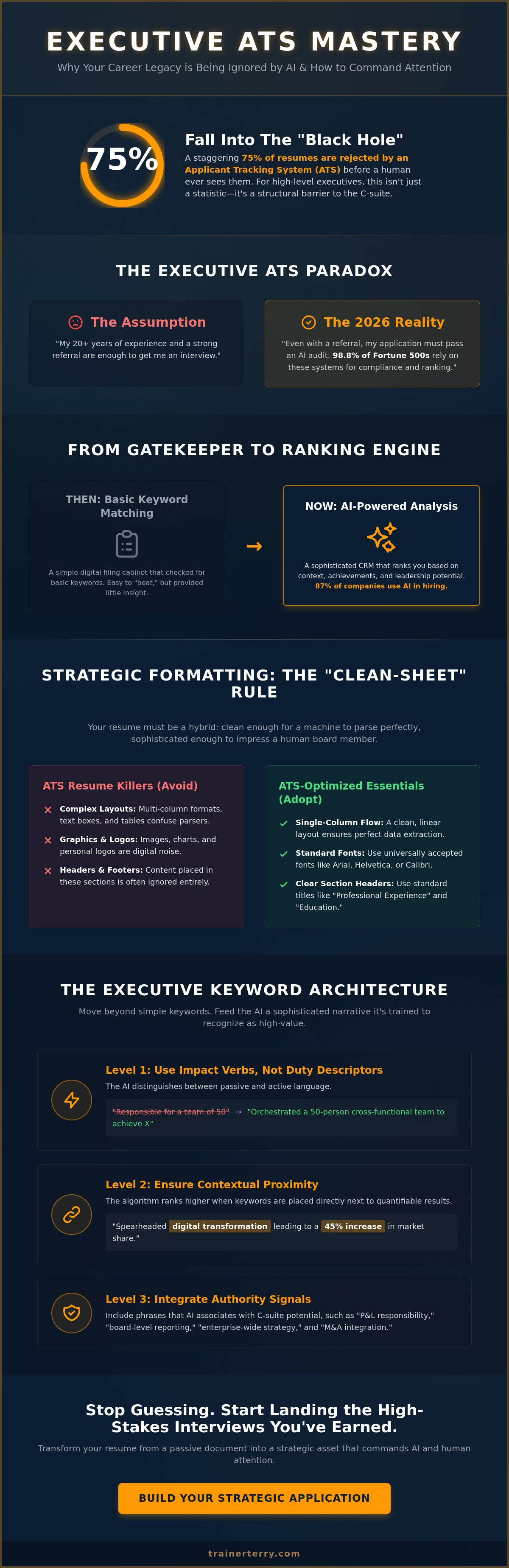
You've spent two decades leading teams, driving millions in revenue, and steering organizations through volatile markets. Now, you're applying for a VP or C-suite role, and you're getting nothing but silence. It's the Executive Paradox. The more complex and impactful your career becomes, the harder it is for a machine to digest. In 2026, What is an Applicant Tracking System? has evolved from a simple gatekeeper into a sophisticated AI ranking engine. If your document isn't built for this reality, your legacy is effectively invisible to the systems that 98.8% of Fortune 500 companies now use.
Don't think a referral saves you from this process. Regulatory changes like the Colorado Artificial Intelligence Act, which took effect on June 30, 2026, mean companies must document their hiring decisions more strictly than ever. Even if the CEO wants you on the team, HR compliance usually requires your data to live in the system and pass an initial audit. Falling into the "Black Hole" isn't just a minor setback; it's a massive waste of your professional ROI. Effective ats optimization for executive job applications is no longer just a technical chore. It's a foundational part of your broader career strategy.
The Evolution of the "Bot" in 2026
Modern hiring software has moved far beyond simple keyword matching. Today's systems use Natural Language Processing to evaluate the context of your achievements. They don't just look for the word "Leadership." They analyze your "Skill Taxonomy" to see if your experience with digital transformation or AI strategy matches the company's specific needs. Since 81% of companies now focus on skills-based hiring, the machine is looking for evidence of competency, not just a list of past titles. It "reads" your career narrative to determine if you're a high-performer or just a generic applicant.
Why Traditional Executive Resumes Fail the Test
Many leaders rely on "creative" layouts, multi-column designs, or heavy graphics to convey executive presence. To a 2026 parser, these elements are digital noise that breaks the data flow. When the machine can't map your contact info or your most recent role, it assigns a low rank or discards the file entirely. Your 2026 resume needs to be a hybrid document. It must be clean enough for an algorithm to scan while remaining sophisticated enough to impress a human board member. If you want to move from being a "number" to being a top-tier candidate, you need a structured approach like our Career Advancement Blueprint to align your narrative with machine logic. ats optimization for executive job applications requires a balance of high-level strategy and technical precision. Stop settling for silence and start feeding the engine the data it needs to rank you first.
Beyond Keywords: How AI-Driven ATS and CRM Systems Evaluate Leadership
The game changed while you were leading. In 2026, executive search firms and corporate HR departments have moved from basic filtering to advanced Candidate Relationship Management (CRM) platforms. These systems don't just discard your resume. They index it. Your document becomes a permanent asset in a searchable talent pool. This makes ats optimization for executive job applications about long-term visibility, not just a one-time pass. Since 87% of companies now use AI in their hiring process, your resume is constantly being "re-read" by algorithms looking for specific leadership patterns.
Algorithms now prioritize "Impact Verbs" over simple "Duty Descriptors." If your resume says you were "responsible for a team," the machine sees a manager. If it says you "orchestrated cross-functional scaling," it sees an executive. This distinction is vital. Modern systems also look for "Contextual Proximity." This means the machine evaluates how close your keywords are to quantifiable results. Placing "Revenue Growth" next to a specific percentage creates a stronger ranking signal than burying it in a list of skills. This is why a generic list of buzzwords no longer works.
The 2026 AI Ranking Factors for Leaders
AI now calculates your "Career Velocity" by analyzing the time between promotions and the increasing scale of your P&L responsibilities. It looks for "Authority Signals," which are phrases that indicate high-stakes decision-making. If you want to stand out, you must group your "Hard Skill" clusters effectively. For instance, a VP of Technology should cluster skills around AI Strategy, Cybersecurity Governance, and Digital Transformation. This helps the machine's "Semantic Search" capabilities find you even when a recruiter uses synonyms you didn't explicitly include in your text.
The Passive Discovery Engine
Your resume lives in a database long after you click apply. Recruiters use "Search Strings" to find candidates for future roles they haven't even posted yet. If your document isn't optimized for these future queries, you're missing out on passive opportunities. You must also integrate this strategy with your LinkedIn Positioning to create a unified digital footprint. The machine compares your resume data with your public profile to verify consistency and authority. If you want to ensure your narrative is actually working for you, a free strategy call can help align your positioning with these modern requirements. ats optimization for executive job applications is the foundation of your digital presence. Don't leave it to chance.
Strategic Formatting: Balancing Algorithmic Compliance with Executive Presence
You want your resume to look like a high-end board presentation. I get it. But there's a fine line between "Executive Presence" and "Technical Sabotage." In 2026, the "Clean-Sheet" Rule is the new standard for executive luxury. Minimalism isn't about being boring; it's about being readable. If a machine can't find your data, you don't exist. This is the core of ats optimization for executive job applications. Stop overcomplicating your layout. Complex tables, columns, or text boxes might look sophisticated to you, but they trap your information in a digital cage that most parsers can't unlock.
Standardize your headers immediately. Your contact info and current title should be the first thing a ranking engine sees. Don't put your name inside a graphic or a header tag. Use modern, sans-serif fonts like Calibri, Arial, or Roboto. While "Web-Safe" was the old rule, 2026 systems handle modern typography well, but they still choke on custom icons, skill bars, or images. These visual "Graphics Traps" appear as garbled code to a bot, which can lead to an automatic rejection regardless of your qualifications. You need a document that works for the machine so you can get the chance to talk to a human.
The Hybrid Resume Architecture
The "Top Third" Strategy is where you win. You have roughly six seconds to grab a human's attention and even less time to satisfy an algorithm. Your Executive Summary is your most valuable real estate. It's not a generic objective; it's a high-impact narrative packed with the strategic keywords the system is hunting for. Below that, use a "Core Competencies" section to group your leadership skills. This isn't just a list. It's a strategic cluster designed to maximize keyword density without sounding like a robot wrote it. If you're struggling to balance these elements, our Career Advancement Blueprint provides a structured framework to align your legacy with modern machine logic.
File Types and Compatibility
The debate is over. For 2026 executive portals, high-quality PDFs are usually safe, but a standard .docx file remains the gold standard for parsing accuracy. Name your file with precision: [FirstName]-[LastName]-[TargetRole]-Executive-Resume.pdf. Avoid spaces or special characters that can confuse older database systems. To ensure your data maps correctly, a standard heading should feature your full name on the top line, followed by your contact details on separate lines, avoiding the use of headers or footers which often cause parsing failures. ats optimization for executive job applications requires this level of technical discipline to ensure your narrative actually reaches the decision-makers.
The Executive Keyword Architecture: Mapping Your Value Proposition to Machine Logic
Stop treating keywords like a grocery list. In the high-stakes world of executive hiring, keywords are the DNA of your professional identity. When you approach ats optimization for executive job applications, you're building a strategic bridge between your past impact and a company's future needs. You have to decode the job description like a board-level strategist. Look for the "hidden" requirements. If the post mentions "cross-functional alignment" three times, that's not a suggestion. It's a mandatory search anchor. You must translate your legacy into the specific language the machine is programmed to find.
Avoid "Buzzword Burnout" at all costs. Empty jargon like "visionary leader" or "passionate innovator" provides zero value to a 2026 ranking engine. These are "empty calories" for an algorithm. Instead, focus on quantifying your leadership. A machine can't feel your charisma, but it can calculate your impact. If you don't provide hard data, you're leaving your ranking to chance. You've worked too hard to let a lack of metrics keep you in the "discard" pile. Feed the engine the specific, verifiable data it craves.
Building Your Keyword Cloud
Success requires a tiered approach. "Tier 1" keywords are the non-negotiables found in the job title and core requirements, such as "Global Supply Chain" or "M&A Integration." "Tier 2" keywords are the supporting skills that differentiate you from the pack. Use modern AI tools as a mirror to test your resume before you hit submit. This allows you to see exactly how the parser interprets your Career Narrative. If the "mirror" doesn't reflect a high-level executive, you aren't ready to apply.
Integrating the STAR Method into ATS Logic
The STAR Method isn't just for talking. It's for writing. Using the "Verb-Result" formula creates a keyword-rich achievement that the machine ranks highly. For example, "Increased revenue by 20%" is a much stronger search anchor than "Sales management." It provides the action, the context, and the quantifiable proof in a single string. This technical precision is what separates the finalists from the ghosted. Once you've mastered the machine logic, you need to be ready for the human element. Our 1-on-1 job interview prep helps you bridge the gap between these resume keywords and the high-performance storytelling required in the room. Don't just pass the bot. Win the role.
Executing Your Move: Transforming Your Application into a Strategic Asset
You've built the engine. Now it's time to drive. All the technical work we've discussed remains theoretical until you hit that submit button. But don't rush the finish line. A high-performance executive doesn't leave success to chance. You need a final filter to ensure your document isn't just "good," but undeniable. This is where ats optimization for executive job applications moves from a technical task to a strategic asset. If your resume doesn't reflect your 20-year legacy within the first few seconds of a machine scan, you've already lost the ROI on your effort.
Remember that the ATS is only 50% of the battle. Even with a perfect algorithmic score, you're still selling to a human board or a hiring committee. Your application must position you as the "Logical Conclusion" to their search. This means your follow-up shouldn't sound like a plea for attention. Instead, it should be a professional reinforcement of the value you've already demonstrated in your document. You aren't just looking for a job; you're offering a solution to their most pressing organizational challenges. Stop guessing and start executing with precision.
The High-Performance Application Workflow
Success at the C-suite level requires meticulous organization. Stop using mental notes or messy spreadsheets. Use a dedicated tracking tool to manage your pipeline and stay ahead of the average 44-day time-to-fill cycle. This is where working with a Career Strategist becomes a game-changer. They audit your digital footprint to ensure your LinkedIn, your resume, and your verbal narrative are in total alignment. When you move from being a generic "applicant" to a high-tier "candidate" via our Career Advancement Blueprint, you stop competing with the masses. You start leading the conversation.
Next Steps for the 2026 Leader
The "One-and-Done" approach to resume writing is dead. As an executive, your positioning is a continuous process. You should be refining your narrative even when you aren't actively looking for a move. This keeps you ready for the passive discovery engines and CRM systems that recruiters use to find talent before a role is even posted. Don't wait for a crisis to fix your strategy. It's about being proactive, not reactive. If you want to know exactly where you stand in the eyes of modern AI, schedule a free strategy call today to audit your executive ATS readiness. ats optimization for executive job applications is a discipline, not a one-time fix. Master it, and you'll never have to worry about the "black hole" again. It's time to execute.
Master the Machine to Lead the Future
Your 20-year legacy deserves more than a "no-reply" email. You've learned that modern hiring isn't just about filtering; it's about feeding a sophisticated AI engine the strategic data it needs to rank you as a top candidate. By balancing minimalist formatting with a high-impact narrative, you bridge the gap between machine logic and board-level expectations. Integrating the STAR method into your document ensures your achievements act as powerful search anchors in any database. Success in 2026 demands total mastery of ats optimization for executive job applications.
It's time to stop guessing and start executing. Our personalized 1:1 executive coaching has a global reach and is led by a former Corporate VP with 20+ years of experience. We specialize in STAR method interview and resume strategy to ensure you don't just pass the bot, but win the room. You have the experience. Now, let's make sure the world sees it. Your next high-stakes role is within reach. Secure your next promotion with the Career Advancement Blueprint.
Frequently Asked Questions
Is it better to submit my executive resume as a PDF or a Word document in 2026?
Submit a standard .docx file if you want to ensure the highest level of parsing accuracy. While most 2026 enterprise systems have improved their ability to read PDFs, Word remains the gold standard for avoiding data mapping errors. If the portal doesn't specifically request a PDF, stick to Word to ensure every bit of your leadership narrative is indexed correctly by the algorithm.
Do ATS systems really reject resumes automatically without a human seeing them?
Yes, algorithms frequently filter out candidates before a person ever reviews the file. This makes ats optimization for executive job applications the most critical first step in your search. If your document doesn't meet the machine's threshold for technical relevance and formatting, you'll never get the chance to impress the hiring committee with your actual experience.
How many keywords should I include in my executive resume to rank highly?
Focus on quality and relevance rather than a specific "magic number" of words. You should aim to include all "Tier 1" essential skills found in the job description while maintaining a natural, sophisticated tone. Modern AI evaluates "Contextual Proximity," so placing keywords near quantifiable results is more effective than simply repeating a buzzword ten times throughout the document.
Can I use a two-column layout for a C-suite resume, or will it break the ATS?
Avoid two-column layouts because they frequently break the data flow of modern parsers. When a machine reads a multi-column document, it often merges the text across the columns, creating a garbled mess of information. Stick to a clean, single-column "Clean-Sheet" design to guarantee that your contact info, titles, and achievements are mapped perfectly to the recruiter's database.
Does the "Executive Summary" section count toward ATS keyword matching?
Yes, the Executive Summary is one of the most valuable sections for keyword matching. It's the perfect place to front-load your "Authority Signals" and industry-specific certifications. Because this section typically appears at the top of your resume, it provides an immediate ranking boost for the machine while also serving as your "elevator pitch" for the human recruiter.
What happens if I have a career gap; how does the ATS interpret that in 2026?
Modern AI in 2026 calculates your growth trajectory rather than just looking for continuous dates. A gap isn't an automatic rejection if your surrounding narrative shows a history of high-impact leadership and skill development. Be transparent and use your summary or a brief hybrid section to provide context for the transition, focusing on the value you bring now.
Should I use a "functional" resume format to hide certain dates from the bot?
No, you should avoid purely functional resume formats because they confuse ATS algorithms and are often viewed as red flags by executive recruiters. A hybrid format is the superior choice for 2026. It allows you to highlight your "Core Competencies" and skill clusters at the top while still providing the chronological work history that systems need to verify your experience.
How do I know if my resume is actually ATS-optimized before I apply?
Use an AI mirror tool or a professional audit to see exactly how a machine interprets your data. If the tool shows your contact information is missing or your job titles are garbled, your formatting is likely breaking the parser. Don't leave your career to chance; verify that the machine sees a high-level executive before you hit the submit button on a high-stakes role.

Article by
Terry Jones
Terry Jones is the Founder and Chief Career Strategist of the Career Advancement Blueprint and Executive Coach and Lead Consultant at FireBridge Consulting.
As an ICF Certified Accredited Career Coach and Certified Master Career Services professional, he partners with professionals at all levels, including senior leaders and executives, to navigate career transitions, secure new opportunities, and position themselves for advancement. His approach goes beyond surface level coaching, focusing on how individuals think, communicate, and lead so they can operate with clarity, authority, and strategic intent in high stakes environments.
In his work as an executive coach, Terry engages in high impact advisory conversations that help leaders strengthen decision making, elevate their presence, and align their leadership style with organizational expectations. He is known for helping clients translate their experience into influence, ensuring they are not only seen for what they have done, but trusted for what they are capable of leading next.
With over 20 years of corporate experience, including serving as a Vice President and leading Learning and Development functions for three New York City organizations, Terry brings a deep understanding of how companies evaluate talent, develop leaders, and make promotion decisions. This allows him to bridge the gap between individual ambition and organizational reality.
His insights have reached over 630,000 followers and generated more than 70 million video views, where he shares direct, experience driven guidance that helps professionals think differently and take action.