
If your resume reads like a list of daily chores rather than a high-stakes balance sheet, you're leaving executive opportunities on the table. In a 2026 market where global tech spend is hitting $5.6 trillion, companies aren't looking for people who simply "managed teams." They want leaders who drove the 12.28% returns we've seen in the S&P 500 this year. You've done the work, but if you can't prove it with numbers, it didn't happen in the eyes of a recruiter.
You likely feel that your leadership is too "soft" to measure, or perhaps you're struggling to access specific data from a role you left years ago. It's frustrating to watch peers land interviews for roles you're more qualified for just because their bullet points look more technical. You know you're executive material; it's time your resume reflected that reality.
This guide will show you exactly how to quantify accomplishments on a senior manager resume by turning your strategic decisions into high-impact metrics. You'll learn the specific formulas for translating leadership into ROI and how to estimate data when the original files are out of reach. We're going to transform your career narrative into a powerful tool that commands attention and builds immediate confidence for your next high-stakes interview.
Key Takeaways
- Shift from simple task lists to high-impact statements that highlight the scale and financial weight of your leadership.
- Discover how to quantify accomplishments on a senior manager resume using a strategic formula that connects your actions directly to top-line business results.
- Target the four pillars of executive metrics to showcase your experience with P&L ownership, budget optimization, and global organizational scope.
- Learn how to use professional ranges and frequency data to build a credible resume even when you don't have access to exact historical figures.
- Implement the "Rule of 3" to focus on your most impressive wins and position yourself as the obvious choice for executive-level roles.
What Does it Mean to Quantify a Senior Manager Resume?
Quantification isn't just a math exercise; it's the process of attaching scale, frequency, or financial impact to your professional actions. It's the difference between saying you "managed a team" and stating you "led a 50-person cross-functional organization through a global digital transformation." The first is a line from a job description. The second is a scope of responsibility that commands executive attention. When you understand how to quantify accomplishments on a senior manager resume, you stop describing your chores and start articulating your value.
In 2026, recruiters have no time for generic descriptors. With global technology spend projected to reach $5.6 trillion this year, companies are looking for "evidence-based leadership." They need to know you can handle the massive scale of modern business. This data-driven approach serves as the foundation for the most effective Resume Examples 2026. Every bullet point on your resume must act as a mini business case for your hire. If you can't prove your impact with metrics, you're essentially asking the hiring committee to take your word for it. In a high-stakes market, that's a risk they won't take.
The Shift from Tactical to Strategic Metrics
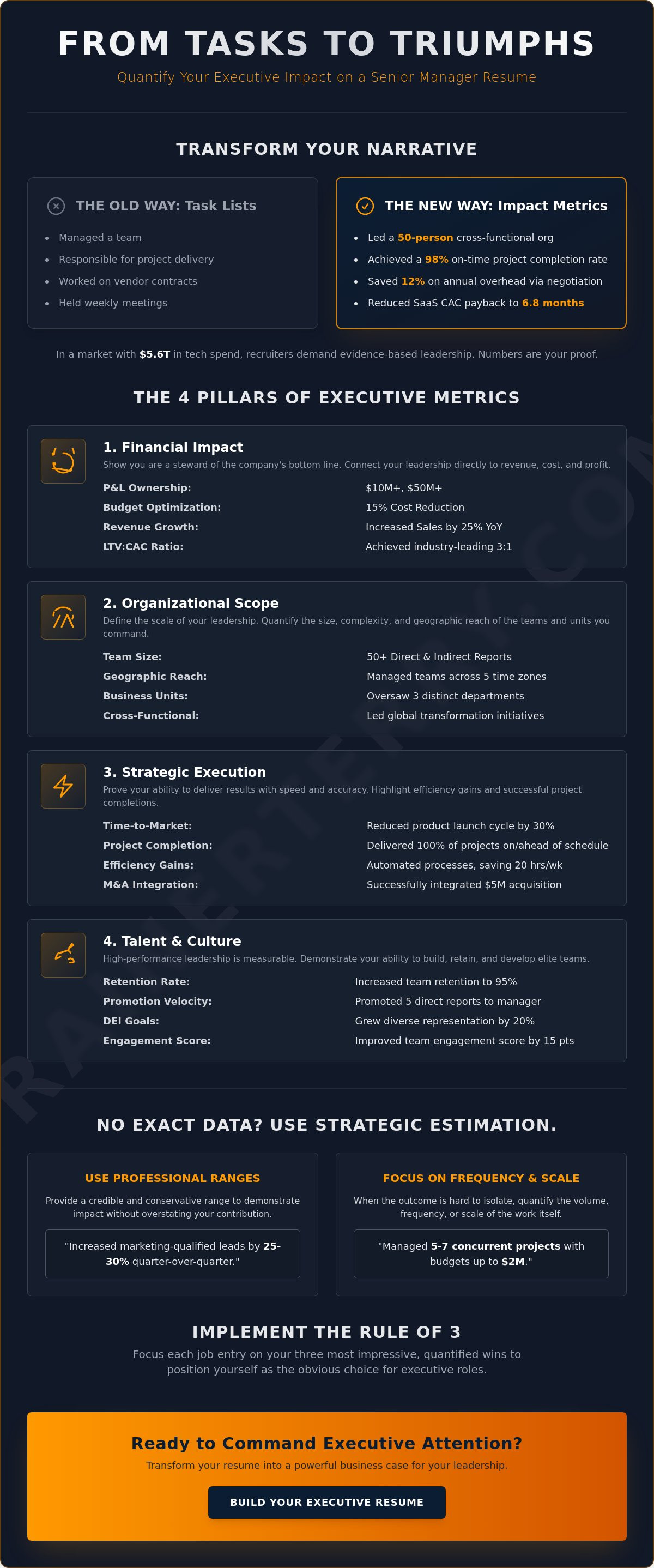
You must move from "what you did" to "what the business gained." While junior roles focus on micro-tasks, senior managers must focus on macro-outcomes. C-suite hiring managers don't care that you held weekly meetings. They care that those meetings reduced the median SaaS CAC payback period to under 6.8 months. Numbers have a profound psychological impact on executive recruiters. They provide a concrete anchor for your claims and transform you from a "people person" into a "revenue driver." Don't just list your duties; show the ROI of your leadership.
Benchmarks for Senior Leadership Success
Understanding industry-standard metrics is vital for your credibility. You should be intimately familiar with your function's specific Key Performance Indicator (KPI) sets. Are you hitting the 3:1 LTV:CAC ratio that investors demand? How does your team's performance stack up against the 12.28% S&P 500 returns we've seen so far this year? Use competitive benchmarking to validate your wins. If you aren't measuring your success against the market, you aren't leading strategically. Strategic Quantification is the translation of leadership into ROI.
The 4 Pillars of Executive Metrics: What to Quantify
Stop guessing what recruiters want to see. Most guides tell you to "add numbers," but they fail to distinguish between a junior manager and a strategic leader. At your level, the metrics must reflect your ability to move the needle for the entire organization. If you want to know how to quantify accomplishments on a senior manager resume, you need to focus on four specific areas of impact. These pillars prove you aren't just managing people; you're managing the business.
- Pillar 1: Financial Impact. This goes beyond hitting sales targets. It includes P&L ownership, budget optimization, and aggressive revenue growth strategies.
- Pillar 2: Organizational Scope. Numbers here define your territory. Think team size, geographic reach across multiple time zones, and the number of business units under your command.
- Pillar 3: Strategic Execution. This is about speed and accuracy. Use metrics like time-to-market for new products, project completion rates, and the successful integration of M&A assets.
- Pillar 4: Talent & Culture. High-performance leadership is measurable. Track retention rates, the promotion velocity of your direct reports, and progress toward DEI goals.
Focusing on these areas ensures your resume speaks the language of the C-suite. It's about showing that you understand the macro-environment, including the projected $308 billion global cybersecurity spend or the rapid 39.7% CAGR of the AI market. You aren't just a passenger in these trends; you're the driver.
P&L Ownership and Financial Stewardship
You don't need a sales title to show financial value. If you managed a department budget, you were a financial steward. Quantify your cost-avoidance. Did you renegotiate vendor contracts to save 12% on annual overhead? That's a win. When dealing with sensitive company data, use percentages instead of absolute dollar amounts. Stating you "reduced operational waste by 15%" is often more impactful and safer than listing internal revenue figures. It shows you understand the bottom line without compromising confidentiality.
Quantifying Leadership and Talent Development
Leadership isn't a "soft skill" when you measure the results. Look at the velocity of your team's career growth. If you promoted four direct reports to Director-level roles within two years, you're a talent multiplier. Use "Stakeholder Reach" to demonstrate your influence. Leading a project that required buy-in from 12 global department heads proves you can handle complex, cross-functional environments. This level of detail transforms a vague leadership claim into a hard fact that recruiters can't ignore.
Refining these metrics is a core part of our Career Advancement Blueprint, where we help you align your past wins with the high-stakes expectations of executive roles. Don't let your best work stay hidden behind generic bullet points. Every number you add is a brick in the foundation of your executive presence.
The Formula for High-Impact Accomplishment Statements
Most senior-level resumes fail because they're a collection of passive duties rather than a record of active wins. If you want to stand out, you need a repeatable blueprint for every bullet point. Learning how to quantify accomplishments on a senior manager resume requires you to adopt the Executive Formula: [Action Verb] + [Strategic Project] + [Metric] + [Business Outcome]. This structure ensures that every claim you make is backed by evidence and tied to a larger corporate goal. It moves you away from "doing things" and toward "achieving results."
This formula does more than just fix your resume; it prepares you for the intensity of Executive Career Coaching and high-stakes interviews. By using this structure, you're essentially integrating the STAR method (Situation, Task, Action, Result) into your career narrative. When a recruiter asks about your leadership style, you won't have to scramble for an answer. You'll have a library of quantified stories ready to go. Every bullet point becomes a script for your future success, proving you can handle the complexities of a $5.6 trillion global tech market.
Action Verbs That Command Authority
"Managed" is a low-energy word that suggests you simply maintained the status quo. At the senior level, you aren't just a caretaker; you're a builder and a fixer. You need verbs that imply vision and ownership. The verb you choose sets the stage for the metric that follows. If you "Architected" a solution, the reader expects a massive, foundational result. If you "Negotiated" a deal, they expect to see a specific financial gain. Here are 10 high-performance verbs for your 2026 resume:
- Orchestrated (implies complex coordination)
- Spearheaded (implies being the first to lead)
- Architected (implies building from scratch)
- Galvanized (implies motivating a large group)
- Restructured (implies solving a fundamental problem)
- Pioneered (implies innovation)
- Optimized (implies making something better/faster)
- Negotiated (implies financial or contractual skill)
- Cultivated (implies long-term growth and development)
- Leveraged (implies using resources strategically)
Connecting Actions to Board-Level Outcomes
Recruiters don't care about your tasks; they care about how those tasks impacted the board-level objectives. Every result must tie back to either the "Top-Line" (revenue growth) or the "Bottom-Line" (cost savings and efficiency). For example, don't just say you "improved team culture." Instead, say you "Cultivated a high-performance culture that resulted in a 15% reduction in annual turnover." This turns a soft skill into a hard financial win by reducing recruitment costs.
Consider a software implementation. Instead of saying you "launched a new platform," use the framework to say: "Architected a global AI implementation project that drove a 20% increase in operational throughput, capturing a larger share of the $309.6 billion AI market." This sample bullet point follows the formula perfectly. It starts with a strong verb, defines the strategic project, provides a clear metric, and finishes with a massive business outcome. That is how you command executive attention.
How to Quantify When You Don't Have Exact Data
Stop letting a lack of spreadsheets hold your career back. If you don't have the exact revenue figures from your 2024 projects, you don't have to settle for vague bullet points. Learning how to quantify accomplishments on a senior manager resume when data is scarce is about using logical proxies and credible estimates. You were in the room. You led the people. You saw the shift. That experience is quantifiable if you know which levers to pull.
Ranges are your best friend. Instead of guessing a single number and hoping no one questions it, use a conservative range. Stating you "managed $5M–$7M annual budgets" shows you understand the scale without claiming impossible precision. Frequency and volume also provide massive weight. "Led weekly briefings for 15+ global stakeholders" proves your influence much better than just saying you "communicated well." It defines the rhythm and reach of your leadership.
Try the "Before and After" snapshot. Describe the state of the organization when you arrived versus the state when you left. If you inherited a department with a 40% project failure rate and reduced it to 5% by the time you moved on, that is a hard, measurable win. You can also use comparative metrics. Were you ranked #1 out of 12 regions for operational compliance? That ranking is a metric in itself, even if you don't have the underlying raw data. It shows how you stack up against your peers in real-time.
The Power of Scale and Scope
Complexity is a metric. You can quantify the number of users, countries, or departments impacted by your decisions. If you led a digital transformation that touched 5,000 employees across 6 time zones, you've established a massive scope. Don't forget legacy metrics. What processes did you build that are still in place today? If your framework remains the company standard three years after your departure, that is a testament to your strategic depth and long-term value.
Leveraging Qualitative Data as Quantified Proof
Even "soft" feedback can be hardened into data. If you received consistently high marks in performance reviews, translate that into an "achieved 98% stakeholder satisfaction rating." Awards and industry recognition serve as external validation that acts as a proxy for performance data. Finally, use time-savings as a proxy for financial gain. If your new workflow saved the team 10 hours per week, multiply that by the average hourly rate of your staff. Suddenly, you have a concrete dollar amount for efficiency gains.
Your resume should be a reflection of your true capacity, not just a list of things you remember. If you're struggling to frame these stories for your next big move, our High-level Interview Strategy and Preparation will help you turn these estimates into bulletproof executive narratives.
Positioning Your Quantified Resume for the Executive Move
You've built the foundation. You've translated your leadership into high-impact metrics. Now, you must deploy that data strategically. A resume full of numbers is powerful, but a resume where those numbers align perfectly with a specific board-level objective is unstoppable. Learning how to quantify accomplishments on a senior manager resume is only half the battle. The other half is ensuring those metrics speak directly to the specific problems your future employer is desperate to solve. If the job description emphasizes scaling, your resume should scream about your 39.7% CAGR AI growth wins. If they need efficiency, show them the 6.8-month SaaS CAC payback periods you've mastered.
Don't drown the recruiter in a sea of percentages. Use the "Rule of 3." Identify your three most impressive, quantified wins and give them prime real estate at the top of your professional summary or your most recent role. These are your executive pillars. They anchor your candidacy in reality and provide a clear ROI for your potential hire. This focused approach is the first step in our Career Advancement Blueprint. We don't just help you list what you did; we help you position your value so you're seen as the only logical choice for the role.
Prepare to defend your numbers. In high-stakes interviews, executive recruiters will dig into the "how" behind your "what." Use the STAR method to give your metrics a soul. When you talk about that 20% increase in throughput, explain the specific architectural decisions you made to achieve it. This consistency between your written resume and your verbal narrative builds massive trust. It proves you aren't just "guessing" at numbers; you're a leader who manages by the data.
Customizing Metrics for Different Stakeholders
Different stakeholders care about different numbers. A CEO wants to hear about market share and how you're capturing part of that $5.6 trillion global tech spend. An HR Director is looking for retention rates and team velocity. If you're applying for a "Growth" role, emphasize revenue and expansion metrics. For "Turnaround" roles, focus on cost-avoidance and operational stabilization. Finally, ensure your LinkedIn profile mirrors this impact. If a recruiter sees one set of numbers on your resume and a vague description on LinkedIn, your credibility vanishes instantly.
Next Steps: Auditing Your Current Resume
Perform a 5-minute audit right now. Scan your bullet points for words like "responsible for," "assisted," or "familiar with." These are soft bullets. They need numbers. If you're still in your current role, start gathering data today. Once you lose access to those internal dashboards, your ability to quantify your impact drops significantly. Don't wait until you're desperate for a move to start this process. Success favors the prepared. Ready to level up your executive presence and command the salary you deserve? Schedule your free strategy call with Trainer Terry and let's turn your experience into an executive powerhouse.
Take Command of Your Executive Narrative
You've seen the blueprint. Mastering how to quantify accomplishments on a senior manager resume is the single most effective way to separate yourself from the pack. By applying the executive formula and focusing on high-level pillars like P&L ownership and strategic execution, you transform your resume into a high-stakes business case. Don't let your leadership stay invisible behind generic bullet points. Numbers don't just tell a story; they prove your worth in a global market that demands evidence-based results.
This is about more than just a document; it's about your legacy. Led by a former Corporate VP with 20+ years of experience, our approach specializes in the STAR method to ensure you win in high-stakes interviews. We have a proven track record of helping leaders secure 6-figure promotions by aligning their value with market demands. Stop settling for "good enough" and start demanding the recognition your experience deserves. Your career isn't a cost center; it's a revenue driver.
Secure your executive future with the Career Advancement Blueprint
Your next big move is waiting. Go out there and claim it with confidence.
Frequently Asked Questions
How many quantified accomplishments should I have per job?
Aim for three to five high-impact, quantified bullets for your most recent senior roles. Quality beats quantity every time at the executive level. Focus on the strategic wins that demonstrate your ability to scale operations or drive revenue. For roles held over a decade ago, one or two key metrics are sufficient to show a consistent history of performance without cluttering your resume.
Is it okay to estimate numbers on a senior manager resume?
Yes, professional estimation is acceptable and often necessary when you no longer have access to internal dashboards. Use conservative figures based on your best recollection of budget sizes or team growth. Providing a credible range is always better than leaving a bullet point purely task-oriented. It shows you understand the scale of your impact even if the exact decimal point is out of reach.
How do I quantify accomplishments if my work is highly confidential?
Use percentages, ratios, or relative benchmarks to protect sensitive company data. Instead of stating exact revenue figures, say you "increased departmental profitability by 22%" or "reduced operational overhead by 15%." This is a key strategy for how to quantify accomplishments on a senior manager resume without violating NDAs. Recruiters respect data privacy and will appreciate your professional discretion during the hiring process.
What if my best accomplishments aren't related to money or sales?
Quantify efficiency, time-savings, or organizational scope instead of just dollar amounts. Focus on metrics like "reduced project turnaround time by 30%" or "led a cross-functional team of 40 plus across five global regions." These numbers prove your leadership capacity and operational excellence. Impact is about the value you created, and that value isn't always measured in immediate currency.
Should I use percentages or hard numbers on an executive resume?
Use a mix of both to provide context and scale. Hard numbers like a "$10M budget" establish the scale of your environment and your level of authority. Percentages like "12% growth" highlight the effectiveness of your specific actions regardless of the starting point. Hard numbers are great for defining scope, but percentages are often more impressive for demonstrating year-over-year improvement.
How do I quantify soft skills like leadership or communication?
Measure the tangible outcomes of those skills rather than the skills themselves. Leadership can be quantified by retention rates or the promotion velocity of your direct reports. Communication is measured by the successful delivery of projects involving multiple global stakeholders. If your leadership style led to a 15% increase in team productivity, that soft skill has a very hard number attached to it.
Can I use ranges if I don't know the exact figure?
Absolutely, ranges are an excellent way to maintain accuracy and credibility. Stating that you managed budgets "between $15M and $20M" is more believable than a suspiciously round single figure. Ranges show you're being honest about the variable nature of senior-level responsibilities. They provide enough detail for a recruiter to understand your level of authority without requiring impossible precision.
What happens if a recruiter asks me to prove my quantified claims?
Be prepared to walk through your logic using the STAR method during the interview. You don't need to bring physical receipts or internal documents to the meeting. Instead, explain the specific actions you took to arrive at that result. If you stated a 20% efficiency gain, describe the "before" state, the strategy you implemented, and the final result. Your deep knowledge of the process is your proof.

Article by
Terry Jones
Terry Jones is the Founder and Chief Career Strategist of the Career Advancement Blueprint and Executive Coach and Lead Consultant at FireBridge Consulting.
As an ICF Certified Accredited Career Coach and Certified Master Career Services professional, he partners with professionals at all levels, including senior leaders and executives, to navigate career transitions, secure new opportunities, and position themselves for advancement. His approach goes beyond surface level coaching, focusing on how individuals think, communicate, and lead so they can operate with clarity, authority, and strategic intent in high stakes environments.
In his work as an executive coach, Terry engages in high impact advisory conversations that help leaders strengthen decision making, elevate their presence, and align their leadership style with organizational expectations. He is known for helping clients translate their experience into influence, ensuring they are not only seen for what they have done, but trusted for what they are capable of leading next.
With over 20 years of corporate experience, including serving as a Vice President and leading Learning and Development functions for three New York City organizations, Terry brings a deep understanding of how companies evaluate talent, develop leaders, and make promotion decisions. This allows him to bridge the gap between individual ambition and organizational reality.
His insights have reached over 630,000 followers and generated more than 70 million video views, where he shares direct, experience driven guidance that helps professionals think differently and take action.