How to Negotiate Salary After a Lowball Offer: The 2026 Executive Playbook

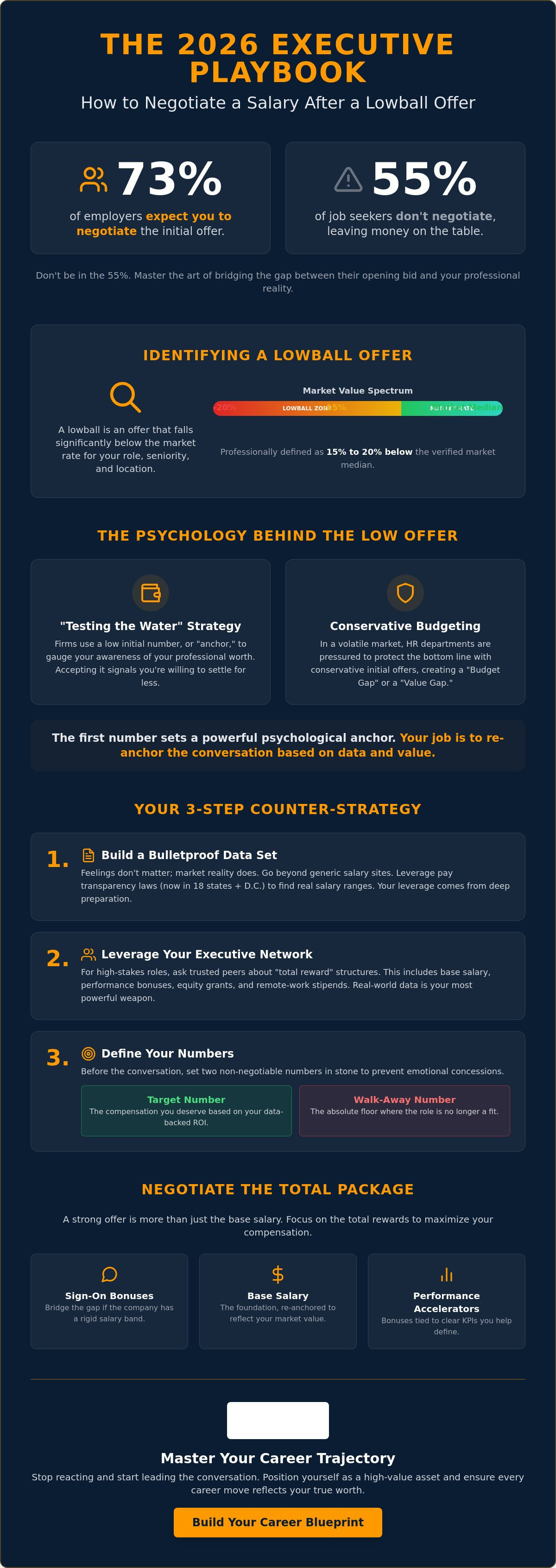
Did you know that 73% of employers actually expect you to negotiate, yet 55% of job seekers leave their future earnings to chance? It’s a massive missed opportunity. When you receive a number that doesn’t reflect your worth, it’s natural to feel undervalued or fear that the offer might be rescinded if you speak up. You want a package that matches your actual value, but you don't want to burn bridges before you even start. Mastering how to negotiate salary after a lowball offer is about closing the gap between their opening bid and your professional reality.
You’re here because you refuse to settle for less than you've earned. In this 2026 executive playbook, you’ll learn the strategic framework to turn a disappointing lowball offer into a high-performance compensation package without risking the job. We’re going to cover the latest pay transparency laws, the psychology of the "Value Gap," and the exact scripts you need for a successful negotiation call. It's time to stop reacting and start leading the conversation. Let’s get to work.
Key Takeaways
- Identify a true lowball offer by benchmarking against the 2026 market median and learn why firms often start with conservative initial numbers.
- Discover how to negotiate salary after a lowball offer using a strategic re-anchor that bridges the gap while keeping your relationship with the hiring manager professional.
- Build a bulletproof data set by looking beyond generic salary sites and leveraging real-world compensation insights from your executive network.
- Negotiate beyond the base salary by focusing on total rewards, including sign-on bonuses and performance accelerators tied to clear KPIs.
- Use the Career Advancement Blueprint to position yourself as a high-value asset and ensure every career move reflects your true worth.
What is a Lowball Offer and Why Does it Happen in 2026?
Receiving an offer should be a moment of triumph. But in 2026, many executives open their offer letters only to find a number that feels like a punch to the gut. A lowball offer is professionally defined as any compensation package that falls 15% to 20% below the verified market median for your role, seniority, and location. It isn't just about the money; it’s about the message it sends regarding how the company perceives your potential impact. You aren't just a line item on a spreadsheet, and you shouldn't be treated like one.
Why is this happening so frequently now? The 2026 market is defined by volatility. HR departments are under immense pressure to remain conservative with initial offers to protect the bottom line against economic shifts. Sometimes, it’s a "Testing the Water" strategy. Firms use these lower figures to gauge your level of desperation or your awareness of your own professional worth. If you accept a low number without pushback, you’ve just told them you’re willing to settle. Understanding how to negotiate salary after a lowball offer starts with recognizing whether you’re facing a budget-constrained offer or a strategic lowball designed to save the company money at your expense.
The Psychology of the Initial Anchor
The first number mentioned in a negotiation acts as a psychological anchor. It creates a mental boundary that defines the "reasonable" range for the rest of the conversation. The fundamentals of bargaining theory suggest that whoever sets the anchor first often controls the final outcome. Anchoring bias is a cognitive phenomenon where the first piece of information offered heavily influences all subsequent decisions and negotiations within 2026 salary discussions. If you accept a low anchor immediately, you’re not just losing money today. You’re setting a dangerous precedent that will limit your internal raises and promotion potential for years to come. Don't let their starting point define your finish line.
The 'Value Gap' vs. The 'Budget Gap'
You need to diagnose the "why" before you can fix the "what." A "Budget Gap" means the company truly lacks the capital, often because they’re out of touch with 2026 compensation trends. A "Value Gap" is different. It means you haven't yet convinced them of the massive ROI you’ll deliver. This is where your Career Narrative Development becomes your most powerful weapon. You aren't asking for more money because you need it; you’re adjusting the offer to reflect the high-stakes leadership and results you’re bringing to the table. Learning how to negotiate salary after a lowball offer is essentially the art of bridging this gap with data and conviction. Stop viewing the offer as a final verdict and start seeing it as the first step in a high-performance dialogue.
Assessing Your Market Value Before You Respond
Research is your armor. Don't go into battle without it. When you're figuring out how to negotiate salary after a lowball offer, your feelings don't matter to the company; only the market reality does. By 2026, 18 states and Washington D.C. have enacted pay transparency laws. This is a massive tactical advantage. You can now access real salary ranges for similar roles in high-transparency hubs like California, New York, or the recently added Massachusetts. If the offer is for a remote position, these laws often still apply, giving you a baseline that didn't exist a few years ago.
Generic sites like Glassdoor are often lagging. For executive roles, you need to leverage your network for "real-world" compensation data. Reach out to trusted peers or mentors and ask about the "total reward" structures they're seeing in the current 2026 market. This includes base salary, but also performance bonuses, equity grants, and even remote-work stipends which have become standard for top-tier talent. To build a truly bulletproof case, you should study expert negotiation strategies from Harvard, which emphasize that your leverage comes from deep preparation rather than just persistence.
Before you pick up the phone, define two numbers. Your "Target Number" is what you deserve based on your ROI. Your "Walk-Away Number" is the absolute floor where the opportunity no longer makes financial or professional sense. Having these numbers set in stone prevents you from making emotional concessions in the heat of the moment. If you're feeling stuck on how to calculate these, you can book a strategy call to review your specific situation and market data.
Identifying Your High-Performance Differentiators
Why should they pay you a premium? You must identify the unique problems you solve that your competitors can't. Using the STAR Method allows you to turn vague responsibilities into concrete financial results. Instead of saying you "managed a team," state how you "optimized team workflows to increase output by 22% in six months." Align these wins with the company’s specific 2026 pain points, such as efficiency in a volatile market or leading digital transformation. When you show them the money you'll save or make them, the salary increase becomes an investment, not a cost.
The Executive Presence Check
Your communication style during this phase dictates your power. Executives don't "ask" for more money; they state their value based on market alignment. If you sound hesitant, you validate their lowball offer. Maintaining executive presence means being comfortable with silence and staying firm on your data-backed requirements. If you want to master this high-level positioning, the Career Advancement Blueprint provides the exact framework for navigating these high-stakes corporate moves with total confidence.
The Strategic Re-Anchor: How to Respond to a Lowball Offer
A lowball offer is a test of your professional composure. When the number hits your inbox, your first instinct might be to feel insulted. Don't let emotion drive the car. Instead, view this as the moment the real bargaining begins. Mastery of how to negotiate salary after a lowball offer requires a specific, five-step sequence that moves the conversation from their low anchor to your market-justified reality. You aren't fighting for dollars; you're defending your professional trajectory.
- Step 1: Express sincere gratitude while acknowledging the "gap" immediately. This shows you're a team player who knows their worth.
- Step 2: Ask clarifying questions. Shift the burden of proof back to the employer to explain their math.
- Step 3: Present your market data. Use the 2026 transparency laws and peer data we discussed earlier as an objective, third-party reality.
- Step 4: Re-state your value proposition. Use a "Value-First" framework to remind them of the specific problems you solve.
- Step 5: Propose a data-backed range. This range should start slightly above your target number to leave room for the final landing.
The 'Gratitude and Gap' Script
Success starts with the right words. You want to communicate that you're excited about the role but firm on the compensation. Try this: "I’m genuinely excited about the vision for this team and the impact I can make. However, I noticed a significant gap between the current offer and the market data for this level of responsibility." Notice what’s missing? A counter-offer. You should never give your number in the first two minutes of the call. Silence is a tool. Let them absorb the fact that you aren't an easy "yes." Maintaining a positive relationship is vital, but so is standing firm on your value.
Asking the 'Why' Questions
Turn the negotiation into a collaborative problem-solving session. Ask, "Can you help me understand how this figure was reached relative to current 2026 market benchmarks?" This forces the recruiter to reveal if they're dealing with a rigid budget or a performance-based misunderstanding. If they hit you with the "this is the top of our range" objection, don't panic. Ask if the range was set for the specific impact you're expected to deliver or if it’s a generic band. If the budget is truly capped, it’s time to look at the "Total Reward" components we'll cover in the next section.
Advanced Negotiation Tactics for High-Stakes Roles
Base salary is just one lever in the executive machine. When you're mastering how to negotiate salary after a lowball offer, getting stuck on the monthly paycheck is a rookie mistake. High-stakes roles in 2026 require a "Total Reward" perspective. If the base salary is capped by rigid corporate bands, pivot immediately to sign-on bonuses and performance accelerators. Sign-on bonuses are one-time hits to the budget, making them significantly easier for HR to approve than a permanent increase in fixed costs. Performance accelerators go a step further; they ensure your compensation scales automatically as you hit your predefined targets.
Another powerful tool is the "Delayed Review" strategy. If the company claims they can't meet your number today, ask for a guaranteed review in six months. Tie this review to specific, measurable KPIs that prove your impact. You’ve already used the STAR Method to quantify your past ROI; now use it to project your future value. This shifts the financial risk onto your performance, which is a bet you should always be willing to take on yourself. It signals confidence and keeps the door open for the compensation you deserve. Learning how to negotiate salary after a lowball offer isn't just about the first year; it's about the compound interest of your entire career.
Negotiating Beyond the Base Salary
Cash isn't the only way a company pays for talent. Equity and Restricted Stock Units (RSUs) align your personal wealth with the company’s long-term success. In the 2026 market, these are often more valuable than a slightly higher base. Don't ignore extra Paid Time Off (PTO) or a robust professional development budget. A $20,000 budget for executive coaching or specialized training is a massive win for your career trajectory. Also, look at your title. A more senior title can be worth more than a $10,000 raise because it sets the floor for your next career move.
Handling the 'Final Offer' Ultimatums
Recruiters often use "final offer" as a pressure tactic. When you hear this, deploy the Strategic Pause. Stop talking. Let the silence hang for five seconds. Often, the other side will start filling that silence with concessions or explanations. To win this game, you must know your Best Alternative to a Negotiated Agreement (BATNA). If you aren't prepared to walk away, you aren't negotiating; you're pleading. If a firm won't respect your value now, they never will. If you need help identifying your leverage, book a strategy call today to build your custom negotiation plan.
Mastering Your Career Trajectory with Trainer Terry
Negotiation is a muscle. The more you use it, the stronger it gets. Most professionals treat a salary discussion like a hurdle to get over. They're wrong. It’s a foundational skill that determines your trajectory for the next decade. If you’ve been wondering how to negotiate salary after a lowball offer, you’ve already taken the first step toward reclaiming your power. But don't stop there. One successful negotiation shouldn't be an outlier; it should be your new standard for every professional interaction you have from this point forward.
Securing the compensation you deserve requires more than just a script. It requires a fundamental shift in how you're perceived by the market. This is where high-level coaching becomes your competitive edge. An executive coach doesn't just read your offer; they help you decode the company’s internal politics and hidden budget constraints. They provide the objective perspective you lose when you’re emotionally invested in a role. By working with a mentor, you ensure that you never walk into a high-stakes meeting without a clear, data-backed plan of attack.
The Trainer Terry Difference: From VP to Mentor
Terry doesn't operate from theory. His approach is built on years of corporate experience, giving you direct access to the "hiring manager’s playbook." You aren't just learning how to ask for more money. You're learning the art of strategic career positioning. Terry’s mentorship moves you away from transactional job searching and into a world where you’re the sought-after solution to a company’s most expensive problems. If you're currently staring at a disappointing offer letter, book a free strategy call today to review your specific situation and flip the script before the window of opportunity closes.
Your 2026 Career Roadmap
Your 2026 roadmap starts with the Career Advancement Blueprint. This program is designed for leaders who refuse to settle for stagnant growth. It prepares you for high-stakes corporate moves by aligning your professional narrative with your financial goals. Your LinkedIn positioning serves as the foundation of this power. When your digital brand screams "high-value asset," the likelihood of receiving a lowball offer drops significantly. You're building a reputation that precedes you in the boardroom, making the negotiation process a confirmation of your value rather than a battle for it.
The work doesn't end when you sign the contract. Mastering how to negotiate salary after a lowball offer is just the beginning of your internal advancement planning. Every conversation, every KPI met, and every leadership win is a chance to re-anchor your value. You aren't just negotiating a check. You're negotiating your future, your freedom, and the impact you’ll leave behind. The market is moving fast. Don't get left behind. It’s time to take control of your career path today.
Secure the Package Your Impact Deserves
A lowball offer isn't a dead end. It’s a data point that reveals exactly where you need to bridge the gap between their initial budget and your actual market value. By now, you have the tools to re-anchor the conversation using 2026 transparency data and the STAR method. You know that total rewards, from performance accelerators to equity, are just as vital as the base salary. Mastering how to negotiate salary after a lowball offer isn't just about one paycheck; it’s about establishing your authority as a high-value leader who knows their worth.
Don’t leave your earnings to chance or settle for a "conservative" bid. Terry brings over 20 years of experience as a former Corporate VP to your side of the table. We use specialized STAR method negotiation techniques and a proven track record in executive career transitions to ensure you walk away with a package that reflects your true ROI. Stop reacting to their numbers and start leading the dialogue. Schedule a Free Strategy Call to Review Your Offer. You’ve done the hard work of building a stellar career. Now, let’s make sure you’re compensated for it. Your future is waiting.
Frequently Asked Questions
What should I do if a company says they have a fixed salary budget?
Shift the negotiation toward non-salary "Total Reward" components immediately. Ask for sign-on bonuses, performance accelerators, or equity grants that don't hit the same recurring budget line as base pay. This allows the hiring manager to stay within their fixed cap while still meeting your total compensation requirements. It’s about solving their budget problem while protecting your professional worth.
Is it ever okay to accept a lowball offer if I really need the job?
You can accept a lower offer if necessary, but you must secure a written "Delayed Review" agreement first. Negotiate a formal salary bump at the six-month mark based on hitting specific, measurable KPIs. This protects your long-term trajectory and ensures the low starting point is temporary. Never accept a lowball without a clear, documented path to the market median.
How long should I wait before responding to a lowball offer email?
Wait 24 to 48 hours before responding to a lowball offer email. This window shows you're being thoughtful and analytical rather than emotional. It also gives you time to gather the market data required for a strategic re-anchor. Responding too quickly can signal desperation; waiting too long might signal a lack of interest in the role.
Can an employer rescind a job offer if I try to negotiate for more?
Employers rarely rescind offers for professional negotiation; in fact, 73% of employers expect you to negotiate. As long as your tone remains collaborative and data-driven, the risk is minimal. Learning how to negotiate salary after a lowball offer without being confrontational is the key. If a company pulls an offer simply because you asked a data-backed question, it’s a major red flag about their culture.
How do I negotiate for a remote role when the offer is based on local rates?
Negotiate for remote roles by using national market medians and pay transparency data from high-demand hubs. By 2026, 18 states and Washington D.C. require salary disclosure, so you should reference those ranges regardless of where you live. Argue that your value is based on the impact you deliver to the organization, not the cost of living in your specific zip code.
What is the best way to bring up market research during a salary talk?
Present market research as an objective third-party reality rather than a personal opinion. Use phrases like, "Based on 2026 transparency data for this seniority level, the market median is currently X." This removes the friction from the conversation. It positions you as an informed executive who’s helping the company align their offer with current industry standards.
Should I disclose my current salary if the new offer is lower?
Don't disclose your current salary, especially since over 20 states now have salary history bans in place. Your current pay is irrelevant to the value you'll provide in a new role. Instead, redirect the conversation to the market value of the position and the specific results you're expected to achieve. Focus on where the market is going, not where you've been.
How do I handle a lowball offer from a recruiter vs. a hiring manager?
Talk to recruiters about budget logistics and to hiring managers about value and impact. Recruiters often have a fixed range they're told to hit, while hiring managers have the power to "find" extra budget if they're convinced you're the solution to their problems. Use how to negotiate salary after a lowball offer strategies that emphasize your ROI when speaking directly to your future boss.

Article by
Terry Jones
Terry Jones is the Founder and Chief Career Strategist of the Career Advancement Blueprint and Executive Coach and Lead Consultant at FireBridge Consulting.
As an ICF Certified Accredited Career Coach and Certified Master Career Services professional, he partners with professionals at all levels, including senior leaders and executives, to navigate career transitions, secure new opportunities, and position themselves for advancement. His approach goes beyond surface level coaching, focusing on how individuals think, communicate, and lead so they can operate with clarity, authority, and strategic intent in high stakes environments.
In his work as an executive coach, Terry engages in high impact advisory conversations that help leaders strengthen decision making, elevate their presence, and align their leadership style with organizational expectations. He is known for helping clients translate their experience into influence, ensuring they are not only seen for what they have done, but trusted for what they are capable of leading next.
With over 20 years of corporate experience, including serving as a Vice President and leading Learning and Development functions for three New York City organizations, Terry brings a deep understanding of how companies evaluate talent, develop leaders, and make promotion decisions. This allows him to bridge the gap between individual ambition and organizational reality.
His insights have reached over 630,000 followers and generated more than 70 million video views, where he shares direct, experience driven guidance that helps professionals think differently and take action.