Counter Offer Negotiation Script for a Promotion: The 2026 Executive Guide

Your company already knows exactly what you earn, but that doesn't give them the right to dictate your future value. If you're stepping into more responsibility, an 8.7% average raise shouldn't be your ceiling just because it's the corporate standard in 2026. You've already proven your worth on the ground, so why feel like you're asking for a favor? You need a precise counter offer negotiation script for a promotion that reframes your internal history into a high-leverage market asset.
It's normal to feel anxious about internal politics or worry that leadership will use your current salary to lowball the new offer. You've worked hard for this advancement, and the last thing you want is to feel undervalued or damage the relationships you've built. I'm going to show you how to master the psychological frameworks that turn "we'll see" into a "yes." You'll learn how to negotiate with confidence, ensuring your new compensation reflects the actual market rate and your unique impact.
This guide breaks down the exact words to use when the initial offer falls short. We'll explore how to use 2026 pay transparency laws to your advantage and how to negotiate the full package, from bonuses to professional development. It's time to stop settling for what's offered and start securing what you've earned. Let's get to work.
Key Takeaways
- Stop paying the "loyalty tax" by shifting your mindset from a functional expert to a strategic leader.
- Use the STAR method to conduct a rigorous Value Audit that proves your market worth with hard data.
- Deploy a proven counter offer negotiation script for a promotion to handle lowball offers while maintaining elite professional relationships.
- Bypass "standard" HR budget caps by targeting alternative compensation pools like training funds and equity.
- Pivot from a one-time win to a long-term executive narrative that secures your next move before this one is even finalized.
The Internal Promotion Trap: Why Your First Offer is Rarely the Best
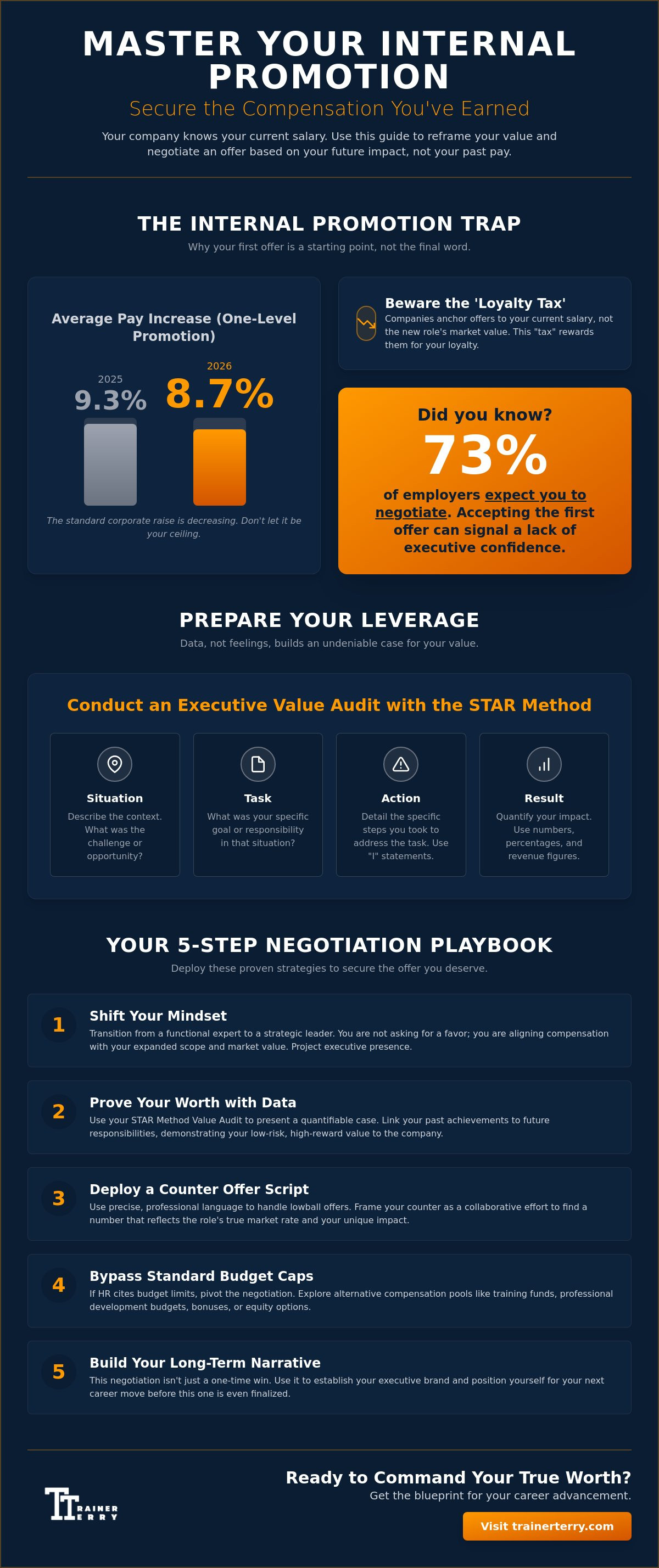
You've been grinding. You've hit every KPI. Now, the promotion is finally on the table. But when you see the numbers, they feel safe. That's the Internal Promotion Trap. In 2026, the average pay increase for a one-level promotion sits at 8.7 percent, which is actually a decrease from the 9.3 percent we saw last year. Why is this happening? Because your company is betting on your loyalty to save them money. They know your current salary; and they're using it as an anchor to keep their department costs down. It's time to break that anchor and realize that your first offer is almost always a lowball attempt based on your past, not your future.
Your existing relationship with the company isn't a liability that limits your pay. It's actually your greatest leverage. Think about the risk they take by hiring someone from the outside. They have to pay recruiter fees, wait months for onboarding, and pray the new person doesn't quit in ninety days. You are the proven, low-risk choice. In the 2026 market, internal retention is significantly cheaper for them than external hiring, even if they give you a massive raise. They need you to stay to maintain momentum. Don't let them convince you that you're lucky to be there. They're lucky to have a leader who already knows how to win.
Recognizing the 'Loyalty Tax' in 2026
HR departments often rely on your comfort level to bypass market rates. This is the "Loyalty Tax." If your new offer looks like a glorified cost-of-living adjustment rather than a reflection of your new responsibilities, you're being taxed for your tenure. You must identify this early. Is the bump based on a percentage of your old salary, or is it based on what the role actually pays in the open market? Applying fundamental negotiation principles allows you to see this offer for what it is: a starting point, not a final verdict. Since 73 percent of employers expect you to negotiate, accepting the first offer actually makes you look less like an executive and more like a junior employee who doesn't know their worth.
Shifting the Power Dynamic
You aren't just doing the job anymore. You're leading the function. This requires a massive psychological pivot. If you approach this meeting with a "just happy to be here" attitude, you've already lost the room. You need to establish executive presence from the very first thank you. This is where a precise counter offer negotiation script for a promotion becomes your most valuable tool. It reframes the discussion from asking for more money to aligning compensation with your expanded scope of impact. You're a business partner now. Partners don't work for discounts, and they certainly don't settle for the first number thrown across the table. If you want to master this transition, a Career Advancement Blueprint can help you map out the exact strategy needed to command the salary you deserve.
Preparing Your Leverage: The Value Audit and Market Benchmarking
Data is your armor. If you walk into a negotiation room relying on a "gut feeling" that you deserve more, you've already handed the advantage to HR. Your leverage doesn't come from your tenure or how hard you've worked; it comes from the specific, quantifiable ROI you've delivered. Before you even look at a counter offer negotiation script for a promotion, you must build a case that makes it impossible for them to say no. In 2026, with pay transparency laws expanding across at least 16 states, the information gap is closing. You have more access to data than ever before, so use it.
Don't forget your hidden leverage. Is your department currently understaffed? Are you the only one who understands the architecture of a critical project? This institutional knowledge is expensive to replace. When you factor in that organizations plan to promote around 9 percent of their workforce this year, you realize you're part of an elite group they cannot afford to lose. You need to establish your "Target Number" based on market peak and a "Walk-Away Number" where the increased stress of the new role simply isn't worth the paycheck.
The Executive Value Audit (STAR Method)
You need to translate your daily tasks into executive wins using the STAR method: Situation, Task, Action, and Result. Don't just say you managed a team; say you inherited a department with 20 percent turnover and implemented a mentorship program that halted exits for twelve months. Link every past win to a future responsibility in your new role. My primary ROI over the last year was delivering a 12 percent increase in regional revenue by optimizing the supply chain, directly adding 1.4 million dollars to the bottom line. If you want to refine these points, you can schedule a free strategy call to map out your specific wins before the big meeting.
2026 Market Benchmarking Strategies
Generic salary aggregators are often outdated or too broad. In 2026, you should prioritize niche industry reports and the "Network Intel" method. Reach out to peers in your industry and ask: "I'm benchmarking a senior lead role for an internal move; based on your experience, what's the current range for someone delivering X results?" This provides real world context that a website can't match. Researching these figures prevents you from making common negotiation mistakes like basing your request on personal expenses rather than market reality. Remember to look at the total package:
- Base Salary: Aim for the upper end of the company's stated pay band.
- Performance Bonuses: Ensure these are tied to the metrics you've already proven you can hit.
- Equity and Lifestyle: If the salary budget is truly capped, pivot to stock options or flexible work arrangements.
3 High-Impact Counter Offer Scripts for Internal Promotions
Preparation is useless if you stumble during the delivery. You've done the audit and found the data. Now, you need to execute. How you frame your request determines whether you're seen as a rising executive or a disgruntled employee. Remember that 73 percent of employers expect a negotiation. If you stay silent, you aren't being a "team player"; you're showing them you don't understand your own market value. Use these scripts to stay firm, professional, and results-oriented.
Timing is everything. Never counter the moment you receive the offer. Take 24 hours to review the details. When you return, lead with the "strategic pause." State your counter clearly, then stop talking. The silence creates a vacuum that the other side will often fill with concessions or vital information about their budget flexibility. Learning how to counter a job offer effectively requires you to treat the conversation as a collaborative problem-solving session rather than an ultimatum.
Script 1: The Market Realignment Approach
This script is your best weapon when the offer is a standard lowball based on your current salary rather than the role's value. "I truly appreciate the leadership’s trust in me for this role, and I’m fully committed to the vision we’ve discussed for the department. However, after reviewing the 2026 market benchmarks and our internal pay transparency data, the base salary in this offer is below the standard for this level of responsibility. Based on the increased scope and the market data for [Title], I’m looking for a base of [Number] to align with the value I’m bringing to this function."
Script 2: The Increased Responsibility Pivot
Use this when the role they’re giving you is significantly larger than the official job description suggests. "Thank you for the offer. I’m excited to step up. As we discussed, this role now includes [Project X] and [Responsibility Y], which are massive revenue drivers. This counter offer negotiation script for a promotion focuses on the ROI you'll deliver. Since the actual expectations have expanded beyond the initial scope, I’d like to adjust the compensation to [Number] to reflect the direct impact I’ll be having on our bottom line." If you need to sharpen your delivery, you should Learn more about Interview Strategy and Preparation.
Script 3: Negotiating Beyond the Base Salary
If HR hits you with a hard "budget cap" on base salary, don't walk away yet. Pivot to the "Total Rewards" model. "I understand the base salary budget is firm for this quarter. To bridge the gap between this offer and the market rate, I’d like to propose a success-based bonus tied to our Q3 targets or an immediate grant of additional equity. Can we also include a formal mid-year salary review in six months to realign with the market?" You can Schedule a free strategy call to refine your script before you walk into that room.
Handling Internal Objections: Navigating Budget Caps and Equity
HR's primary weapon is the "standard policy." They'll tell you that the company doesn't allow more than a 10 percent jump for internal moves. This is often just a psychological anchor designed to see if you'll fold. In 2026, where 70 percent of organizations listing pay ranges report better candidate quality, you have the right to challenge these arbitrary caps. If you encounter this, your counter offer negotiation script for a promotion should pivot the focus from a "raise" to a "level reclassification." You aren't just getting more money for the same job; you're moving into a different tier of value altogether. This shift bypasses many of the standard percentage rules that bind middle management.
Internal equity is another common hurdle. HR might claim they can't pay you more because it wouldn't be fair to your peers. This is a deflection. Your compensation should be based on your specific impact and market value, not the lowest common denominator in your department. Remind them that more than 20 states now have salary history bans, meaning your past pay shouldn't dictate your future. If they truly can't move on the base salary, it's time to look for money in different buckets. Often, the "salary" budget is locked, but the "training" or "retention" buckets are wide open. Finding these gaps is how you secure the win when the front door is closed.
Defeating the 'Standard Increase' Myth
Policy is a guideline, not a law. If the budget for your current department is capped, ask where the flexibility lies. Is there a different bucket for talent retention or executive transitions? Using Executive Presence during this pushback is critical. You must stay calm, cite the market data we already established, and remain firm on the ROI you deliver. If they say the policy is fixed, ask: "Who has the authority to grant an exception for high-impact roles?" This identifies the real decision-maker and moves you past the gatekeepers.
What to Do When the Answer is 'Not Now'
Sometimes the answer really is "not right now" due to fiscal cycles. Don't let that be the end of the story. Negotiate for a "trigger-based" review. This means you agree to the current offer on the condition of a formal salary realignment in six months, tied to specific KPIs. You can also negotiate for high-value assets like Leadership Development funds. This increases your future market value even if the cash isn't hitting your bank account today. It's about playing the long game. If you're feeling stuck between a budget cap and your target number, book a strategy call today to find your hidden leverage and plan your next move.
Beyond the Script: Long-Term Career Positioning Strategy
The signature on your new contract isn't the finish line; it's the starting block. You've successfully used a counter offer negotiation script for a promotion to secure your worth, but your long-term positioning starts today. If you want to keep that momentum going, you can't go back to just doing the job. You need to transition from a high-performing doer to a recognized thought leader within your organization. This requires a shift in how you communicate your results to leadership every single week. Negotiation is a continuous cycle of value demonstration, not a one-time event you dread once a year.
Internal leverage is built in the quiet months between promotions. In 2026, where organizations plan to promote around 9 percent of their workforce, the competition for top-tier executive slots is fierce. You must ensure your name is the first one that comes to mind when high-impact projects arise. This means your "Executive Narrative" needs to be consistent, data-driven, and visible to the people who control the budgets. Don't wait for a formal review to highlight your impact. Share your wins as they happen, framing them as milestones in the company’s broader success story.
Continuous Value Communication
Your STAR wins shouldn't live in a dusty file until next December. Document them in real time. When you solve a crisis or hit a revenue target, frame it as a business win immediately. This is how you build an "Executive Narrative" that makes the next negotiation even easier. Your internal leverage is also directly tied to your external perception. Even if you aren't looking for a new role, your LinkedIn Positioning must reflect your new level of authority. When leadership sees you being recognized as an industry expert by your peers, your internal value skyrockets. It reminds them that you have options, which is the ultimate negotiation tool.
Your Strategic Blueprint for 2026
High-stakes corporate moves shouldn't involve guesswork or anxiety. The 2026 market moves fast, and you need a system that keeps you ahead of the curve. The Career Advancement Blueprint is designed to turn your career trajectory into a calculated growth strategy. It's not just about one script; it's about a complete positioning overhaul. Through personalized coaching, we remove the "what if" from your internal moves. We provide the psychological frameworks and communication strategies needed to command respect at the highest levels. We'll help you develop a Career Narrative that makes your value undeniable to even the toughest HR departments. You've proven you have the discipline to lead. Now, give yourself the tools to dominate. Apply for the Blueprint today and start your journey toward executive mastery.
Command Your Value and Lead with Authority
You've done the hard work. You've audited your wins and mastered the data. Now it's time to execute. Remember that your first offer is just a starting point; it's not a final verdict on your worth. By using a precise counter offer negotiation script for a promotion, you aren't just asking for more money. You're establishing yourself as a strategic partner who understands the bottom line. Don't let corporate policies or budget caps dictate your ceiling. You have the tools to bypass the standard increase and secure a package that reflects your actual market impact.
This journey is led by a former Corporate VP with over 20 years of experience, using proven STAR method frameworks designed for high-stakes executive positioning. Ready to stop guessing and start leading? Secure your next promotion with the Career Advancement Blueprint. It's time to own your narrative and lead with the confidence you've earned. Your future doesn't happen by accident. You build it right now.
Frequently Asked Questions
Is it risky to negotiate a promotion offer internally?
It isn't risky if you remain professional; it's actually a sign of leadership. Negotiating shows you understand the business value of the role and your own impact. Most executives expect a back and forth, and staying silent can signal that you don't realize the market worth of your new title. It establishes you as someone who knows how to handle high-stakes business discussions.
What if HR says there is a hard cap on internal salary increases?
You should ask for a level reclassification or an exception based on high impact. HR policies are guidelines, not laws, and they're often used as a first line of defense to control costs. If they won't budge on the percentage, ask who has the authority to approve a market realignment. This moves the conversation from "company rules" to "business reality."
Can I negotiate for more vacation time instead of a higher salary?
Yes, lifestyle benefits are highly negotiable when base salary budgets are frozen. If the cash isn't there, pivot to more PTO, flexible work arrangements, or professional development funds. These assets increase your long-term value and quality of life without hitting the department's salary cap. It's about finding value in different "buckets" of the company budget.
How do I use the STAR method during a salary negotiation?
Use the Result part of the STAR method to justify your request with hard numbers. Don't just list tasks; show the revenue generated or costs saved during your previous projects. When using a counter offer negotiation script for a promotion, lead with the specific ROI you've delivered over the last year to prove you're already operating at the next level.
Should I mention a competing external offer during my promotion talk?
It's usually better to focus on your proven internal value and market data first. Mentioning an external offer can feel like an ultimatum, which might damage the long-term trust you've built with your boss. Only bring it up if you're actually prepared to leave and want to show that your market value is being validated by a competitor.
What is the best way to follow up after sending a counter-offer email?
You should wait at least 48 to 72 hours before sending a polite, professional nudge. Keep it short and focused on the next steps rather than re-litigating your points. A simple message stating you're looking forward to finalizing the details of your new role keeps the momentum going without making you sound desperate for an answer.
How do I handle it if my boss gets defensive about my request for more pay?
You need to remain calm and immediately bring the focus back to the business goals. If your boss gets emotional, say, "I'm fully committed to our team's success, which is why I want to ensure my compensation aligns with the market for this expanded scope." It's very difficult for a leader to argue with objective data and a clear commitment to results.
What are the most common mistakes professionals make in promotion negotiations?
The biggest mistake is making the request about your personal expenses instead of your professional results. Another error is neglecting to have a counter offer negotiation script for a promotion ready, which leads to stumbling when HR pushes back with standard objections. Always base your numbers on market benchmarks and the value you'll create in the new role.

Article by
Terry Jones
Terry Jones is the Founder and Chief Career Strategist of the Career Advancement Blueprint and Executive Coach and Lead Consultant at FireBridge Consulting.
As an ICF Certified Accredited Career Coach and Certified Master Career Services professional, he partners with professionals at all levels, including senior leaders and executives, to navigate career transitions, secure new opportunities, and position themselves for advancement. His approach goes beyond surface level coaching, focusing on how individuals think, communicate, and lead so they can operate with clarity, authority, and strategic intent in high stakes environments.
In his work as an executive coach, Terry engages in high impact advisory conversations that help leaders strengthen decision making, elevate their presence, and align their leadership style with organizational expectations. He is known for helping clients translate their experience into influence, ensuring they are not only seen for what they have done, but trusted for what they are capable of leading next.
With over 20 years of corporate experience, including serving as a Vice President and leading Learning and Development functions for three New York City organizations, Terry brings a deep understanding of how companies evaluate talent, develop leaders, and make promotion decisions. This allows him to bridge the gap between individual ambition and organizational reality.
His insights have reached over 630,000 followers and generated more than 70 million video views, where he shares direct, experience driven guidance that helps professionals think differently and take action.