Negotiating a Job Offer with Multiple Companies in 2026: The Strategic Blueprint

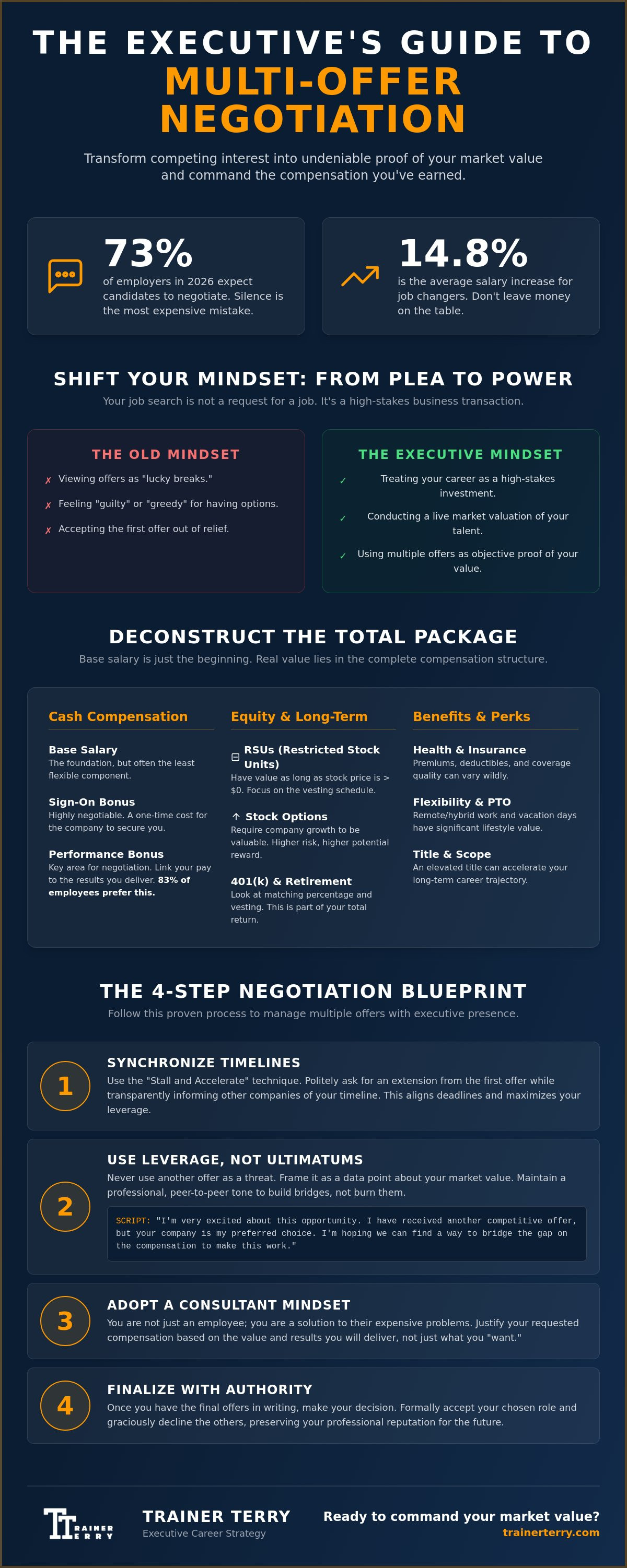
Stop treating your career like a series of lucky breaks and start treating it like the high-stakes investment it is. If you're currently negotiating a job offer with multiple companies, you aren't "playing" anyone; you're conducting a live market valuation of your executive talent. With 73% of employers expecting you to negotiate in 2026, silence is the only way to lose. Research shows job changers are currently seeing an average salary increase of 14.8%, yet many leaders still freeze when faced with "exploding offers" or complex tax brackets. You feel the pressure of those 48-hour deadlines. You worry about your reputation. That ends today.
I know the anxiety that comes with comparing RSUs, performance bonuses, and health premiums across different states with varying pay transparency laws. It's overwhelming to weigh long-term growth against immediate liquid cash. This guide is your strategic blueprint to handle these conversations with absolute executive presence. You'll learn how to synchronize offer timelines, decode total compensation packages, and use your leverage to command the terms you've earned. Let's build the career narrative that puts you in the driver's seat and secures the future you've worked for.
Key Takeaways
- Learn how to transform competing interest into objective proof of your market value, leveraging the "social proof" effect to command higher compensation.
- Master the strategic blueprint for negotiating a job offer with multiple companies by using the "Stall and Accelerate" technique to align conflicting timelines.
- Discover how to accurately value complex executive packages, focusing on RSUs and performance incentives rather than just base salary in the 2026 market.
- Adopt a "consultant" mindset to justify your price point using high-performance logic, ensuring you stay professional and avoid the "greedy" label.
- Navigate the final steps of acceptance and rejection with authority, securing your top choice while protecting your long-term professional reputation.
The Leverage of Choice: Why Multiple Job Offers Are Your Greatest Career Asset
Stop viewing a job search as a plea for employment. It's a business transaction. In 2026, having multiple offers isn't a source of stress; it's your most powerful asset. Multi-offer leverage is the objective, undeniable proof of your market value. When you're negotiating a job offer with multiple companies, you're essentially conducting a real-time audit of what the industry is willing to pay for your specific results. You have the receipts. This data allows you to speak from a position of strength, not desperation.
The #1 mistake I see senior professionals make is accepting the first offer out of pure relief. They want the uncertainty to end, so they sacrifice the strategy. Don't fall into this trap. Companies actually value candidates who are in high demand. This is the "Social Proof" effect in action. When a hiring manager knows you're being pursued by competitors, their desire to "win" you increases. It confirms their judgment. You aren't "playing" them. You're performing essential due diligence on your own career trajectory to ensure the fit is right for both sides. Since 73% of employers anticipate that job applicants will negotiate, failing to do so actually makes you look less like an executive and more like an amateur.
Reframing the 'Guilt' of Competing Interest
Get rid of the guilt immediately. Professional loyalty is a commitment that starts only after the contract is signed. Until that pen hits the paper, you're a free agent. Remember that hiring managers are also "selling" their company to you. They expect you to look at the market. Market Validation is the alignment of multiple professional valuations into a single, clear price point for your talent. If three different companies see your value, you aren't being greedy. You're being accurately priced. This is a core component of any high-level Career Advancement Blueprint. Don't apologize for being the solution to their most expensive problems.
The Difference Between Leverage and Ultimatums
Leverage builds bridges. Ultimatums burn them. Never use another offer as a threat. Instead, use it as a tool for transparency. Tell them: "I've received another offer that is very competitive in terms of equity, but your mission aligns more closely with my goals. Can we bridge the gap on the base?" You don't always need to share company names. Keep that information private to maintain your executive presence. By mastering effective negotiation tactics, you position yourself as a high-value asset that simply requires a competitive investment. You're showing them that you know your worth. In 2026, that's exactly the kind of leader companies want to hire. They aren't just buying your time; they're investing in your ability to drive results.
Calculating the Total Value: Beyond the Base Salary
Stop staring at the base salary number. In the executive world, that figure is often the least flexible and least impactful part of your wealth creation. When you are negotiating a job offer with multiple companies, you need to look at the total package. This includes performance-based incentives, which 83% of employees now prefer over fixed pay according to 2026 market trends. Look for sign-on bonuses, relocation packages, or performance accelerators that trigger higher payouts when you hit specific milestones. These are one-time costs for a company and are often much easier to secure than a permanent increase in base pay.
Equity is where real wealth is built, but it requires a sharp eye in a volatile 2026 market. Are they offering Restricted Stock Units (RSUs) or stock options? RSUs have value as long as the stock price stays above zero, while options require growth to be worth anything at all. You must understand the vesting schedule. A four-year vest with a one-year cliff is standard, but you can often negotiate for monthly vesting after the first year. This is how you negotiate from a point of power by showing you understand the financial mechanics of the business you are joining.
The Offer Comparison Framework
Compare "Hard Benefits" like cash and 401(k) matching against "Soft Benefits" such as remote flexibility and title scope. Assign a weight to each based on your current life stage. If Company A offers $20,000 more but requires 50% travel, is that cash worth the potential burnout? Don't ignore the "Growth Premium." A slightly lower offer at a high-growth scale-up might be worth significantly more in three years than a stagnant role at a legacy firm. Calculate the opportunity cost of staying comfortable. Watch for red flags in the fine print, such as vague bonus structures or "discretionary" equity grants that lack a defined formula.
Justifying Your Counter-Offer with Market Data
Don't just ask for more because you want it. Use hard data. Sites like Levels.fyi provide a baseline, but your best data point is your competing offer. Cite that offer as a market benchmark rather than a demand. You can tell a recruiter: "The market for my specific skillset is currently benchmarking at this level, as evidenced by another offer I'm evaluating, but your team is my first choice." This keeps the conversation collaborative and professional. If you're struggling to weigh these variables, you can schedule a free strategy call to audit your specific offers and identify which one truly aligns with your long-term trajectory.
The Synchronization Strategy: Managing Offer Timelines
Timing is the invisible lever in any high-stakes career move. If you are negotiating a job offer with multiple companies, you aren't just comparing numbers; you're managing a complex calendar. Most professionals fail because their offers arrive weeks apart, forcing them into a corner. You must become the conductor of this process. The 'Stall and Accelerate' technique is your primary tool here. You need to slow down the company that moved too fast while putting a tactical fire under your preferred choice. This ensures you have all your options on the table at the exact same moment.
Don't let an "exploding offer" rattle your focus. A 48-hour deadline is a psychological anchor designed to trigger fear and stop you from looking elsewhere. High-level executives don't make life-altering decisions under artificial duress. Handle these deadlines with poise. In 2026, a one-week extension is a standard and reasonable request for senior roles. If a company refuses to grant you a few extra days to review a multi-year commitment, they're showing you exactly how they'll treat you as an employee. That's a red flag you can't ignore.
How to Ask for an Extension Without Sounding Uninterested
Framing is everything. Never tell a company you're waiting for a better deal. Instead, use the 'Due Diligence' script. Frame the delay as a sign of your professional thoroughness. Use specific phrasing: "I'm incredibly excited about the potential here. Because I take my professional commitments seriously, I want to ensure I can commit 100% to this decision. I need until Friday to finalize my review of the full package." This protects your Executive Presence and shows you're a leader who makes calculated moves.
Accelerating the Lagging Offer
If your dream role is dragging its feet while another offer is on the table, use that leverage immediately. Contact the recruiter or hiring manager at your preferred company. Be direct and transparent: "I've just received a written offer from another firm, but I'd much rather work with your team. Can we accelerate the final decision so I can make an informed choice by the end of the week?" This is the 'Final Call' strategy. It forces them to move while signaling that you're a high-value asset that won't stay on the market for long. It turns their "maybe" into a "yes" by introducing the very real risk of losing you to a competitor.
The Peer-to-Peer Negotiation Script: How to Handle the Conversation
Stop acting like an applicant. Start acting like a consultant. When you're negotiating a job offer with multiple companies, you aren't asking for a favor. You're setting the price for a solution to their business problems. If they have a multi-million dollar revenue gap and you're the person who can close it, a $20,000 difference in base salary is a rounding error. Use the STAR method logic to justify your price point. Remind them of the specific Situation and Task you handled, the Action you took, and the measurable Result you achieved. Your compensation is simply a percentage of the value you create.
Master the "Sandwich Technique" to keep the conversation productive. Start with genuine enthusiasm for the team and the mission. Insert your data-backed ask in the middle. Close with a restatement of your commitment to the role. If they hit a hard budget cap, don't panic. Pivot immediately to non-monetary benefits like accelerated vesting, increased PTO, or a professional development budget. Every "no" on salary is an opportunity to say "yes" to a different lever of value. You're building a partnership, not winning a fight.
The 'Competing Offer' Script
Transparency is your edge. You don't need to be aggressive. Use this word-for-word phrasing: "I’ve received another offer that is more aligned with the current market for my skill set, but your company remains my top choice because of the specific challenges we discussed." This signals your value without making it feel like a threat. You don't need to name the other company yet. Keep them focused on the market rate, not the competitor's logo. Once you make your ask, use the "Strategic Pause." The Strategic Pause is the sound of your value sinking in; don't interrupt it.
Negotiating with Your Future Manager vs. HR
HR follows a grid. Your future manager follows a goal. Whenever possible, keep the value-based discussion with the person who has the most to gain from your success. Empower your future boss by giving them the data they need to fight for your budget internally. Tell them exactly why you're worth the extra investment and how you'll make their life easier. They want you on their team to solve their problems. If you want to refine these scripts in a high-pressure environment, sign up for 1-on-1 Job Interview Prep to run mock negotiation sessions before the real call.
Securing the Win: Finalizing the Offer with Authority
You've done the heavy lifting. You've balanced the scales while negotiating a job offer with multiple companies and arrived at a decision that aligns with your worth. But don't celebrate just yet. The space between a verbal agreement and a signed contract is the danger zone. A verbal "yes" is a signal of intent, not a legal obligation. Never resign from your current position or stop your momentum until you have a finalized, written offer in your inbox. This document must reflect every single detail you fought for, from the specific RSU vesting schedule to the performance-based accelerators. If it isn't on paper, it doesn't exist.
In the 2026 market, precision matters. Take the time to audit the final contract against the current 2026 tax brackets and the $16,100 standard deduction for single filers. You need to know exactly what your net take-home pay looks like after all the high-level math is done. This isn't being difficult; it's being a professional. Once the contract is signed, your focus shifts immediately to the "First 90 Days" mindset. You aren't just starting a job. You're launching a new phase of your career with the momentum of a successful negotiation behind you. Use that energy to drive results from day one.
Declining with Grace
Reputation is the only currency that never devalues. You likely have a "silver-medal" company that was a close second. Don't ghost them. Use the "Not Now, But Maybe Later" script to protect your professional network. Tell them: "I've decided to move forward with another opportunity that aligns with my current growth phase, but I've been incredibly impressed by your team. Let's stay in touch as our paths will likely cross again." This keeps the door open for future leadership roles or advisory positions. Building this kind of long-term strategic network is a core pillar of the Career Advancement Blueprint. Treat every rejection as a "see you later" rather than a "goodbye."
Setting the Stage for Your First Promotion
The terms you negotiate today set the floor for your next raise. If you've secured a competitive package, you've already established a high ceiling for your future internal advancement. Don't let the conversation end at the signature. Document the "Performance Triggers" you discussed during the negotiation process. Send a brief, professional recap to your new manager: "I'm excited to hit the ground running. To recap our discussion, we've agreed to revisit the compensation structure once the initial Q3 growth targets are achieved." This turns a verbal promise into a roadmap for your next promotion. Negotiation is the first act of your leadership in this new role. You've shown them you're a high-value asset; now it's time to deliver the results that justify their investment.
Take Command of Your Executive Future
You've moved past the anxiety of "exploding offers" and decoded the true value of complex equity packages. You now understand that negotiating a job offer with multiple companies is actually your final interview. It is the moment you prove you can handle high-stakes synchronization and professional communication under pressure. By using the STAR-method logic to justify your value and maintaining your executive presence through every stall and acceleration, you've set a new floor for your career. Don't let that momentum go to waste by second-guessing your final move.
Terry brings over 20 years of experience as a former Corporate VP to help you navigate these critical transitions. Through the proven Career Change Blueprint methodology, we specialize in turning high-demand candidates into high-earning leaders. You've done the hard work of securing the offers; now ensure you secure the terms you actually deserve. Stop leaving money on the table; book your free Strategy Call with Terry today. Your next chapter is waiting for a leader who knows their worth. Go out there and claim it.
Frequently Asked Questions
Is it okay to tell a company I have another job offer?
Yes, sharing that you have a competing offer is a professional move that validates your market value. In 2026, 73% of employers expect you to negotiate, and being transparent about your options shows you're a high-demand asset. It changes the dynamic from you asking for a job to them competing for your talent. Just keep the tone collaborative rather than confrontational.
Can a company rescind an offer if I try to negotiate?
While technically possible, it's incredibly rare for a company to rescind an offer simply because you negotiated professionally. Most firms build a "negotiation buffer" into their initial offer. If a company pulls an offer because you asked for a market-rate adjustment based on data, they've revealed a toxic culture. You've just avoided a major professional mistake by finding that out early.
How do I handle an 'exploding offer' with a very short deadline?
Don't let an artificial 48-hour deadline force a panicked decision. Request an extension by framing it as your commitment to thoroughness. Tell them you need a few extra days to review the full package details to ensure you can commit 100% to the role. Professional organizations will respect your executive presence and almost always grant the extra time you need.
What if the company I prefer offers less money than the other one?
Use the higher offer as a benchmark to bridge the gap at your preferred company. Be direct: "I'd rather work with your team, but I have another offer at a higher price point." Ask if they can match the base or offer a sign-on bonus to make the decision easier. This is the core of negotiating a job offer with multiple companies successfully.
Should I lie about having another offer to get more leverage?
Never lie about having a competing offer. The professional world is smaller than you think; getting caught will destroy your reputation and your offer instantly. If you don't have another offer, focus on market data from 2026 pay transparency laws instead. Authenticity is a non-negotiable requirement for high-level leadership. Stick to the facts and your own proven value.
How do I compare a startup equity offer with a corporate cash offer?
Weigh the "liquid cash" of a corporate role against the "potential wealth" of startup equity. Corporate offers provide immediate stability; startup RSUs or options are a bet on future growth. Look at the company's funding stage and the 2026 market volatility. If you can't pay your bills with it today, treat equity as a long-term bonus rather than guaranteed income.
What is the best way to decline a job offer after negotiating it?
Decline immediately once you've signed your top choice. Be brief, grateful, and professional: "I've decided to move forward with another opportunity that aligns better with my current growth goals." Don't burn the bridge. A gracious exit ensures you remain a top candidate for future executive roles or advisory positions at that company later in your career.
How much of an increase is reasonable to ask for with multiple offers?
A 10% to 20% increase over the initial offer is a standard starting point for negotiation. Since job changers in 2026 are seeing an average salary increase of 14.8%, aim for that range as your baseline. Always justify the number with specific results you've delivered. Negotiating a job offer with multiple companies allows you to push toward the higher end of that bracket with confidence.

Article by
Terry Jones
Terry Jones is the Founder and Chief Career Strategist of the Career Advancement Blueprint and Executive Coach and Lead Consultant at FireBridge Consulting.
As an ICF Certified Accredited Career Coach and Certified Master Career Services professional, he partners with professionals at all levels, including senior leaders and executives, to navigate career transitions, secure new opportunities, and position themselves for advancement. His approach goes beyond surface level coaching, focusing on how individuals think, communicate, and lead so they can operate with clarity, authority, and strategic intent in high stakes environments.
In his work as an executive coach, Terry engages in high impact advisory conversations that help leaders strengthen decision making, elevate their presence, and align their leadership style with organizational expectations. He is known for helping clients translate their experience into influence, ensuring they are not only seen for what they have done, but trusted for what they are capable of leading next.
With over 20 years of corporate experience, including serving as a Vice President and leading Learning and Development functions for three New York City organizations, Terry brings a deep understanding of how companies evaluate talent, develop leaders, and make promotion decisions. This allows him to bridge the gap between individual ambition and organizational reality.
His insights have reached over 630,000 followers and generated more than 70 million video views, where he shares direct, experience driven guidance that helps professionals think differently and take action.