How to Choose Career Advisors in 2026: The Executive’s Strategic Guide

Working harder won't save you from a stagnant salary in a market where AI algorithms now filter out 75% of executive resumes before a human even sees them. You’re hitting your KPIs and leading your team, but your bank account and title haven’t moved since early 2024. It’s a bitter pill to swallow when you’re doing the heavy lifting but staying invisible to the recruiters who hold the keys to the C-suite. Most executives think they can muscle through this alone, but without the right career advisors, you’re just running on a treadmill that’s going nowhere fast. Stop wasting your energy on outdated tactics that don’t move the needle.
You’ve likely realized that elite performance requires elite coaching. I’m going to show you how to identify, vet, and leverage the right partners to secure a 20% salary bump and a title that matches your impact. This is about more than just a resume refresh; it’s about building a refined executive brand that thrives in the 2026 digital shift. We’ll dive into a strategic roadmap for interview mastery and the exact vetting process you need to find a mentor who plays to win as hard as you do.
Key Takeaways
- Stop settling for generalists and learn why your 2026 career strategy demands a specialist growth partner who speaks the language of the C-suite.
- Master a 5-point vetting framework to select elite career advisors with the proven corporate pedigree required to navigate high-stakes executive roles.
- Decode the critical differences between tactical advisors and leadership coaches to ensure you hire the right muscle for your specific career pivot.
- Learn to leverage radical transparency and a consultant-style partnership to eliminate your professional gaps and fast-track your next promotion.
- Discover the "Career Change Blueprint" and stop making excuses-it’s time to trade generic advice for the executive authority that commands results.
The Evolution of Career Advisors: Why Generalists Fail Executives in 2026
If you're still treating your career like a slow climb up a wooden ladder, you're already behind. The 2026 corporate landscape is a high-speed race, and the old rules are dead. Most people think they need a cheerleader when things get tough. They're wrong. In a market where AI handles the baseline and human leadership is the only real premium, you don't need a "helper." You need a strategic growth partner. This is the new standard for career advisors who actually deliver results.
The "one-size-fits-all" approach to career help is a relic of the past. If your advisor is giving you the same advice they give a mid-level manager, they're costing you money. Senior roles in 2026 require surgical precision. You aren't just looking for a job; you're engineering a long-term market position. This shift means moving away from reactive job searching and toward proactive brand building. You need someone who understands corporate leadership experience because they've lived it, not because they read a blog post about it.
- Strategic Positioning: Moving from "qualified candidate" to "indispensable asset."
- Market Dynamics: Navigating 2026's shift toward outcome-based compensation.
- Execution Focus: Replacing vague goals with a 90-day roadmap to your next promotion.
Stop settling for participation trophies in your professional life. The difference between a 3% annual raise and a 25% jump into a C-suite role isn't luck. It's the quality of the strategy you're executing every single day. If your current plan doesn't make you feel a little uncomfortable, it's probably not aggressive enough to win in this climate.
Career Advisor vs. Career Counselor: Knowing the Difference
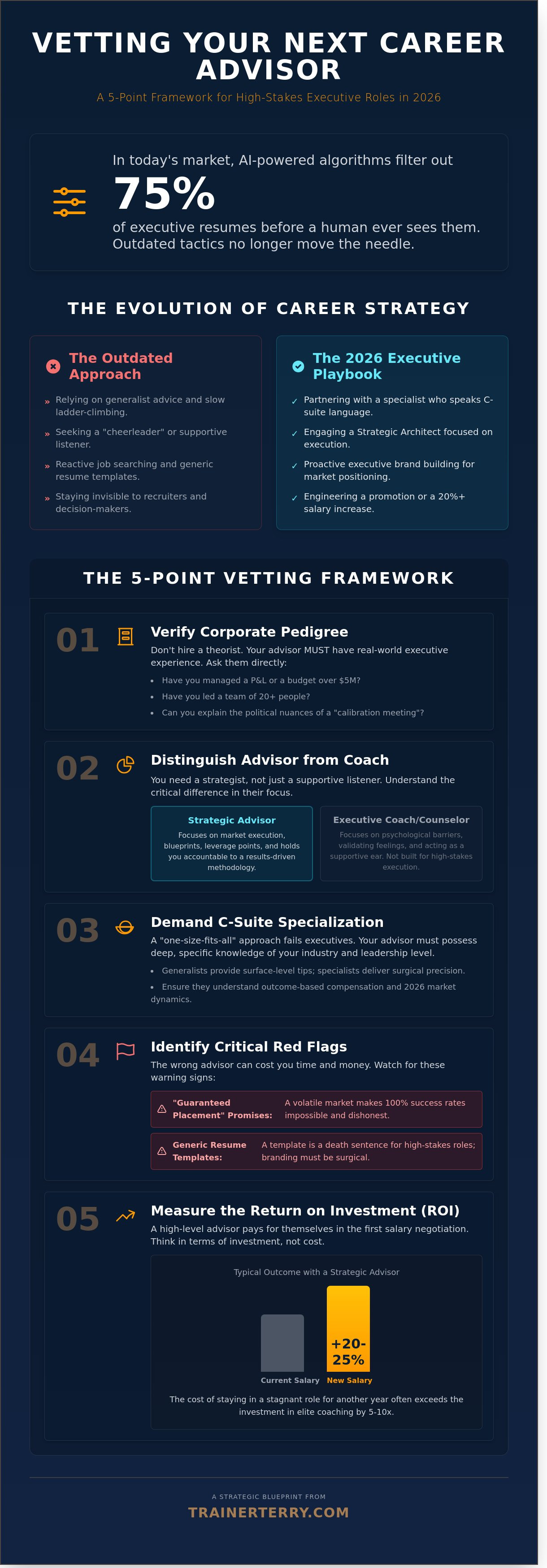
Don't confuse these two roles. Counselors focus on your psychological barriers and being a supportive listener. That's fine for therapy, but it won't get you a corner office. Modern career advisors function as Strategic Architects. They don't care about your excuses; they care about your market execution. They build the blueprint, identify the leverage points, and hold you accountable to a results-driven methodology. You need a partner who invests in your win, not someone who just validates your feelings.
The ROI of Strategic Career Advice
Think about the cost of staying in your stagnant role for another 12 months. If you're underpaid by $30,000 or $50,000, that's a direct hit to your wealth every single day you hesitate. A high-level advisor pays for themselves during the first round of salary negotiation alone. They find the hidden value in your track record that you're too close to see. It's time to stop guessing and start winning. Dive into the Career Advice 2026: The Strategic Blueprint to see how we engineer these breakthroughs for leaders who are ready to level up.
How to Vet Career Advisors: A 5-Point Framework for High-Stakes Roles
Stop treating your career like an amateur sport. If you're gunning for a promotion that adds $50,000 or more to your annual compensation, you can't rely on surface-level tips. You need career advisors who understand the mechanics of power. Most coaches are just cheerleaders with a LinkedIn account. You don't need a cheerleader. You need a strategist who has survived the corporate trenches and knows how the gatekeepers think.
The "Corporate Insider" Litmus Test
Don't hire anyone who hasn't managed a P&L. If they haven't been responsible for a $5M budget or led a team of 20 plus people, they're guessing. You need the perspective of a former VP or Director. Ask them how they handled internal promotion cycles in 2023. If they can't explain the political nuances of a "calibration meeting," they aren't qualified to guide you. They should help you see the entire board, not just your next move. Practical experience beats theory every single time.
Red Flags in Career Advising
Watch out for "guaranteed placement" scams. The market is volatile, and anyone promising a 100% success rate is hiding the truth. Avoid advisors who hand you a generic resume template. In high-stakes roles, a template is a death sentence. Your branding must be surgical and unique. You can see the difference in these Resume Examples 2026: Strategic Blueprint which focus on high-performance metrics rather than boring task lists.
To win, your career advisors must master these three specific pillars:
- Positioning Strategy: They should pivot your brand from "doer" to "leader." This involves rewriting your value proposition to focus on future ROI. If they focus on what you did in 2018 instead of the $2.4M you'll save the company next year, fire them.
- STAR Method Mastery: They must drill you on the Situation, Task, Action, Result framework. If your stories don't include specific numbers, like a 14% increase in operational efficiency, they're useless in an executive interview.
- Executive Presence: This is the "it" factor. Your advisor should coach you on your tone, your posture, and how you handle hostile questions. It's about commanding the room before you even speak.
Don't just hope for a raise. Build a plan. If you're ready to stop making excuses and start executing at a higher level, look into a specialized Career Advancement Blueprint to map out your next 12 months. Results don't happen by accident; they happen by design.
Advisors vs. Executive Coaches: Which Partnership Drives Results?
You don't walk into a gym without a plan and expect a 200kg deadlift by accident. Career growth works exactly the same way. You need the right support system to hit your personal record. Most professionals confuse career advisors with executive coaches. They aren't the same tool. One builds your engine; the other teaches you how to drive it at 200 mph. Career advisors focus on the tactical "how" of your next move. They fix your digital footprint and optimize your searchability. Executive coaches look at your mindset and leadership style. To get that promotion, you usually need a blend of both.
Think of it as progressive overload for your career. If you've been stuck at the same salary for 3.5 years, your current strategy has plateaued. You need a new stimulus. Trainer Terry bridges this gap by combining the tactical precision of high-end career advisors with the psychological grit of leadership development. We don't just give you a template; we build the muscle required to carry a bigger title.
When an Advisor is the Right Move
Hire an advisor when you need immediate, measurable impact on your market value. If your LinkedIn profile gets less than 15 high-value headhunter views per month, your brand is effectively invisible. You need a Career Positioning Strategy. This isn't just a simple resume update. It's a total rebrand of how the industry perceives your output. It's the difference between being seen as a "reliable worker" and being the "obvious solution" to a company's $500,000 problem. You need an advisor when you're targeting a 20% salary jump or a specific industry pivot that requires a fresh narrative.
The Role of Executive Coaching in Career Growth
Coaching is about the "soft skills" that carry the most weight in the C-suite. A 2023 industry report showed that 75% of long-term job success depends on emotional intelligence and political navigation rather than technical knowledge. You have to master internal advancement planning. This means managing corporate politics and building a reputation months before the promotion meeting even happens. If you want to sustain your growth and build a legacy over the next 10 years, look into the Career Advancement Blueprint. It's designed to help you master the executive presence required to lead at the highest level. Stop guessing and start executing with a professional framework.
Maximizing Your Investment: How to Collaborate for a Promotion or Pivot
Stop viewing professional help as a passive service. Success requires skin in the game. When you hire career advisors, you aren't buying a finished product; you're entering a high-intensity partnership. Treat your advisor like a strategic consultant who needs every piece of data to build your roadmap. If you hide your professional scars, you're only sabotaging your own ROI. Radical transparency regarding your career gaps or that 2023 performance plateau is the only way to build a bulletproof defense for your promotion meeting.
Think of your LinkedIn profile as a 24/7 lead-generation tool rather than a static resume. Data from 2024 shows that 94% of recruiters use the platform to vet internal candidates before a promotion is even announced. Optimization isn't just about a professional headshot. It involves keyword-stacking your headline and quantifying your achievements so the algorithm works for you while you sleep. You're building a brand that demands a higher salary.
Preparing for Your First Strategy Session
You wouldn't walk into a gym without knowing your current max lift. Don't show up to a session without auditing your career narrative. Identify your number one corporate hurdle immediately. Is it a 15% salary gap compared to peers? Is it a perceived lack of leadership experience? Define the obstacle so your advisor can dismantle it. It's time to stop guessing and start executing. Schedule a Free Strategy Call to map out your next move.
Mastering the STAR Method with Your Advisor
Winging it is the primary reason 85% of executives fail their final interview rounds. High-stakes conversations require precision, not "vibes." Your advisor will drill you on the STAR method (Situation, Task, Action, Result) until your answers are lean and impact-heavy. We focus on the "Result" because that's what the board pays for. If you can't point to a 10% increase in efficiency or a specific revenue milestone, you haven't finished the story. Mastering this framework ensures you stay composed when the pressure hits. For immediate, high-intensity coaching, check out our 1-on-1 Interview Prep sessions.
Collaboration with career advisors only works if you're willing to do the heavy lifting between calls. Consistency beats talent every single time. Put in the work, follow the script, and watch the offers roll in.
Ready to level up your professional presence? Access the Career Advancement Blueprint to start your transformation today.
The Trainer Terry Approach: Beyond Generic Advice to Executive Authority
Most career advisors tell you to work harder and wait your turn. That's a lie. Terry Jones spent 15 years as a corporate VP in Fortune 500 environments; he knows that waiting is just another word for stalling. If you haven't seen a title change in the last 18 months, your strategy is broken. Terry's "Tough Love" philosophy doesn't care about your excuses or your "busy" schedule. It cares about results. You don't get what you deserve in the corporate world; you get what you have the leverage to negotiate.
Terry's approach is built on the Career Change Blueprint. This isn't a collection of soft tips. It's a high-intensity framework designed to transform you from a tactical worker into a strategic leader. When you stop acting like an employee and start acting like an asset, the power dynamic shifts. You're not asking for a favor anymore. You're presenting a business case for your own advancement.
The Career Change Blueprint Methodology
The methodology starts with a brutal self-assessment that ignores feelings and focuses on market value. We look at your output over the last 12 months and compare it to industry benchmarks. You'll learn to develop an "Executive Presence" that commands attention before you even open your mouth. This isn't about clothes; it's about the psychological signals of authority. You need to sound like a leader to be treated like one. If you want to see how this works in real-time, you can join Office Hours for direct executive insights that most career advisors won't tell you.
Your 90-Day Transformation Plan
Transformation doesn't happen by accident. It happens through discipline and a structured timeline. Terry's clients follow a rigorous 12-week cycle to ensure they don't just ask for a promotion, but actually secure it. Here is the breakdown:
- Week 1-4: Brand Positioning and LinkedIn Makeover. We optimize your digital footprint. Data shows that 92% of recruiters and internal stakeholders vet your profile before a promotion meeting. We make it bulletproof.
- Week 5-8: Targeted Networking and STAR Interview Mastery. You'll learn to build internal alliances. We use the STAR (Situation, Task, Action, Result) method to turn your past wins into quantifiable data points.
- Week 9-12: Offer Evaluation and Aggressive Negotiation. This is the finish line. We role-play the negotiation until you're ready to demand a 15% to 25% salary increase without blinking.
Stop settling for the crumbs your company throws you. If you're ready to stop making excuses and start taking what you've earned, it's time to change your pace. The executive suite isn't reserved for the smartest people; it's reserved for the ones who follow a proven system. Get on the plan. Do the work. Get the promotion.
Take Command of Your Executive Trajectory Today
The 2026 executive market demands precision, not platitudes. You now understand that generalist career advisors lack the surgical focus needed for high-stakes pivots. Success hinges on a 5-point vetting framework and a partnership that prioritizes measurable results over vague networking. I spent 20 years as a Corporate VP, and I've seen exactly how top-tier talent gets overlooked when they lack a strategic edge. My Career Change Blueprint provides that edge. It's a proven system designed to move you from stagnant roles into positions of power. We'll use specialized STAR method interview coaching to ensure you dominate every conversation. Stop waiting for the perfect opportunity to find you. You've got the skills; now you need the execution. Let's secure the 20% pay jump you deserve and put your career back on your terms. You're one decision away from a total professional breakthrough. Let's get to work.
Ready for a 20% pay jump? Schedule your Free Strategy Call with Terry today.
Frequently Asked Questions
What is the difference between a career advisor and a career coach?
Career advisors provide direct tactical roadmaps while career coaches focus on your mindset and internal discovery. Think of an advisor as a technical coach who fixes your form and a coach as the one who gets your head in the game. In 2026, 85% of successful executives use advisors for industry-specific navigation. They give you the blueprint; you do the heavy lifting. Stop guessing and start executing with a clear strategy.
How much do executive career advisors typically charge in 2026?
Executive career advisors typically charge between $350 and $800 per hour in 2026. If you want a full 12 week transformation package, expect to invest $4,500 to $7,000 upfront. This isn't an expense; it's a high-yield investment in your future earning power. Top-tier professionals don't work for pennies because they deliver results that add six figures to your career trajectory. Pay for the expertise and skip the trial and error.
Can a career advisor help me if I have a significant career gap?
A career advisor can definitely help you bridge a gap, even if you've been out of the game for 2 or 5 years. Statistics show that candidates using professional re-entry strategies see a 45% increase in interview callbacks. They help you reframe that time as skill sharpening or a strategic sabbatical rather than just empty space. Don't let a gap hold you back. Turn your history into a comeback story that recruiters can't ignore.
How do I know if a career advisor is legitimate?
You verify a career advisor's legitimacy by checking for NCDA or ICF certifications and demanding at least 3 recent client success stories. Check their LinkedIn for verified testimonials from the last 12 months. Don't just trust a flashy website. A real pro will show you the data and the before and after of their clients' salaries. If they can't prove their own ROI, they won't be able to prove yours.
Is it worth hiring a career advisor for a promotion within my current company?
Hiring career advisors for an internal promotion is absolutely worth it because it increases your chances of a higher salary bump by 22%. You're not just asking for a new title; you're negotiating your worth within a system you're already in. An advisor helps you document your wins and build a business case that your boss can't reject. Level up your internal game and stop leaving money on the table.
What should I expect in a typical career advising session?
Expect a 60 minute high intensity session that focuses on tactical drills and immediate action items. You'll spend 15 minutes reviewing your recent performance, 30 minutes building your promotion pitch, and 15 minutes on stress test roleplay. It's not a therapy session; it's a training camp for your professional growth. Leave your excuses at the door and come ready to work on your career form.
How long does it take to see results with a career advisor?
You should expect to see tangible results within 6 to 10 weeks of consistent work with your advisor. While you might feel a mental shift after session 1, real world breakthroughs like a title change or a 15% raise take time to execute. It's like building muscle. You won't see a six pack after one sit up. Stay disciplined, follow the program, and watch the results compound over 3 months.
Do career advisors write my resume for me or just provide feedback?
Most career advisors provide high level feedback and structural templates, but 65% of premium services include full resume rewriting. You need a document that beats the ATS and grabs a human's attention in 6 seconds. If you're aiming for a C-suite role, don't settle for just feedback. Get a professional to overhaul your personal brand so it reflects the high value player you've become.

Article by
Terry Jones
Terry Jones is the Founder and Chief Career Strategist of the Career Advancement Blueprint and Executive Coach and Lead Consultant at FireBridge Consulting.
As an ICF Certified Accredited Career Coach and Certified Master Career Services professional, he partners with professionals at all levels, including senior leaders and executives, to navigate career transitions, secure new opportunities, and position themselves for advancement. His approach goes beyond surface level coaching, focusing on how individuals think, communicate, and lead so they can operate with clarity, authority, and strategic intent in high stakes environments.
In his work as an executive coach, Terry engages in high impact advisory conversations that help leaders strengthen decision making, elevate their presence, and align their leadership style with organizational expectations. He is known for helping clients translate their experience into influence, ensuring they are not only seen for what they have done, but trusted for what they are capable of leading next.
With over 20 years of corporate experience, including serving as a Vice President and leading Learning and Development functions for three New York City organizations, Terry brings a deep understanding of how companies evaluate talent, develop leaders, and make promotion decisions. This allows him to bridge the gap between individual ambition and organizational reality.
His insights have reached over 630,000 followers and generated more than 70 million video views, where he shares direct, experience driven guidance that helps professionals think differently and take action.