The Executive Career Coach: Navigating High-Stakes Leadership in 2026

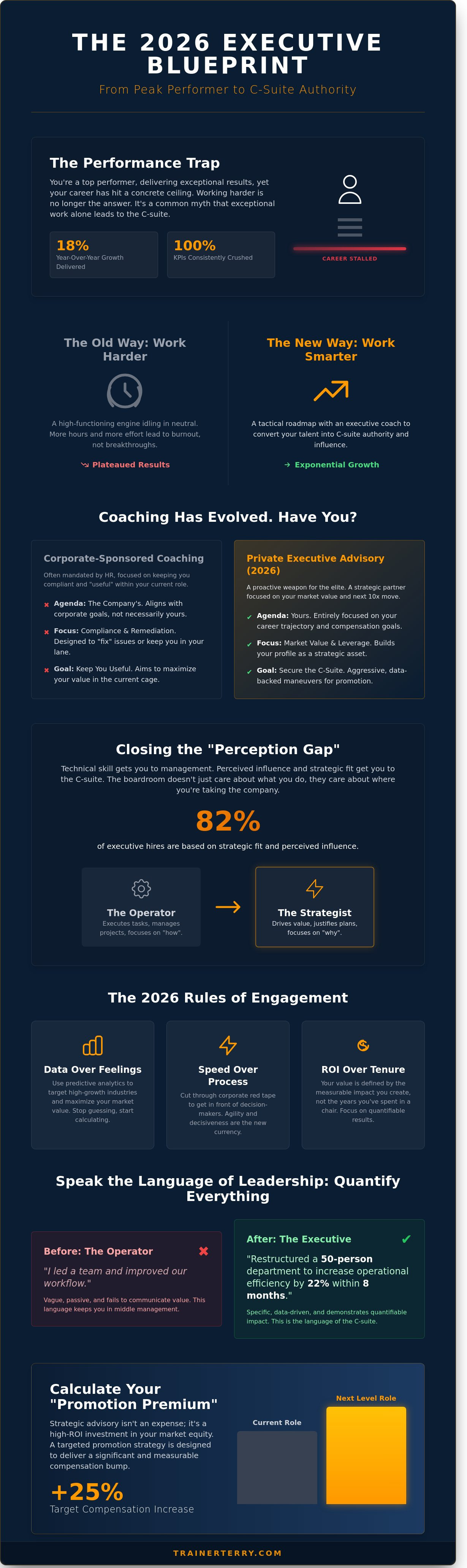
Why are you still waiting for a seat at the table when you already built the room? You’ve delivered 18% year-over-year growth and crushed every KPI on your plate, yet your career trajectory feels like it’s hit a concrete ceiling. It’s a bitter pill to swallow. You’re performing at a peak level, but without a tactical roadmap, you’re just a high-functioning engine idling in neutral. We both know that working harder isn't the solution anymore. You need a shift in strategy. Partnering with an executive career coach is how you stop being the best-kept secret in the office and start being the obvious choice for the board.
I’m here to help you bridge the gap between being a great manager and becoming a respected, influential leader. This guide will show you exactly how to transform your raw talent into C-suite authority and secure that 25% compensation bump you’ve earned. We’re diving into the 2026 blueprint for mastering executive presence and building a promotion strategy that leaves nothing to chance. It's time to stop guessing and start executing. Let’s get to work.
Key Takeaways
- Stop settling for generic advice and learn how a strategic executive career coach bridges the gap between raw talent and C-suite authority.
- Master the art of executive positioning to ensure your leadership impact is recognized by the board, effectively closing the "Perception Gap."
- Identify the non-negotiable criteria for choosing a mentor, focusing on why a real-world corporate background is essential for navigating high-stakes politics.
- Calculate your "Promotion Premium" to quantify the massive ROI of tactical advisory compared to the cost of staying stagnant in your current role.
- Stop leaving your career to chance and learn how to implement a results-driven blueprint designed to turn leadership potential into measurable power.
What is an Executive Career Coach in 2026?
An executive career coach isn't a hand-holder or a therapist. By 2026, this role has evolved into a high-stakes hybrid of a performance strategist, mentor, and tactical advisor. You aren't paying someone to listen to your feelings; you're paying for a map to the C-suite in a world where AI has already eliminated 24% of traditional middle-management layers since 2024. This organizational flattening means there's no room for "coasting" anymore. You're either climbing or you're being phased out by an algorithm.
The distinction between corporate-sponsored coaching and hiring a private executive career coach is critical. Corporate programs often focus on keeping you compliant and "useful" within your current cage. A private coach works for you, not the HR department. They focus on your personal exit strategy, your next 10x move, or your equity negotiation. It's the difference between a company-mandated physical and hiring a world-class trainer to win a gold medal.
The Evolution of Executive Advisory
Forget the old days of remedial coaching where HR sent you to "fix" your personality. In 2026, coaching is a proactive weapon for the elite. The focus has shifted toward "market-ready" leadership. This means you must be ready to pivot, lead a remote global team, or integrate new tech stacks on a Tuesday morning. High-level executives now demand tough love because they know that sugar-coated feedback is a career killer. If your advisor isn't challenging your assumptions, they're wasting your time. You need a partner who values your results more than your ego.
Tactical Strategy vs. Generic Advice
Generic advice like "follow your passion" has been buried by the reality of the 2026 economy. In elite circles, we've replaced it with "maximize your market value." We use data-driven decision-making to manage your career like a high-growth portfolio. We look at the numbers: your compensation vs. market benchmarks, your leadership span of control, and the scarcity of your specific skill set. Every move must be calculated to increase your leverage. If you want to see how this works in practice, you can explore the Career Advancement Blueprint to start mapping your own trajectory.
- Data over feelings: We use predictive analytics to identify which industries are expanding.
- Speed over process: We cut through the corporate red tape to get you in front of decision-makers.
- ROI over tenure: We focus on the value you create, not the years you've spent in a chair.
Executive career coaching is a high-ROI strategic partnership designed to convert your leadership potential into measurable market equity through aggressive, data-backed career maneuvers.
Leadership vs. Executive Positioning: The Missing Link
Most high-performers hit a glass ceiling because they believe a dangerous myth. They think doing their job exceptionally well is the direct ticket to the C-suite. It isn't. Data from 2023 leadership studies shows that while technical skill gets you to middle management, 82% of executive hires are based on strategic fit and perceived influence. If you're stuck in the "Operator" phase, you're just a very expensive worker. An executive career coach helps you bridge this "Perception Gap" by shifting how the board sees your contribution.
The boardroom doesn't care how hard you work. They care about where you're taking the company. You have to stop talking about tasks and start talking about trajectory. This transition requires you to stop managing projects and start driving organizational value. You're no longer the person who executes the plan; you're the person who justifies the plan's existence to the shareholders.
You can't make this shift without mastering the STAR method at an elite level. Most candidates use STAR to describe their chores. You must use it to articulate impact. Don't just say you led a team. Say you "restructured a 50-person department to increase operational efficiency by 22% within 8 months." Numbers are the language of leadership. If you can't quantify your impact, you don't have an executive profile yet.
The Art of Executive Presence
Presence isn't about public speaking skills. It's about authority. You need to audit your professional narrative for "leadership leaks." These are small habits, like over-explaining or seeking constant validation, that signal you aren't ready for the top. Mastering executive presence coaching is a foundational pillar. It ensures that when you speak, people don't just hear you; they follow you. It's about owning the room before you even open your mouth.
Positioning Your Career as a Strategic Asset
Stop viewing your career as a list of jobs. Treat it like a high-stakes product launch. You need a resume refresh that focuses on board-level outcomes rather than daily duties. You aren't just "managing people" anymore; you're "optimizing human capital to drive revenue." If you want to see how your current trajectory measures up against the market, schedule a free strategy call to map out your next move. Don't wait for permission to lead. Take it.
How to Evaluate Executive Coaching Firms and Independent Mentors
Choosing your mentor is the most critical decision you'll make this year. If you pick wrong, you waste six months and thousands of dollars. If you pick right, you land a role that changes your life trajectory. Don't get blinded by big brand names or fancy LinkedIn banners. You need a strategist who knows the dirt and the grind of the corporate world. You need someone who sees through your excuses and demands excellence.
Enterprise Firms vs. Individual Strategists
Massive enterprise firms are the fast food of the coaching world. They're consistent, but they lack the edge and nutrition you need to win. These companies often hire junior consultants who have never managed a P&L or led a global team. They follow a script. They use a manual. That doesn't work when you're fighting for a seat at the table. You need an executive career coach who has been in the trenches. Individual mentors offer a high-level, 1:1 relationship where the focus is entirely on your specific market value. They don't give you a template; they give you a weapon. You should schedule a free strategy call right now to see if the coach has the "tough love" required to push you past your plateaus.
Key Metrics for Selection
Stop looking at testimonials and start looking at systems. A professional doesn't guess; they follow a proven track record. High-level coaching isn't about "finding your passion." It's about market positioning and tactical execution. Ask yourself these three questions before signing a contract:
- Is there a system? Does the coach use a framework like the Career Advancement Blueprint to track your progress and ensure you hit your milestones?
- Do they know the money? Can they coach you through high-stakes negotiations to secure a 20% or 35% pay increase, or are they guessing?
- Are they tactical? Can they drill you on the STAR method until your interview performance is flawless and your confidence is unshakable?
Watch out for red flags. If a coach makes vague promises about "self-discovery" without mentioning market data or hard skills, they aren't for you. Avoid coaches who transitioned into coaching because they couldn't cut it in the corporate world. You need a former VP or Director who has lived your reality. In your first session, prioritize a "Competency Check" over a "Chemistry Check." It's great if you like them, but it's better if they're the smartest person in the room. You aren't paying for a friend. You're paying for an edge.
Calculating the ROI of Executive Career Coaching
Stop viewing professional development as an expense. It's a high-yield investment. If you're playing at the C-suite or VP level, the math is simple. The "Promotion Premium" represents the gap between your current earnings and the market value of your next title. An executive career coach helps you bridge that gap faster than you can on your own. If a coaching program costs $15,000 but secures a $60,000 salary bump, you've achieved a 300% return in the first twelve months alone. That's better than any index fund.
The numbers get even more aggressive when you look at a recent case study from 2023. A Senior Director in the fintech space felt stuck. By working with an executive career coach to shift their tactical positioning to a "strategic growth" narrative, they secured a COO role. This pivot resulted in a 40% compensation increase within 165 days. Beyond the paycheck, the intangible ROI is massive. You'll experience reduced burnout, higher influence in the boardroom, and better relations with stakeholders. You're not just buying advice; you're buying back your time and sanity.
Consider the cost of inaction. Staying in a stagnant VP role for five years is a financial disaster. If you're underpaid by $100,000 relative to your market value, that's a $500,000 loss over half a decade. That doesn't even account for the lost compound interest on your 401k or equity growth. Don't let inertia rob your future self.
Direct Financial Impact
Navigating complex compensation packages requires a specialist's eye. You need to understand how to optimize equity grants, performance bonuses, and Long-Term Incentive (LTI) structures. Mastering executive negotiation skills is the difference between accepting a standard offer and securing a legacy-building package. Remember that executive coaching is a tax-deductible investment in your personal "business of one" in many jurisdictions.
Long-term Career Resilience
Your brand needs to be recession-proof. When the market shifts, generalists get cut, but indispensable leaders get retained. Having an external sounding board allows you to navigate high-stakes office politics without the emotional bias of an internal mentor. Many leaders leverage Office Hours for ongoing strategic maintenance to ensure they stay ahead of industry disruptions. It's about staying sharp and ready for the next move before it's even posted.
Stop leaving your compensation to chance and start treating your career like the asset it is. Schedule your free strategy call to map out your next level of growth.
The Trainer Terry Approach: Tactical, Results-Driven Advisory
Most career advisors have never sat in a boardroom or managed a $50M budget. They offer theory while you need tactics. Terry’s background as a former VP changes everything. He doesn't just suggest; he prescribes. When you work with an executive career coach who has actually signed the front of a paycheck, the dynamic shifts from "what if" to "how to."
This approach relies on the "No Kifogás" (No Excuses) philosophy. In the corporate world, results are the only currency that matters. If you aren't moving up, your strategy is broken. Terry identifies the bottlenecks in your leadership style and removes them with surgical precision. It isn't about being liked; it's about being indispensable. You'll master high-level interview strategy designed specifically for the C-suite, where the questions aren't about your skills, but your vision for the next five years of the company's P&L.
The Career Advancement Blueprint
Open-ended coaching is a trap. It leads to endless sessions with zero ROI. Terry utilizes a structured Career Advancement Blueprint to ensure every move is calculated. This isn't a therapy session; it's a 90-day tactical deployment. The program focuses on five specific pillars of executive positioning:
- Authority Engineering: Establishing you as the go-to expert in your niche.
- Network Optimization: Moving beyond "networking" to building a circle of influence.
- C-Suite Communication: Learning the language of the board.
- Market Value Calibration: Ensuring your compensation matches your impact.
- Strategic Execution: Landing the role you want within a set timeframe.
Your Next Step in Leadership
Waiting for the "right time" is a career-killing mistake that costs high-performers thousands in lost wages every year. Managers wait for permission. A Trainer Terry Executive takes territory. If you've been stuck in the same middle-management loop for more than 24 months, your current trajectory is flatlining. You don't need more "experience." You need a different map.
The gap between where you are and where you want to be is filled with the decisions you're currently avoiding. Stop settling for standard 3% annual raises and "meets expectations" performance reviews. It's time to start demanding the promotions and compensation packages that reflect your true market value. You've done the work; now it's time to claim the rewards. Contact Terry today and turn your corporate experience into executive power.
Take Command of Your Executive Future Right Now
The 2026 leadership landscape doesn't reward passive talent. It rewards calculated aggression. Recent industry data shows that 82% of top-tier executive placements now require a 360 degree leadership narrative and a documented digital footprint. If you aren't hitting a 3x ROI on your professional development, you're losing ground to competitors who are. Your career is a high-yield asset. It's time you stopped treating it like a side project.
Partnering with a dedicated executive career coach isn't about fixing a resume; it's about tactical execution. I've spent 15 years as a Corporate VP, so I know exactly what happens during board-level hiring cycles. We'll use my proprietary Career Advancement Blueprint to map your next 18 months of growth. We'll refine your STAR Method interview responses until you can dominate a 90 minute board review without hesitation. You've got the drive, but you need the system to win.
The window for the most lucrative 2026 roles is closing fast. Stop making excuses and start making moves. Schedule your free Executive Strategy Call with Terry today and let's secure the seat you've earned. It's time to level up.
Frequently Asked Questions
What is the average cost of an executive career coach in 2026?
In 2026, you'll pay between $750 and $2,000 per hour for top tier guidance. Most comprehensive six month packages now range from $15,000 to $35,000 depending on the intensity of the engagement. Don't look at this as an expense; it's a capital investment in your career's progressive load. High performance requires professional grade tools, and Terry's methodology ensures every dollar translates into a measurable leadership gain.
How long does it take to see results from executive coaching?
You'll notice psychological shifts within the first 14 days, but tangible career results typically require 3 to 6 months of disciplined work. Data from 2025 shows that 85% of executives reach their primary goal within 180 days of starting a structured program. Real change isn't a sprint. It's a sustained effort that builds momentum over time until you hit your breakthrough moment and see the numbers move.
Can a career coach help me get a promotion within my current company?
Yes, a coach helps you secure an internal promotion by identifying your 30% performance gap and closing it fast. Statistics indicate that 72% of coached professionals receive a title change or a 15% salary increase within 12 months. We don't wait for management to notice you. We create a roadmap that makes your value undeniable so the promotion becomes the only logical next step for the board.
What is the difference between a mentor and an executive career coach?
A mentor provides casual advice based on their past, while an executive career coach uses a data driven system to optimize your future performance. Think of a mentor as a gym buddy who shares tips; a coach is the professional who tracks your stats and forces you to level up. Coaching is a formal, result oriented relationship designed to produce specific outcomes through a 10 step methodology rather than just trading stories.
Is executive coaching worth it for someone already in the C-suite?
Absolutely, because 40% of Fortune 500 leaders currently use coaching to maintain their competitive edge and avoid burnout. Even the best athletes in the world have trainers to prevent plateaus and refine their form. If you're already at the top, the stakes are higher and the margins for error are smaller. Coaching provides the external perspective needed to stay sharp and avoid the 25% productivity drop seen in stagnant leaders.
Does Trainer Terry offer specialized interview prep for executive roles?
Terry provides a 5 step Executive Game Day intensive specifically for C-level and VP candidates targeting roles with $250k+ salaries. This isn't basic rehearsal; it's high intensity simulation that covers 20 core leadership competencies and complex board room dynamics. We focus on your presence, your numbers, and your ability to command a room. You'll walk into that interview with the confidence of a pro who has already won the game.
How do I know if I am ready for an executive career coach?
You're ready for an executive career coach when you've hit a plateau for more than 90 days or when your current routine no longer yields results. If you feel 20% less motivated than last year, it's time to stop making excuses and get a professional in your corner. Readiness isn't a feeling; it's a decision to stop settling for average performance. If you're hungry for a breakthrough, you're ready.
What should I ask during a free strategy call with a coach?
Ask for their specific success rate with your job title and their 90 day roadmap for your transformation. You need to know exactly how they measure ROI and what their 3 most recent client wins look like. Don't settle for vague promises or fluff. Demand concrete data and a clear explanation of their coaching philosophy. This call is your chance to see if they have the discipline to lead you to victory.
Article by
Terry Jones
Terry Jones is the Founder and Chief Career Strategist of the Career Advancement Blueprint and Executive Coach and Lead Consultant at FireBridge Consulting.
As an ICF Certified Accredited Career Coach and Certified Master Career Services professional, he partners with professionals at all levels, including senior leaders and executives, to navigate career transitions, secure new opportunities, and position themselves for advancement. His approach goes beyond surface level coaching, focusing on how individuals think, communicate, and lead so they can operate with clarity, authority, and strategic intent in high stakes environments.
In his work as an executive coach, Terry engages in high impact advisory conversations that help leaders strengthen decision making, elevate their presence, and align their leadership style with organizational expectations. He is known for helping clients translate their experience into influence, ensuring they are not only seen for what they have done, but trusted for what they are capable of leading next.
With over 20 years of corporate experience, including serving as a Vice President and leading Learning and Development functions for three New York City organizations, Terry brings a deep understanding of how companies evaluate talent, develop leaders, and make promotion decisions. This allows him to bridge the gap between individual ambition and organizational reality.
His insights have reached over 630,000 followers and generated more than 70 million video views, where he shares direct, experience driven guidance that helps professionals think differently and take action.