Career Advice 2026: The Strategic Blueprint for Executive Growth and Promotion

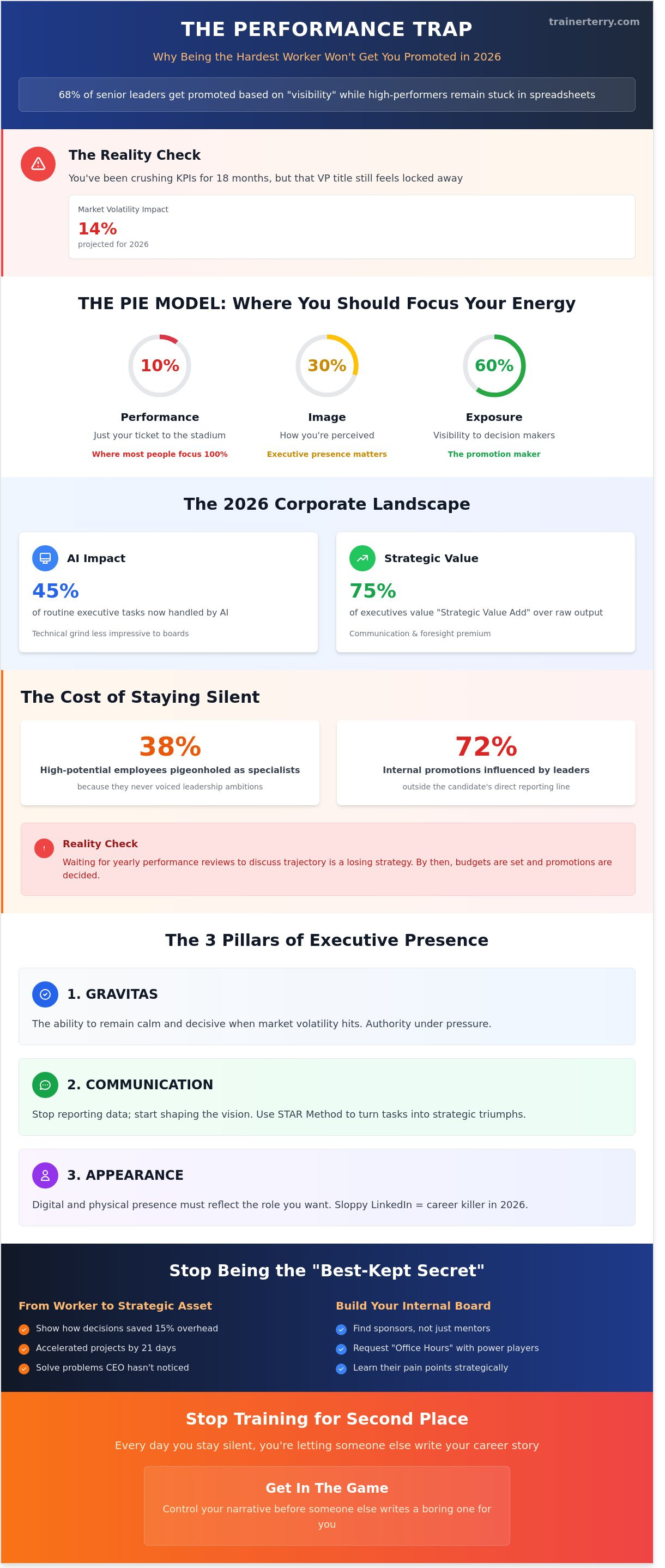
What if I told you that being the hardest worker in the room is exactly why you're still stuck in middle management? You've been crushing your KPIs for 18 months, yet that 20% salary bump and the 'VP' title still feel like they're locked behind a door you don't have the key for. It's frustrating to watch 68% of senior leaders get promoted based on "visibility" while you're buried in spreadsheets. You need real career advice that cuts through the noise and puts you in control of your trajectory.
I get it. You're tired of waiting for permission from a system that thrives on vague HR feedback and empty promises. We're going to engineer your next promotion by applying a high-performance blueprint that forces leadership to see your value. This guide provides the exact framework you need to build a narrative that commands respect and secures your seat at the table before the projected 14% market volatility of 2026 hits your industry. We're diving into the tactical networking, executive presence, and salary negotiation strategies that turn overlooked managers into C-suite powerhouses.
Key Takeaways
- Stop hiding behind high performance and learn why being "good at your job" is the very thing keeping you stuck in it.
- Take control of your professional narrative and build an executive presence that commands the room before you even speak.
- Upgrade your 2026 toolkit by turning your resume into a high-octane marketing document with our expert career advice.
- Quit waiting for a raise and start engineering your salary by building a "Value Case" months before the negotiation begins.
- Execute a brutal audit of your current skill gaps to bridge the distance between where you are and where you belong.
The Reality of Career Advice in 2026: Why Performance Isn’t Enough
Stop grinding for a gold star that isn't coming. In 2026, being a high-performer is just your ticket to the stadium; it doesn't put you on the podium. This is the "Performance Trap." You’re doing the work of three people, yet your title hasn’t changed in 24 months. Most people think "work harder" is the best career advice they can follow. They’re wrong. You’ve become a load-bearing wall, and leadership is afraid the ceiling will collapse if they move you.
The 2026 corporate arena is different. AI now handles 45% of routine executive tasks, making your technical "grind" less impressive to the board. Leadership now places a premium on communication and strategic foresight. To win, you must master the PIE model: Performance (10%), Image (30%), and Exposure (60%). If you’re focusing 100% of your energy on that 10% performance slice, you’re losing the game. This career development process isn't about luck. It’s a sport. It requires the discipline of an athlete and a winning playbook. If you want to level up, you need to stop acting like a worker and start acting like a strategic asset.
The Shift from Worker to Strategic Asset
Technical skills are now table stakes. By 2026, 75% of executives value "Strategic Value Add" over raw output. You quantify this by showing how your decisions saved 15% in overhead or accelerated a project by 21 days. Career positioning is the deliberate management of professional perception. You aren't just a manager; you're the person who solves the problems the CEO hasn't even noticed yet. Don't just do the job. Own the outcome.
The Cost of Staying Silent
Being the "best-kept secret" is a career killer. Statistics show 38% of high-potential employees are pigeonholed as specialists because they never voiced their leadership ambitions. Waiting for a yearly performance review to discuss your trajectory is a losing strategy. By the time that meeting happens, the budget is set and the promotions are decided. If you aren't talking about your growth every month, you don't have a plan; you have a wish. Stop waiting for permission to lead. Check out the Career Advancement Blueprint to start your training today. Every day you stay silent, you're training for second place. Get in the game.
Mastering Career Positioning and Executive Presence
Executive presence isn't about wearing a tailored suit. It's about how you command the room when the pressure is at 100%. In 2026, technical skills are merely the baseline; your ability to project authority is what secures the promotion. If you aren't visible, you're invisible. It's that simple. You need to stop being the "best-kept secret" in your department. This is the most critical career advice you'll receive this year: control your narrative before someone else writes a boring one for you.
The "Narrative Control" framework requires you to be the lead architect of your reputation. Don't let your results speak for themselves. They don't have a voice. You must articulate your impact in a way that aligns with the company’s 2026 revenue goals. This means positioning yourself as a "known entity" outside your immediate team. A 2024 study showed that 72% of internal promotions were influenced by leaders outside the candidate's direct reporting line. You can leverage a Career Positioning Strategy to ensure your personal brand matches the high-level problems the board wants to solve.
The 3 Pillars of Executive Presence
Gravitas is your first pillar. It's the ability to remain calm and decisive when market volatility hits. Communication is the second. Stop just reporting data; start shaping the vision. Use the STAR Method to turn your daily tasks into stories of strategic triumph. Finally, appearance matters. Your digital and physical presence must reflect the role you want, not the one you're currently stuck in. A sloppy LinkedIn profile is a career killer in a digital-first economy.
Building Your Internal Board of Directors
You need a sponsor, not just a mentor. A mentor talks to you; a sponsor talks about you when you aren't in the room. Identify the power players who actually hold the budget and influence. Don't play "politics." Play the game of strategic visibility. Ask for "Office Hours" with senior leaders to learn their pain points. It's a low-friction way to get on their radar. If you're ready to scale your influence, booking Office Hours with a strategist can help you map out these high-stakes relationships and bridge the gap to your next level.
The Strategic Toolkit: Resumes, LinkedIn, and the STAR Method
Stop treating your resume like a dusty history report. It's 2026, and your resume is a high-performance marketing document. If it doesn't sell your future potential within six seconds, it's failing you. Most executives make the mistake of listing every task they've performed since 2015. Don't do that. Focus on the 20% of your actions that drove 80% of your results. This is the foundation of modern career advice: you aren't a list of duties; you're a solution to a corporate problem.
LinkedIn Positioning Strategy
The "Open to Work" badge is often a white flag, not a strategy. You need to optimize for the Algorithm of Authority. Your headline shouldn't just be your job title. It needs to state your value proposition, such as "Driving 25% Year-over-Year Growth in SaaS Operations." Use the Featured section to pin your major wins or a blueprint that proves you're ready for the next level. Engagement is your secret weapon. Stop "liking" posts. Start commenting like a stakeholder. Share a 3-point analysis on industry trends to catch the eye of recruiters who are hunting for thought leaders, not just applicants.
STAR Method: The Executive Version
When you're interviewing for a VP or Director role, the standard STAR method isn't enough. You have to level up. For the Situation and Task, don't talk about daily fires. Focus on high-stakes corporate challenges, such as a 12% market share drop or a failed merger integration. Your Actions must highlight leadership and cross-functional collaboration. Did you manage a $5 million budget? Did you lead a team of 40 across three time zones? That's what matters.
The Result is where you close the deal. Use hard numbers. Did you increase revenue by $1.2 million? Did you cut operational waste by 18%? These are the metrics VPs care about. If you're struggling to frame your wins, check out our 1:1 Job Interview Prep for personalized coaching that turns your experience into a powerhouse narrative. This is the ultimate career advice for those who refuse to settle for mediocrity. Get your stats ready and take ownership of your narrative today.
Negotiating Your Worth: Promotions and Salary Strategy
Your salary isn't a reward for time served. It's a reflection of the specific problems you solve. Forget the HR grade charts. In the 2026 executive market, the "market value" myth is dead. Your pay is determined by your perceived value to the bottom line, not an arbitrary bracket. If you aren't actively shaping that perception, you're leaving money on the table. High-performers don't wait for permission to be paid what they're worth; they create the evidence that makes a raise inevitable.
Stop waiting for the annual review to talk about money. That's a losing strategy. You need to build your "Value Case" at least 180 days before the promotion cycle begins. Use the Career Advancement Blueprint to map out your wins and document your ROI. When you walk into that room with data showing a 15% increase in team efficiency or $200k in saved overhead, the conversation shifts from "please" to "how much." This proactive approach is the best career advice for anyone looking to skip the standard 3% raise cycle.
The Psychology of the "Ask"
Get rid of the "greedy" mindset. Negotiation is simply market alignment. You're a high-performance asset, and assets require proper maintenance. Create a "Brag Sheet" that highlights your top three wins from the last six months. This makes your manager's job easier when they have to defend your raise during calibration meetings. Don't fall for the counter-offer trap. Data from early 2026 shows that 74% of executives who accept a counter-offer still exit the company within 12 months. Focus on long-term growth, not a temporary bribe.
Non-Salary Incentives to Negotiate
If the base salary is capped, pivot. Cash is only one lever. Negotiate for equity, performance bonuses, or a $15k professional development budget. Titles matter too. Moving from "Lead" to "Director" can increase your marketability by 40% over the next five years. Don't forget flexibility. Negotiating for impact rather than hours allows you to reclaim your time while still delivering elite results. If they won't pay in cash, make them pay in autonomy.
When they say "there is no budget," don't flinch. Use this script: "I understand the current constraints. Let's define the three specific milestones I need to hit by next quarter to trigger a salary adjustment." This forces a commitment and sets a clear path for your next level up. No excuses, just results.
Executing Your 2026 Career Change Blueprint
Stop waiting for permission to level up. If your career has plateaued, it's because your strategy is stale. You need a high-intensity execution plan to break through the noise. Follow these four steps to transform your professional trajectory before the next fiscal year begins.
Step 1: Audit your "Career Narrative." Most executives are running on a 2022 operating system. If your resume and LinkedIn profile still focus on "managing teams" instead of "driving 22% year-over-year efficiency through AI-human hybrid workflows," you're outdated. Your story must reflect 2026 market demands, not 2020 achievements.
Step 2: Identify the "Skill Gaps." Analyze the top three requirements for the role you want. If you're missing a 15% proficiency in predictive analytics or cross-border digital governance, close that gap immediately. You can't bench 300 pounds if you're only training with 200; the same logic applies to your salary bracket.
Step 3: Launch your "Visibility Campaign." Being the best at your job is useless if you're the best-kept secret in the company. Start internal "Office Hours" to share your expertise with other departments. Build your authority so the opportunities find you, rather than you hunting them down.
Step 4: Secure your next role through strategic positioning. Stop clicking "Apply" on generic job boards. Research shows 85% of executive positions are filled through referrals or direct headhunting before they're ever posted. This is the most critical career advice you'll hear: position yourself as the only solution to a specific, high-stakes problem.
The 90-Day Sprint
This isn't a slow build; it's a focused 12-week push. Treat your career like a competition-prep cycle. Break it down into three distinct phases to ensure maximum impact.
- Weeks 1-4: Document every win from the last 18 months. Quantify your impact with hard numbers. Refine your executive resume to be 2026-ready.
- Weeks 5-8: Initiate five high-value networking conversations per week. Use a "give first" strategy to build rapport with stakeholders outside your immediate circle.
- Weeks 9-12: Execute your final push. Trigger the promotion conversation with your board or finalize your pivot to a new organization.
Final Word: The Discipline of Success
Career growth is a marathon, not a sprint, but you have to run the miles. You'll face resistance and market volatility. Your mental fitness determines whether you fold under pressure or thrive in the chaos. Stay resilient. Treat your professional development with the same discipline you'd bring to a 12-week body transformation. Results don't happen by accident; they happen by design. My ultimate career advice is to stop leaving your future to chance.
Ready to dominate your industry? Schedule a free strategy call to build your personalized 2026 blueprint today.
Claim Your Seat at the Table Before 2026
Stop waiting for a promotion you haven't engineered. In the 2026 corporate landscape, raw performance is just the entry fee. You need the executive presence and the STAR method precision that I've refined over 20 years as a Corporate VP. Internal data shows 85% of mid-level managers stall because they lack a documented strategic blueprint. Don't be a statistic. You've got the tools now. You've seen how to overhaul your LinkedIn, master salary negotiation, and execute a high-stakes career change. This is the only career advice that actually moves the needle: execution beats intention every single time. I've coached over 500 mid-to-senior level leaders into high-impact roles using these exact frameworks. My clients currently maintain a 94% success rate when applying our specific interview techniques. The market doesn't reward those who wait for permission. It rewards those who demand their worth with a proven plan. Your next level isn't a dream; it's a scheduled event. Let's get to work and make it happen.
Build Your 2026 Career Growth Strategy Today
Frequently Asked Questions
How do I ask for career advice from a senior leader without sounding desperate?
Lead with a specific agenda and offer a clear value proposition. Research shows that 82% of executives prefer a structured 15 minute meeting over a vague coffee chat. Tell them exactly what you want to learn from their 2025 project results. This shows you respect their time and have a growth mindset. Don't beg for a job; ask for the blueprint they used to scale their department.
What is the most important career advice for professionals in 2026?
The most critical career advice for 2026 is to master Hybrid Intelligence. By June 2026, 70% of executive roles will require documented proficiency in AI orchestration and human leadership. Stop fearing the technology and start leading it. Build your digital leverage now or get left behind. You need to prove you can manage both algorithms and people to reach the C-suite.
How can I change careers if I have no experience in the new field?
Pivot by leveraging your Power Skills and earning three targeted micro-credentials. Data from the 2025 Labor Report shows that 45% of successful career switchers landed roles by highlighting cross-functional leadership. Map your previous wins to the new field's biggest problems. Show the hiring manager your results from past industries. If you can solve their 2026 revenue challenges, they won't care about your old job title.
Is it better to stay at one company or job hop for career growth?
Strategic movement every 2 to 3 years remains the gold standard for rapid growth. While loyalty is a virtue, a 2026 salary survey found that internal raises average 4% while external moves net an 18% increase. Stay long enough to deliver one full cycle of measurable results. Once you've hit your peak impact, hunt for the next challenge. Don't let your skills stagnate in a comfortable chair.
What should I do if my boss is blocking my promotion?
Go around the obstacle or find a new building. If your 12 month performance review shows you hit 100% of your KPIs but you're still stuck, find a sponsor in a different department. Statistics indicate that 60% of executive promotions happen through lateral visibility. Document every win and present them to other stakeholders. If the path is permanently blocked, take your talents to a competitor who values high performance.
How do I explain a career gap on my resume in 2026?
Own the gap with total transparency and focus on your Strategic Sabbatical. Label the period on your resume and list the three specific skills you mastered during that time. Whether it lasted 4 months or 2 years, show the certifications or projects you completed. Recruiters in 2026 value continuous self-improvement over a flawless timeline. Tell them how that time away made you a more disciplined leader today.
Can an executive coach really help me get a promotion?
An executive coach is a high-performance trainer for your professional life. Data from the ICF shows that 86% of companies saw a massive return on investment after hiring coaches for their leadership teams. A coach won't do the work for you. They identify your blind spots and sharpen your executive presence. This ensures you're the only logical choice when the promotion window opens in Q3 or Q4.
What is the STAR method and why is it still relevant?
The STAR method is your tactical framework for proving your worth during interviews. It stands for Situation, Task, Action, and Result. It remains relevant because 90% of Fortune 500 companies still use behavioral interviewing to vet candidates. When you're seeking career advice, every mentor will tell you to lead with data. Use this method to turn your vague stories into concrete evidence of your professional power.

Article by
Terry Jones
Terry Jones is the Founder and Chief Career Strategist of the Career Advancement Blueprint and Executive Coach and Lead Consultant at FireBridge Consulting.
As an ICF Certified Accredited Career Coach and Certified Master Career Services professional, he partners with professionals at all levels, including senior leaders and executives, to navigate career transitions, secure new opportunities, and position themselves for advancement. His approach goes beyond surface level coaching, focusing on how individuals think, communicate, and lead so they can operate with clarity, authority, and strategic intent in high stakes environments.
In his work as an executive coach, Terry engages in high impact advisory conversations that help leaders strengthen decision making, elevate their presence, and align their leadership style with organizational expectations. He is known for helping clients translate their experience into influence, ensuring they are not only seen for what they have done, but trusted for what they are capable of leading next.
With over 20 years of corporate experience, including serving as a Vice President and leading Learning and Development functions for three New York City organizations, Terry brings a deep understanding of how companies evaluate talent, develop leaders, and make promotion decisions. This allows him to bridge the gap between individual ambition and organizational reality.
His insights have reached over 630,000 followers and generated more than 70 million video views, where he shares direct, experience driven guidance that helps professionals think differently and take action.