
Getting passed over for a promotion isn't a career death sentence. It's the high-intensity interval training your professional brand needs to reach the next level. You've likely spent the last 12 months outperforming your KPIs only to watch someone else take the title you earned. It's frustrating to feel your influence stall while your workload increases by 25% without a single extra dollar in your paycheck. You feel undervalued, and that's a signal you can't ignore.
I'm here to hand you the 2026 VP-level blueprint on how to get promoted after being passed over. We're going to stop the bleeding and start the rebuild immediately. You'll learn how to turn this setback into a strategic advantage by auditing your internal reputation and demanding the respect you deserve. This guide provides a 90-day comeback plan, specific scripts for high-stakes feedback meetings, and a 5-point decision framework to help you decide if you should stay or find a company that actually values your output.
Key Takeaways
- Avoid the "sore loser" trap by mastering a professional poker face during the critical 48-hour window following the decision.
- Conduct a "Strategic Audit" to uncover the specific feedback you need on how to get promoted after being passed over.
- Shift your executive brand from a "doer" to a "leader" by refining your presence and communication in high-stakes meetings.
- Execute a disciplined 90-day action plan to close perception gaps and make your professional value unignorable to leadership.
- Recognize the "dead-end" signs and moving goalposts to decide whether to stay and fight or pivot to a new opportunity.
The Immediate Aftermath: Avoiding the "Sore Loser" Trap
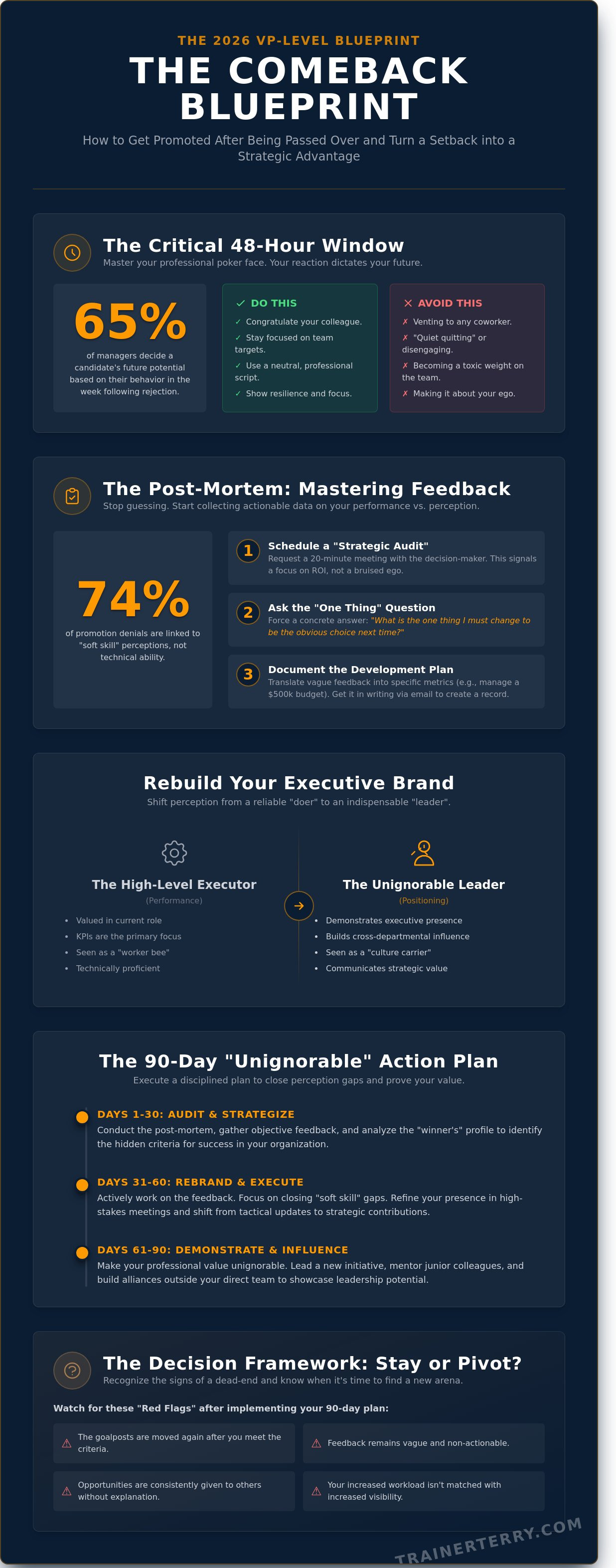
You just got the news. The door closed, and someone else is sitting in the seat you earned with late nights and missed weekends. It stings. It feels like a physical blow to the gut. But listen closely: your career isn't over unless you kill it yourself in the next 48 hours. This window is your "formative stress test." How you react right now dictates your entire future trajectory. If you want to know how to get promoted after being passed over, you must first master your professional poker face. Decision-makers aren't just looking at your past KPIs; they're watching how you handle defeat. A 2024 study of corporate leadership transitions found that 65% of managers decide if a passed-over candidate has future potential based solely on their behavior in the week following the rejection.
Don't fall into the "quiet quitting" trap. It's the fastest way to cement your status as a "B-player" in their eyes. When you disengage, you're not punishing the company; you're proving they made the right choice by skipping you. You might feel slighted because of The Peter Principle, where people are promoted to their level of incompetence, leaving the real workhorses behind. Whether that's true or not doesn't matter right now. What matters is the internal narrative being written about you. Are you the resilient pro who stays focused, or the bitter employee who becomes a toxic weight on the team? Choice is yours. If you're ready to stop sulking and start planning, let's schedule a free strategy call to map out your next move.
The 48-Hour Cooling-Off Protocol
Stop the venting sessions immediately. Your "work bestie" is a liability right now because words travel fast in a pressurized office. When you see the person who got the job, look them in the eye, shake their hand, and say: "Congratulations, I'm looking forward to seeing what you do with the role." It's not about being fake; it's about being bulletproof. Draft a neutral internal statement for when people ask. Use this: "I'm disappointed, but I'm focused on hitting our Q3 targets and supporting the transition." Short. Professional. Final.
The "Tough Love" Reality Check
Working harder won't save you. If results alone got people promoted, you'd already have the office. You need to separate your performance from your positioning. Performance is what you do; positioning is how you're perceived by the people who sign the checks. You've been doing the reps, but your "brand" is off. Look in the mirror and define your current brand in one sentence. For example: "The board sees me as a high-level executor who is too valuable in my current role to risk moving into management." That's your starting line for the comeback. This is how to get promoted after being passed over: you stop being a worker bee and start acting like the leader they can't afford to lose.
The Post-Mortem: Mastering the Feedback Loop
You missed the lift. It happens. In the 2026 corporate arena, you don't get points for participation; you get points for results. If you're wondering how to get promoted after being passed over, stop looking for excuses and start looking for the tape. You need a post-mortem. This isn't a vent session. It's a high-intensity data collection phase. You're going to schedule a 20-minute "Strategic Audit" with the decision-maker. Use that exact phrase. It signals that you're focused on the firm's ROI, not your bruised ego.
During this audit, your goal is to identify why the weight didn't move. Was it a technical gap, or a perception gap? A 2024 study by the Corporate Executive Board found that 74% of promotion denials are linked to "soft skill" perceptions rather than a lack of certifications. You might have the best stats in the office, but if the leadership team doesn't see you as a "culture carrier," you'll stay on the bench. You need to uncover the hidden criteria. These are the traits they didn't list in the job description, like executive presence or cross-departmental influence.
Asking the Hard Questions
Don't settle for "You're doing great, just keep at it." That's a stall tactic. Use the "One Thing" technique. Look them in the eye and ask: "What is the one thing I must change to be the obvious choice next time?" This forces them to give you a concrete metric. If they give you vague feedback like "You just need more seasoning," don't let it slide. Ask for the recipe. "Does seasoning mean leading a team of 10+ people, or does it mean managing a budget over $500,000?" Once you have the answer, turn it into a documented development agreement. Write it down and email it to them. Now, your growth is a matter of record, not just a hallway conversation.
Analyzing the "Winner"
You need to be a scout. Look at the person who got the role without resentment. Compare your profiles objectively. Did they have a relationship gap you missed? Maybe they spent 15% more time networking with stakeholders while you were buried in spreadsheets. Identifying if it was a skill gap or a political gap is the only way to adjust your training. If you're ready to stop guessing and start executing, learn how to position your value to ensure you're the undisputed heavy hitter in the next round. This isn't about being "better" in a general sense; it's about being the specific solution the company needs right now. If you want to refine your approach before the next opening, schedule a free strategy call to lock in your comeback plan.
Rebuilding Your Executive Brand and Presence
The scoreboard says you lost. It's a gut punch, but the tape doesn't lie. You were passed over because your current brand is "high-performing doer," not "strategic leader." You're stuck in the weeds. To fix this, you must overhaul how you show up every single day. Leadership isn't just about what you do. It's about how you're perceived by those who make the big calls. If you want to know how to get promoted after being passed over, you have to stop acting like a technician and start acting like an architect.
The Executive Presence Audit
Your gravitas is your weight in a room. If you speak and nobody stops to listen, your gravitas is at zero. A 2024 study by the Center for Talent Innovation found that executive presence accounts for 26 percent of what it takes to get promoted. You likely failed the test because of low-value habits. Do you start sentences with "I just wanted to say" or "In my humble opinion"? Stop it. These are filler phrases that bleed your authority dry.
Switch your communication to a results-first model. In every meeting, move from explaining the process to defining the outcome. High-level leaders don't care about the 40 hours you spent on a spreadsheet. They care about the three insights that will drive revenue in Q4 2026. You need to sharpen this skill immediately. You can find the tools to refine your image in the Career Advancement Blueprint.
Broadening Your Internal Coalition
You can't win this fight alone. You need a sponsor. A mentor gives you advice, but a sponsor gives you opportunities. They're the ones who mention your name when you aren't in the room. If the stakeholders didn't back you this time, it's because they don't feel invested in your success. You need to change that narrative through the "Consultation Strategy."
- Identify three key influencers who didn't support your promotion.
- Request a 15-minute "strategy session" with each.
- Don't ask why you lost. Ask: "What's the one leadership gap I must close to be ready for the next level?"
- Implement their advice and report back on your progress every 30 days.
This approach turns critics into coaches. It shows you have the resilience to handle a loss without ego. This is how to get promoted after being passed over while building a wall of support for your next move. You're demonstrating leadership without the title by taking ownership of your growth. When you treat your career like a high-intensity training program, the results follow. No excuses. Just progress.
The 90-Day "Unignorable" Action Plan
Stop sulking. The promotion you missed wasn't a dead end; it was a performance audit you didn't pass. Now, we rebuild. You have 90 days to transform from "passed over" to "indispensable." This isn't about working harder; it's about working louder and more strategically. If you are serious about how to get promoted after being passed over, follow this 12-week sprint with the same discipline you'd bring to a physical transformation.
- Month 1: Visibility and Quick Wins. Secure three small victories within the first 22 days. Solve a recurring 15-minute headache for your boss. Re-establish your baseline competence immediately.
- Month 2: Closing the Perception Gap. If your feedback said you lack "strategic thinking," lead a project that impacts at least two other departments. Attack the specific weakness they identified with surgical precision.
- Month 3: Re-pitching the Path. Present your results. You aren't asking for a promotion; you're showing them that you're already performing at the next level.
Tracking your wins is non-negotiable. Use a "Success Log" to record every metric you move. Socialize these wins by sharing a bi-weekly "Progress Snapshot" with your manager. Let the data do the bragging for you. If you've increased efficiency by 18%, that number speaks louder than any hallway conversation ever could.
Executing the "Pivot" Projects
Select two projects that solve a "VP-level" problem. This means focusing on revenue, cost savings, or risk mitigation. If you save the company $14,000 in monthly operational costs, that's a pivot win. Document these using the STAR method: Situation, Task, Action, and Result. When you communicate progress, don't just say you're "busy." Tell them you've hit 90% of the project milestone 3 days ahead of schedule. This builds a narrative of high-performance reliability that's impossible for leadership to ignore.
Setting the Next Milestone
Move from "wait and see" to a hard timeline. Learning how to get promoted after being passed over requires you to stop asking for permission and start stating your terms based on data. At the 90-day mark, book a 20-minute meeting. Don't look desperate. Frame the conversation around the progress you've made since the initial rejection. Ask for a specific date for the next review cycle. You've done the work, now claim the territory. If you want to stop guessing and start executing, schedule a free strategy call to build your 90-day plan and get the exact roadmap you need to win.
Stay and Fight or Time to Pivot?
Let’s be real. Sometimes the room you’re in isn’t big enough for your growth. You can follow every strategy on how to get promoted after being passed over, but if the ceiling is made of concrete, you’ll only end up with a headache. A 2024 Gallup report found that 51% of employees are actively or passively looking for a new job because they don't see a clear path forward. You need to recognize when the "ceiling" is a permanent fixture of the company culture rather than a temporary hurdle.
The "Dead-End" signs are usually easy to spot if you stop making excuses for your boss. Vague timelines like "let’s revisit this in six months" or moving goalposts where you hit every KPI only to be told "we need to see more leadership" are red flags. If your manager can't define exactly what "more" looks like with a number or a specific outcome, they’re stalling. You aren't a passenger in your career; you're the CEO. If the current partnership isn't yielding a return on your investment, it's time to liquidate and move your talent elsewhere.
The "Stay vs. Go" Framework
I use the 3-month rule with my clients. If you’ve implemented a feedback loop and hit your new targets, but the internal perception hasn't shifted within 90 days, the environment is the problem, not your performance. An external move is often the fastest way to get the title and the 15% to 20% salary bump you deserve. Data from the 2023 ADP National Employment Report showed that "job-switchers" saw significantly higher pay growth than those who stayed put. To prepare, update your resume by framing your internal "failure" as a period of massive scale. You didn't just "do your job," you managed a $500,000 budget or led a team of 12 through a transition.
Taking the Next Step
Stop waiting for permission to succeed. If you’re tired of being the hardest worker in the room while others skip ahead of you, it’s time for a professional intervention. Learning how to get promoted after being passed over requires a tactical shift that most people never master on their own. I’ve built a system that strips away the fluff and focuses on the high-impact moves that force leadership to take notice.
The Career Advancement Blueprint is designed for professionals who are done with "maybe next year." I’ve helped hundreds of people move from "overlooked" to "indispensable" by applying the same discipline we use in the gym to the boardroom. We don't do "participation trophies" here. We do results. If you’re ready to take control of your trajectory, Join the Career Advancement Blueprint today and let’s start your comeback.
Stop Sulking and Start Your Strategic Ascent
The scoreboard doesn't care about your feelings; it cares about your next move. You've seen the 90 day action plan and the mechanics of rebuilding an unignorable executive brand. Now you have to decide if you'll stay and fight or pivot to a new arena. Success in 2026 requires more than just hard work. It demands a feedback loop that uncovers your blind spots and a commitment to visibility that makes your value undeniable. Learning how to get promoted after being passed over is a discipline, not a one time event.
You need a mentor who has seen the view from the top. My curriculum is built on 20 years of experience as a corporate VP, focusing on the structured internal advancement you've been missing. We use the proven STAR method to prepare you for high stakes roles so you never walk into an interview unprepared again. Don't let another promotion cycle pass you by while you're still waiting for someone to notice your effort. Take control of your career trajectory right now.
Build your foolproof promotion strategy with the Career Advancement Blueprint
The next level is waiting for you. Get after it.
Frequently Asked Questions
Should I tell my boss I’m disappointed about being passed over?
Yes, you should express your disappointment, but keep it focused on your ambition rather than a pity party. A 2023 LinkedIn survey showed that 72% of managers appreciate employees who show emotional investment in their career path. Tell them you're hungry for that level and ask for the three specific gaps in your current form that held you back. This isn't about complaining; it's about setting the stage for your next heavy set.
How long should I wait before asking for a promotion again?
You should wait exactly 180 days before officially reopening the conversation, provided you've hit 100% of the new KPIs set during your feedback session. This six month window gives you enough time to demonstrate progressive overload in your professional skills. Use this time to track every win like a workout log. If you haven't shown a 15% increase in output or efficiency by then, you aren't ready to step back onto the platform.
Is it better to quit immediately if I was passed over for someone less qualified?
No, don't quit in a fit of ego because 40% of employees who rage quit regret it within 30 days according to Joblist data. Stay for at least 90 days to gather data on why the other person was chosen and to polish your resume. Use this time to learn how to get promoted after being passed over by mastering the skills you supposedly lack. Leave on your terms when you have a 20% higher offer elsewhere.
Can I ask for a salary increase even if I didn’t get the promotion?
Yes, you can and should request a market adjustment if your current workload has expanded by more than 20% over the last year. If you're performing 80% of the duties of the higher role without the title, bring the receipts to your boss. A 2024 Robert Half salary guide suggests that high performers often secure a 5% to 10% raise even without a title change. Don't work for free; get paid for the value you're actually delivering.
How do I handle working for the person who got the job instead of me?
Treat them like a training partner, not an enemy. Your performance in the first 90 days of their tenure will define your reputation more than your past three years of work. If you undermine them, you prove the hiring committee was right to skip you. Support their three biggest initiatives immediately. Showing you can lead from any position is a core strategy for how to get promoted after being passed over during the next cycle.
What if my boss can’t give me a clear reason why I was passed over?
If your manager can't give you three concrete areas for improvement, it's a sign of poor leadership on their part. Research from Gallup shows that one in four employees feel they receive zero meaningful feedback. Don't stay in a plateau because of their silence. Set a 60 day deadline to get a clear development plan in writing. If they still can't provide a roadmap, start looking for a new gym where your growth is actually prioritized.

Article by
Terry Jones
Terry Jones is the Founder and Chief Career Strategist of the Career Advancement Blueprint and Executive Coach and Lead Consultant at FireBridge Consulting.
As an ICF Certified Accredited Career Coach and Certified Master Career Services professional, he partners with professionals at all levels, including senior leaders and executives, to navigate career transitions, secure new opportunities, and position themselves for advancement. His approach goes beyond surface level coaching, focusing on how individuals think, communicate, and lead so they can operate with clarity, authority, and strategic intent in high stakes environments.
In his work as an executive coach, Terry engages in high impact advisory conversations that help leaders strengthen decision making, elevate their presence, and align their leadership style with organizational expectations. He is known for helping clients translate their experience into influence, ensuring they are not only seen for what they have done, but trusted for what they are capable of leading next.
With over 20 years of corporate experience, including serving as a Vice President and leading Learning and Development functions for three New York City organizations, Terry brings a deep understanding of how companies evaluate talent, develop leaders, and make promotion decisions. This allows him to bridge the gap between individual ambition and organizational reality.
His insights have reached over 630,000 followers and generated more than 70 million video views, where he shares direct, experience driven guidance that helps professionals think differently and take action.