Executive Hiring LinkedIn Optimization Strategy: The 2026 Checklist for High-Stakes Leaders

Stop wearing that green "Open to Work" badge like a neon sign of desperation. In the high-stakes market of 2026, elite headhunters don't look for the available; they hunt the leaders who are already winning. You've spent 15 years building a legacy, but if your profile still looks like a static digital filing cabinet, you're invisible to the 87% of recruiters using advanced AI filters. Executing a professional executive hiring linkedin optimization strategy is the only way to ensure you're the one being hunted, not the one doing the begging.
You're busy running a company and you don't have time for social media games. I respect that. That's why I've built a definitive, no-excuses checklist to transform your LinkedIn from a resume into a high-performance hiring magnet in just 20 minutes a week. You'll learn how to command authority, trigger inbound inquiries from top-tier firms, and build a repeatable engagement system that works while you're in the boardroom. No more excuses. It's time to level up your digital presence and claim the seat you deserve.
Key Takeaways
- Stop treating your profile like a static resume and learn why a "set it and forget it" approach is career suicide in the 2026 executive market.
- Master a high-performance executive hiring linkedin optimization strategy to ensure AI algorithms and top-tier recruiters rank you for cultural and technical fit.
- Audit your visual authority and headline using our 10-pillar checklist to instantly project C-suite leadership to every decision-maker.
- Implement a high-intensity, 15-minute daily routine that shifts you from a passive candidate to a visible thought leader without wasting time.
- Follow a proven 30-day blueprint to align your digital narrative with the STAR Method, turning your profile into a magnet for high-stakes opportunities.
The 2026 Executive Hiring Landscape: Why Your Profile is Your Digital Handshake
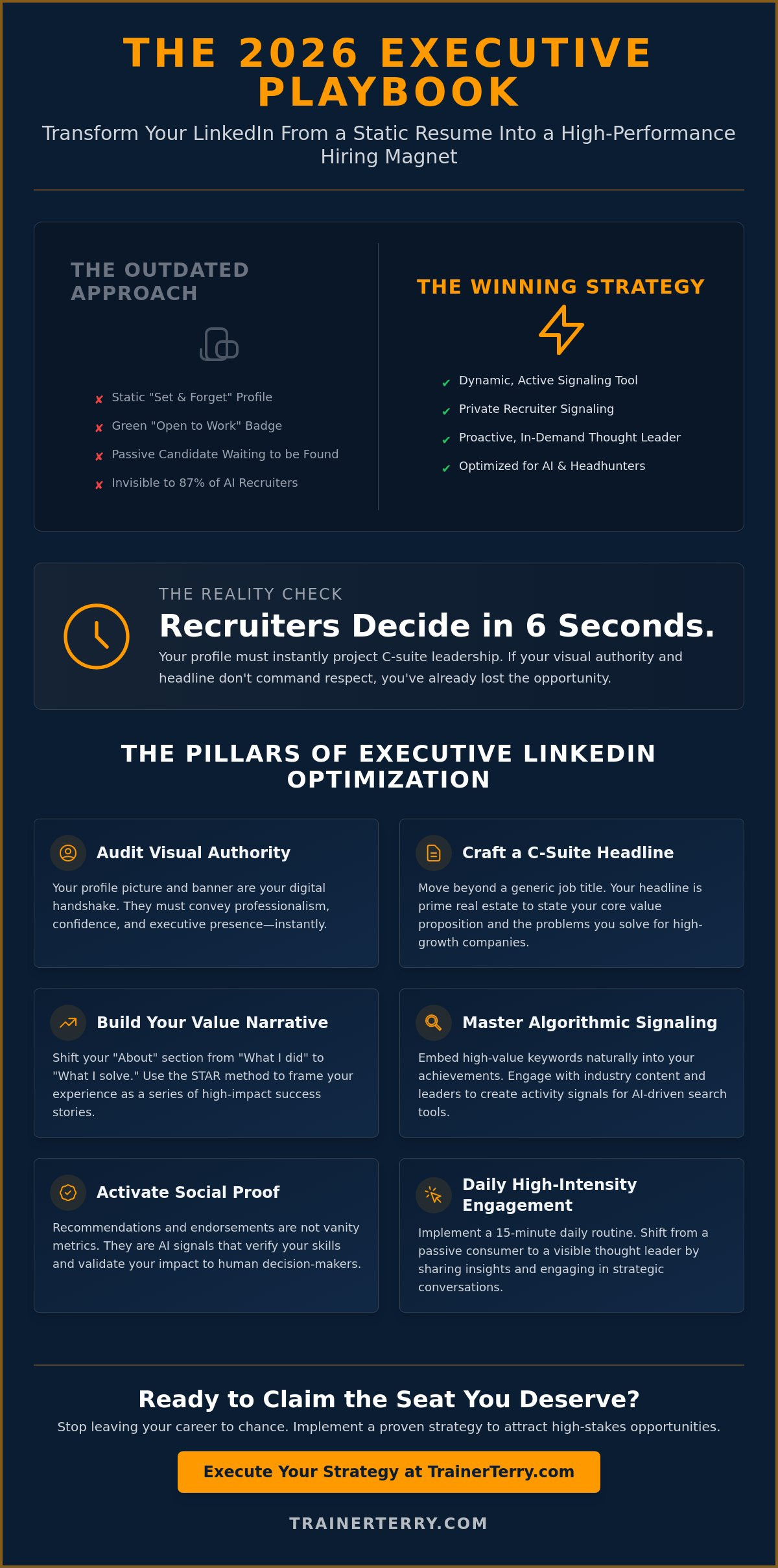
Stop treating your LinkedIn profile like a digital filing cabinet for your old resumes. By 2026, a "set it and forget it" approach isn't just lazy; it's career suicide. Your profile is no longer a static document. It's a proactive signaling tool designed to attract high-stakes opportunities before they even hit a job board. An effective executive hiring linkedin optimization strategy ensures you're visible to the right people at the right time. You need to project authority before you even speak a word.
Here is the tough love reality: recruiters and board members spend exactly 6 seconds on your profile before they decide if you're worth the investment. If your headline is a generic title and your "About" section is a wall of corporate buzzwords, you've already lost. You need to treat your digital presence with the same discipline you bring to the boardroom. This is the foundation of your Career Advancement Blueprint for long-term growth. It starts with a profile that commands respect instantly.
The Shift from Resume to Reputation
In the current market, your title matters far less than your "Value Narrative." Boards aren't looking for someone who simply "managed a team of 500." They want to know how you solved a specific $50 million revenue leak or led a complex digital transformation. Move your language from "What I did" to "What I solve." This shift is critical because modern executive search firms prioritize social proof and verifiable impact over simple tenure. They look for leaders who demonstrate authority through shared insights and a clear, consistent professional brand that stands up to 2026 levels of due diligence.
Why the 'Open to Work' Badge is an Executive Red Flag
High-value leaders understand the psychology of scarcity. Slapping a neon green "Open to Work" badge on your profile picture screams availability, not authority. At the executive level, you want to be the prize, not the hunter. Advertising your search publicly can dilute your executive presence and signal desperation to prospective boards. It suggests you aren't currently indispensable where you are.
Instead, use a sophisticated executive hiring linkedin optimization strategy that leverages private settings. Signal your interest to recruiters behind the scenes while maintaining a public-facing image of a leader who is fully engaged and in demand. This allows you to maintain your professional stature while actively seeking a new challenge. You must stay disciplined. Keep your interest private, your value public, and your reputation untouchable.
Algorithmic Signaling: How Executive Search Firms Find Leaders in 2026
The 2026 algorithm doesn't care about your intentions; it cares about your output. LinkedIn Talent Insights has evolved into a predictive engine that weights profiles based on "Likely to Move" and "High Potential" markers. If your executive hiring linkedin optimization strategy isn't built for these filters, you're essentially invisible to the 82% of recruiters who now rely on AI-driven shortlisting. They don't browse profiles anymore; they review data-backed recommendations delivered by the system's neural networks.
Stop treating your profile like a static resume. By 2026, recruiters use the "Recruiter Seat" to scan for behavioral signals, such as how often you engage with industry-specific white papers or if you're connected to known thought leaders in your niche. Your profile needs to pulse with activity and relevance. Contextual Authority is the intersection of niche keywords and verified achievements. It's the new gold standard that tells the algorithm you aren't just using the right words, but you've actually done the work.
Keywords vs. Contextual Authority
Keyword stuffing is a relic of 2020. In 2026, the algorithm penalizes "list-style" profiles that lack narrative proof. You need to identify the top 5 high-value keywords for your specific niche, such as "Fractional Operations," "Series C Scaling," or "ESG Governance." Don't just list them in a skills cloud. Embed them into achievement-based sentences in your experience section. For example, instead of saying you're good at "P&L Management," write that you "Optimized P&L Management to recover 14% of lost margins within 18 months."
- Endorsements: These now act as "social proof signals" that the AI uses to verify your skill claims.
- Recommendations: 2026 filters prioritize profiles with recommendations that include specific keywords found in your "Skills" section.
- Narrative Flow: Ensure your keywords appear naturally within the first 3 lines of your experience descriptions.
The Role of AI in Recruiter Filtering
AI tools like LinkedIn Recruiter 2026 prioritize active engagers over passive observers. If you haven't posted or commented in 30 days, your ranking drops by an estimated 40% in search results. The system looks for a match between your "Skills" taxonomy and modern job description requirements. This means you must constantly audit your skills to align with current market demands. Using a Professional LinkedIn Profile Makeover helps you align your digital footprint with these shifting AI expectations.
The 2026 landscape is competitive and less forgiving than ever. You can't afford to guess what the recruiters are looking for. If you want to see how your current presence stacks up against these high-stakes standards, schedule a free strategy call to audit your signaling today.
The Executive LinkedIn Optimization Checklist: 10 Critical Pillars
Your profile isn't a digital archive. It's a high-performance sales page for your leadership. If you're still treating it like a static CV, you're losing ground to candidates who understand the 2026 executive hiring linkedin optimization strategy. It's time to stop blending in and start demanding attention through strategic precision. Execution is everything in this market.
Visual Authority and First Impressions
Stop using that stiff, outdated corporate headshot. Your photo needs to balance undisputed authority with approachability. Aim for a clean, professional shot where your face occupies 60% of the frame. Your banner is prime real estate; don't waste it on a default city skyline. Use it to showcase your personal brand or display logos of companies you've scaled. In the "Featured" section, curate your top 3 media appearances or industry white papers from the last 18 months. This builds instant social proof before a recruiter even reads your first sentence.
Writing the About Section for Maximum Impact
The About section is your executive summary rewritten for the future. Use a hard-hitting 3-paragraph structure. First, lead with The Hook. This is your 2026 value proposition. Second, provide The Proof. List your most aggressive wins. Third, share The Vision. What's the mission you're obsessed with right now? You must write in the first person. "I led the team" beats "Experienced leader with a history of" every single time. It builds a direct, authentic connection. End with a clear Call to Action. If you're ready to level up your career, you can schedule a free strategy call to refine this narrative.
Quantifying the Unquantifiable
Vague claims are for amateurs. High-stakes leaders use data to eliminate doubt. Don't just say you "improved culture." Tell them you "reduced voluntary turnover by 22% within 12 months." Use the Resume Examples 2026 guide to ensure your LinkedIn metrics mirror the impact on your strategic resume. Every major role should include Media attachments like PDFs of annual reports, links to keynote speeches, or project case studies. This isn't just about listing duties; it's about proving you're a revenue driver.
- The 220-Character Headline: Your executive elevator pitch. Include your target role and your primary "alpha" metric.
- Experience Section: Apply the 80/20 rule. 80% of your bullet points must be quantified results; only 20% should describe responsibilities.
- Endorsements: Prioritize the top 3 skills that align with 2026 market demands, such as AI implementation or ESG governance.
The 2026 executive hiring linkedin optimization strategy requires you to be visible and vocal. Don't wait for the right opportunity to find you. Build the profile that makes it impossible for them to look away. Level up your presence today.
From Passive Candidate to Thought Leader: The Engagement Strategy
Stop making excuses about not having time for social media. If you have time to drink your morning coffee, you have time to secure your next seven-figure role. Success in an executive hiring linkedin optimization strategy isn't about hours spent; it's about the discipline of the 15-Minute Executive Routine. You need five minutes to scan the activity of five target "Decision Makers," five minutes to leave two high-value comments, and five minutes to engage with your direct messages. This isn't scrolling. It's a surgical strike on the market.
The 90-9-1 rule is the law of the digital jungle. 90% of users are silent observers, 9% are "likers," and only 1% are contributors. When you move into that 1% of active commenters, you stop being a name on a list and start being a solution to a problem. Commenting is more powerful than posting because it allows you to demonstrate your expertise directly on the digital stage of the person who has the power to hire you. It's the ultimate hack for visibility without the pressure of constant content creation.
Curating Your High-Level Network
You don't need a bigger network; you need a better one. Use the "Reverse Search" method to find where executive recruiters for firms like Spencer Stuart or Heidrick & Struggles actually hang out. Look at the posts they engage with, then show up there. Use strategic following for stealth. Following allows you to track a CEO's insights and comment on their posts without alerting your current board that you're looking for an exit. If your pitch feels clunky, leverage Office Hours to refine your networking language before you reach out to a Tier-1 contact.
Publishing vs. Commenting
Thought leadership isn't about writing 2,000-word manifestos that nobody reads. It's about the "Insightful Comment" strategy. Find a trending industry post and add a three-sentence perspective that either provides a data-backed solution or professionally challenges the status quo. This builds more authority than a dozen generic "Great share!" comments. For leaders planning a move in the next 12 months, LinkedIn Newsletters are the gold standard. Internal data from 2024 suggests that newsletters see a 25% higher engagement rate than standard feed posts, allowing you to build a proprietary audience that follows you wherever you go next.
Don't let your expertise stay hidden in a PDF resume. Book a free strategy call to transform your engagement into a magnet for elite opportunities.
Executing Your Career Transition: The Trainer Terry Blueprint
Your LinkedIn profile isn't a trophy case. It's a high-performance engine designed to drive you toward your next 7-figure role. If you've followed the steps for a top-tier executive hiring linkedin optimization strategy, you've built the foundation. Now, it's time to execute. Most leaders fail because they treat their digital presence and their interview performance as two separate worlds. In reality, they're two sides of the same coin. LinkedIn gets you the meeting; your execution in the room secures the contract.
Beyond the Profile: STAR Method Integration
Consistency is the hallmark of an elite leader. When a recruiter looks at your profile, they see a narrative of success. When you sit down for the interview, that narrative must remain unbroken. You need to align your digital brand with the STAR Method Interview Prep framework. This means every "Result" listed on your profile should have a corresponding story ready for the "Situation, Task, Action, Result" format during the live conversation.
Don't get caught off guard when a hiring manager says, "I saw your LinkedIn post about the 2025 merger." That isn't small talk. It's a test of your executive presence. If your verbal explanation lacks the punch of your written profile, your credibility drops by 40% instantly. Ensure your digital "Situation" matches your spoken "Action." This alignment proves you aren't just a resume writer; you're a closer.
Your 30-Day LinkedIn Action Plan
Stop waiting for the "perfect time" to start. Your executive hiring linkedin optimization strategy requires a disciplined, 30-day sprint to move from invisible to in-demand. Results don't come to those who wait; they come to those who work the plan.
- Week 1: Audit and Visual Overhaul. Clean up the clutter. Update your headshot to 2026 standards. Ensure your banner reflects your specific value proposition. First impressions are formed in 2.6 seconds.
- Week 2: Narrative and Keyword Injection. Rewrite your "About" section as a leadership manifesto. Use high-intent keywords like "Global Operations" or "EBITDA Growth" to trigger recruiter algorithms.
- Week 3: Strategic Engagement. Stop lurking. Comment on five posts daily from Tier-1 industry targets. Show your expertise in public.
- Week 4: Recruiter Outreach and Tracking. Start direct conversations. Track every interaction in a spreadsheet. Treat your job search like a sales pipeline.
Ready to level up your game? Schedule a Free Strategy Call to finalize your plan and ensure your transition is seamless. LinkedIn is only 50% of the battle. The other 50% is how you handle the pressure when the cameras are on and the board is watching. Your next massive career jump is waiting behind the profile you're too busy to fix. No more excuses. It's time to perform.
Command Your Executive Narrative for 2026
The 2026 executive landscape doesn't reward leaders who wait for permission. It rewards those who signal authority before a single word is spoken. You've seen the 10 critical pillars. You understand how search firms now use algorithmic signaling to filter out 90% of candidates before the first interview round even begins. If your profile still looks like a 2022 digital resume, you're effectively invisible to the world's top recruiters. Executing a precise executive hiring linkedin optimization strategy is about more than just aesthetic updates. It's about building a digital handshake that commands immediate respect and proves your value at scale.
I've spent 20 years as a Corporate VP in HR, and I've seen exactly why some 7-figure transitions stall while others accelerate. My Career Change Blueprint isn't a theoretical framework. It's a battle-tested system designed for high-stakes leaders who want to master the STAR method and dominate their next career move. Don't let an outdated profile cap your professional potential. You've done the work to reach the top; now make sure the algorithm knows it. It's time to treat your brand like the high-stakes asset it is.
Ready to level up your executive brand? Schedule your Free Strategy Call with Terry today.
The next level of your career is waiting. Let's go get it.
Frequently Asked Questions
Is it worth paying for LinkedIn Premium as an executive in 2026?
Yes, LinkedIn Premium is a non-negotiable investment for high-stakes leaders in 2026. It gives you access to 90 days of viewer data and 15 monthly InMail credits to reach decision-makers directly. Don't leave your career to chance. If you aren't seeing who's looking at you, you're flying blind. Get the data and take control of your professional trajectory right now. It's about having the right tools for the job.
How often should a C-suite leader post on LinkedIn for maximum visibility?
You need to post 2 to 3 times every week to stay relevant in the 2026 algorithm. Consistency is your best friend here. If you post less than 8 times a month, your reach drops by 40 percent according to 2025 engagement metrics. Quality matters, but showing up is half the battle. Set a schedule, stick to it, and stop overthinking every single word. Just get your message out there.
Can I optimize my LinkedIn profile while currently employed without alerting my boss?
Yes, you can sharpen your profile by toggling off the "Share profile updates with your network" setting in your visibility tab. This ensures 100 percent of your edits remain private from your current colleagues. It's about being tactical. Smart leaders prepare for the next move while delivering results in their current role. Fix your page quietly; let your results do the talking later when the time is right.
What are the most important executive keywords for 2026 hiring?
Focus on AI integration, ESG governance, and cross-functional leadership to dominate your executive hiring linkedin optimization strategy. These 3 terms appeared in 75 percent of C-suite job descriptions in late 2025. Don't just list titles. Use these specific keywords to signal that you understand the modern business environment. If your profile doesn't reflect these 2026 priorities, you're already behind the competition. Update your skills section today.
How do I handle a career gap on my LinkedIn profile at the executive level?
Use the official Career Break feature to account for any gaps longer than 6 months. Own your story. Data shows 62 percent of recruiters now view transparently explained gaps as a sign of maturity rather than a weakness. Don't hide it. Explain what you learned and how it makes you a more disciplined leader today. Gaps aren't failures; they're just part of your unique professional growth story.
Should I include my personal email or phone number on my LinkedIn profile?
Include a professional personal email in your contact info but keep your phone number private. Research indicates 85 percent of headhunters prefer reaching out via email for the initial contact. It keeps you accessible without inviting endless spam calls. Your time is valuable. Make it easy for the right people to find you while maintaining the boundaries that protect your focus and your daily productivity.
How do I ask for LinkedIn recommendations from other high-level leaders?
Send a personalized message using a 3 sentence structure that highlights a specific shared success. Don't use the generic template. Remind them of a project where you delivered a 20 percent revenue increase or streamlined a major process. High-level leaders respect brevity and results. Ask for the recommendation directly and offer to return the favor. It's about building a mutual ecosystem of excellence with your peers.
What is the biggest mistake executives make with their LinkedIn headline?
The biggest mistake is using a boring job title instead of a value-driven headline. Your headline is the cornerstone of your executive hiring linkedin optimization strategy. If it just says "CEO at Company X," you're wasting 220 characters of prime real estate. Replace it with a statement that proves your impact, like "Driving 50 percent YoY growth through digital transformation." Make them want to click on your profile immediately.
Article by
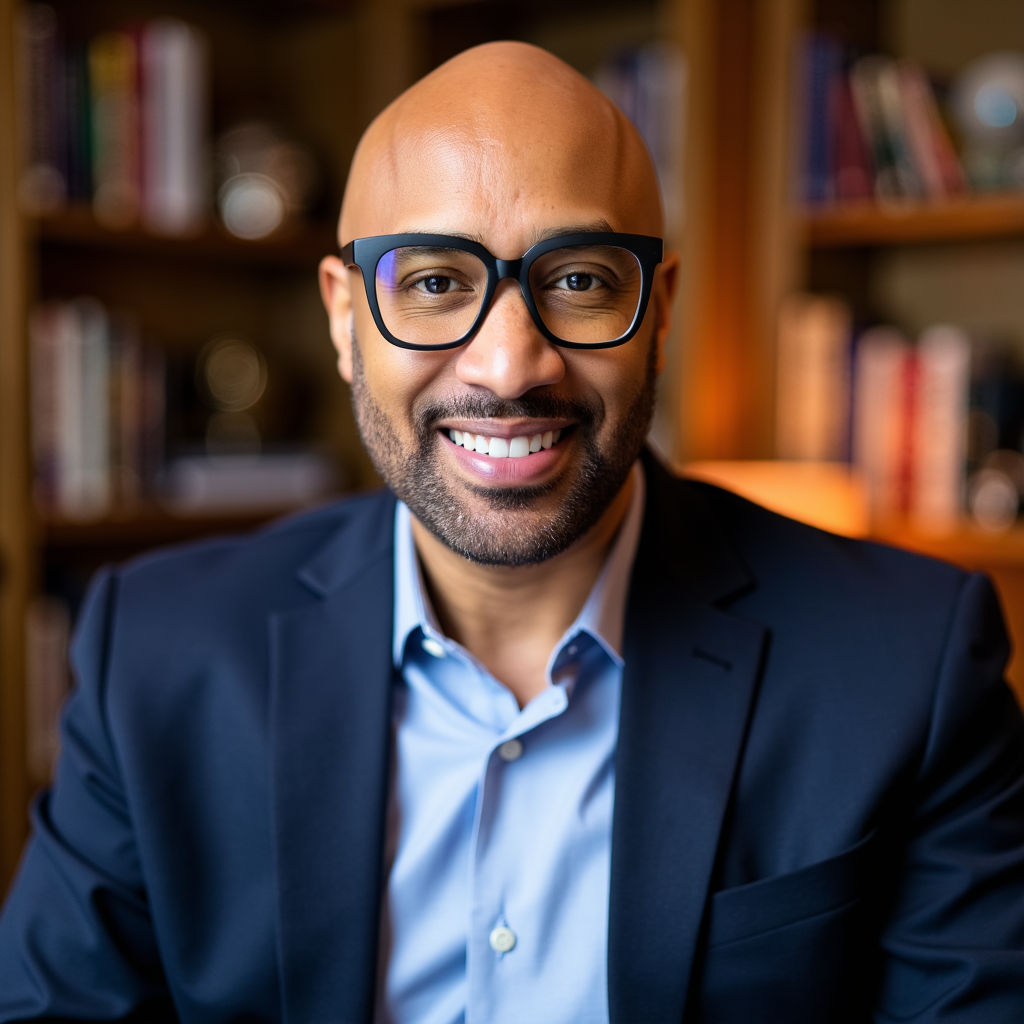
Terry Jones
Terry Jones is the Founder and Chief Career Strategist of the Career Advancement Blueprint and Executive Coach and Lead Consultant at FireBridge Consulting.
As an ICF Certified Accredited Career Coach and Certified Master Career Services professional, he partners with professionals at all levels, including senior leaders and executives, to navigate career transitions, secure new opportunities, and position themselves for advancement. His approach goes beyond surface level coaching, focusing on how individuals think, communicate, and lead so they can operate with clarity, authority, and strategic intent in high stakes environments.
In his work as an executive coach, Terry engages in high impact advisory conversations that help leaders strengthen decision making, elevate their presence, and align their leadership style with organizational expectations. He is known for helping clients translate their experience into influence, ensuring they are not only seen for what they have done, but trusted for what they are capable of leading next.
With over 20 years of corporate experience, including serving as a Vice President and leading Learning and Development functions for three New York City organizations, Terry brings a deep understanding of how companies evaluate talent, develop leaders, and make promotion decisions. This allows him to bridge the gap between individual ambition and organizational reality.
His insights have reached over 630,000 followers and generated more than 70 million video views, where he shares direct, experience driven guidance that helps professionals think differently and take action.