Executive Communication Coaching for Senior Leaders: The 2026 Strategic Blueprint

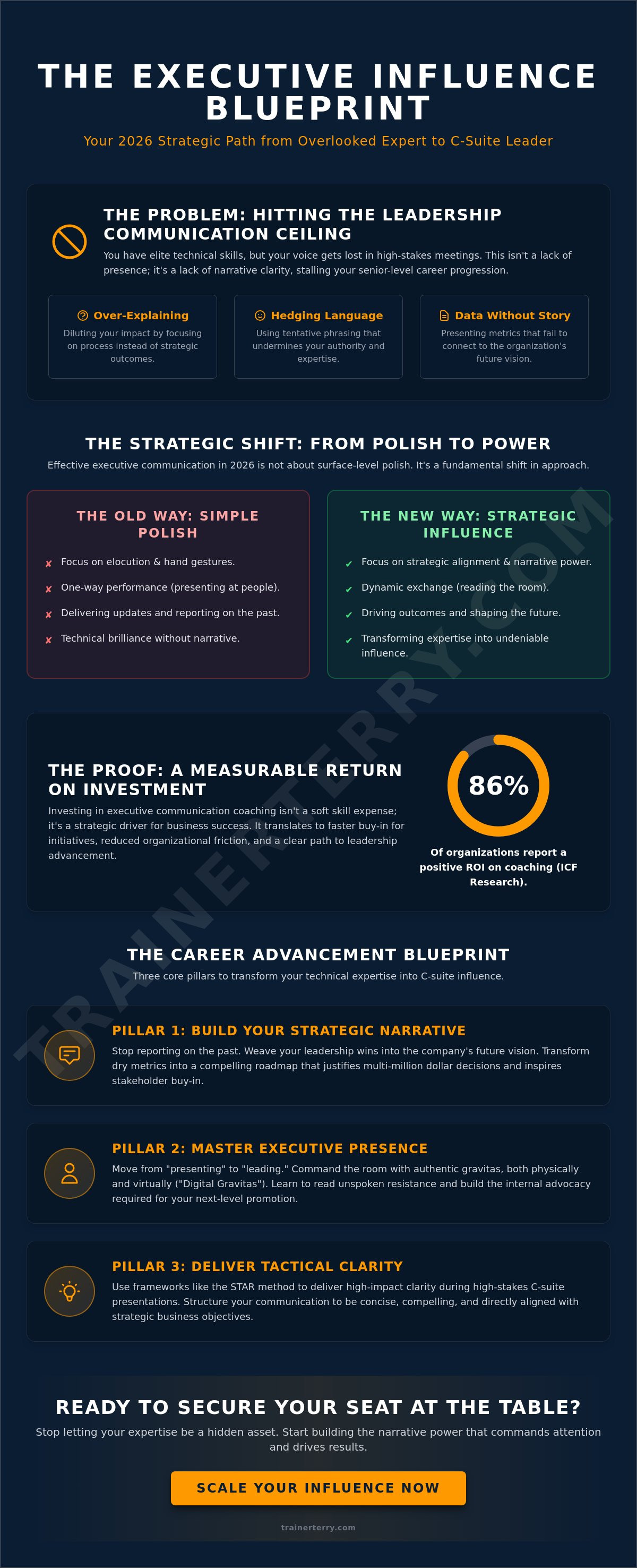
You have reached the upper echelons of leadership, yet you still feel invisible in the highest-stakes meetings. It is a frustrating paradox. You are often misdiagnosed as lacking presence when the real problem is a lack of narrative clarity. If you cannot persuade skeptical stakeholders, your expertise remains a hidden asset. This is why executive communication coaching for senior leaders is no longer a luxury. With 86% of organizations reporting a positive ROI on coaching according to ICF research, it is the most direct path to the C-suite.
We know you are tired of being overlooked for the next-level promotion despite your track record. You want to command the room with authentic gravitas and ensure your voice carries weight. This article provides the 2026 strategic blueprint to help you master high-stakes influence and secure your seat at the table. You will learn how to leverage the updated 2026 ICF standards and shift your style from simple persuasion to strategic alignment. We are moving beyond simple polish to focus on the narrative power that wins internal advocacy and drives real results.
Key Takeaways
- Stop settling for simple "speech polish" and start building a strategic narrative that aligns your leadership wins with the organization's future.
- Identify the specific "Gravitas Gaps" like over-explaining and hedging that are currently stalling your senior-level career progression.
- Master the tactical application of the STAR method to deliver high-impact clarity during high-stakes C-suite presentations.
- Discover how professional executive communication coaching for senior leaders transforms technical expertise into undeniable influence at the table.
- Learn to use the Career Advancement Blueprint to bridge the gap between your current performance and your next-level promotion.
Beyond the Polish: What Executive Communication Coaching Really Solves in 2026
Stop thinking about elocution or hand gestures. Executive communication isn't about "fixing" how you talk. It's a high-performance engine for your professional influence. Many VPs hit a communication ceiling where their technical output is elite, but their seat at the table remains shaky. They've mastered the "what" of their role, yet they're struggling with the "how" of leadership. In 2026, the game has changed. Information is cheap; strategic alignment is the new currency. Business and executive coaching has moved far beyond simple speech polish to become a tactical necessity for the modern C-suite.
When you engage in executive communication coaching for senior leaders, you're investing in a measurable ROI. Research shows that 86% of organizations report a positive return on their coaching spend. This isn't just a "feel-good" metric. It translates to faster buy-in for your initiatives and significantly reduced friction during organizational shifts. You stop being the person who "delivers updates" and start being the leader who "drives outcomes." This shift is what separates the long-term VPs from the future CEOs.
The Difference Between 'Speaking' and 'Leading'
Being a polished presenter doesn't mean you have executive presence. Presentation is often a one-way performance. Leadership is a dynamic exchange. True presence requires active listening and high-level emotional intelligence to read a room's unspoken resistance. You must transition from "doing" the work to "positioning" its value to the board. It's about moving from technical brilliance to narrative authority. If you can't tell a story that justifies a $20 million budget shift, your technical skills won't save you.
Why Senior Leaders Seek Coaching Now
Hybrid leadership has created a new set of challenges. You need "digital gravitas" to command a virtual room just as effectively as a physical boardroom. Stakeholders in 2026 are more skeptical; they demand alignment between your words and the company’s strategic reality. Many leaders suffer from a "promotion gap" where their results are visible, but their leadership potential is ignored. Our Career Advancement Blueprint solves this by focusing on how you are perceived during high-stakes moments. You aren't just communicating data. You're building the internal advocacy required to reach the next level. Don't let your career stall because your message isn't landing with the weight it deserves.
The Strategic Narrative: Why Your Leadership Story Dictates Your Influence
Data doesn't make decisions. People do. If you're relying solely on spreadsheets to win over the board, you've already lost. An "Executive Narrative" isn't a fairy tale. It's the connective tissue between your past wins and the company's future trajectory. You must weave your individual successes into the broader corporate vision. This is where many fail. They speak in the past tense. They focus on what was done instead of what's next. Strategic storytelling is the tool that transforms dry metrics into a compelling roadmap. It's the difference between being a reporter and being a visionary. This high-level shift is a primary focus of executive communication coaching for senior leaders who want to move beyond the middle-management ceiling.
Crafting Your Executive Value Proposition
Your value proposition must signal "future leader" rather than "past manager." It's a common trap. You list achievements like a grocery list. Instead, align your personal narrative with the organization’s 2026 goals. Show them how your specific leadership style solves the problems they haven't even faced yet. If you're struggling to frame this, working with The Executive Career Coach can help you navigate these high-stakes leadership conversations. You need a voice that resonates with the C-suite's vision while still inspiring the front line. Finding that balance is the heart of authenticity. It's not a performance. It's a refined version of your unique leadership truth. When your brand is consistent, you don't have to work as hard to convince people of your value. Authenticity isn't about being "unfiltered"; it's about being intentional.
Storytelling for Stakeholder Buy-In
Stanford researchers emphasize the importance of developing executive presence to build trust. One effective way to do this is through the "Logic-Emotion-Action" framework. Start with the logic: the data that proves your point. Add the emotion: the human impact or the risk of inaction. End with the action: exactly what you need from the stakeholders now. Strategic Narrative is the bridge between data and action. You aren't just simplifying complex financial data. You're giving that data a soul. This is a core pillar of executive communication coaching for senior leaders. It's about moving people from "I understand" to "I'm in." If you're ready to stop being invisible, consider how our Career Advancement Blueprint can sharpen your narrative and help you command the room. You have the expertise. Now, give it the voice it deserves.
Presence vs. Performance: Identifying the Communication Gaps That Stall Senior Careers
You've delivered the results. You've hit the KPIs. Yet, when the big decisions are made, you're still not the first person they call. This disconnect is what we call the "Gravitas Gap." It's the space between your actual authority and your perceived influence. Having the title doesn't guarantee your message will land. In fact, many leaders sabotage their own authority with subtle communication habits they don't even notice. Through executive communication coaching for senior leaders, we identify these silent career-killers before they cost you another promotion.
The most common pitfall? Over-explaining. When you provide too much detail, you signal that you're seeking permission rather than providing direction. High-level stakeholders don't want a lecture; they want a decision. Hedging language like "I feel" or "we might want to consider" further erodes your stance. It makes you look like a tactician stuck in the weeds instead of a strategist looking at the horizon. If you want to move up, you have to stop talking like a manager and start sounding like an owner.
Influence also happens in the "Shadow Organization." This is the informal communication network where the real decisions are made in the "meeting before the meeting." If you're only speaking up during the official board call, you're already behind the curve. You need to handle high-stakes dissent with composure, turning conflict into a tool for alignment without losing your executive presence. Authentic leadership isn't about avoiding disagreement; it's about navigating it with total clarity.
The Diagnostic Checklist for Senior Leaders
Ask yourself: are you perceived as a tactician or a strategist? A tactician talks about the "how," while a strategist focuses on the "why" and the "what's next." Check your non-verbal and digital blind spots. Does your camera angle on Zoom make you look small? Are you using filler words like "um" or "actually" that leak your authority? These small qualifiers act like a slow leak in a tire. Eventually, you lose all momentum. We help you patch those holes through targeted executive communication coaching for senior leaders.
Reclaiming Your Seat at the Table
Commanding a room of dominant personalities requires strategic interjection. You don't need to be the loudest person, but you must be the most impactful. Learn to use silence as a weapon. Wait for the right moment, then speak with concision. You can also build this authority externally. Learning how to use LinkedIn effectively allows you to position yourself as a thought leader before you even step into the boardroom. Managing "up" to the board and "out" to partners requires a different vocabulary; one rooted in risk mitigation and long-term value. Stop performing and start leading.
Tactical Execution: Applying the STAR Method to High-Stakes Leadership Scenarios
Many leaders mistakenly believe the STAR method is a tool reserved for entry-level job interviews. They're wrong. In the world of high-stakes influence, clarity is your most valuable weapon. If you can't articulate your impact in sixty seconds, you'll lose the room. Executive communication coaching for senior leaders reframes this classic framework into a high-performance engine for boardroom authority. It's about cutting through the noise and delivering a narrative that stakeholders can actually use to make decisions.
Stop providing rambling updates that focus on effort rather than impact. The C-suite doesn't care about how hard you worked; they care about the value you created. The "Executive STAR" adds a critical layer to the traditional Situation, Task, Action, Result model: the Strategic Outcome. This final layer connects your win directly to the company's long-term health. The Executive STAR is a framework for results-oriented influence. It ensures every word you speak reinforces your position as a visionary leader.
Consider a real-world crisis. A sudden 15% drop in operational efficiency could easily derail a senior career. A tactician describes the chaos. A leader uses a structured narrative. "Last month, supply chain delays threatened our Q3 targets (S). I needed to protect our delivery commitments without spiking costs (T). I negotiated a temporary localized sourcing agreement (A). We restored 90% efficiency within two weeks (R). This move secured our market share during a competitor's stock-out, positioning us as the most reliable partner in the region (Strategic Outcome)." That's how you turn a crisis into a leadership win.
STAR for Boardroom Presentations
In the boardroom, use STAR to justify budget requests or strategic pivots. Don't lead with the money you need; lead with the situation that demands it. Focus heavily on the "Result" and "Strategic Impact" to align your request with board priorities. If they see the direct line between your action and the company's 2026 goals, the "yes" becomes inevitable. You can master these nuances by learning more about The STAR Method and how it functions in high-stakes environments.
STAR for Town Halls and Large-Scale Influence
When speaking to a skeptical workforce, you must humanize the "Action" part of your story. Explain why the change was necessary and what you did to support the team through it. Keep it punchy. Follow the 2-minute STAR rule for all executive updates. If you can't explain the win in two minutes, you don't understand the win well enough yet. Ready to sharpen your delivery for the next big meeting? Book a high-level strategy session to refine your executive narrative and command the room with total confidence.
The Executive Advancement Blueprint: Scaling Your Influence with Trainer Terry
Knowledge is only potential. Execution is power. You've seen the frameworks and you've identified the gaps. Now, you need a system to scale that influence across your entire organization. Most programs treat communication as a side dish. We treat it as the main course of your promotion strategy. Trainer Terry’s Advancement Blueprint isn't just another workshop; it's a structured bridge between where you are and the C-suite seat you've earned. We don't just coach you to speak better. We coach you to be perceived as indispensable.
Generic coaches often lack the context of a high-pressure boardroom. Terry’s "VP-to-VP" model is different. It's built on years of experience in the trenches. We understand that your corporate culture dictates your communication strategy. A narrative that wins at a tech startup might fail at a legacy financial institution. We customize your approach to fit the specific political and cultural landscape of your company. This level of personalization is the hallmark of effective executive communication coaching for senior leaders who refuse to play small.
You are moving from the "expert" phase to the "leader" phase. Experts are hired for what they know. Leaders are promoted for how they influence. If you're still being valued primarily for your technical output, you're stuck in the expert trap. Scaling your influence means learning to delegate the "how" so you can own the "why." This transition requires a total recalibration of your verbal and non-verbal cues. It's a high-intensity process, but the results are permanent and measurable.
A Structured Path to Executive Growth
The path to growth rests on three pillars: Narrative, Presence, and Internal Advocacy. You need a story that aligns with the board's 2026 vision. You need a presence that commands the room without exhausting it. Most importantly, you need advocacy; leaders who champion your name when you aren't in the room. This is why one-on-one strategy sessions are superior to generic leadership workshops. You get specific, surgical feedback on your unique blind spots. Our Career Advancement Blueprint provides this structured roadmap for senior professionals who are ready for the next level.
Your Strategic Next Step
Before your next board meeting, audit your current style. Are you leaning too heavily on spreadsheets? Is your "Gravitas Gap" leaking your authority in small, digital interactions? Don't wait for an annual review to find out you've been misperceived by the people who hold your future in their hands. The most successful leaders take proactive control of their professional narrative. Your strategic next step is simple. Identify where your influence is stalling. We offer a direct way to pinpoint these issues. Schedule your Free Strategy Call with Trainer Terry today. Let's end the "invisible expert" phase of your career and start your transition into an indispensable leader.
Own Your Narrative and Secure Your Promotion
The window to secure your seat at the table is narrowing. In 2026, technical brilliance is just the baseline. To truly lead, you must bridge the gap between your results and your perceived authority. We have explored how narrative clarity and the tactical use of the STAR method can transform your influence. You now have the blueprint to stop being an invisible expert and start winning internal advocacy for your biggest initiatives. Mastering these skills ensures your contributions are never misdiagnosed as a lack of presence.
Professional executive communication coaching for senior leaders is the catalyst for this transformation. It's not about learning to speak; it's about learning to lead through every word and action. You don't have to navigate this high-stakes transition alone. Terry is a former Corporate VP with over 20 years of experience who specializes in using the STAR method to secure C-suite promotions. Stop letting your expertise stay hidden in the weeds of middle management.
Take the first step toward your next promotion today. Schedule your Free Strategy Call with Trainer Terry to identify your specific communication gaps. It's time to unlock your full executive potential and command the room with the gravitas you have already earned. Your seat at the table is waiting.
Frequently Asked Questions
What is the difference between executive coaching and executive communication coaching?
Executive coaching focuses on broad leadership behaviors and personal mindset, while executive communication coaching for senior leaders targets the specific mechanics of influence and narrative. It is the difference between deciding on a vision and having the voice to lead everyone toward it. Communication coaching is surgical; it fixes the way you articulate strategy and handle high-stakes resistance in the boardroom.
How long does it take to see results from communication coaching for senior leaders?
You can expect to see noticeable improvements in your narrative clarity and meeting presence within 4 to 8 weeks. While deep behavioral shifts take longer, tactical changes like using the STAR method or removing qualifiers yield immediate results. Most comprehensive programs for senior leaders last between 6 and 18 months to ensure sustainable, long-term career transformation and promotion readiness.
Can communication coaching help me get a promotion to the C-suite?
Yes, communication coaching is often the final piece of the puzzle for a C-suite promotion. Technical brilliance gets you to the VP level, but narrative authority gets you the seat at the table. We focus on building the internal advocacy and digital gravitas required to convince a board that you are ready for the highest level of organizational responsibility.
Is the STAR method actually useful for senior executives or just for interviews?
The STAR method is a foundational tool for executive clarity, not just a job interview tactic. It allows you to structure complex project updates into a concise narrative that board members can actually use. By adding a Strategic Outcome layer, you transform a simple report into a powerful statement of leadership impact that resonates with stakeholders.
How much does executive communication coaching typically cost in 2026?
Industry rates for executive coaching in 2026 vary based on certification level. Master Certified Coaches (MCC) typically charge between $500 and $1,000 per hour. Elite engagements for C-suite leaders can range from $10,000 to over $100,000 for long-term programs. Retainers for ongoing advisory support usually fall between $1,500 and $7,500 per month depending on the depth of the partnership and professional standards.
What are the most common communication mistakes senior leaders make?
The most common mistakes include over-explaining technical details, using hedging language like "I think," and failing to align personal narratives with company goals. Many leaders also neglect the "meeting before the meeting," where critical influence is actually won. These gaps often make a strategist look like a tactician, which can stall career growth despite excellent performance metrics.
Can I do executive communication coaching online or must it be in person?
Coaching is increasingly delivered through hybrid models that combine virtual sessions with in-person deep dives. Digital-first delivery is essential for developing the virtual leadership skills required in 2026. Online sessions allow for real-time feedback on your digital presence, which is just as important as your boardroom conduct for leaders managing remote or global teams.
How do I know if I need a communication coach or a general leadership coach?
Choose a communication coach if your results are high but your influence is low; choose a general coach for broader organizational or emotional intelligence challenges. If stakeholders misdiagnose you as lacking presence when the issue is narrative clarity, you need executive communication coaching for senior leaders. This specialized focus ensures your expertise isn't lost because of poor delivery.

Article by
Terry Jones
Terry Jones is the Founder and Chief Career Strategist of the Career Advancement Blueprint and Executive Coach and Lead Consultant at FireBridge Consulting.
As an ICF Certified Accredited Career Coach and Certified Master Career Services professional, he partners with professionals at all levels, including senior leaders and executives, to navigate career transitions, secure new opportunities, and position themselves for advancement. His approach goes beyond surface level coaching, focusing on how individuals think, communicate, and lead so they can operate with clarity, authority, and strategic intent in high stakes environments.
In his work as an executive coach, Terry engages in high impact advisory conversations that help leaders strengthen decision making, elevate their presence, and align their leadership style with organizational expectations. He is known for helping clients translate their experience into influence, ensuring they are not only seen for what they have done, but trusted for what they are capable of leading next.
With over 20 years of corporate experience, including serving as a Vice President and leading Learning and Development functions for three New York City organizations, Terry brings a deep understanding of how companies evaluate talent, develop leaders, and make promotion decisions. This allows him to bridge the gap between individual ambition and organizational reality.
His insights have reached over 630,000 followers and generated more than 70 million video views, where he shares direct, experience driven guidance that helps professionals think differently and take action.