
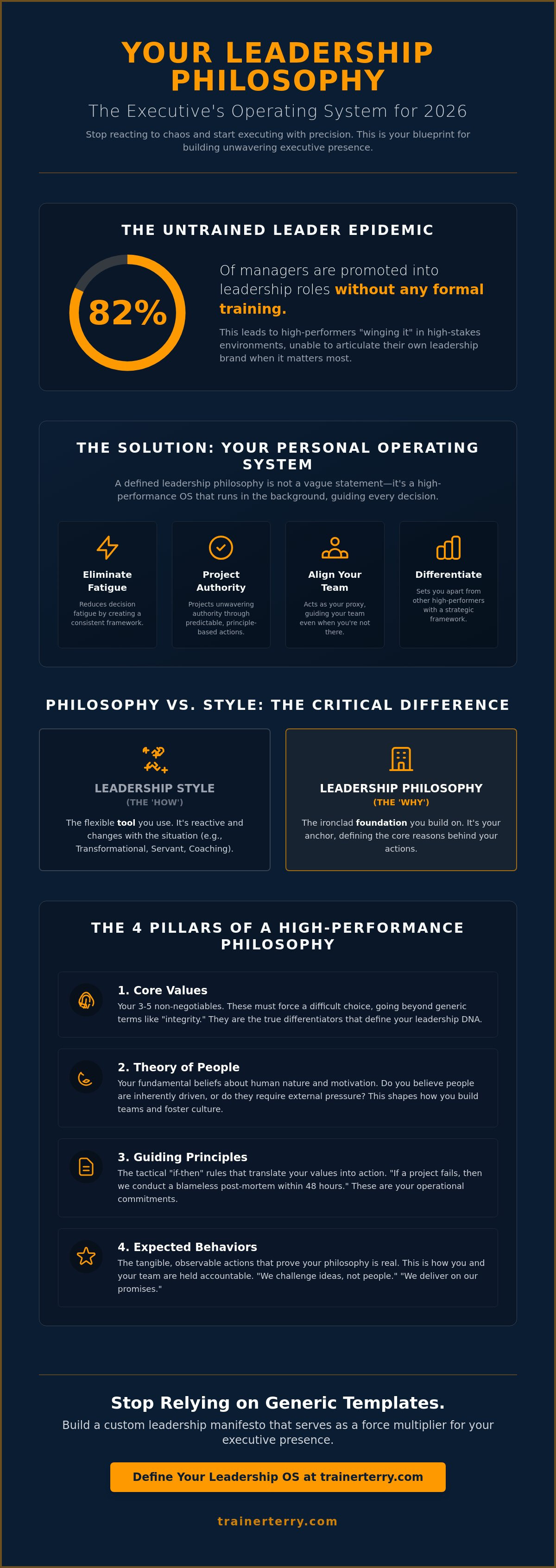
Did you know that 82% of managers enter their roles without any formal leadership training? It's no wonder so many high performers feel like they're just winging it when they step into executive circles. If you can't articulate how you lead, you can't expect a board to trust you with their vision. Understanding what is a leadership philosophy and how to write one is the difference between being a boss and becoming a respected executive with a clear brand. It's your personal operating system. Without it, you're just reacting to the noise.
You probably feel that your leadership style is intuitive, yet you struggle to put it into words during high-stakes interviews. That ends today. We're going to transform that gut feeling into a strategic framework that boosts your executive presence and secures your next promotion. You'll learn how to distill your values into a repeatable system that guides your team and differentiates you from the competition. We'll break down the exact steps to build your 2026 leadership blueprint, from defining your core principles to integrating human-centered empathy into your daily decision making. It's time to stop guessing and start leading with intent.
Key Takeaways
- Define your leadership style as a high-performance operating system to eliminate decision fatigue and project unwavering authority.
- Master exactly what is a leadership philosophy and how to write one using a structured logic framework that differentiates you from other high-performers.
- Identify the non-negotiable core values and fundamental beliefs about people that will drive your team’s consistency and results.
- Learn how to weave your written philosophy into high-stakes interviews using the STAR method to prove your executive readiness.
- Stop relying on generic online templates and build a custom leadership manifesto that serves as a force multiplier for your executive presence.
Defining Your Leadership Philosophy: The Corporate Operating System
Think of your leadership like a high-end computer. You can have the best hardware, the most expensive suit, and a corner office, but if the software is glitchy, the whole system crashes under pressure. A leadership philosophy is your personal Operating System (OS). It's the set of core principles that run in the background, filtering every email you send and every crisis you manage. When you understand what is a leadership philosophy and how to write one, you stop reacting to chaos and start executing with precision.
A written philosophy is the bedrock of executive presence. Without it, your decisions seem erratic to your peers and confusing to your subordinates. High-level stakeholders look for consistency. They want to know that your actions yesterday align with your strategy tomorrow. If you can't explain the "why" behind your "what," you'll never secure that seat at the table. It's about creating a predictable environment where excellence is the only logical outcome.
In a world of remote and global teams, your physical presence is often limited. Your philosophy acts as your proxy. It provides a framework so your team knows how to move when you aren't in the room. This aligns perfectly with the Three Levels of Leadership Model, which emphasizes that personal leadership, your inner core, must be solid before you can effectively lead in public or private settings. Your OS ensures that whether you are leading 5 people or 5,000, the core message remains the same.
The 2026 Shift: Why Authenticity is Now a Strategic Asset
The era of the faceless executive is dead. In 2026, corporate cultures have pivoted away from rigid command-and-control structures. They now demand leaders who are transparent and value-driven. This isn't just about being "nice." It's about building psychological safety. When your team understands your OS, they feel safe to innovate because they know the boundaries. A leadership philosophy is the bridge between your personal values and your professional performance.
Philosophy vs. Style: Clearing the Confusion
Don't confuse your leadership style with your philosophy. Your style is a tool; your philosophy is the craftsman. You might use a "transformational" style to motivate a struggling department, but your philosophy determines why you care about their motivation in the first place. A style-based approach is reactive and changes with the weather. A philosophy-led approach is anchored. To succeed in 2026, you need the flexibility of different styles backed by the ironclad stability of a written philosophy. Learning what is a leadership philosophy and how to write one gives you that anchor.
The Core Components of a High-Performance Leadership Philosophy
If your philosophy sounds like a generic motivational poster, it's useless. In the high-stakes environment of 2026, a "vibe" isn't a strategy. You need a document that functions like a tactical manual. When you master what is a leadership philosophy and how to write one, you focus on four specific pillars: Core Values, Theory of People, Guiding Principles, and Expected Behaviors. These aren't abstract concepts; they're the rules of engagement for your career. They define how you handle a missed quarterly target or a high-potential employee who's losing steam.
Think of these components as the structural integrity of a building. If one is weak, the whole executive brand collapses under the weight of a crisis. You aren't just writing a statement for your LinkedIn profile. You're building a decision-making engine. While some frameworks point to the 13 Components of an Effective Leadership Philosophy to cover every organizational angle, your personal manifesto should be leaner and more aggressive. It must be something you can recall in a split second during a boardroom confrontation.
Identifying Your Non-Negotiable Core Values
Most leaders pick safe words like "integrity" or "honesty." Stop doing that. Integrity is the entry fee, not a differentiator. Pick 3-5 values that actually force a difficult choice. If you value "Speed over Perfection," you're signaling that you'll accept a 90% solution today rather than a 100% solution next month. That's a choice. Use terms like "Extreme Ownership" or "Radical Transparency." Try this: think of the last time you said "no" to a profitable project. What value were you protecting? That's your real core value.
Defining Your Theory of Human Performance
This is the engine room of your leadership. Do you believe people are intrinsically motivated and just need the right environment, or do they require clear, rigid structures to perform? There's no wrong answer, but there is a wrong application. Your belief dictates how you delegate and how you develop talent. If you believe in intrinsic motivation, your job is to remove obstacles. If you believe in structure, your job is to build the tracks. This clarity is essential for your career positioning strategy because it tells the board exactly what kind of culture you'll build. Don't leave them guessing. Define your theory, then execute it with total consistency.
Step-by-Step: How to Write Your Leadership Philosophy for Executive Impact
Stop looking at generic templates. You don't need a copy-paste job; you need a process that extracts your unique leadership DNA. Most people fail because they start with a blank page and a list of tired adjectives. That's a waste of time. You need a forensic audit of your career history to truly grasp what is a leadership philosophy and how to write one that commands respect in the boardroom. You aren't inventing a persona. You're documenting your best self in a way that's repeatable and scalable.
Start by looking at your last three years. Pinpoint exactly where you excelled and where the team fell apart. Patterns will emerge. Maybe your best wins came when you gave your team total autonomy, or perhaps you realized that your involvement in the final 10% of a project is what ensures quality. These aren't just memories. They're the raw data for your personal operating system. Once you identify these recurring patterns, you can begin to codify them into a manifesto that guides your future actions.
The "If-Then" Framework for Practical Principles
Logic is the language of the executive. If you want your team to follow you, give them a clear script. Vague philosophies die in the boardroom; specific ones thrive in the trenches. Use "If-Then" logic to remove ambiguity. For example: "If a project fails, then we audit the process, not the person." This isn't just a sentiment. It's a command. It tells your managers exactly how to behave when things go south. It builds trust because it makes your reactions predictable and your expectations crystal clear.
Refining Your Narrative for the C-Suite
Once you have the logic, clean up the language. Weak leaders use "I think" or "I try." Executives use "I ensure," "I empower," and "I deliver." Your philosophy must sound like a strategic directive, not a diary entry. Keep it tight. One page is your maximum limit. You also need a 30-second elevator pitch version for those quick hallway conversations with the CEO. This level of clarity is a core component of our Career Advancement Blueprint. It's how you signal that you're ready for the next level. Finally, test it. Take a current conflict in your department. Does your new philosophy provide a clear path forward? If it doesn't, it's too soft. Refine it until it cuts through the noise and drives real results.
From Paper to Practice: Communicating Your Philosophy in Interviews and at Work
You've done the deep work. You've answered the fundamental question of what is a leadership philosophy and how to write one. Now, it's time to weaponize it. A document sitting in your desk drawer is just ink on paper. To see a real return on your investment, you must integrate this operating system into every high-stakes interaction. This starts the second you walk into an executive interview or step into a new role. Your philosophy isn't a secret; it's your professional signature.
When an interviewer asks about your leadership style, most candidates stumble through generic clichés. You won't. You'll pivot directly to your written philosophy. Use the STAR method to ground your principles in reality. Describe a Situation and Task, then explain the Action you took based specifically on your leadership principles. This proves your results aren't accidental. It shows you have a repeatable process for success that the company can rely on.
The Interview Advantage: Philosophy as Your Strategic Edge
Pivoting from "style" to "philosophy" signals that you're a strategist, not just a manager. It positions your future performance as a guarantee. You're telling the board exactly how you'll handle their capital and their people. This level of clarity is rare. To sharpen this narrative and ensure your delivery matches your executive presence, invest in 1:1 job interview prep. We'll pressure-test your philosophy against the toughest behavioral questions to ensure you sound like the leader they need.
Once you land the role, use your philosophy to lead through the first 90 days. Transparency kills anxiety. Share your "If-Then" framework with your new team immediately. Tell them exactly how you make decisions and what you value in a crisis. This removes the "guessing game" that usually plagues leadership transitions. It also provides a objective filter for performance reviews. When your team knows the rules of engagement, they can perform without fear. This clarity is a direct antidote to the stress that 71% of leaders currently face according to DDI’s 2025 Global Leadership Forecast.
Managing Culture Conflicts
What happens if your personal "OS" doesn't match the company's culture? If you value radical transparency but the organization is built on silos and secrets, you'll hit a wall. Don't abandon your principles just to "fit in." Modern leadership is about being a "cultural add." Use your philosophy as a career compass. If the misalignment is permanent, your philosophy will tell you exactly when it's time to transition to an environment that respects your brand of excellence. Never compromise your integrity for a paycheck.
Refining Your Executive Presence: Why Strategy Trumps Generic Statements
Don't fall into the trap of using a "canned" leadership philosophy you found on a random blog. Your executive presence depends on authenticity, not a script. If you copy someone else's values, people will notice the friction between your words and your actions. It's a fast track to losing trust and looking like a middle-manager trying to play dress-up. Truly understanding what is a leadership philosophy and how to write one means building a document that is uniquely yours, reflecting your specific scars, successes, and vision. In the high-stakes environment of 2026, a generic statement is a liability.
A custom philosophy is more than just a document. It acts as a force multiplier for your overall career trajectory. When you work with a career strategist, this philosophy becomes the foundation for your entire personal brand. It informs your resume, your LinkedIn presence, and your internal advancement planning. It tells the world that you aren't just a participant in the corporate machine; you're the architect of your own performance. It's the difference between being a high-performer and being a leader who is indispensable.
Leadership is iterative. The philosophy you wrote three years ago won't cut it today. With 56% of organizations now expecting leaders to integrate AI into strategic decision-making, your "OS" must evolve. Revisit your principles every 2 to 3 years. Audit your beliefs against the current market demands. If your philosophy doesn't account for the current shift toward human-centered leadership and AI fluency, it's already outdated. Stay agile. Stay relevant. The moment you stop refining your philosophy is the moment your growth plateaus.
The Force Multiplier Effect
When your philosophy is clear, your executive branding on LinkedIn becomes effortless. You aren't guessing what to post or how to comment on industry trends. You're simply projecting your core principles into the digital space. This clarity also streamlines talent development and organizational consulting. Your team doesn't have to guess what you want because you've already given them the blueprint. Leaders who can articulate their vision and maintain consistency get promoted faster because they are seen as lower risk and higher reward by the C-suite. They provide the stability that organizations crave in volatile times.
Next Steps for Your Executive Journey
Stop letting your leadership style be a matter of "intuition." It's time to treat your career with the same level of strategy you apply to your quarterly targets. A "Strategy First" approach is the only way to navigate the complexities of modern executive roles. If you're ready to stop winging it and start leading with a documented, high-performance operating system, it's time to take action. Book a strategy call to refine your leadership narrative and secure your executive future today. Don't wait for the next promotion cycle; build the foundation for it right now.
Take Command of Your Leadership Narrative
You now have the tactical framework to stop winging your career and start leading with a documented strategy. Defining what is a leadership philosophy and how to write one is the first step toward building the executive presence you need for that next promotion. Don't let your leadership style remain a mystery to your board or your team. Turn your values into an ironclad operating system that drives consistent results and eliminates decision fatigue in every high-stakes scenario.
This isn't just theory. It's the same high-performance logic used in our Career Advancement Blueprint. Led by a former Corporate VP with over 20 years of experience, we specialize in high-stakes interview strategy and executive communication for senior professionals. We don't do generic advice; we deliver the strategic edge you need to stand out. It's time to stop guessing and start executing with the precision of a true executive.
Ready to build a career that matches your ambition? Refine your leadership narrative with a free strategy call today. Your future self will thank you for the discipline you show right now. Let's get to work.
Frequently Asked Questions
How long should a leadership philosophy statement be?
Keep your leadership philosophy to a single page, ideally between 200 and 500 words. This length ensures your message stays punchy and easy for others to digest. A concise document is easier to recall during a high-stakes meeting or a crisis. If it's too long, it loses its strategic impact and becomes a document that people simply ignore.
Can I change my leadership philosophy later in my career?
You should update your philosophy every two to three years to reflect your professional evolution. As you gain experience and the corporate landscape shifts, your "operating system" must adapt to stay relevant. A static philosophy becomes a relic of your past self. Treat it as a living document that grows alongside your executive presence and your career goals.
Is a leadership philosophy different from a mission statement?
A mission statement focuses on what you want to achieve, while a leadership philosophy defines why and how you lead. Mission statements are often about the "what," such as hitting a revenue target. Understanding what is a leadership philosophy and how to write one is about your personal convictions and behavioral standards. It's the internal engine that drives you toward those mission-critical goals.
Should I share my leadership philosophy with my team?
Share your philosophy with your team during your first 90 days to eliminate the "guessing game" of leadership. Transparency builds psychological safety and provides your subordinates with a clear manual on how to interact with you. When they understand your "If-Then" logic, they can make decisions with more confidence. It turns your personal values into a collective standard for performance.
What are some common mistakes when writing a leadership philosophy?
The most common mistake is using generic, "canned" clichés like "servant leadership" without adding specific, actionable details. If your philosophy doesn't help you make a difficult decision, it's too vague. Avoid being overly emotional or idealistic; focus on the results you want to drive. Another major error is failing to align your daily actions with your written principles, which kills your credibility instantly.
How do I know if my leadership philosophy is actually working?
Your philosophy is working when your team starts making decisions that align with your values without needing your direct input. It should also simplify your own life by providing a clear filter for difficult choices. If you feel less stressed during a crisis because you have a framework to follow, your system is functional. Consistency in your team's behavior is the ultimate proof of success.
Do I need a leadership philosophy if I am not in an executive role yet?
You need a leadership philosophy now if you have any ambition for future growth. Starting early allows you to test your principles while the stakes are lower. It helps you build a reputation for consistency and strategic thinking before you even step into the boardroom. Learning what is a leadership philosophy and how to write one today prepares you to lead with authority tomorrow.
Can a leadership philosophy help me get a promotion?
A well-articulated leadership philosophy is a major differentiator that signals executive readiness to your superiors. It allows you to move beyond "doing the work" and shows you can "lead the culture." During promotion cycles, boards look for leaders who are predictable and strategic. By presenting a clear operating system, you reduce the perceived risk of moving you into a high-level role.

Article by
Terry Jones
Terry Jones is the Founder and Chief Career Strategist of the Career Advancement Blueprint and Executive Coach and Lead Consultant at FireBridge Consulting.
As an ICF Certified Accredited Career Coach and Certified Master Career Services professional, he partners with professionals at all levels, including senior leaders and executives, to navigate career transitions, secure new opportunities, and position themselves for advancement. His approach goes beyond surface level coaching, focusing on how individuals think, communicate, and lead so they can operate with clarity, authority, and strategic intent in high stakes environments.
In his work as an executive coach, Terry engages in high impact advisory conversations that help leaders strengthen decision making, elevate their presence, and align their leadership style with organizational expectations. He is known for helping clients translate their experience into influence, ensuring they are not only seen for what they have done, but trusted for what they are capable of leading next.
With over 20 years of corporate experience, including serving as a Vice President and leading Learning and Development functions for three New York City organizations, Terry brings a deep understanding of how companies evaluate talent, develop leaders, and make promotion decisions. This allows him to bridge the gap between individual ambition and organizational reality.
His insights have reached over 630,000 followers and generated more than 70 million video views, where he shares direct, experience driven guidance that helps professionals think differently and take action.