
Your promotion wasn't a reward for your past work; it's a mandate to stop doing it. Moving from top performer to team leader is the hardest pivot you'll ever make, especially when you're suddenly managing people who used to be your peers. You feel the pressure to have every answer, but the truth is that your old "execution" mindset is now your biggest liability. Success now depends entirely on setting team goals and objectives for the first time with a level of strategic clarity that commands respect. With global employee engagement sitting at just 20 percent in 2026, you can't afford to guess your way through this transition.
It's normal to feel overwhelmed by the shift from daily tasks to high-level strategy. You're likely worried about looking like a "boss" instead of a leader, and the new 2026 legal frameworks around merit-based performance only add to the complexity. This guide will help you master your new executive presence and provide a proven 90-day framework to align your team without the awkwardness. We'll break down the exact communication strategies you need to build a high-performance culture and ensure your first three months set the stage for long-term career advancement.
Key Takeaways
- Ditch the "doer" mindset and master the peer-to-boss transition by identifying high-value leadership tasks that actually drive results.
- Discover how to build psychological safety through a structured 1:1 meeting rhythm that turns rapport into measurable team ROI.
- Stop giving generic feedback and start using an adapted STAR framework for setting team goals and objectives for the first time with precision.
- Execute a battle-tested 90-day roadmap designed to establish your authority and align your team’s efforts with corporate strategy.
- Break the cycle of "I'll just do it myself" by learning the specific delegation tactics that separate high-performance leaders from overwhelmed managers.
The Mindset Shift: Mastering the Peer-to-Boss Transition
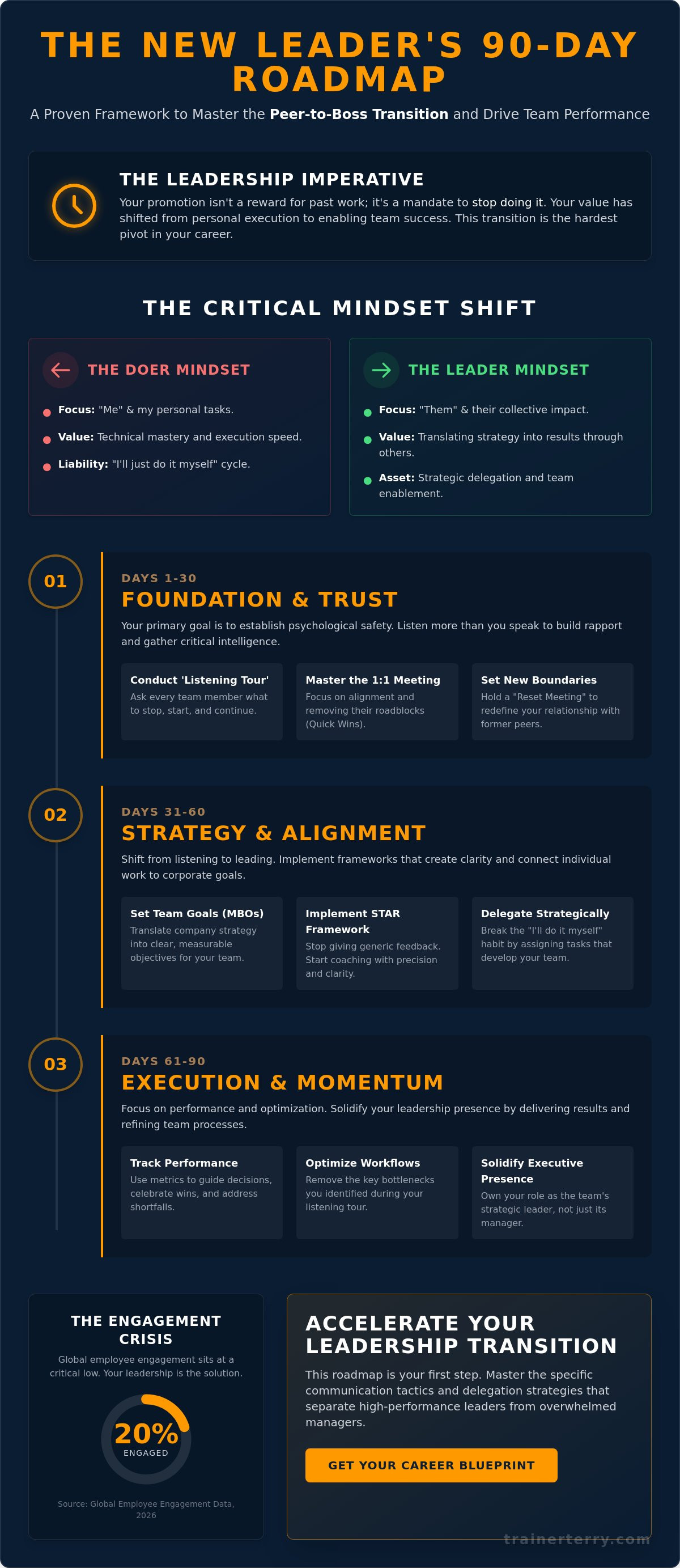
Yesterday, you were a high-performing peer. Today, you're the person responsible for everyone else's output. In 2026, the individual contributor model is about "me" and my technical mastery. The leadership model is about "them" and their collective impact. Your technical skills, while impressive, are no longer your primary value driver. Your value now lies in your ability to translate company strategy into actionable results through others. Managerial Rebranding is the intentional shift of your professional focus from individual execution to the strategic enablement of your team's success.
This transition requires a new professional narrative. You aren't just a "promoted employee." You're a strategic asset hired to maximize team performance. When setting team goals and objectives for the first time, you'll quickly realize that your old friends now look to you for direction, not just a lunch companion. You must reconcile the "Friendship vs. Authority" boundary immediately. If you don't define the relationship, the relationship will define your failure. It's time to stop executing and start leading.
Setting New Boundaries Without Burning Bridges
Don't ignore the elephant in the room. Schedule a "Reset Meeting" with your former peers. Use a direct script: "I value our history and our friendship, but my role has changed. My job now is to clear the path for your success and hold the team to a new standard of excellence." This transparency builds respect faster than pretending nothing has changed. When attending social outings, maintain your presence but be the first to leave. You can be friendly without being "one of the guys." This distance is essential for maintaining the objectivity required for Management by Objectives (MBO) to actually work.
Overcoming First-Time Manager Imposter Syndrome
Stop telling yourself you got lucky. Your promotion was a calculated business decision based on your potential to lead, not just your ability to do. If you don't have all the answers, don't fake it. Reframing "not knowing" as "seeking team expertise" isn't a sign of weakness; it's a high-level coaching tactic that builds trust. It shows you value their specialized knowledge while you focus on setting team goals and objectives for the first time. True executive presence isn't about being the smartest person in the room. It's about being the person who can lead the smartest people in the room toward a shared vision. Own your seat at the table. You earned it by showing you can think beyond the task list.
The Trust Blueprint: Building a High-Performing Foundation
Trust isn't a soft skill; it's a performance multiplier. If your team doesn't trust you, they won't follow your lead, and they certainly won't hit the targets you set. In an era where global engagement is struggling, psychological safety is the foundation of team ROI. It's the shared belief that the team is safe for interpersonal risk-taking. When you're setting team goals and objectives for the first time, you need your people to feel safe enough to point out flaws in the plan before those flaws become expensive failures.
The 1:1 meeting is your most lethal weapon for building this foundation. These sessions aren't for status updates or micromanagement. They are for alignment, rapport, and uncovering the unspoken challenges within the department. To successfully transition from peer to boss, you must use these meetings to listen more than you speak during your first 30 days. Your goal is to identify "Quick Wins," which are small, irritating roadblocks you can remove immediately to prove you have your team's back.
Conducting Your First 'Listening Tour'
A Listening Tour is a diagnostic leadership phase where you gather the data necessary to lead effectively. In your first week, ask every team member these three questions: What's the biggest bottleneck in your daily workflow? What's one thing our team should stop doing immediately? How can I best support your career growth? This process uncovers the roadblocks your predecessor might have ignored. If you want to accelerate this transition, our Career Advancement Blueprint provides the exact communication frameworks you need to handle these high-stakes conversations with confidence.
Establishing Radical Transparency in Goal Setting
Buy-in happens when people understand the "Why" behind the "What." When upper management hands down a new directive, don't just pass it along. Explain the strategic reasoning behind it. If you're setting team goals and objectives for the first time, transparency is your best tool for gaining commitment. Sometimes you'll have information you cannot share. Be honest about it. Tell them: "I can't share those details yet because they aren't finalized, but I'll give you an update the moment I'm cleared to do so." This honesty builds more respect than a vague lie ever could. Treat every mistake as a data point for growth rather than a reason for blame. This shift transforms your team from a group of hesitant employees into a resilient, high-performing unit.
Communication Frameworks: Adapting STAR for Internal Leadership
Generic feedback is a relic of passive management. Saying "Good job!" might feel supportive, but it provides zero direction. In 2026, your team needs to know exactly which behaviors led to success. When you're setting team goals and objectives for the first time, vague praise creates a dangerous ambiguity. If they don't know why they succeeded, they can't repeat it. You need a framework that connects individual actions to the team's broader mission.
You probably know the STAR method as an interview technique. As a manager, you'll flip it into a feedback tool. This creates a high-performance feedback loop where communication is a two-way street. You aren't just delivering a verdict; you're facilitating a conversation. This approach also helps you manage up. By using structured data to communicate your team's successes to your own boss, you position yourself as a leader who understands ROI, not just activity.
The STAR-Feedback Model for Managers
Effective leadership requires precision. Use this four-step model to ensure your feedback sticks:
- Situation/Task: Describe the specific project or challenge the employee faced. Avoid generalizations.
- Action: Focus on the specific behavior you observed. Comment on their actions, not their personality or "attitude."
- Result: Quantify the impact. How did their action help the team reach its goals? Use numbers whenever possible.
- Next Steps: This is the most critical part. Don't just end with the result. Collaboratively define what happens next to build on this success or correct a mistake.
Navigating Difficult Conversations Early
Address performance issues the moment they appear. Waiting for a formal review is a leadership failure. Use the "24-Hour Rule" to regulate your emotions before delivering tough news, but don't wait longer than that. If you notice a performance dip, address it as a problem to be solved together, not a reason for punishment. You can lower the barrier for team input by holding regular Office Hours. This gives your team a safe, predictable space to share concerns before they escalate into crises. When setting team goals and objectives for the first time, your ability to handle these early friction points will determine your long-term authority.
The Delegation Trap: Shifting from Doing to Leading
"I'll just do it myself" is a death sentence for your leadership career. It feels faster in the moment, but it's a trap that keeps you stuck in the weeds while your team remains stagnant. When you're setting team goals and objectives for the first time, your primary job is to ensure the work gets done, not to do the work yourself. If you're still doing 80 percent of the execution, you aren't managing; you're just a glorified individual contributor with a bigger title. Scale requires letting go.
High-performance leadership requires a ruthless audit of your time. High-value tasks include strategic planning, stakeholder management, and coaching your reports. Low-value tasks are the repetitive execution steps you mastered in your previous role. Apply the 70 percent rule: if a team member can perform a task at 70 percent of your proficiency, delegate it immediately. This 30 percent gap is where their growth happens. By matching these tasks to their individual career goals, you transform "extra work" into a high-stakes development opportunity.
How to Delegate Without Micromanaging
Micromanagement is just a lack of trust disguised as "quality control." To avoid this, define the "What" (the desired outcome) but leave the "How" to the person doing the work. This is the outcome-based assignment framework essential for 2026 teams. Instead of hovering over their daily progress, set clear check-in milestones. These are pre-scheduled moments to review results and offer support, allowing your team the autonomy they need to actually take ownership. If you define the finish line clearly, you don't need to run the race for them.
Empowering Your Subject Matter Experts
Your team is full of specialized talent. Use your 1:1 meetings to identify each member's "superpowers" and align their tasks accordingly. When you step back, you create the space for them to step up and lead their own projects. This isn't just about clearing your plate. It's a deliberate tool for career advancement within your department. When your team members see that you are invested in their growth, they will be more committed to the targets you set when setting team goals and objectives for the first time.
Ready to stop being the bottleneck and start being the leader your team needs? If you want to master high-level leadership communication and delegation, schedule a free strategy call today to build your custom roadmap.
Your 90-Day Roadmap to Leadership Authority
A promotion is just a title until you back it up with a plan. Your first 90 days determine whether you'll be seen as a temporary placeholder or a strategic architect. This isn't the time for guesswork or "playing it by ear." You need a phased approach that moves you from observer to leader. By the end of this period, setting team goals and objectives for the first time will feel less like an experiment and more like a core competency. Success in 2026 requires a roadmap that balances human rapport with ruthless strategic alignment.
Month 1: Building the Foundation
Your first 30 days are about data collection and rapport. Complete 1:1 meetings with every report and key stakeholder. Map the team's current workflow to identify hidden pain points that have been ignored for months. Resist the urge to make sweeping changes immediately. Stability is your priority. If you start dismantling processes before you understand them, you'll lose the team's trust before you've even earned it. Use this time to learn the "unwritten rules" of how the team actually functions. You're a diagnostic investigator right now, not a disruptor.
Month 2: Strategic Alignment
Now that you have the data, it's time to lead. Draft your team's "North Star" goal for the quarter. This objective should align perfectly with the company's growth pillars and the latest career advice for emerging executives. This is the stage where setting team goals and objectives for the first time becomes a collaborative reality. Implement one "Quick Win" identified in Month 1. Solving a major team frustration proves you aren't just listening; you're acting on their behalf. You're showing them that life under your leadership is objectively better.
Month 3: Full Authority and Growth
By day 60, the "new manager" label should be gone. Use Month 3 to conduct your first formal performance reviews using the STAR framework. Don't just look backward; look ahead. Identify the future leaders within your own team for succession planning. A confident leader builds other leaders. Seek out 360-degree feedback to refine your own style. You should also set long-term KPIs for yourself as a leader. Measure your success by team retention, project velocity, and the professional growth of your reports. Your personal output is no longer the metric; team transformation is.
Leadership is a high-stakes game that requires a battle-tested strategy. If you're ready to accelerate this transition and secure your place in the executive suite, our Career Advancement Blueprint provides the exact framework you need. Don't wait for permission to lead. Build the authority yourself and make your impact undeniable.
Own Your Seat at the Leadership Table
Your transition from top performer to strategic leader is the most critical phase of your career. It requires more than just a new title; it demands a complete rebranding of your professional identity. By mastering the peer-to-boss shift and implementing structured feedback loops, you move from being a bottleneck to becoming a high-performance enabler. Remember that setting team goals and objectives for the first time isn't about control. It's about creating a clear "North Star" that empowers your team to execute with autonomy and purpose.
Don't leave your first 90 days to chance. You need the same actionable frameworks used by Fortune 500 executives to navigate these high-stakes transitions. I've spent over 20 years as a Corporate VP leading these exact shifts, and I know how to turn initial awkwardness into genuine executive presence. It's time to stop second-guessing your authority and start building a legacy of results that get you noticed by upper management.
Book a Free Strategy Call to build your personalized Leadership Blueprint and take command of your new role today. You've earned this promotion. Now, let's make sure you excel in it.
Frequently Asked Questions
What is the biggest mistake first-time managers make when setting goals?
The most common error is trying to be a "super-executor" instead of a leader. New managers often focus on the technical "how" of a task rather than the strategic "what" and "why." When setting team goals and objectives for the first time, many fail to align team targets with broader corporate KPIs. This leads to a team that is busy but not productive. Focus on outcomes and let your experts handle the execution.
How do I handle a former peer who is unhappy that I got the promotion?
Address the friction directly in a private, professional setting. Acknowledge that the dynamic has changed and emphasize your commitment to their personal career growth. Don't apologize for your new role. Instead, explain that your job is to clear the path for their success. This transparency builds respect and shifts the focus from personal feelings to professional results.
How often should I hold one-on-one meetings with my new team?
You should hold 1:1 meetings weekly or bi-weekly for at least 30 minutes. Consistency is the key to building trust and maintaining alignment. These sessions are your primary vehicle for setting team goals and objectives for the first time and uncovering hidden roadblocks. Use this time for high-level coaching and behavioral feedback rather than simple status updates that could be handled via email.
Is it okay to admit to my team that I'm nervous or don't have all the answers?
Admitting you don't have every answer is a sign of executive presence, but keep your nerves private. Reframing "not knowing" as "valuing the team's specialized expertise" builds immediate rapport. Your team doesn't expect you to be a walking encyclopedia. They expect you to be a decisive leader who knows how to leverage the collective intelligence of the group to find the best solution.
How do I transition from being 'one of the team' to 'the boss' without being cold?
Transition by setting clear professional boundaries while remaining human and approachable. You can be friendly without being a peer by shifting your focus to the team's performance and long-term development. This "Managerial Rebranding" means you must step back from office gossip and cliques. Your goal is to be a mentor who is emotionally invested in their success without compromising your objectivity.
What should I focus on in my very first meeting as a new manager?
Focus on your vision for the team and your commitment to a "Listening Tour." Don't announce major process changes on day one. Instead, tell the team that your first priority is understanding their current bottlenecks and identifying "Quick Wins" to make their work easier. This establishes your authority through a commitment to service and support rather than just exercising power.
How can I balance my own workload with the new responsibilities of managing others?
Balance your workload by ruthlessly delegating execution tasks that others can handle. Your value has shifted from "doing" to "leading." Prioritize high-value leadership tasks like strategy, stakeholder management, and team coaching. If a report can perform a task at 70 percent of your proficiency, delegate it. This creates growth opportunities for them and frees you to focus on the team's strategic ROI.
How do I manage a team member who has significantly more experience than I do?
Manage experienced reports by acting as an advocate and a path-clearer. Acknowledge their deep expertise and ask how you can best support their high-level projects. You don't need to be more technically skilled than them to be their leader. When they see you are focused on securing resources and removing their administrative roadblocks, they will respect your role as a strategic facilitator.

Article by
Terry Jones
Terry Jones is the Founder and Chief Career Strategist of the Career Advancement Blueprint and Executive Coach and Lead Consultant at FireBridge Consulting.
As an ICF Certified Accredited Career Coach and Certified Master Career Services professional, he partners with professionals at all levels, including senior leaders and executives, to navigate career transitions, secure new opportunities, and position themselves for advancement. His approach goes beyond surface level coaching, focusing on how individuals think, communicate, and lead so they can operate with clarity, authority, and strategic intent in high stakes environments.
In his work as an executive coach, Terry engages in high impact advisory conversations that help leaders strengthen decision making, elevate their presence, and align their leadership style with organizational expectations. He is known for helping clients translate their experience into influence, ensuring they are not only seen for what they have done, but trusted for what they are capable of leading next.
With over 20 years of corporate experience, including serving as a Vice President and leading Learning and Development functions for three New York City organizations, Terry brings a deep understanding of how companies evaluate talent, develop leaders, and make promotion decisions. This allows him to bridge the gap between individual ambition and organizational reality.
His insights have reached over 630,000 followers and generated more than 70 million video views, where he shares direct, experience driven guidance that helps professionals think differently and take action.