
Your promotion wasn't just a reward for your hard work; it was a total rebranding of your professional identity. You've probably already noticed the shift. The office jokes stop when you enter the room, and your former lunch buddies are suddenly questioning your decisions. It's uncomfortable. Facing transitioning from peer to manager challenges feels like walking a tightrope where one slip-up costs you either your authority or your friendships.
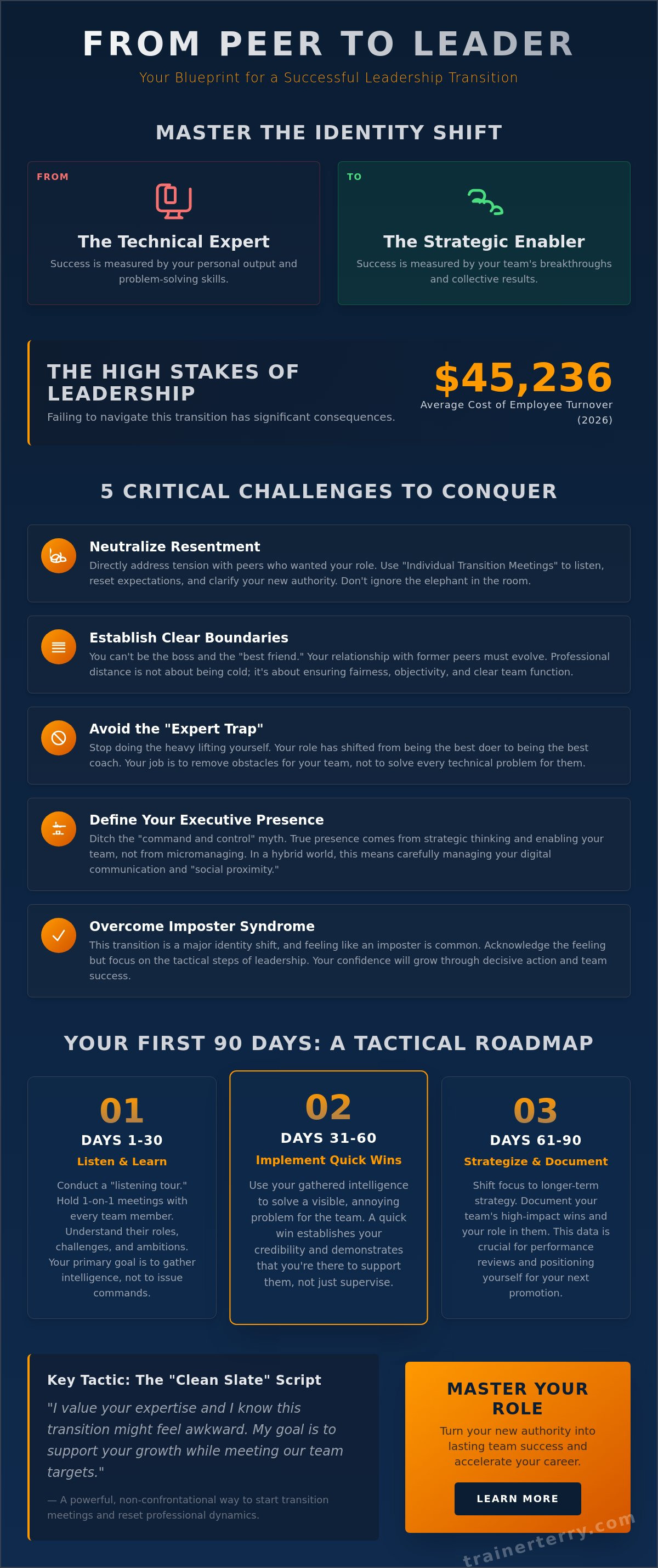
You aren't alone in this struggle. With the average cost of employee turnover hitting $45,236 in 2026, the pressure to get leadership right from day one is higher than ever. Do you want to maintain respect without being a tyrant? You need to drive performance without losing the team's trust. It's about shifting from a technical doer to a strategic enabler who commands the room.
This article gives you the blueprint to master the psychological and tactical shifts required to lead with executive presence. You'll learn how to establish clear boundaries and overcome the imposter syndrome that holds most new managers back. We're diving into the five critical challenges you must conquer to turn your new authority into lasting team success.
Key Takeaways
- Shift your identity from a technical expert to a strategic enabler to lead your former team with newfound authority.
- Neutralize workplace resentment by mastering the "Individual Transition Meeting" to address the elephant in the room directly.
- Overcome common transitioning from peer to manager challenges by ditching the "command and control" myth for true executive presence.
- Follow a tactical 90-day roadmap that balances a listening tour with quick wins to establish immediate leadership credibility.
- Leverage your first management role as a career positioning tool to document high-impact wins for your next major promotion.
Why the "Friend to Boss" Transition is Your First True Leadership Test
You’ve spent years building your reputation as the go-to expert. Now, that same reputation is your biggest hurdle. Transitioning from peer to manager challenges your very sense of self. You aren't just one of the team anymore. You’re the person responsible for their output, their raises, and their mistakes. This isn't a small adjustment; it's a fundamental identity shift. It requires you to develop a new leadership style that prioritizes team results over individual accolades. If you don't make this mental leap early, you'll find yourself stuck in the middle, respected by neither your team nor your own supervisors.
Most new managers fall into the "Expert Trap." They think that because they were the best coder, salesperson, or analyst, they should keep doing that work to show the team how it's done. That's a mistake. If you’re still doing the heavy lifting, you aren't managing; you’re just a glorified individual contributor with a bigger title. Your job is now to remove obstacles, not solve every technical problem yourself. Stop trying to be the hero. Start being the coach.
The Identity Crisis of the New Manager
Success used to be about your personal metrics. Now, your win is someone else's breakthrough. This shift is jarring because you lose the immediate dopamine hit of completing a task. You must learn to find fulfillment in collective team success. If you spend your days seeking approval from former peers, you’ve already lost. You can’t be the boss and the "best friend" at the same time. Boundaries aren't walls; they’re the framework that allows your team to function without confusion or favoritism. Facing these transitioning from peer to manager challenges head-on means accepting that your relationship with the "inner circle" must evolve into something professional and objective.
The 2026 Leadership Landscape
In 2026, the hybrid work model adds a layer of complexity. You don't have the luxury of reading the room in a physical office every day. Digital transparency means every Slack message and LinkedIn update is scrutinized for bias or weakness. You must manage "social proximity" carefully. If you’re still in the private group chats where the team complains about upper management, you’re compromising your authority. Establish your professional baseline in the first 48 hours. Don't wait for things to get awkward. Set the tone immediately by defining how communication will flow and what the new expectations are. Clarity is the highest form of respect you can show your former colleagues.
Managing the "Resentment Factor": Handling Peers Who Wanted Your Job
You can't ignore the silence in the room. If you were promoted over a colleague who wanted your seat, the tension is thick. Ignoring it won't make it go away. It will only manifest as passive-aggressive resistance or, worse, a total breakdown in team productivity. One of the most difficult transitioning from peer to manager challenges is facing the "disappointed runner-up" with a mix of genuine empathy and unwavering leadership. You aren't there to apologize for your success. You’re there to ensure the team still functions at its peak. Address the elephant in the room immediately. Acknowledge their ambition, but make it clear that the decision is final and the focus must shift back to the mission.
Passive-aggressive behavior is a direct threat to your authority. If a former peer starts missing deadlines or "forgetting" to include you in emails, don't let it slide. Hold individual transition meetings with every team member. These aren't casual chats. They are strategic sessions to reset expectations. Ask them directly how they feel about the change. Listen more than you speak. By giving them a platform to voice their frustration, you drain the power from their resentment. If you need a structured way to handle these high-stakes interactions, consider looking into the Career Advancement Blueprint to refine your internal strategy.
The "Clean Slate" Conversation
Start with a clear script. Tell them: "I value your expertise and I know this transition might feel awkward. My goal is to support your growth while meeting our team targets." This isn't about being liked; it's about being effective. Ask for their support while clarifying that your new responsibilities involve making tough calls that won't always be popular. Professional distance is your most valuable tool here. It isn't about being cold or distant; it's about creating a space where every team member is evaluated on performance rather than personal history. This boundary ensures fairness for everyone.
Neutralizing Favoritism Allegations
The "work bestie" dynamic is now a liability. If you continue with "business as usual" with your closest friends on the team, you’re handing your critics a weapon. Every coffee break or private joke is now viewed through the lens of favoritism. You must set transparent, data-driven criteria for all assignments and rewards. Use executive career coaching principles to remain objective and keep your personal feelings out of the performance review process. When the team sees that results—not relationships—drive your decisions, the resentment will eventually fade. If you're struggling to find that balance, you can always schedule a free strategy call to map out your leadership approach.
Redefining Your Executive Presence: From Expert to Strategic Leader
Executive presence isn't a mysterious trait reserved for the C-suite. It's the silent signal that you belong in your new seat. One of the most persistent transitioning from peer to manager challenges is the urge to remain the technical expert. You want to prove you still "have it." Stop. Your value no longer comes from your ability to execute tasks. It comes from your ability to influence outcomes. Shifting from a technical doer to a strategic advisor requires a total audit of how you show up in every meeting and every digital thread.
The "Command and Control" model is a relic of the past. In 2026, your authority isn't derived from your title, but from your strategic insight. You aren't there to give orders. You’re there to provide the context and resources your team needs to win. This requires a shift in your leadership narrative. You must justify your seat at the table by demonstrating that you understand the bigger picture, not just the daily grind. Successfully navigating transitioning from peer to manager challenges means proving you can think three steps ahead of the current workflow.
The 3 Pillars of New Manager Presence
Gravitas: This is your emotional discipline. When a project fails or a deadline is missed, the team looks to you for a reaction. If you panic, they panic. Staying calm and focused on the solution is the hallmark of a leader. It shows you have the mental fegyelem to handle high stakes without cracking.
Communication: Stop reporting status. Start sharing vision. Your team needs to know how their daily tasks contribute to the company's 2026 goals. Use clear, assertive language that removes ambiguity. Short, punchy sentences command more respect than long, rambling explanations.
Appearance: This isn't just about clothes. It's about your digital and physical positioning. Your title changed; your professional brand must follow. Your digital footprint should reflect a leader who enables others, not just an employee who completes tickets.
Leveraging Your Career Narrative
Your history as a peer is an asset, not something to apologize for. You know the team's pain points because you lived them. Use that knowledge to build authentic buy-in. When you communicate your "Why," you give the team a reason to follow you that goes beyond the org chart. To ensure your external brand matches your internal growth, learn more about how to use LinkedIn to reflect your new leadership status. Your profile should no longer list what you did; it should showcase the results you lead.
The First 90 Days: A Tactical Roadmap for New Managers
The first 90 days are the most volatile period for any new leader. Mastering transitioning from peer to manager challenges requires a disciplined, phase-based approach that builds trust before it demands changes. You can't just walk in and start tearing down systems. You need to understand the friction points before you try to grease the wheels. Think of this period as your leadership training cycle. You’re building the mental and operational foundation that will support your team for the next three years, not just the next three months.
- Phase 1 (Days 1-30): The Listening Tour. Your only goal is to gather intel. Schedule 1:1 meetings with every team member. Ask what’s working, what’s broken, and what they need from you to win. Don't make promises yet. Just listen.
- Phase 2 (Days 31-60): Establishing Quick Wins. Find a small, persistent problem and fix it. Maybe it’s a redundant meeting or a broken reporting tool. By delivering a "Quick Win," you prove you’re an enabler who adds value to their workday.
- Phase 3 (Days 61-90): Implementing Standards. Now that you have trust, set the bar. Define what high performance looks like. Use the STAR Method to deliver objective performance feedback. Focus on the Situation, Task, Action, and Result to keep the conversation professional and data-driven.
By Day 90, your team should see you as a strategic enabler who has successfully navigated the most common transitioning from peer to manager challenges. You aren't just a placeholder; you’re the catalyst for their success.
Mastering the Feedback Loop
Delivering tough feedback to someone you used to grab drinks with is the ultimate test of your authority. You must separate the person from the performance. Don't say "You’re being lazy." Instead, point to the data. Use specific examples of where the output missed the mark. If you feel your old friendships are clouding your judgment, schedule a 1:1 job interview prep session to practice these difficult leadership conversations. Learning to hold others accountable is a skill you must train like a muscle.
Setting Boundaries that Stick
Your old "Open Door Policy" might be killing your productivity. You aren't a complaint department; you’re a strategic leader. Protect your deep-work time by setting specific hours for walk-ins. You also need to manage the social shift. Declining a Thursday night happy hour doesn't make you a jerk; it makes you a professional. You now have access to confidential information regarding salaries and restructuring. You can't be part of the office gossip mill anymore. Guard that information with total integrity.
If you’re ready to stop playing defense and start leading with authority, master the transition with the Career Advancement Blueprint today.
Beyond Survival: Using Your New Role as a Career Advancement Catalyst
Don't make the mistake of treating your first management role as a finish line. It’s a launchpad. Most professionals get stuck in the "survival phase" because they’re too focused on the daily friction. You need to look higher. Successfully overcoming transitioning from peer to manager challenges is the ultimate proof of your executive potential. If you can lead a team of former equals, you can lead an entire organization. This role is your first real chance to build a reputation as a strategic enabler rather than just a high-performing doer.
Every decision you make now should be documented. You aren't just managing projects; you’re gathering evidence for your next promotion. Find a mentor who has already walked the path from peer to VP. They can help you spot the political landmines you can’t see yet. Integrating your new leadership experience into a structured Career Advancement Blueprint ensures you don't stay at this level any longer than necessary. You’re training for the C-suite now.
Building Your Executive Portfolio
Your personal metrics are dead. Your team's KPIs are your new resume. Start tracking how your leadership directly impacts the bottom line. Are you reducing turnover? Are you hitting targets faster than the previous manager? Talent development is now your primary product. Your success is measured by how many of your team members are ready for their own promotions. When the time comes for your next move, you’ll need a High-Level Interview Strategy that focuses on these leadership wins rather than your old technical skills.
Next Steps for High-Performance Leaders
The jump from manager to a "leader of leaders" requires another level of mental fegyelem. You have to stop managing tasks and start managing culture. Continuous leadership development is non-negotiable in the fast-moving market of 2026. The skills that got you here won't be enough to keep you moving upward. You need to stay ahead of the curve. Don't let your progress stall because you got comfortable in a mid-level seat.
Ready to turn this transition into a permanent upward trajectory? Don't leave your growth to chance. Join the Career Advancement Blueprint today and start building your legacy.
Take Command of Your Leadership Future
You’ve seen the roadmap. You know that moving from "one of the team" to the person in charge isn't about luck; it’s about a deliberate identity shift. You must ditch the technical heroics and start enabling the people around you. By mastering your first 90 days and setting clear boundaries, you transform from a former peer into a respected strategic leader. This isn't just about survival. It's about positioning yourself for every promotion that follows. Stop reacting to office drama and start driving measurable results.
Successfully navigating the transitioning from peer to manager challenges is the most significant catalyst your career will ever see. It’s the moment you prove you belong in the executive ranks. Don't leave this critical phase to trial and error. You need a proven system that works in the high-stakes environment of 2026. You’ve worked too hard to let a lack of strategy hold you back now.
Led by former Corporate VP Terry Jones, who brings 20+ years of high-stakes executive experience, our program integrates the proven STAR method to give you an unfair advantage. Stop guessing and start leading. Secure your seat in the Career Advancement Blueprint and lead with confidence today. Your team is waiting for a leader. Become the one they need. You’ve got this.
Frequently Asked Questions
How do I handle a friend who ignores my deadlines now that I am their manager?
You must address the missed deadline in a private, formal 1:1 meeting immediately. Don't let your personal history cloud the operational reality. Explain that while you value the friendship, your role requires you to ensure the team hits its targets. Use the STAR method to show the impact of the delay on the collective goal. If you don't set this boundary now, you're telling the rest of the team that favoritism is the new standard.
What is the biggest mistake new managers make when promoted from within?
The biggest mistake is falling into the "Expert Trap" where you keep doing the technical work yourself. You're no longer the star player; you're the coach. Many new leaders fail because they prioritize being liked over being effective. This is one of the most common transitioning from peer to manager challenges. You must shift your focus from individual tasks to team enablement. If you’re still doing the work, you aren’t leading.
How do I manage a former peer who is older or more experienced than me?
Acknowledge their experience openly and seek their counsel on technical matters. You don't need to be the smartest person in the room to be the leader. Your job is to provide the strategic direction and resources they need to excel. Respect their tenure, but remain firm on the team's objectives. When they see you as an enabler of their success rather than a threat, the age gap becomes irrelevant to the mission.
Can I still be friends with my team after becoming their manager?
You can maintain a friendly relationship, but the "best friend" dynamic must evolve into professional mentorship. Boundaries are essential for fairness. You can't be part of office gossip or private gripe sessions anymore. If you have access to salary data or restructuring plans, you must guard that information with total integrity. True friends will respect your new responsibilities; those who don't are a risk to your authority and the team's culture.
How do I establish authority without sounding like I have "gone corporate"?
Authority comes from clarity and consistency, not buzzwords or a title. Be transparent about why decisions are made and how they align with the team's goals. Use direct, punchy communication. You don't need to act like a different person; you just need to act with more purpose. When you focus on removing obstacles for your team, they’ll respect your authority because it's rooted in results rather than a corporate script.
What should I do if a former peer is openly hostile about my promotion?
Face the hostility directly in a private setting. Ask them: "I’ve noticed some tension since the promotion. Can we talk about what’s going on?" Don't get defensive. Listen to their concerns, but make it clear that the team's performance is the non-negotiable priority. If the behavior continues to disrupt the team, it becomes a performance issue. You must protect the team's productivity from toxic resentment at all costs.
How do I balance being a "coach" and a "boss" simultaneously?
Think of yourself as a high-performance trainer. As a "boss," you set the non-negotiable standards and deadlines. As a "coach," you help your team develop the skills to meet those standards. Successfully navigating transitioning from peer to manager challenges means knowing when to switch gears. Use your 1:1s for individual coaching and your team meetings to reinforce the "boss" level expectations. Both roles serve the same goal: winning as a unit.

Article by
Terry Jones
Terry Jones is the Founder and Chief Career Strategist of the Career Advancement Blueprint and Executive Coach and Lead Consultant at FireBridge Consulting.
As an ICF Certified Accredited Career Coach and Certified Master Career Services professional, he partners with professionals at all levels, including senior leaders and executives, to navigate career transitions, secure new opportunities, and position themselves for advancement. His approach goes beyond surface level coaching, focusing on how individuals think, communicate, and lead so they can operate with clarity, authority, and strategic intent in high stakes environments.
In his work as an executive coach, Terry engages in high impact advisory conversations that help leaders strengthen decision making, elevate their presence, and align their leadership style with organizational expectations. He is known for helping clients translate their experience into influence, ensuring they are not only seen for what they have done, but trusted for what they are capable of leading next.
With over 20 years of corporate experience, including serving as a Vice President and leading Learning and Development functions for three New York City organizations, Terry brings a deep understanding of how companies evaluate talent, develop leaders, and make promotion decisions. This allows him to bridge the gap between individual ambition and organizational reality.
His insights have reached over 630,000 followers and generated more than 70 million video views, where he shares direct, experience driven guidance that helps professionals think differently and take action.