Leadership Development Goals for Aspiring Executives: Your 2026 Strategic Roadmap

You're hitting every KPI and managing your team with precision, yet that C-suite door remains firmly locked. The hard truth is that the tactical skills that made you a brilliant manager are often the very things holding you back from the VP level. To bridge this gap, you must define and crush specific leadership development goals for aspiring executives that prioritize strategic influence over daily task execution. It's no longer about how much you do; it's about how much impact you steer.
It's exhausting to feel overlooked for high-level roles because you're seen as the "doer" rather than the "visionary." You deserve a seat at the table where the real decisions happen. This guide delivers a 2026 roadmap to help you master executive presence and articulate your strategic impact with total confidence. We'll break down how to transition from managing people to leading organizational outcomes, ensuring you're ready for the high-stakes demands of the executive suite.
Key Takeaways
- Stop just managing tasks; learn to bridge the "Executive Gap" by shifting your focus from operational output to strategic steering.
- Master the art of business impact by moving beyond departmental KPIs to drive organization-wide P&L results and proactive trend forecasting.
- Command every room with a reinforced executive presence, using the PIE model to master high-stakes storytelling and stakeholder influence.
- Secure your promotion by setting actionable leadership development goals for aspiring executives that prove you are a visionary leader ready for the C-suite.
- Leverage the Career Advancement Blueprint to align your personal brand with the strategic needs of the organization and secure your seat at the table.
Bridging the Gap: Why Aspiring Executives Need Different Goals
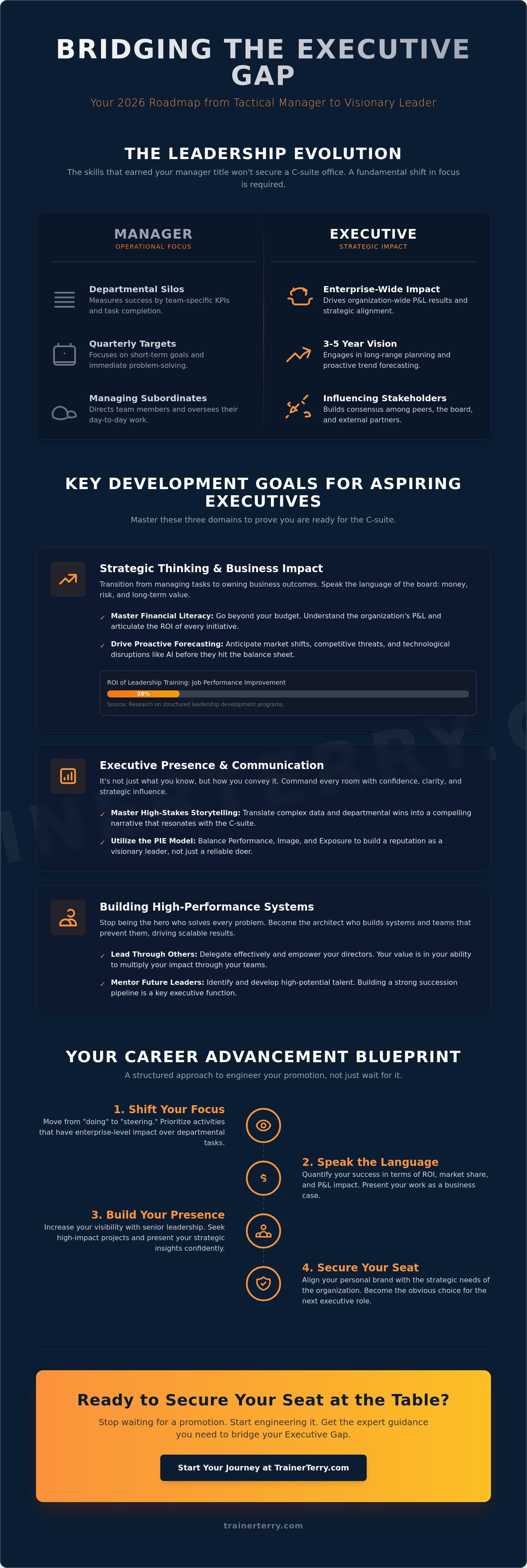
You've likely reached your current position through hard work, technical mastery, and operational precision. But here's the reality: the skills that got you here won't get you to the C-suite. This is the "Executive Gap." It's the chasm between managing daily tasks and steering long-term organizational strategy. To cross it, your leadership development goals for aspiring executives must shift from personal output to systemic influence. You need to stop being the person who solves every problem and start being the person who builds the systems that prevent them.
The "Executive Gap" manifests in three specific ways:
- Focus: Shifting from departmental silos to enterprise-wide impact.
- Time Horizon: Moving from quarterly targets to 3-5 year strategic visions.
- Relationships: Transitioning from managing subordinates to influencing peers, board members, and external stakeholders.
In 2026, the stakes are higher than ever. It's not just about hitting numbers; it's about navigating rapid AI integration and volatile global shifts. You're no longer just pulling levers; you're the one deciding which levers even matter. This requires a profound psychological transition. You must move from the comfort of "doing" to the high-stakes arena of "leading." It's a shift in how you perceive your own value. Your growth isn't just a corporate requirement; it's a strategic investment in your personal brand equity. Understanding what is leadership development? helps you realize that this process is about expanding your capacity to influence across the entire organization. Stop doing. Start leading.
The Evolution of Leadership Expectations in 2026
The era of command-and-control is over. Today's boardrooms demand inclusive, strategic influence. You need the foresight to anticipate market disruptions before they appear on a spreadsheet. Agility is your most valuable asset. Ironically, your past technical success might be your biggest barrier to promotion. Because the organization depends on you to keep the engine running, they might be hesitant to move you to the cockpit. You have to prove you can let go of the details to focus on the horizon.
The ROI of Targeted Executive Development
Setting specific goals doesn't just make you better; it shortens your timeline to a VP or C-suite role. When you speak the language of the board, you build instant credibility. They need to see that you understand risk, capital allocation, and long-term value. Executive leadership is the ability to drive organizational results through others. By following a structured Career Advancement Blueprint, you position yourself as the obvious choice for the next opening. You aren't just waiting for a promotion; you're engineering it.
Strategic Thinking and Business Impact Goals
Stop hiding behind your team's internal metrics. If you want a seat at the table, you have to speak the language of the table: money and strategy. You're no longer just a manager; you're a business owner within the business. This shift requires you to master trend forecasting and competitive analysis before the board even asks for it. High-level leadership development goals for aspiring executives must prioritize these business levers over simple task completion. Check out these leadership development tips to see how the best in the business stay ahead of the curve.
Developing a "CEO Mindset" means you stop asking what's good for your department and start asking what's vital for the organization's P&L. You must align every project with the long-term vision of the parent company. It's about ownership. If you're struggling to translate your daily wins into executive-level value, it's time to refine your strategy with a Career Advancement Blueprint. Don't wait for permission to think like a leader. Start today.
Mastering Financial Literacy and P&L Responsibility
You can't lead what you can't measure in dollars. Set a goal to understand the full financial health of your organization, not just your budget line. You need to articulate the ROI of your initiatives in every executive meeting. Research shows that well-structured leadership training can lead to a 20% improvement in job performance. Prove that your work drives that level of strategic value. Bridge the gap between operational costs and long-term capital gains.
Driving Innovation and Change Management
In 2026, you must be the architect of change, not a reluctant participant. This means identifying and implementing disruptive technologies, like AI, safely and effectively. Set goals for building a culture of calculated risk-taking within your team. Don't just follow trends; anticipate them. When you lead through innovation, you prove you're ready for the C-suite. Your ability to navigate uncertainty is what makes you an executive.
Cultivating Executive Presence and Communication
You can have the best strategy in the world, but if you can't command a room, it stays on your hard drive. Executive presence isn't an invisible aura; it's a skill you build through the PIE model: Performance, Image, and Exposure. While performance gets you into the room, your image and exposure keep you there. This is where most leadership development goals for aspiring executives fall short. They focus on the work, not the worker. You need to refine your executive presence to ensure your voice carries weight in high-stakes environments.
Gravitas is the cornerstone. It's the ability to remain calm under fire and make tough decisions with total confidence. But gravitas alone isn't enough. You must master high-stakes storytelling to win over skeptical stakeholders. Board members don't want a data dump; they want a narrative that explains where the company is going and why they should follow you. Developing high emotional intelligence (EQ) allows you to read the room and navigate complex corporate politics without losing your integrity. It's about influence, not just authority.
High-Stakes Communication and Public Speaking
Your words are your currency. Start by eliminating "filler" language like "um," "uh," or "I think" from your vocabulary. These verbal ticks erode your authority instantly. Set a concrete goal to present at one major industry event or a board-level meeting this year. Use these opportunities to practice simplifying complex data. Executives don't have time for the weeds. They need the "so what?" behind the numbers. If you can't explain your strategy to a five-year-old, you don't understand it well enough yet.
The Art of Strategic Influence and Negotiation
Success at the executive level is a team sport. You must build alliances across departments to drive cross-functional wins. This requires negotiating for resources and buy-in without having formal authority over everyone involved. Think of it as internal resource advocacy. You can apply salary negotiation coaching principles here to secure the budget and headcount your initiatives need. It's about creating win-win scenarios that align with the company's broader mission. Stop asking for permission and start building partnerships.
Building High-Performance Teams and Mentorship
Your value as an executive isn't measured by what you do. It's measured by what your team achieves when you aren't in the room. To move up, you must stop being a manager of people and start being a developer of leaders. This is a non-negotiable pillar of leadership development goals for aspiring executives. If you're still the bottleneck for every decision, you aren't ready for the C-suite. You need to build a machine that runs without you. This requires a shift from tactical oversight to high-level mentorship.
Psychological safety isn't a soft HR concept. It's a performance multiplier. When your team feels safe to fail, they innovate faster. They take the risks that lead to market breakthroughs. You should use the STAR method not just for interviewing, but as a coaching framework. It helps your team articulate their Situation, Task, Action, and Result with clarity. This builds the high-performance culture required at the executive level. When your team wins, you win. It's that simple.
If you want to fast-track your transition from manager to visionary leader, schedule a free strategy call to map out your leadership transition today. Don't let your current workload block your future promotion.
Succession Planning as a Leadership Strategy
If you are indispensable in your current role, you are unpromotable. It's a hard truth. You must identify and groom your replacement now. This frees you to focus on the higher-level strategic goals we've discussed. Set measurable growth targets for your direct reports. When you prove you can build a talent pipeline, you show the board that you think like an owner. Replacing yourself is the fastest way to get promoted. It demonstrates that you've mastered the art of organizational scalability.
Leading Through Diversity and Inclusion
In 2026, cognitive diversity is a competitive advantage. You need a team that challenges your assumptions, not one that echoes them. Set concrete goals for building teams that out-innovate the competition through diverse perspectives. Measure the impact of your inclusive leadership on team retention and output. Don't just be a supporter; be an executive sponsor for underrepresented talent. This isn't just about ethics. It's about driving superior business results through a wider range of ideas and experiences.
Executing Your Executive Promotion Strategy
You've defined the gap, mastered the financials, and refined your presence. Now comes the execution phase. Crushing your leadership development goals for aspiring executives isn't just about self-improvement; it's about market positioning. You're no longer just a candidate; you're a solution to a high-level business problem. To make this transition seamless, you need to synthesize everything you've learned into a coherent Career Advancement Blueprint. This is your training plan for the C-suite. Stick to it with the same discipline you'd bring to a high-intensity physical transformation.
Internal positioning is where most talented professionals fail. They wait to be noticed. Don't make that mistake. You must actively manage how the organization perceives your value. Use tools like Office Hours to pressure-test your strategic narrative with an expert who has sat in the chair you want. Refine your message until it's undeniable. If you're ready to stop guessing and start moving, the final step is scheduling a free strategy call to map your 2026 promotion path with precision. Consistency in execution is what separates the VPs from the permanent middle managers.
Personal Branding for the C-Suite
Your LinkedIn profile shouldn't be a list of past chores. It needs to reflect executive authority. Shift the focus from what you did to what you built, saved, or transformed. Your executive resume must highlight strategic wins over tactical duties. If your current branding feels like it's stuck at the manager level, working with an executive career coach can provide the outside perspective needed to elevate your narrative. You are the product. Market yourself with the same intensity you bring to your work.
The Final Interview: Proving You Belong
When you get to the final round, the board isn't checking your references; they're checking your vision. Use the STAR method to demonstrate executive-level problem solving. Don't just talk about the result; talk about the strategic "why" behind your actions. Prepare for questions about risk mitigation, organizational culture, and long-term scalability. This is where you close the deal. Once they see you as an equal, you'll have the leverage to negotiate an executive compensation package that reflects your true impact. Don't leave money on the table because you were too hesitant to claim your worth.
Claim Your Seat at the Executive Table
The path to the C-suite isn't paved with more hard work; it's paved with better strategy. You've now seen how to bridge the gap between operational management and visionary leadership. By setting precise leadership development goals for aspiring executives, you stop reacting to the business and start steering its future. You have the roadmap to master your presence, command financial outcomes, and build the next generation of leaders who will carry your vision forward.
Don't let another year pass while you're stuck in the middle. Trainer Terry brings over 20 years of experience as a former Corporate VP to help you navigate these high-stakes promotions. Through the proven Career Advancement Blueprint and specialized STAR method coaching, you'll gain the confidence to dominate board-level interviews and secure the influence you deserve. It's time to turn your potential into professional reality.
Are you ready to stop waiting for permission? Secure your executive future with a Free Strategy Call with Trainer Terry today. The transformation starts now. You have the talent; let's build the legacy you were meant for.
Frequently Asked Questions
What are the top 3 leadership goals for new executives in 2026?
The top goals in 2026 center on AI-augmented decision-making, mental well-being, and managing distributed teams. You must move from just understanding data to using AI as a collaborator for strategic insights. Additionally, prioritizing the psychological safety of your team is no longer optional. It's a core executive responsibility that drives retention and performance in volatile, hybrid markets.
How do I demonstrate executive presence if I am still in a middle-management role?
You demonstrate executive presence by focusing on gravitas and enterprise-wide impact rather than just team output. Stop talking about your department's daily tasks and start talking about how your initiatives influence the company's bottom line. Command respect by simplifying complex problems and remaining calm during high-stakes meetings. Your goal is to be seen as a visionary who understands the parent company's long-term roadmap.
How often should I review and update my leadership development goals?
You should review your leadership development goals for aspiring executives every quarter to stay aligned with rapid market shifts. Monthly check-ins are also essential to ensure you aren't slipping back into tactical, "doing" habits. In the fast-moving environment of 2026, agility is your greatest asset. If your goals don't evolve as business challenges change, you'll find yourself leading with an outdated playbook.
Can I develop executive skills without a mentor or formal coach?
You can develop these skills through observation and trial; however, a formal coach provides the strategic mirror you can't create yourself. Self-study requires immense discipline to identify your own blind spots. Professional advisory helps you articulate your impact in a way that resonates with the board. It turns years of trial and error into a focused, months-long transition to the C-suite.
What is the difference between a leadership goal and a professional development goal?
Professional development goals focus on individual competencies like learning a new software. Leadership goals are systemic; they focus on your ability to drive results through others. While professional development makes you a better worker, leadership development makes you a better steer of the organization's future. One is about technical mastery, while the other is about strategic influence and organizational impact.
How do I measure the success of soft-skill leadership goals like "influence"?
Measure influence by tracking how quickly you gain cross-functional buy-in for your initiatives. Look at the resources and headcount allocated to your projects compared to previous quarters. You can also use 360-degree feedback to see if peers and superiors now seek your opinion on matters outside your immediate department. If people are coming to you for strategic guidance, your influence is growing.
What role does AI play in executive leadership development goals for 2026?
In 2026, AI is a critical collaborator that enhances your decision-making capacity. Your leadership development goals for aspiring executives should include mastering AI-driven data analytics to gain competitive insights. It's not about replacing human judgment; it's about augmenting it. Leaders who can blend human empathy with AI-powered foresight will be the ones who secure the most prestigious executive roles.
How do I balance daily operational tasks with high-level leadership development?
Balance starts with aggressive delegation and strict time-blocking for strategic thinking. You must treat your leadership development like a non-negotiable executive meeting on your calendar. If you are too busy "doing" to lead, you are effectively blocking your own promotion. Automate what you can, delegate the rest, and protect the hours you spend on high-level organizational strategy.
Article by
Terry Jones
Terry Jones is the Founder and Chief Career Strategist of the Career Advancement Blueprint and Executive Coach and Lead Consultant at FireBridge Consulting.
As an ICF Certified Accredited Career Coach and Certified Master Career Services professional, he partners with professionals at all levels, including senior leaders and executives, to navigate career transitions, secure new opportunities, and position themselves for advancement. His approach goes beyond surface level coaching, focusing on how individuals think, communicate, and lead so they can operate with clarity, authority, and strategic intent in high stakes environments.
In his work as an executive coach, Terry engages in high impact advisory conversations that help leaders strengthen decision making, elevate their presence, and align their leadership style with organizational expectations. He is known for helping clients translate their experience into influence, ensuring they are not only seen for what they have done, but trusted for what they are capable of leading next.
With over 20 years of corporate experience, including serving as a Vice President and leading Learning and Development functions for three New York City organizations, Terry brings a deep understanding of how companies evaluate talent, develop leaders, and make promotion decisions. This allows him to bridge the gap between individual ambition and organizational reality.
His insights have reached over 630,000 followers and generated more than 70 million video views, where he shares direct, experience driven guidance that helps professionals think differently and take action.