How to Give Difficult Feedback to a Direct Report: A Strategic Leader’s Guide for 2026

Did you know that 92% of professionals believe redirecting feedback is effective at improving their performance if it's delivered the right way? Most leaders still avoid these talks because they fear conflict or worry about demotivating their best people. You aren't alone if you've spent days rehearsing a five minute conversation only to back down at the last second. Learning how to give difficult feedback to a direct report isn't about being a "bad boss." It's about being a strategic mentor who invests in your team's future success.
You want to be a respected leader, not just a liked one. It's natural to feel anxious about emotional reactions, but withholding the truth is what actually limits a high-potential's growth. This article will show you how to deliver tough messages that build trust and drive high performance results. You'll gain the executive presence needed to handle any reaction with total confidence and professional poise.
We're going to break down a clear script for your next meeting and explore how to shift the focus from past errors to future behavior. It's time to stop the procrastination and start leading with clarity. Let's transform your communication into your greatest leadership asset.
Key Takeaways
- Stop treating silence as kindness; avoiding tough conversations is a form of career sabotage that destroys trust and performance.
- Ditch the outdated "compliment sandwich" for the SBIF model to ensure your message is clear, direct, and focused on future results.
- Master how to give difficult feedback to a direct report by building the executive presence needed to remain calm under pressure.
- Prepare a high-impact script by auditing recent performance data and drafting an opening statement that sets a professional tone immediately.
- Transform every feedback session into a strategic launchpad for growth by using a structured follow-up plan to track measurable improvement.
The High Cost of Managerial Silence in 2026
Silence feels safe. It feels like you're protecting your direct report's feelings or keeping the peace. In reality, staying quiet is the fastest way to sabotage a career. When you withhold the truth about performance, you deny your employee the chance to pivot and grow. This isn't kindness; it's a failure of leadership. Leaders who avoid the hard stuff aren't just being nice. They're being ineffective.
Consider the "Patrick Effect." This happens when an employee goes through the entire year thinking they're a star, only to be hit with a list of failures during their annual performance appraisal. This sudden shock destroys trust instantly. It makes you look like a manager who lacks the courage to lead in real time. If you don't know how to give difficult feedback to a direct report as issues arise, you're setting them up for a public fall. Your reputation as a leader is tied to their success. If they fail because you were too "polite" to speak up, that failure belongs to you.
Avoiding these talks creates a "mediocrity trap." When you accept sub-par work, that becomes the new standard for the whole team. Your executive presence suffers because your peers and superiors see a leader who can't hold the line. True authority comes from the ability to navigate friction without losing your cool.
Why We Avoid the Conversation (and the Psychology of Feedback Anxiety)
Most managers fall into the "Agreeableness Trap." You want to be liked, so you avoid the friction. Your brain often treats workplace conflict like a physical threat, triggering a biological fight or flight response. You have to override this instinct. Shift your perspective. Feedback is a professional tool, not a personal attack. A high-potential employee can't fix a problem they don't know exists. You're giving them the fuel they need to reach the next level.
The Ripple Effect on Team Culture and Performance
Your A-players are always watching you. When they see you ignoring underperformance, they lose motivation. Why should they give 110% if the person next to them gets away with doing the bare minimum? Clear, consistent feedback is linked to 78% higher team engagement rates. In the competitive market of 2026, radical transparency is your best retention tool. If you want to keep top talent, you must be willing to have the hard conversations today. Don't let your team's potential die in the silence.
The Strategic Feedback Framework: Beyond the Compliment Sandwich
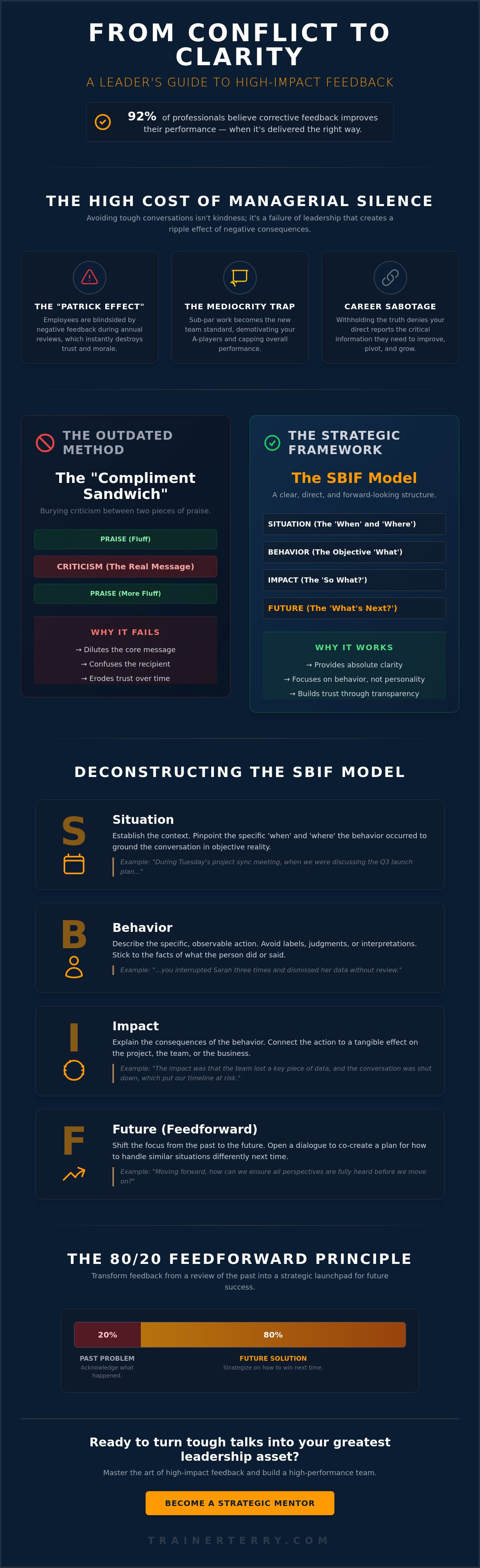
Stop sugarcoating your message. The old "compliment sandwich" is dead. In 2026, high-performers see through the fluff, and it only makes you look indecisive. If you want to know how to give difficult feedback to a direct report, you need to be surgical. Burying a critical point between two compliments doesn't soften the blow; it muddies the water. It leaves your team wondering what actually matters. Instead, adopt the SBIF model: Situation, Behavior, Impact, and Future.
This framework shifts the energy from a post-mortem to a strategy session. You aren't just looking at what went wrong. You're looking at how to win next time. Spend 20% of the conversation on the past and 80% on "Feedforward"—the concrete steps for future success. This distinction is vital. Performance feedback addresses the "what," like missing a sales target. Behavioral feedback addresses the "how," such as a lack of collaboration during meetings. You must master both to drive real results.
Step 1 & 2: Situation and Observed Behavior
Strip away the drama and the adjectives. Your job is to present objective, observable data points. Don't tell someone they have a "bad attitude." That's an opinion, not a fact. Use the STAR method in reverse to document exactly what happened. Identify the Situation and the Task, then point to the specific Action the report took. For example, instead of saying "you aren't a team player," say "during Tuesday's project sync, you interrupted Sarah three times and dismissed her data without review." Specificity builds trust. Generalizations build resentment. When you lead with facts, you remove the report's need to get defensive.
Step 3 & 4: Impact and the Path to "Feedforward"
Connect the behavior to the business. If you want to give negative feedback that sticks, the report needs to see the ripple effect. Explain how their late report delayed the investor update or how their tone in Slack is lowering team morale. Once the impact is clear, pivot immediately to the future. Co-create a "Future State" where the report understands exactly what high performance looks like in their role. Feedforward is a collaborative roadmap for future high-performance. Mastering this transition is a key part of sharpening your Executive Presence and Leadership Communication. You aren't just a judge; you're a mentor invested in their next win.
Maintaining Executive Presence During High-Stakes Conversations
Executive presence isn't about your suit or your title. It's about how you hold the room when the pressure is on. In 2026, your ability to stay calm while delivering hard truths defines your leadership trajectory. If you lose your cool or show visible discomfort, you lose your authority. Learning how to give difficult feedback to a direct report requires more than just a script; it requires a shift in how you carry yourself. Before you click "Join Meeting," you must regulate your own emotions. Take three deep breaths. Remind yourself that you aren't entering a battle. You are entering a development session where you act as the guide.
When you're mastering how to give difficult feedback to a direct report, remember your role. You aren't a judge handing down a sentence. You are a mentor identifying a barrier to their success. Active listening is your most powerful tool in these moments. If a report becomes defensive, don't interrupt or get combative. Let them finish their thought. Summarize what they said to show you've processed their perspective. This simple act of validation lowers their heart rate and keeps the focus on the solution.
The Language of Leadership: Words to Use and Avoid
Precision in your vocabulary is vital. A single "but" can invalidate every positive thing you've said. Replace it with "and" to keep the conversation flowing forward. Stop using "you" statements that sound like accusations. Instead of saying "You missed the deadline," try "The data shows the report was submitted two days late." This removes the personal sting and focuses on the objective reality. Mastering Executive Presence and Leadership Communication is the #1 skill for promotion in 2026. It signals to the organization that you can handle high-stakes human capital issues with professional poise.
Handling Defensive Reactions and Tears
Emotions are part of the job. If a report starts crying or blaming external factors, don't retreat. Use the "Pause and Breathe" technique to de-escalate the room. Silence is a leadership tool; it gives everyone a moment to reset. If they start blaming the market or other departments, redirect them firmly. Acknowledge the external challenge, then ask, "Given those factors, what could we have done differently?" Stay firm but empathetic. Remind them: "I care about your success, which is why we are having this talk." This keeps the relationship intact while maintaining high standards. If you need a specific plan to navigate these growth hurdles, consider a Career Advancement Blueprint to refine your strategy.
Step-by-Step: Preparing Your Feedback Script
Winging a high-stakes meeting is a recipe for disaster. If you want to master how to give difficult feedback to a direct report, your preparation must be surgical. Don't let your own anxiety dictate the pace. Start by auditing their recent performance data and their current Career Narrative. Is this behavior an isolated incident or part of a larger trend that’s stalling their growth? You need to know the answer before you sit down. Draft an opening statement that is clear and unapologetically direct. State the purpose of the meeting in the first thirty seconds to set the professional standard.
Anticipate the pushback. Prepare Strategic Rebuttals based on documented facts, not feelings. If they claim they weren't aware of a standard, have the email or project brief ready. Timing is everything. Never schedule these talks for a late Friday afternoon. That’s a move that breeds resentment and leaves the report stewing over the weekend with no way to take action. Aim for a Tuesday morning. This allows for immediate follow-up and keeps the momentum on improvement, not anxiety.
The 24-Hour Preparation Checklist
Success is built in the day leading up to the talk. First, review the Career Advice 2026 principles to ensure your feedback aligns with current corporate standards and leadership expectations. Verify your "Impact" statements with specific project metrics or peer feedback. Finally, set the environment. Whether it's a physical room or a virtual link, ensure total privacy and zero interruptions. Your focus signals the importance of their growth.
The First 5 Minutes: Setting the Tone
The first five minutes dictate the next fifty. State the "Why" immediately. This stops the "waiting for the axe to fall" feeling that kills productivity. Once you've laid out the facts, confirm understanding. Ask, "Does this match your perception of the situation?" This forces the report to engage with the reality of the data. Transition quickly from the problem to the solution. You aren't there to dwell on the mistake; you're there to build the fix. This directness is a core component of high-level Executive Coaching and Advisory for modern leaders.
Turning Tough Feedback into a Career Advancement Strategy
Don't view a critical conversation as a dead end. View it as a catalyst. When you master how to give difficult feedback to a direct report, you're actually handing them the keys to their next promotion. This session should serve as the foundation for a Career Advancement Blueprint. You're shifting the narrative from "what you did wrong" to "how we get you to the next level." This strategic pivot is what separates high-level mentors from average managers.
Execution requires a timeline. Implement a 30-60-90 day follow-up plan to track improvement with precision. Vague hopes for change don't yield results; documented milestones do. During this period, keep your eyes open for "Green Shoots." These are the small, early signs of behavioral change. Reinforce them immediately. A quick Slack message or a 30-second comment after a meeting can solidify a new, positive habit. This consistent reinforcement proves you're emotionally invested in their success.
Mastering this conversation is also a prerequisite for your own "Executive Positioning." Senior leadership isn't looking for managers who can keep people happy. They're looking for leaders who can drive performance through friction. Your ability to navigate these high-stakes human moments signals that you're ready for greater organizational responsibility. You're showing the firm that you can handle the complexities of talent development without flinching.
Rebuilding Trust and Psychological Safety
The period after a tough talk is fragile. You must master the "Check-in" vs. the "Check-up." A check-up feels like micromanagement; it’s focused on surveillance. A check-in is supportive; it’s focused on barriers. Ask, "What do you need from me to hit our next milestone?" This maintains a supportive presence without making the report feel "watched." Discuss their long-term goals frequently. Showing that you still see a future for them at the firm is the fastest way to rebuild psychological safety and keep them engaged.
Scaling Your Leadership Impact
It's time to transition from a "Fixer" to a "Coach." Using Executive Career Coach methodologies allows you to scale your impact across the entire team. When you consistently know how to give difficult feedback to a direct report, you become the most valuable asset in your company. You create a culture where excellence is the only standard. Ready to sharpen your edge? Schedule a Free Strategy Call today to refine your leadership communication and claim your seat at the table.
Elevate Your Leadership Communication Today
You've seen the high cost of staying silent. Real leadership in 2026 isn't about avoiding friction; it's about navigating it with professional poise. By replacing the outdated compliment sandwich with the surgical SBIF framework, you transform critical moments into strategic wins. Mastering how to give difficult feedback to a direct report is the fastest way to solidify your executive presence and build a team that actually delivers high-performance results.
Stop letting anxiety stall your career growth or your team's potential. You need a proven system to handle high-stakes conversations without losing your cool. Trainer Terry, a former Corporate VP with 20+ years of leadership experience, integrates the proven STAR method into a strategy that builds genuine authority and trust. It's time to stop rehearsing and start leading with total confidence.
Master your leadership communication; schedule your free strategy call with Trainer Terry today.
Take the first step toward becoming the mentor your team deserves. You have the tools and the framework; now it's time to execute. Your future as a strategic leader starts with the next conversation you choose not to avoid.
Frequently Asked Questions
How do I start a difficult feedback conversation with a direct report?
Start with a clear, direct opening statement that sets the professional purpose of the meeting within the first thirty seconds. Avoid awkward small talk about the weather or the weekend. Use a lead-in like, "I've called this meeting to discuss specific areas where your current performance isn't meeting our team's standards." This transparency removes the "waiting for the axe to fall" anxiety and allows both parties to focus on the data.
What is the best framework for giving negative feedback?
The Situation, Behavior, Impact, Future (SBIF) model is the gold standard for 2026 leadership. It forces you to strip away personal judgments and focus on objective data points. You identify the specific situation, describe the observed behavior, explain the business impact, and then pivot 80% of the talk to "Feedforward" solutions. This framework ensures your message is surgical and growth-oriented rather than punitive.
How do I give feedback to a high-performer who is slipping?
Frame the conversation around their long-term career narrative and professional marketability. High-performers are often motivated by growth, so explain how the current slip puts their promotion strategy at risk. Be direct about the gap between their usual excellence and current output. By showing you are invested in their "A-player" status, you turn the feedback into a collaborative mission to restore their peak performance.
What should I do if my direct report gets angry or cries?
Use the "Pause and Breathe" technique to de-escalate the room without retreating from your message. If a report cries or reacts with anger, acknowledge the emotion but stay focused on the performance data. Say, "I can see this is difficult to hear, but I'm sharing this because I care about your success here." This maintains your executive presence while ensuring the necessary truth isn't lost in the emotional reaction.
Is the "compliment sandwich" still effective in 2026?
No, the "compliment sandwich" is considered ineffective and confusing in modern leadership. It dilutes the critical message and makes your positive feedback feel insincere. In 2026, employees value radical transparency. Learning how to give difficult feedback to a direct report means being brave enough to deliver the truth directly. Skip the fluff and lead with the core issue to maintain your professional credibility and trust.
How often should I give critical feedback to my team?
Shift from annual reviews to a culture of continuous feedback. Real-time adjustments prevent the "Patrick Effect," where year-end surprises destroy trust and motivation. Aim for weekly or bi-weekly check-ins where performance is discussed as an ongoing dialogue. This high-frequency approach ensures that small issues don't snowball into major failures and keeps your team in a constant state of improvement and alignment.
Can I give difficult feedback over Zoom or should it be in person?
In-person is ideal for high-stakes talks, but Zoom is a reality for the 2026 hybrid workforce. If you must use video, ensure your environment is private and your camera is at eye level to maintain executive presence. Avoid delivering tough news via email or Slack. The nuances of tone and body language are essential for preserving the relationship while you navigate how to give difficult feedback to a direct report.
What if the direct report disagrees with my feedback?
Pivot back to the objective data and ask for their specific perception of the facts. If they disagree, say, "Help me understand your perspective on these specific metrics." This keeps the talk collaborative rather than combative. Even if you don't reach a total consensus on the past, you must reach an agreement on the future behavior and the 30-60-90 day follow-up plan to ensure growth.

Article by
Terry Jones
Terry Jones is the Founder and Chief Career Strategist of the Career Advancement Blueprint and Executive Coach and Lead Consultant at FireBridge Consulting.
As an ICF Certified Accredited Career Coach and Certified Master Career Services professional, he partners with professionals at all levels, including senior leaders and executives, to navigate career transitions, secure new opportunities, and position themselves for advancement. His approach goes beyond surface level coaching, focusing on how individuals think, communicate, and lead so they can operate with clarity, authority, and strategic intent in high stakes environments.
In his work as an executive coach, Terry engages in high impact advisory conversations that help leaders strengthen decision making, elevate their presence, and align their leadership style with organizational expectations. He is known for helping clients translate their experience into influence, ensuring they are not only seen for what they have done, but trusted for what they are capable of leading next.
With over 20 years of corporate experience, including serving as a Vice President and leading Learning and Development functions for three New York City organizations, Terry brings a deep understanding of how companies evaluate talent, develop leaders, and make promotion decisions. This allows him to bridge the gap between individual ambition and organizational reality.
His insights have reached over 630,000 followers and generated more than 70 million video views, where he shares direct, experience driven guidance that helps professionals think differently and take action.