Managing Underperforming Employees with Empathy: The 2026 Leadership Blueprint

Did you know that losing a single employee in 2026 costs your company an average of $45,236? You're likely exhausted from "babysitting" underperformers and dreading the HR-induced headache of a Performance Improvement Plan, especially with the recent legal shifts making PIPs a higher risk for your organization. It's tempting to avoid the conflict, but that silence is draining your team's productivity and your own emotional energy. Managing underperforming employees with empathy isn't just a soft skill anymore. It's your most effective diagnostic tool to identify root causes and stop the talent drain before it starts.
You're about to learn how to transform poor performance into high-impact results using a strategic, empathy-driven leadership framework. We'll provide a clear roadmap for difficult conversations that protects you legally and boosts your team's output. You don't have to choose between being a supportive mentor and a results-oriented executive. This guide gives you the blueprint to master both, ensuring you retain talent through elite coaching while maintaining a commanding leadership presence. Let's turn that underperformance into your next big win.
Key Takeaways
- Stop viewing empathy as a soft skill and start using it as a high-precision diagnostic tool to uncover the real "why" behind declining performance.
- Master the Performance Quadrant to instantly determine if an employee is facing a "can't do" skill gap or a "won't do" environmental blocker.
- Learn the exact scripts and executive presence needed for managing underperforming employees with empathy while keeping the conversation focused on objective results.
- Replace outdated, punitive PIPs with collaborative Growth Plans that define clear, measurable success indicators for the next 30 days.
- Gain the confidence to execute a strategic exit when necessary, recognizing that letting someone go can be the most empathetic act for the team’s health.
The Strategic Shift: Why Empathy is a Performance Diagnostic, Not a Soft Skill
Most leaders treat empathy like a participation trophy. They think it's about being "nice" or lowering the bar to avoid hurt feelings. In 2026, that mindset is a liability. True empathy isn't a soft skill; it's a high-precision diagnostic tool. It's the ability to look past a missed deadline and understand the "why" behind the "what." When you're managing underperforming employees with empathy, you aren't making excuses for them. You're gathering the intelligence required to fix the problem for good.
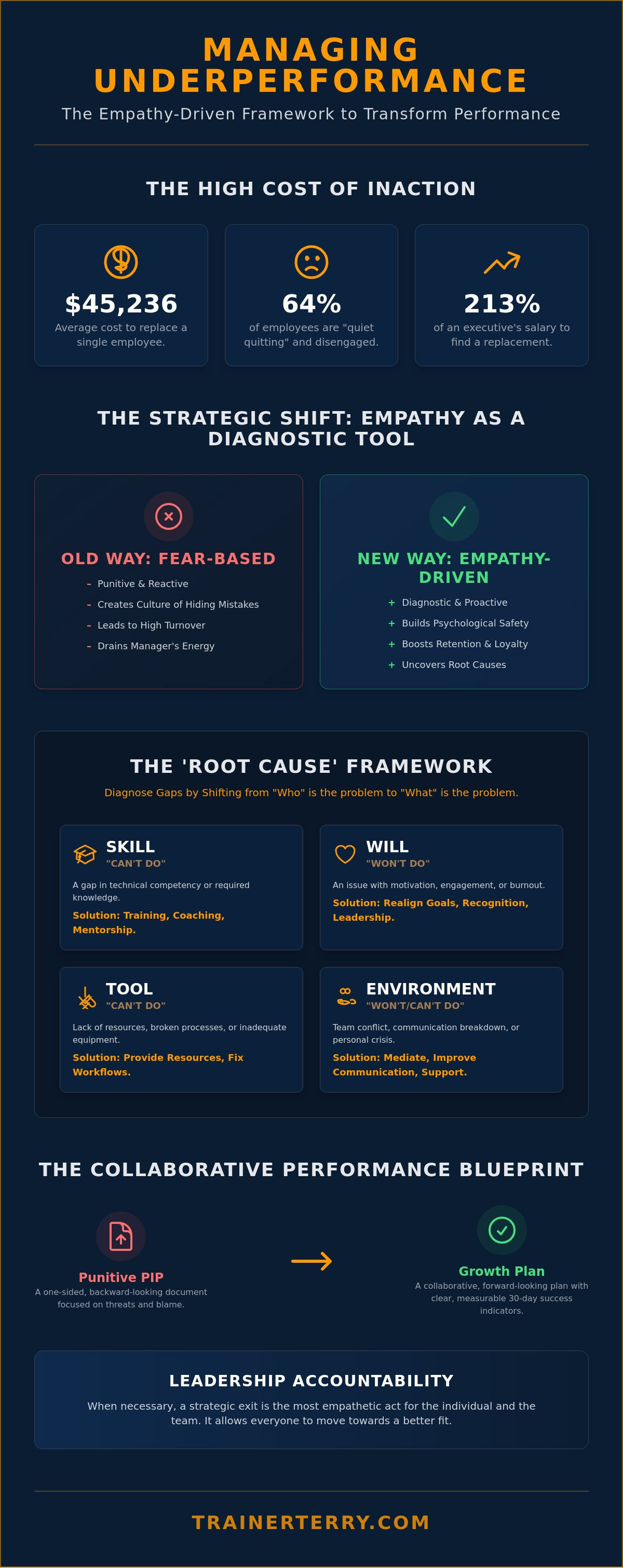
The old fear-based management model is dead. It's expensive, too. Fear creates a culture of "quiet quitting," where 64% of employees are currently checked out according to Gallup’s 2026 report. When people fear for their jobs, they hide their mistakes. They don't innovate; they survive. An empathy-based model does the opposite. It builds psychological safety, allowing your team to flag errors early so you can pivot before a small mistake becomes a $45,236 turnover catastrophe. This isn't about sympathy. Sympathy is feeling for someone, which can cloud your judgment. Empathy is understanding their perspective so you can lead them back to peak performance.
The ROI of Empathetic Management
High-performance cultures don't happen by accident. They're built on the back of a robust performance appraisal process that prioritizes growth over punishment. When you lead with empathy, you stop losing money on the "revolving door" of talent. Replacing an executive can cost up to 213% of their annual salary. By using empathy as your first response, you identify whether you're dealing with a broken process or a people problem much faster. This builds a level of loyalty that survives market volatility and keeps your best talent from looking for the exit the moment a headhunter calls.
Empathy as a Data-Gathering Tool
Think of empathy as your infrared vision. It allows you to see the invisible barriers to productivity that don't show up on a spreadsheet. Is it a lack of resources? A breakdown in communication? Or a personal crisis draining their mental energy? You won't know unless you listen. Active listening isn't just staying quiet while they talk; it's a tactical interrogation of the root cause. Managing underperforming employees with empathy means you're acting as a mentor who is emotionally invested in the common goal. Empathetic Performance Management is a strategic asset that transforms individual struggle into organizational strength.
The 'Root Cause' Framework: Diagnosing Performance Gaps Without Blame
Stop guessing why your team's output is lagging. When a previously solid performer starts missing targets, your first instinct might be frustration, but frustration isn't a strategy. To fix the issue, you need a diagnostic lens that cuts through the noise. Managing underperforming employees with empathy starts with the Performance Quadrant. You must determine if the breakdown is happening in Skill, Will, Tool, or Environment. This framework shifts the conversation from "What is wrong with you?" to "What is blocking your success?"
Most performance issues aren't character flaws. They're systemic gaps. By isolating these four variables, you can stop "babysitting" and start coaching. Are they missing a specific technical competency? Is their motivation tanking due to a lack of recognition? Or are your own internal processes the actual underperformer? You can't solve a "Tool" problem with a "Will" conversation. Use this framework to identify the "Can't Do" versus the "Won't Do" scenarios before you take any formal action.
Skill vs. Will: The Management Crossroads
The hardest part of leadership is identifying the crossroads of ability and desire. A "Can't Do" situation is simply a training gap. Perhaps they haven't mastered the 2026 tech stack or the latest workflow automation. This is a fixable investment. However, a "Won't Do" scenario signals a deeper issue with engagement or burnout. Use the STAR method to analyze their history. If they successfully handled the Situation, Task, and Action in the past but are failing the Result now, their "Will" has likely shifted. This requires a different, more personal leadership approach to reignite their internal drive.
Environmental and Tool-Based Barriers
Don't blame the person for a broken system. "Hidden friction" often hides in communication silos, outdated software, or unclear KPIs that change every week. Before you assume an employee is disengaged, conduct empathetic performance diagnostics to see if they have the resources they need. Ask them directly: "What is one thing in our current process that makes your job harder than it needs to be?" Their answer might reveal that your organization is the bottleneck, not their effort. If you want to sharpen your ability to lead through these complexities, our Career Advancement Blueprint provides the high-level strategy you need to manage upward and downward simultaneously.
Finally, respect the impact of organizational noise. Constant restructuring and market volatility create a psychological tax. While you aren't a therapist, acknowledging personal life disruptions with professional boundaries is essential. Empathy means recognizing that an employee is a human being first. When you protect the person, you often save the professional. Identify the root cause, clear the path, and watch the performance follow.
The Empathy-First Performance Conversation: Scripts and Executive Presence
Stop summoning your team members to "the office." In 2026, the traditional top-down reprimand is a relic that kills engagement. Managing underperforming employees with empathy requires you to set a stage where growth is possible. Timing is everything. Never hold a performance talk on a Friday afternoon when stress is high. Instead, use "The Invitation." Send a brief, neutral note asking for their input on a specific project. This shifts the power dynamic from a principal's office vibe to a collaborative workshop.
Your opening line dictates the entire outcome. Use the "Observation vs. Judgment" technique. Judgment sounds like, "You've been lazy with your reports." Observation sounds like, "I noticed the last three reports were submitted after the 5:00 PM deadline." Facts are hard to argue with; labels invite defensiveness. You must maintain a high level of Executive Presence during these moments. This doesn't mean being a cold robot. It means having the composure to show vulnerability, admitting that you might not have provided enough clarity, and then using the "Strategic Pause." Silence is a tool. After you state your observation, wait. Let them fill the space.
Communication Scripts for High-Stakes Talks
Replace accusations with curiosity. Use the "Curiosity Opener" to lower the temperature in the room. Try saying: "I noticed a dip in the project velocity this month, and I want to help me understand what's happening from your perspective." This tells the employee you're on their side. When they respond with defensiveness, don't escalate. Acknowledge their feeling, then bring it back to the data. When you use "I" statements to describe your observations, you actively lower the employee's cortisol levels and prevent their brain from entering a defensive fight-or-flight state.
The Career Narrative Alignment
Performance isn't just about the company's bottom line. It's about the employee's own Career Narrative. Help them see that their current output is a chapter in their professional story. If they want a promotion or a future leadership role, their current metrics are the evidence they'll need. Frame the conversation as "us vs. the problem" instead of "me vs. you." You're both looking at the same obstacle, and your job is to help them clear it. If you're dealing with a particularly complex team dynamic and need a tailored approach, you can schedule a free strategy call to map out your next move. Focus on the future, not just the failures of the past.
The Collaborative Performance Blueprint: Moving from PIPs to Growth Plans
Traditional Performance Improvement Plans (PIPs) are professional death warrants. Everyone in the room knows it. HR sees it as a legal shield, and the employee sees it as a countdown to termination. This "box-ticking" approach is why manager engagement has plummeted to 22% in 2025. If you want results, you have to stop writing obituaries and start building blueprints. Managing underperforming employees with empathy requires a shift from a punitive mindset to a collaborative one. You aren't just documenting failure; you're architecting a comeback.
The first step is defining Success Indicators for a tight, 30-day window. Generic goals like "improve communication" are useless. You need specific, measurable outputs that prove the needle is moving. Once the goals are set, assign Co-Accountability. Ask yourself: "What will I do to support this?" If the employee lacks a resource or clear direction, that's your bottleneck to fix. Establish a high-frequency, low-friction feedback loop with weekly 15-minute micro-check-ins. Finally, paint a "Future State" vision. Show them exactly how this role evolves once they master these current challenges. This gives them a reason to fight for their position rather than just surviving the week.
Building the 'Growth Blueprint'
Confidence is the first thing to go when performance dips. To rebuild it, focus your Growth Blueprint on "Quick Wins" during the first ten days. These are small, achievable tasks that prove to the employee they still have the "Will" and the "Skill" to succeed. This is also the time to integrate Leadership Development into the plan. By investing in their growth while they're struggling, you signal that you still see them as a high-potential asset. If you're ready to master these high-stakes talent strategies, our Career Advancement Blueprint provides the framework to lead teams through even the most complex transitions.
Measuring Progress Beyond the Numbers
KPIs only tell half the story. You must also track behavioral changes like collaboration, initiative, and response to feedback. Encourage the employee to keep a "Progress Journal" to document their own growth and roadblocks. This shifts the burden of proof from you to them, fostering a sense of ownership. Reward incremental improvement. You don't wait for a marathon to end before you give a runner water. Small wins sustain momentum. When you focus on the person's trajectory alongside the data, managing underperforming employees with empathy becomes a powerful retention tool rather than a legal formality. It’s about protecting the talent you’ve already invested in.
Leadership Accountability: When Empathy Leads to a Strategic Exit
Empathy isn't a blank check for mediocrity. Sometimes, despite your best coaching and the most detailed growth plans, the performance needle doesn't move. In these moments, managing underperforming employees with empathy means making the hardest call of all: termination. Keeping someone in a role where they are clearly failing isn't kind. It's a slow drain on their self-esteem and a poison for your team's morale. True leadership accountability requires you to recognize when the "Growth Blueprint" has reached its limit.
Before you act, distinguish between the "Wrong Seat, Right Bus" and the "Wrong Bus" scenarios. If the employee has the right attitude but lacks the specific skills for their current tasks, look for a different seat within the organization. However, if their values or "Will" no longer align with your mission, they are on the wrong bus. Leaving them there is a disservice to their potential. A strategic exit allows them to find an environment where they can actually win, rather than just struggling to tread water under your watch.
The 'Exit as a Career Pivot' Mentality
Conducting a dignified exit is an art. Reframe the conversation. It's not about a personal failure; it's about a misalignment of talents. You can protect their self-worth by focusing on the future. Offer a Career Positioning Strategy as part of their transition package. This helps them understand how to communicate their value to the next employer. When you maintain professional bridges, you turn a painful ending into a strategic pivot. They leave with their head held high, and you preserve your reputation as a leader who cares about people even when the business relationship ends.
Self-Care for the Empathetic Leader
Firing someone is emotionally taxing. You'll likely feel "Manager’s Guilt," but you can't let that stall your decision-making. Your primary responsibility is to the health of the entire team. After the exit, be transparent with your remaining staff about the "why" without violating privacy. This rebuilds trust and clears the air. If you're feeling the weight of these high-stakes decisions, use our Office Hours to decompress and refine your strategy. Ready to master the balance of empathy and results? Schedule a strategy call today to level up your leadership communication and drive high-performance results.
Architect Your High-Performance Culture Today
Leadership isn't about avoiding hard conversations. It's about having them with more precision and less friction. You've seen how shifting from a punitive mindset to a diagnostic one changes everything. By identifying root causes and replacing outdated PIPs with collaborative Growth Blueprints, you stop reacting to failure and start driving results. Managing underperforming employees with empathy is the ultimate test of your executive presence. It's how you protect your team's output while honoring the human element of your organization.
Don't let team disengagement or legal fears stall your progress. You need a strategy that reflects your ambition. Our customized 1:1 advisory is led by a former Corporate VP with over 20 years of high-stakes experience. We use a proven 'Career Narrative' methodology to help you navigate these complex dynamics with total confidence. It's time to stop babysitting and start leading. Master high-performance leadership with a free strategy call and build the legacy you deserve. Your team is waiting for the leader you're becoming.
Frequently Asked Questions
How do I start a conversation with an underperforming employee?
Start with an observation-based opener rather than a judgment. Use a neutral "I noticed" statement to describe the specific performance gap you've identified. This lowers defensiveness and invites the employee into a collaborative diagnostic process. Instead of saying "You're failing," try asking "I've noticed a shift in project delivery times lately, and I want to understand what's changed from your perspective."
Can I be empathetic and still use a formal Performance Improvement Plan (PIP)?
Yes, you can use a PIP while managing underperforming employees with empathy by reframing it as a growth roadmap. Focus the document on co-accountability and the specific support you'll provide to help them succeed. This approach satisfies HR requirements while showing the employee you're invested in their comeback. It turns a legal formality into a genuine development strategy.
What if the underperformance is due to personal issues outside of work?
Acknowledge the human element while maintaining professional boundaries and performance standards. You aren't a therapist, but you can offer temporary flexibility or point them toward available company resources. Set a clear timeframe for when you expect performance to stabilize. This shows you value them as a person without compromising the team's long-term productivity or goals.
How long should I give an employee to improve their performance?
A 30 to 90-day window is the industry standard, with 30 days being ideal for seeing initial behavioral shifts. Break this time down into weekly milestones so you can track progress in real-time. If you see zero improvement after 30 days of active support and coaching, it's often a sign that the gap is a "Won't Do" issue or a fundamental misalignment.
Is empathy considered a weakness in a high-pressure corporate environment?
No, empathy is a high-level diagnostic tool that increases efficiency in high-pressure settings. It allows you to identify root causes faster than traditional "command and control" methods. Leaders who use empathy effectively see higher engagement and faster problem-solving. It's a strategic asset that prevents the massive costs associated with turnover and psychological burnout in modern organizations.
What are the first signs that an employee is underperforming?
Look for subtle shifts like a decrease in initiative, missed deadlines, or a psychological detachment from team discussions. These behavioral cues often precede a drop in actual KPIs. When you spot these early indicators, it's the perfect time for managing underperforming employees with empathy before the situation requires a more formal, high-stakes intervention that risks losing the talent entirely.
How do I handle an employee who becomes defensive during a performance review?
Stay calm, use a strategic pause, and bring the conversation back to objective data. Defensiveness is usually a fear response, so don't escalate the conflict. Validate their feeling without necessarily agreeing with their excuse, then restate the "us vs. the problem" framework. This maintains your executive presence while keeping the focus on finding a solution rather than winning an argument.
How does empathy help in reducing employee turnover?
Empathy builds the psychological safety that makes employees feel valued and supported during their low points. Data shows that over half of employees who quit believe their manager could have prevented their departure. By showing genuine interest in their growth and challenges, you build long-term loyalty. This protects your high-performing culture and avoids the significant financial drain of constant replacement costs.

Article by
Terry Jones
Terry Jones is the Founder and Chief Career Strategist of the Career Advancement Blueprint and Executive Coach and Lead Consultant at FireBridge Consulting.
As an ICF Certified Accredited Career Coach and Certified Master Career Services professional, he partners with professionals at all levels, including senior leaders and executives, to navigate career transitions, secure new opportunities, and position themselves for advancement. His approach goes beyond surface level coaching, focusing on how individuals think, communicate, and lead so they can operate with clarity, authority, and strategic intent in high stakes environments.
In his work as an executive coach, Terry engages in high impact advisory conversations that help leaders strengthen decision making, elevate their presence, and align their leadership style with organizational expectations. He is known for helping clients translate their experience into influence, ensuring they are not only seen for what they have done, but trusted for what they are capable of leading next.
With over 20 years of corporate experience, including serving as a Vice President and leading Learning and Development functions for three New York City organizations, Terry brings a deep understanding of how companies evaluate talent, develop leaders, and make promotion decisions. This allows him to bridge the gap between individual ambition and organizational reality.
His insights have reached over 630,000 followers and generated more than 70 million video views, where he shares direct, experience driven guidance that helps professionals think differently and take action.