Transferable Skills from Sales to Project Management: Your 2026 Pivot Guide

Stop thinking of yourself as just a salesperson. Sales isn't just about the pitch; it's the ultimate training ground for high-stakes project execution where you've already mastered the core transferable skills from sales to project management. You've spent years managing complex stakeholders and hitting aggressive deadlines, yet you likely feel pigeonholed. You worry that without a formal certification, your resume won't even clear the first hurdle. It's frustrating to know you have the drive, but you're struggling to translate those 'closed deals' into 'successful milestones'.
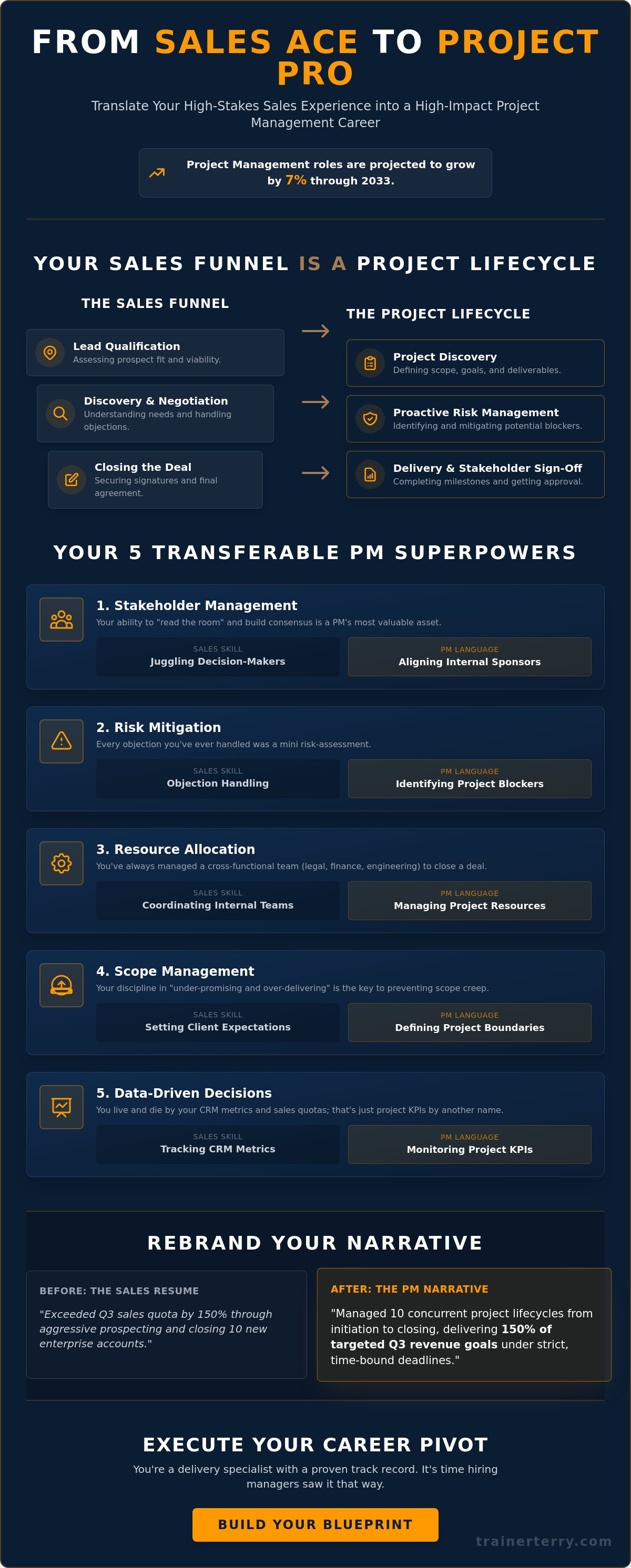
You're in the right place to break that cycle. This guide shows you how to translate your high-stakes sales experience into a powerful project management narrative that gets you hired. With project management roles projected to grow by 7% through 2033, the demand for leaders who can deliver has never been higher. We'll map your experience to the latest PMBOK 8th Edition standards, translate your resume into PM language, and give you the tactical confidence to ace your pivot interview. Let's start building your new career blueprint right now.
Key Takeaways
- Discover why your sales background is the ultimate training ground for project execution and how to leverage that shared DNA to stand out.
- Master the five most critical transferable skills from sales to project management, including turning client objection handling into proactive risk mitigation.
- Learn how to rebrand your professional identity by replacing "sales speak" with high-impact "PM language" on your resume and LinkedIn profile.
- Build a structured transition plan using a Career Change Blueprint approach to navigate the 2026 job market with precision and confidence.
- Understand how to position yourself for Strategic PM roles where your ability to influence stakeholders is valued more than technical certifications.
Why Sales Professionals Make Exceptional Project Managers
You’ve been a project manager for years; you just called it "sales." Every deal you’ve ever chased was a project. It had a start date, a hard deadline like the end of the quarter, a budget in the form of your quota, and a complex set of stakeholders to influence. The foundational principles of project management are already baked into your daily routine. You aren't starting from scratch. You're simply shifting your focus from an external market to an internal organization.
Sales is project management for the client. You lead them through a journey to solve a specific problem. Project management is sales for the organization. Instead of convincing a prospect to buy, you're convincing a development team to hit a sprint goal or a CFO to release more resources. The transferable skills from sales to project management focus on one thing: delivery. You don't just talk. You make things happen. Think about your quota. That wasn't just a target. It was your first project budget. You had to allocate your time, your energy, and your company's resources to achieve that specific, time-bound outcome.
It’s not about what you did; it’s about how you frame it for 2026 standards. In a market that demands extreme efficiency and AI-driven speed, your ability to drive results is more valuable than a dozen entry-level certifications. You need a narrative pivot. You aren't "looking for a change." You're a delivery specialist with a proven track record of stakeholder influence. If you're ready to stop guessing and start executing, our Career Advancement Blueprint helps you frame this authority correctly for hiring managers.
The Funnel vs. The Lifecycle
Your sales funnel is a mirror of the project lifecycle. Lead qualification is project discovery. If the fit isn't there, you kill the deal. That's proactive risk management. The "closing" process isn't just a signature. It's the final delivery and stakeholder sign-off. Even your CRM habits translate perfectly. Moving a deal from "Discovery" to "Negotiation" is no different than tracking a project through its phases. You've been managing timelines, dependencies, and resource allocation your entire career. You just need to change the labels.
Executive Presence in the Pivot
The ability to "read the room" is your secret weapon. Many technical project managers struggle with the human element. You don't. You know how to identify the real decision-maker and handle objections before they become blockers. Sales-driven resilience is a PM superpower. When a project hits a setback, you don't panic. You pivot. You aren't a task-tracker who just checks boxes. You're a leader who drives business value. This executive presence is what separates high-level project leaders from coordinators.
Mapping the 5 Critical Transferable Skills from Sales to Project Management
Stop looking at your sales background as a limitation. It’s your competitive advantage. The transition isn't about learning a brand new language; it's about translating the high-impact work you've already done into a different context. When you break it down, the most valuable transferable skills from sales to project management are the ones that drive results under pressure. You've spent your career hitting targets. Now, you're just changing what those targets look like.
- Stakeholder Management: You've spent years identifying decision-makers and influencers. In project management, your "clients" are now internal sponsors, department heads, and your own team. The goal remains the same: alignment and buy-in.
- Risk Mitigation: Every objection you handled in a sales pitch was a risk identification exercise. Translating "objection handling" into proactive risk management means spotting potential project blockers before they derail your timeline.
- Resource Allocation: Remember coordinating with legal, engineering, and your manager to get a complex contract over the finish line? That’s managing a cross-functional team. You already know how to pull the right levers to get people moving.
- Scope Management: Successful salespeople know that "under-promising and over-delivering" is the only way to maintain a relationship. In PM, this skill is what prevents scope creep and keeps projects from bloating beyond their original intent.
- Data-Driven Decision Making: You lived and died by your CRM metrics. Project management requires that same rigor. You'll use project KPIs and velocity charts the same way you used conversion rates and pipeline velocity.
Stakeholder Influence: The Salesperson’s Edge
Most project managers fail because they treat people like tasks. They send emails and wait for replies. You don't do that. You know how to read the room and identify the real power players. You understand that a project only moves as fast as the people behind it. Use your negotiation skills to manage difficult stakeholders who have competing priorities. If you want to refine how you talk about these high-level interactions, our 1-on-1 interview strategy sessions can help you frame these "sales" wins as "leadership" victories.
From Quotas to KPIs: The Language of Results
In sales, "Revenue Won" is the ultimate metric. In project management, we call that "Business Value Delivered." You need to track project health with the same intensity you used for your sales pipeline. If a project is "red," it's just a deal that's stalled in the negotiation phase. You apply the same urgency to fix it. Project success is the delta between the resources invested and the strategic value realized for the organization. You aren't just checking boxes; you're delivering a return on investment.
Overcoming the 'No PM Experience' Barrier: Certifications vs. Narrative
Stop waiting for permission to call yourself a project manager. The most common hurdle for career changers is the belief that they're unqualified without a PMP® certification. While those initials carry weight, they aren't the only entry point into the field. In 2026, the industry has shifted its focus toward "Power Skills" and business value. Hiring managers are looking for people who can drive results, not just people who can memorize a handbook. Your transferable skills from sales to project management are already your strongest assets; you just need to frame them correctly.
You need to understand the difference between Technical PM and Strategic PM roles. Technical roles often require deep engineering or IT knowledge. Strategic PM roles, however, prioritize stakeholder alignment, ROI, and delivery. This is where sales professionals thrive. You aren't just a task-tracker. You're a solution architect who knows how to manage a budget and hit a deadline. The PMBOK® Guide – Eighth Edition, released in late 2025, emphasizes delivering business value over strict process adherence. This shift plays directly into your hands.
The Certification Roadmap
If you're looking for a formal credential to boost your resume in 2026, start with the Certified Associate in Project Management (CAPM)®. It’s more accessible for career changers, with exam fees ranging from $225 to $300. It proves you understand the foundational language of the industry. The PMP remains the gold standard, but it requires documented hours of leading projects. Don't let that stop your momentum. You can build your narrative while you study. If you're unsure which path fits your specific background, join Trainer Terry's Office Hours for a personalized roadmap and direct advice on your transition.
Auditing Your Sales History
It’s time to stop calling your past work "sales" and start calling it "projectized" experience. Every major deal you closed was a project. Think about a Territory Manager launching a new product line. They didn't just sell; they coordinated marketing assets, managed a rollout timeline, and reported adoption metrics to leadership. That is a textbook project. Use this practical exercise: list three of your most complex deals. For each, identify the initiation, planning, and execution phases. You'll see that your transferable skills from sales to project management are already at an executive level. You've been doing the work; now it’s time to get the credit for it.
Strategic Rebranding: Rewriting Your Sales Resume for PM Success
Stop thinking like a salesperson and start writing like a strategist. Your resume is no longer a list of products sold; it's a portfolio of problems solved. To successfully transition, you must translate your transferable skills from sales to project management into a language that human recruiters and Applicant Tracking Systems (ATS) recognize. This isn't about padding your experience. It's about auditing your history to reveal the project leader who has been there all along.
Step one is a linguistic audit. If your LinkedIn profile says you "crushed quota," you're screaming "salesperson." Change that to "delivered 120% of target value through strategic resource allocation." You're telling the same story, but you're using PM syntax. Recruiters in 2026 are looking for delivery specialists who can manage cross-functional teams, not just lone wolves chasing a commission. Highlight your ability to coordinate engineering, legal, and marketing departments to hit a rollout deadline. If your current resume feels stuck in the sales lane, our Resume Strategy and Executive Resume Development sessions can help you bridge that gap professionally.
Applying the STAR Method to Sales Wins
The STAR Method is your best tool for framing sales wins as project outcomes. Don't just list the revenue. Define the Situation as a business challenge, like a declining market share. Describe the Task as the project objective, such as a territory expansion. Focus your Action on leadership, coordination, and problem-solving rather than just the pitch. Finally, state the Result as a quantitative impact on the organization's efficiency or bottom line. For deeper examples and a step-by-step breakdown, check out our STAR Method Guide.
LinkedIn Positioning for the Pivot
Your LinkedIn headline is your digital billboard. Instead of "Account Executive," try something like "Sales Leader | Strategic Project Delivery." This bridges the gap immediately. Your "About" section should tell a career narrative that explains why your sales background makes you a superior project manager. Focus on your resilience, your stakeholder influence, and your obsession with hitting milestones. Don't forget the "Skills" section. Add keywords like Stakeholder Engagement, Risk Mitigation, and Agile Methodology to ensure the ATS sees you as a match for project management roles. Your career narrative is far more important than your previous job title.
Executing Your Pivot: The Career Change Blueprint Approach
Execution is where most professionals fail. You've spent the previous sections mapping your transferable skills from sales to project management, but without a structured transition strategy, you're just guessing. Stop the "spray and pray" approach of sending dozens of generic resumes into the void. It doesn't work. In 2026, the market rewards precision and narrative authority. You need a Career Change Blueprint that treats your pivot like a high-value sales cycle with a clear path to the "close."
If you're currently employed, your fastest route might be right under your nose. Internal Advancement Planning allows you to transition roles without leaving the company that already trusts your work ethic. Use your existing reputation to bridge the gap. When you propose an internal move, don't ask for a favor. Present a business case. Show leadership how your ability to drive delivery and manage stakeholders will save the department time and money. You're not just changing titles; you're increasing your organizational value.
The "Why the change?" question kills most interviews if you aren't prepared. Never frame it as running away from a quota or "burnout." Frame it as running toward your greatest strength: delivery. You aren't a salesperson trying to learn project management. You're a delivery specialist who used sales as a high-stakes training ground for stakeholder influence and risk mitigation. This perspective makes you the "PM who can actually talk to people," a rare and valuable asset in a world of technical coordinators who struggle to lead.
Interview Strategy for Career Changers
When an interviewer brings up your "lack of experience," don't get defensive. Pivot. Remind them that technical skills can be taught, but the ability to negotiate with a difficult CFO or revive a stalled project is a "power skill" you've honed for years. Use your sales background as your competitive advantage. You know how to hit milestones because your paycheck depended on it. If you want to refine this narrative, our 1-on-1 Job Interview Prep provides the mock session support you need to handle high-stakes questions with total confidence.
Your Next 30 Days
Stop overthinking and start doing. Your 30-day sprint begins now. Refresh your resume using the PM-speak we discussed. Update your LinkedIn headline to reflect your new direction. Reach out to three people in your network who currently hold PM titles and ask for a 15-minute "discovery" call. Understanding why a Career Coach is the shortcut to a successful pivot can save you months of wasted effort. If you're ready to stop the hesitation and secure your first PM title, schedule a free strategy call to discuss your personalized Career Change Blueprint today.
Take Command of Your Career Pivot
The transition from sales to project leadership isn't a leap into the unknown. It's a strategic realignment of the power skills you've spent years perfecting. You've already mastered stakeholder influence, risk mitigation, and delivery under pressure. By rebranding your narrative and applying a structured blueprint, you can stop feeling pigeonholed and start leading high-impact projects. Success in 2026 belongs to those who can translate their transferable skills from sales to project management into a results-driven story that hiring managers can't ignore.
You don't have to navigate this shift alone. Terry Jones, a former Corporate VP with over 20 years of executive experience, designed the specialized Career Change Blueprint to help high-performing professionals secure their next role. From proven STAR method interview preparation to executive presence coaching, we provide the shortcut to your new title. The global market is moving fast; the world will need nearly 30 million more project managers by 2035. Stop waiting for the "perfect" moment and start executing your plan. Ready to pivot? Schedule your free Career Strategy Call with Trainer Terry today!
Frequently Asked Questions
Is sales experience actually good for project management?
Sales experience is one of the strongest foundations for project management because both roles center on achieving specific, time-bound outcomes through stakeholder influence. You've already mastered the high-pressure delivery and resource coordination required to hit a quota. These transferable skills from sales to project management allow you to bridge the gap between technical execution and business value, making you a more effective leader than those with purely administrative backgrounds.
What is the biggest challenge when moving from sales to project management?
The most significant hurdle is the psychological shift from individual performance to team enablement. In sales, you're the primary driver of the result; in project management, you're the orchestrator of others' work. You must transition from "closing the deal" to "removing blockers" for your developers, designers, or engineers. Learning to manage project health without having direct authority over every team member requires a higher level of emotional intelligence and strategic patience.
Can I become a project manager without a PMP certification?
You can absolutely secure a project management role without a PMP® certification, particularly in industries that value strategic delivery over rigid process. While the PMP is a gold standard, many organizations prioritize your ability to manage stakeholders and deliver ROI. For 2026, consider the CAPM® as a faster entry point, as it costs between $225 and $300 for members and proves you've mastered the foundational vocabulary of the industry.
How do I explain my career change from sales to PM in an interview?
Frame the transition as a strategic evolution rather than a total change in direction. Explain that you've already been managing complex projects for clients and now want to apply that delivery expertise to internal organizational goals. Highlight how your transferable skills from sales to project management, such as risk mitigation and stakeholder alignment, make you a "delivery specialist" who understands the bottom line. This positions you as a high-value asset, not an entry-level candidate.
Do project managers earn more than sales representatives?
Compensation varies, but the median annual wage for project management specialists reached $108,000 as of May 2024. While top sales performers can earn more through uncapped commissions, project management offers a higher, more stable base salary. For many, the shift provides a more predictable income stream while maintaining a six-figure earning potential in senior or executive-level PM roles where strategic business value is the primary performance metric.
What are the best industries for sales professionals to pivot into PM?
SaaS, Fintech, and Professional Services are ideal because they rely heavily on the same client-centric delivery models you used in sales. These industries value project managers who can speak "client" and understand the commercial implications of a project delay. Your experience in these high-growth sectors allows you to step into "Strategic PM" or "Sales Project Manager" roles where the average annual salary is approximately $87,802 as of mid-2026.
Which PM methodology is best for former sales professionals to learn?
Focus on Agile and Hybrid methodologies because they mirror the fast-paced, iterative nature of a modern sales cycle. Since companies are increasingly moving away from strict waterfall models, your ability to pivot and handle changing requirements is a natural fit for Scrum or Kanban. These frameworks value speed and stakeholder feedback, which aligns perfectly with the "objection handling" and "customer discovery" skills you've already perfected in your sales career.
How should I list sales achievements on a project management resume?
Stop listing "revenue generated" and start listing "project value delivered." Use the STAR method to describe how you coordinated cross-functional teams to meet a client deadline or how you mitigated risks that could have stalled a contract. Instead of saying you "met quota," say you "delivered 100% of project milestones on a $2M account expansion." This shift in language proves you understand the lifecycle of a project, not just the final signature.

Article by
Terry Jones
Terry Jones is the Founder and Chief Career Strategist of the Career Advancement Blueprint and Executive Coach and Lead Consultant at FireBridge Consulting.
As an ICF Certified Accredited Career Coach and Certified Master Career Services professional, he partners with professionals at all levels, including senior leaders and executives, to navigate career transitions, secure new opportunities, and position themselves for advancement. His approach goes beyond surface level coaching, focusing on how individuals think, communicate, and lead so they can operate with clarity, authority, and strategic intent in high stakes environments.
In his work as an executive coach, Terry engages in high impact advisory conversations that help leaders strengthen decision making, elevate their presence, and align their leadership style with organizational expectations. He is known for helping clients translate their experience into influence, ensuring they are not only seen for what they have done, but trusted for what they are capable of leading next.
With over 20 years of corporate experience, including serving as a Vice President and leading Learning and Development functions for three New York City organizations, Terry brings a deep understanding of how companies evaluate talent, develop leaders, and make promotion decisions. This allows him to bridge the gap between individual ambition and organizational reality.
His insights have reached over 630,000 followers and generated more than 70 million video views, where he shares direct, experience driven guidance that helps professionals think differently and take action.