How to Write a Resume Summary for a Career Change in 2026

Did you know that 75% of resumes are discarded by AI-driven ATS filters before a human ever looks at them? It's a brutal reality in 2026, especially when you feel like your 10 plus years of experience is suddenly "useless" because you're entering a new field. You're likely tired of being ghosted by algorithms and struggling to explain your career pivot in just a few sentences.
I understand the frustration of feeling like a novice when you're actually a seasoned professional. The key to breaking through is mastering how to write a resume summary for a career change that translates your past wins into your future industry's value. Your experience isn't a liability; it's the foundation of your new narrative.
This article will show you exactly how to position yourself as a unique asset so recruiters stop scrolling and start calling. We'll cover how to beat the 91% of employers using AI screening tools and how to build a summary that gives you total confidence in your career narrative. Let's turn your transition into your greatest competitive advantage.
Key Takeaways
- Stop listing past duties and start building a strategic bridge that translates your previous wins into your new industry's language.
- Master how to write a resume summary for a career change by using a three-part framework that establishes your new identity in seconds.
- Identify the "Executive Presence" factors and universal leadership skills that carry significant weight across any industry boundary.
- See real-world examples of how to pivot from corporate or technical roles into entirely new sectors without losing your professional authority.
- Learn how to align your LinkedIn presence and interview strategy to ensure your career narrative is consistent and bulletproof.
Why Your Current Resume Summary is Killing Your Career Pivot
Your current resume summary is likely acting as a chronological obituary of your past career. If you're simply listing every duty you performed over the last decade, you're falling straight into the "Experience Trap." To a recruiter in a new industry, your history looks like a series of irrelevant facts. They don't have the time or the incentive to connect the dots for you. They need to see how your past wins solve their future problems within seconds. Learning how to write a resume summary for a career change means shifting your mindset from a recap to a marketing statement.
Think of your summary as a strategic bridge. It's the only part of your resume that explains why your past makes you the perfect candidate for a job you've never held before. In 2026, the 3-second rule is more unforgiving than ever. Recruiters scan for relevance, not history. If they see a title from your old industry and a list of unrelated tasks, they move on. This is why "Objective" statements are officially dead. Nobody cares what you want from the company. They care about what you can deliver. A modern summary replaces "I am looking for an opportunity" with "I am a professional who delivers specific results using these transferable skills."
The Mistake of the 'Generalist' Summary
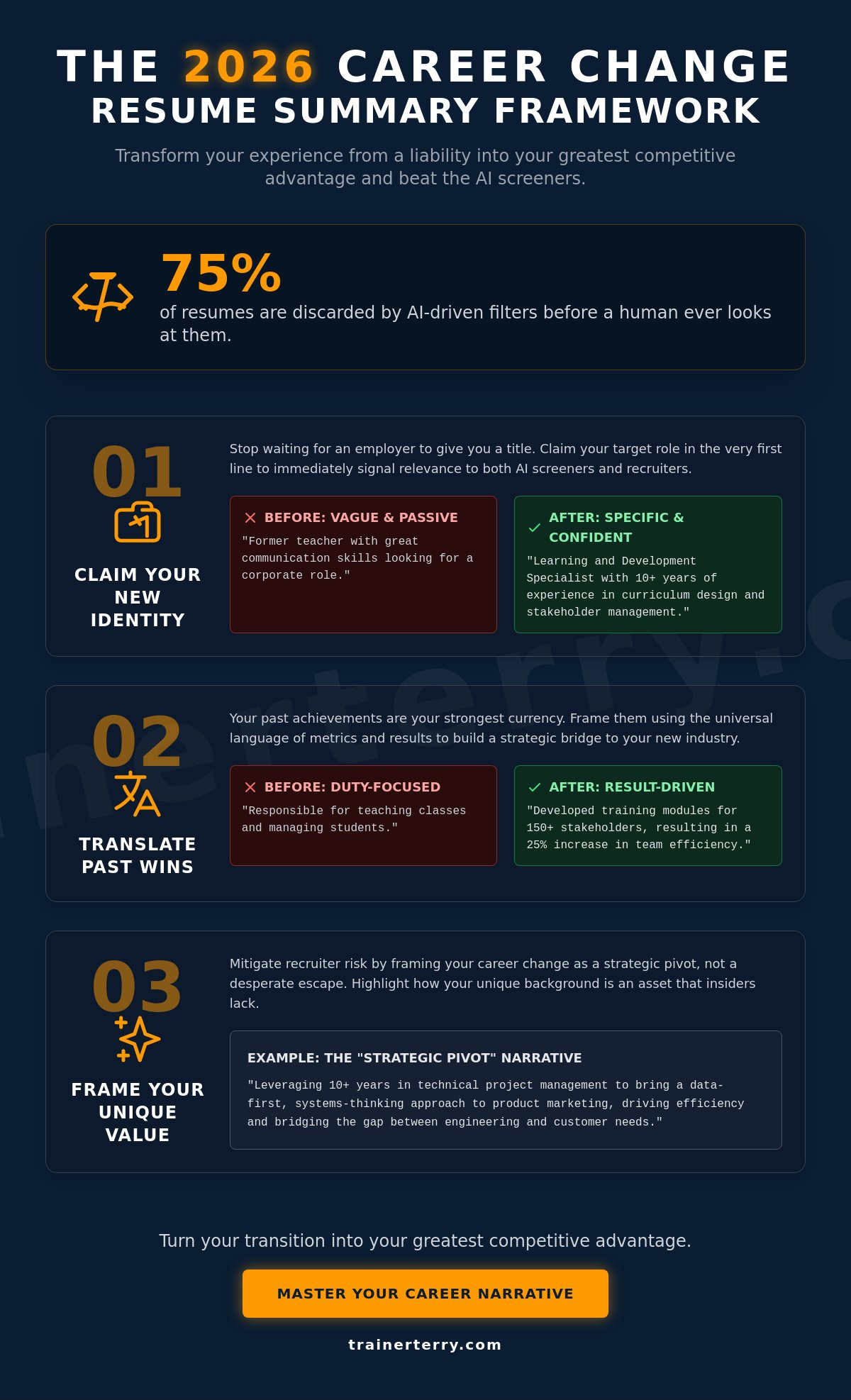
Trying to sound like you're good at everything usually results in looking like you're good at nothing. Vague phrases like "dynamic professional with great communication skills" are invisible to hiring managers. They create a psychological hurdle; the manager can't place you in a specific role because your identity is too blurry. You must define your new professional identity immediately. Instead of saying you're a "former teacher looking for corporate roles," state that you are a "Learning and Development Specialist with 10 years of experience in curriculum design and stakeholder management." Be specific. Be bold. Own the new title before you even have it.
Recruiter Psychology in a Career Shift
Recruiters are naturally risk-averse. They want a safe bet, and a career changer often feels like a gamble. Your summary's job is to mitigate the fear of your "lack of industry knowledge" by highlighting your "Strategic Pivot" narrative. You aren't starting from scratch; you're bringing a unique perspective that industry insiders lack. Understanding different résumé formats for a career change, such as hybrid or functional styles, helps you structure this narrative effectively. When you frame your transition as a deliberate, value-driven move rather than a desperate escape, you transform from a risky hire into a unique asset. You're not just changing jobs; you're upgrading their team with a fresh, proven skillset.
The 3-Part Framework for a 2026 Career Change Summary
Mastering how to write a resume summary for a career change requires a shift from passive description to active marketing. In a job market where 91% of employers use AI tools to screen you, your summary must be punchy, data-driven, and perfectly formatted for mobile scans. Forget the long, winding paragraphs of the past. You need a three-part framework that establishes your authority in seconds. This isn't just about what you did; it's about who you are now and why your unique path makes you a high-value asset.
Step 1: The New Professional Identity
Stop waiting for a new employer to give you a title. Claim it yourself in the very first line. If you are moving from a Marketing Manager role to a Strategic Growth Lead position, your summary should open with that new identity. Use industry-specific keywords that the ATS is programmed to find. This isn't about being dishonest; it's about framing your current capabilities within the context of your target industry. For example, "Strategic Growth Lead with 10 years of experience in data-driven scaling and cross-functional leadership" immediately tells the recruiter you belong in the room.
Step 2: Translating Your 'High-Performance' History
Your past wins are your strongest currency, but only if the recruiter can understand them. You must identify the core competency that bridges your old world and your new one. Use an "Action + Result" formula to make your impact undeniable. A well-crafted resume summary or career profile focuses on transferable achievements. If you're a former educator moving into Corporate Training, don't just say you "taught classes." Write: "Developed and executed training modules for 150 plus stakeholders, resulting in a 25% increase in team efficiency." Metrics are a universal language that translates across every industry boundary.
Step 3: The Unique Competitive Advantage
Candidates who have spent their entire careers in one industry often develop blind spots. You don't have that problem. Your pivot is a feature, not a bug. Use the final sentence of your summary to highlight what you bring that "pure" industry candidates lack. This is where you pass the "So What?" test. Are you a former engineer moving into Sales? Your advantage is technical precision and a deep understanding of product architecture that traditional sales reps can't match. Frame your pivot as a deliberate, strategic choice that provides the company with a fresh, high-impact perspective.
If you're struggling to distill your decade of experience into a few powerful sentences, you might need a more structured approach. Our Career Advancement Blueprint helps professionals like you build a bulletproof narrative that commands respect from day one. Don't let a weak summary hold back your potential. Build your bridge today.
Identifying and Framing Your Transferable Skills
Stop thinking of your skills as industry-specific assets. If you've managed a high-pressure team in retail, you possess the leadership foundations required for a tech environment. The secret to how to write a resume summary for a career change lies in your ability to deconstruct your past and rebuild it using a universal professional vocabulary. While hard skills like coding or accounting are specialized, your soft skills and "Executive Presence" are the universal languages that recruiters actually value during a pivot. They aren't just looking for someone who knows the tools; they're looking for someone who knows how to win.
To find these summary-worthy achievements, use the STAR method (Situation, Task, Action, Result). Don't just list your tasks. Identify the specific result you delivered and the action that caused it. This creates a narrative of "high-potential" that transcends industry boundaries. If you've been promoted quickly in your previous field, that's one of your strongest selling points. It proves you can learn a new system, master it, and lead others within it in record time. This adaptability is exactly what a hiring manager needs to see to feel safe taking a chance on your transition.
The Language of Leadership
Leadership, P&L management, and strategic planning are industry-agnostic. Whether you're managing a budget for a construction project or a marketing campaign, the core discipline is identical. You must frame your corporate challenges as universal problem-solving exercises. If you've successfully navigated an internal pivot before, you've already proven you have the grit to succeed. Many of our clients use the Career Advancement Blueprint to map out these internal wins and position themselves for growth. When you speak the language of strategy, the specific industry becomes secondary to your ability to drive the bottom line.
Quantifying Impact Across Industries
Numbers don't need a translator. Using percentages and dollar amounts is the fastest way to prove your value to a new employer. Instead of saying you "improved operations," say you "delivered a 15% increase in operational efficiency through process automation." This resonates in healthcare, finance, or manufacturing equally. It shows you're an results-oriented professional who understands how to optimize resources. You can even use your promotion history as a metric. Try a sentence like: "Earned two accelerated promotions within three years by consistently exceeding performance targets by 20%, demonstrating rapid industry mastery and high-impact leadership." This turns your past success into a guarantee of future performance.
Career Change Resume Summary Examples for 2026
Seeing the framework in action is where your transformation begins. You've learned the theory, but now it's time to apply it to your specific situation. These examples demonstrate how to write a resume summary for a career change by prioritizing high-level impact over industry-specific jargon. Each one is designed to pass the 3-second scan while proving your value to a skeptical recruiter. Use these as a template to build your own bridge to a new industry.
- Corporate Executive to Non-Profit: Mission-driven leader with 15 years of P&L oversight and organizational scaling. Expert at translating complex corporate strategies into community-focused initiatives that drive 30% growth in donor engagement and operational transparency.
- Technical Expert to Consulting: Strategic Consultant specializing in business architecture for high-growth firms. Leverages a deep technical background to identify operational bottlenecks, delivering a 20% increase in client ROI through automated system optimization.
- Educator to Corporate Training: Instructional Designer and L&D Specialist. Expert at deconstructing complex concepts into actionable training modules for diverse stakeholders, resulting in a 95% proficiency rate among 200 plus corporate learners.
- Sales Leader to Operations: Operations Manager focused on scalable efficiency. Translates 10 years of revenue-driving experience into streamlined internal processes, reducing overhead by 15% while maintaining consistent double-digit growth.
The Executive Pivot: From VP to Consultant
When you're moving from a VP role into Strategic Advisory or Organizational Consulting, your summary must scream "authority." Don't focus on your old title. Focus on the results you can replicate for a new client. You are selling your ability to see the big picture and drive profit. If you want a narrative that positions you as the ultimate asset, our Executive Resume Development strategy ensures your summary speaks the language of the C-suite. Your past revenue drivers are the proof that you can deliver future ROI. Stop summarizing your past and start pitching your future.
The Mid-Career Shift: From Finance to Tech
Moving from Finance to Tech isn't about learning to code; it's about framing your financial rigor as a scalability asset. Tech companies thrive on Data-Driven Decision Making. If you can prove you've managed complex budgets and identified growth trends, you're already a valuable hire. Address the "learning curve" by highlighting your history of rapid adaptability. You aren't "new to tech." You are a Data Strategist who brings a level of precision and fiscal discipline that the tech sector desperately needs to reach the next level of growth.
Beyond the Summary: Executing Your Career Change Blueprint
Your summary is the spark, but your entire professional ecosystem needs to catch fire for the pivot to work. Once you've mastered how to write a resume summary for a career change, you can't leave your LinkedIn profile or your interview pitch stuck in the past. Consistency is what builds trust with skeptical recruiters. If your resume says "Strategic Growth Lead" but your LinkedIn still looks like a "Mid-level Manager," your narrative collapses. You need a unified front that proves you're ready for the next level.
Execution is about more than just words on a page. It's about how you carry that narrative into every interaction. You aren't just a candidate; you're a solution. To make this work, you must stress-test your new career narrative. Join our Office Hours to get direct feedback on your positioning. We'll help you determine if your summary sounds like a beginner asking for a chance or a seasoned pro ready to dominate a new arena.
LinkedIn and Personal Brand Alignment
Your LinkedIn "About" section is your resume summary's louder, more detailed cousin. It's the space where you expand on the strategic bridge we built in previous sections. Every word must reinforce your new professional identity. Don't just tick the "Open to Work" box and hope for a miracle. Use that real estate to tell a specific story of transition. A cohesive LinkedIn Positioning Strategy ensures that when a recruiter clicks your profile, they see a professional who's already living their new role. Your digital presence must match your resume's promise perfectly.
Mastering the Career Change Interview
The interview is where your summary becomes your live elevator pitch. When they ask the inevitable "Tell me about yourself" question, you won't give a chronological history of your life. You'll deliver your summary with conviction. This is your chance to turn a perceived lack of industry experience into a fresh, high-impact perspective. If you're worried about handling skepticism, our 1:1 Job Interview Prep gives you the framework to answer the "Why the change?" question using the STAR method. You'll learn to lead with your wins and leave no doubt that your past success is the perfect foundation for their future goals.
Final Checklist for Your Summary:
- Does the first sentence claim your new professional title?
- Have you replaced industry-specific jargon with universal metrics?
- Does it pass the "So What?" test by solving a future problem for the employer?
- Is the formatting clean and free of tables or columns for 2026 ATS scans?
Claim Your Future Today
Your transition isn't a gamble; it's a strategic move. You've learned that a successful pivot requires more than just a new list of bullet points. You need a bridge that connects your past wins to their future needs. By mastering how to write a resume summary for a career change, you've taken the first step toward reclaiming your professional authority. You aren't starting from scratch. You're bringing years of proven success into a new arena.
Don't let your narrative get lost in an ATS filter or a skeptical recruiter's scan. Our strategy is led by a former Corporate VP with over 20 years of HR experience. We use the specialized Career Change Blueprint and STAR Method interview mastery to ensure your value is undeniable. It's time to stop being ghosted and start being seen as the unique asset you are. You have the experience; now you have the framework to prove it.
Ready to execute your pivot with total confidence? Schedule a Free Strategy Call to build your 2026 Career Change Blueprint. Your next move is waiting. Take the lead today.
Frequently Asked Questions
How long should a career change resume summary be?
A career change resume summary should be between three and five lines long. This length ensures your message stays punchy for mobile scans while giving enough room to build your strategic bridge. If you go longer, you risk losing the recruiter's attention. Keep it focused on your new professional identity and your most impactful transferable wins. Every word must justify its place on the page.
Should I mention my previous industry in the summary?
You should only mention your previous industry if it provides a unique competitive advantage for your new role. For example, if you're moving from Finance to FinTech, your background is a massive asset. However, if the industries are completely unrelated, focus on your universal leadership and operational skills instead. Your goal is to look like an industry insider, not a visitor from another world.
What if I have no direct experience in my target field?
Focus entirely on your transferable skills and high-performance history if you lack direct experience. Recruiter psychology favors results over specific titles. Use metrics like percentages or dollar amounts to prove you know how to win. This is the core of how to write a resume summary for a career change effectively. You're selling your ability to solve problems, which is a skill that translates into any field.
Is a resume objective different from a resume summary for a career change?
Yes, a resume objective is fundamentally different and largely obsolete in 2026. Objectives focus on what you want from the employer, which recruiters find passive and unhelpful. A resume summary for a career change focuses on the value you deliver to the company. It positions you as a contributor from day one. Replace "I am looking for" with "I deliver results through," and you'll see an immediate difference in response rates.
How do I include keywords for a job I've never actually had?
Include keywords by framing your past achievements within the context of your new industry's needs. Scan job descriptions for recurring terms and weave them into your summary naturally. If a job requires "stakeholder management" and you've managed "client relationships," use the job's terminology. This helps you pass ATS filters without misrepresenting your history. It's about translating your experience into the language they speak.
Can I use the same summary for every job application?
You absolutely cannot use the same summary for every application. Each role has specific pain points and goals that your summary must address. Tailoring your message shows the recruiter that you've done your homework and understand their unique challenges. A generic summary signals a lack of effort. Customize your "Strategic Bridge" for every submission to ensure you're seen as the perfect fit for that specific team.
How do I explain a large gap if I took time off to retrain for a career change?
Address the gap directly by framing it as a period of intensive professional development. Don't be defensive about taking time off to retrain. State that you took a deliberate sabbatical to master new technologies or certifications relevant to your pivot. This shows initiative and a commitment to excellence. When you frame the gap as a strategic investment rather than a period of inactivity, it becomes a testament to your drive.

Article by
Terry Jones
Terry Jones is the Founder and Chief Career Strategist of the Career Advancement Blueprint and Executive Coach and Lead Consultant at FireBridge Consulting.
As an ICF Certified Accredited Career Coach and Certified Master Career Services professional, he partners with professionals at all levels, including senior leaders and executives, to navigate career transitions, secure new opportunities, and position themselves for advancement. His approach goes beyond surface level coaching, focusing on how individuals think, communicate, and lead so they can operate with clarity, authority, and strategic intent in high stakes environments.
In his work as an executive coach, Terry engages in high impact advisory conversations that help leaders strengthen decision making, elevate their presence, and align their leadership style with organizational expectations. He is known for helping clients translate their experience into influence, ensuring they are not only seen for what they have done, but trusted for what they are capable of leading next.
With over 20 years of corporate experience, including serving as a Vice President and leading Learning and Development functions for three New York City organizations, Terry brings a deep understanding of how companies evaluate talent, develop leaders, and make promotion decisions. This allows him to bridge the gap between individual ambition and organizational reality.
His insights have reached over 630,000 followers and generated more than 70 million video views, where he shares direct, experience driven guidance that helps professionals think differently and take action.