Should I Take a Pay Cut for a Better Career Opportunity? The Strategic Guide to Executive Pivots in 2026

Staying in a high-paying role that has hit a ceiling isn't "playing it safe." It's actually the fastest way to devalue your professional capital in a 2026 market that rewards agility over tenure. You're likely asking yourself: should I take a pay cut for a better career opportunity, or am I just sabotaging my financial future? It's a heavy question. You've worked hard for your current lifestyle. The fear of never returning to these income levels is real, especially when you feel trapped in a "golden cage."
I get it. When inflation is at 3.8% and tax brackets are shifting, watching your base salary drop feels like a step backward. But a pay cut isn't a loss; it's a tactical reinvestment into a higher-ceiling trajectory. This guide gives you a rigorous framework to determine if a lower salary today is the smartest move for your future earning potential. We'll dive into a clear ROI calculation for your pivot, build your confidence in the decision, and share strategies to negotiate the best possible terms despite the initial cut.
Key Takeaways
- Stop viewing a lower salary as a loss and start treating it as a tactical reinvestment into a career with a significantly higher ceiling.
- Use our ROI framework to determine if you should take a pay cut for a better career opportunity by comparing immediate cash flow against long-term market value.
- Apply the Ceiling Test and Skill Delta to verify if a new role truly "future-proofs" your career and offers a clear path to doubling your income.
- Secure your financial floor by negotiating for non-salary value, including sign-on bonuses and contractually obligated six-month salary reviews.
- Build a powerful career narrative that positions your move as a strategic expansion of your professional portfolio rather than a backward step.
The 2026 Career Pivot: Why a Pay Cut Isn’t Always a Step Back
Stop thinking about your salary as a scoreboard. In the 2026 economy, your bank balance is a trailing indicator of your past performance, not a guarantee of your future value. A strategic pay cut is a deliberate choice to trade short-term liquidity for long-term market equity. It's not a retreat. It's a tactical reload. When you ask yourself, "should I take a pay cut for a better career opportunity," you're really asking if you have the courage to invest in a higher version of yourself.
Many executives find themselves trapped in a "golden cage." You have the title, the perks, and the high six-figure salary, but your professional evolution has flatlined. You're comfortable, but you're also becoming obsolete. The 2026 market doesn't care about your tenure; it rewards agility and the ability to work alongside AI and emerging technologies. Linear ladder-climbing is dead. Today, career success is about expanding your "Career Runway"— the distance you can travel before hitting a hard limit—rather than just bumping against your current "Income Ceiling."
Breaking the Stigma of the Lower Salary
Society views a salary drop as a failure. That's a trap. A temporary dip in compensation is often the precursor to an exponential jump in total net worth. Think of it like a J-curve in private equity; you invest now to reap massive rewards later. A calculated pivot is based on data and trajectory, whereas a desperation move is born from fear. To make this work, you must maintain your executive presence during the transition. If you project the energy of someone who is "settling," the market will treat you that way. If you project the energy of a strategic investor, you'll be seen as a leader who knows how to play the long game.
The Cost of Staying Put
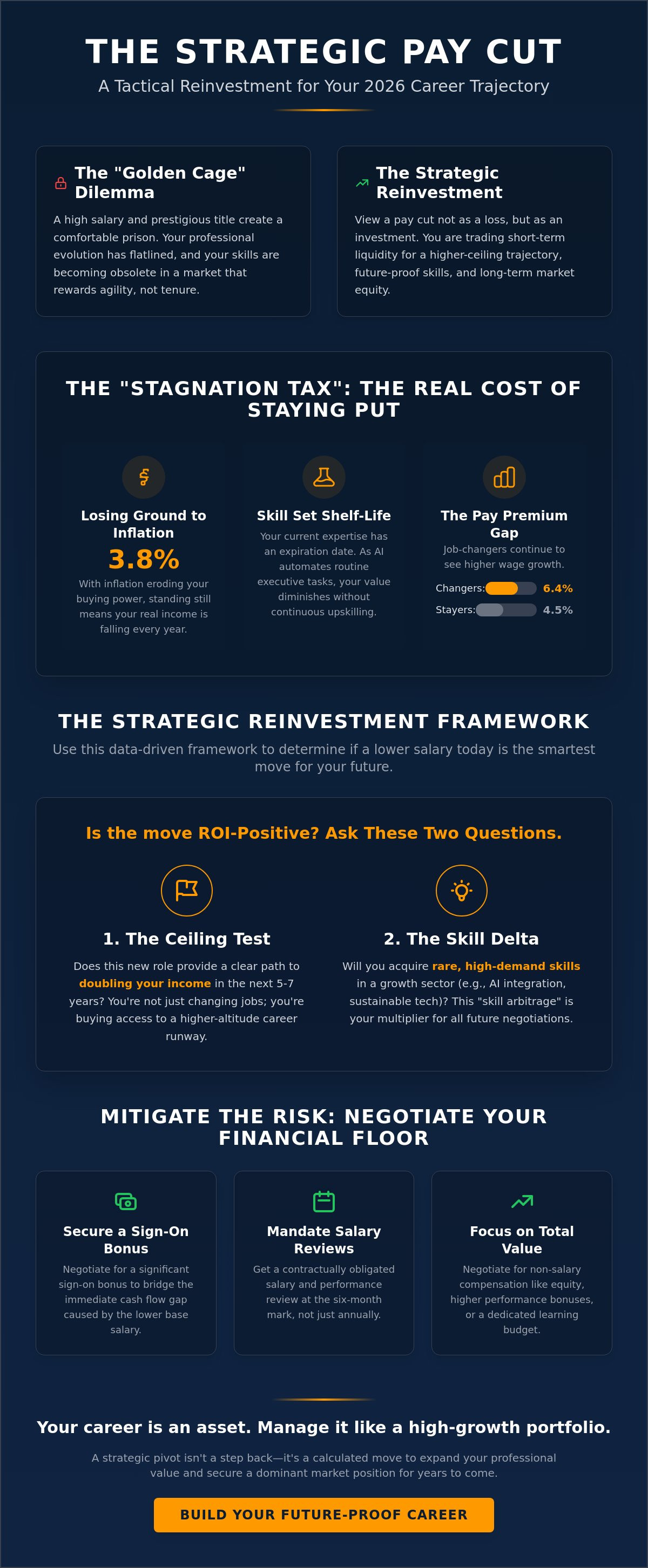
Staying in a role that no longer grows your skills carries a heavy "Stagnation Tax." With inflation sitting at 3.8% as of April 2026, simply standing still means you're losing ground. Your current skill set has a shelf-life. As AI automates more routine executive tasks, the value of staying in a "safe" role diminishes every month. Waiting for the "perfect" lateral move that pays more is often a losing strategy. It creates a massive opportunity cost where you trade years of potential growth for a few extra dollars today. Consider these factors before you decide to stay:
- Skill Obsolescence: Is your current industry shrinking or being disrupted?
- Network Decay: Are you meeting people who can take you to the next level?
- The Pay Premium Gap: While job-stayers saw a 4.5% growth in early 2026, job-changers still lead with 6.4%.
Don't let a current paycheck blind you to a future fortune. If the role offers a bridge to a booming sector or a chance to master a "future-proof" skill, the cut is actually a bargain.
Calculating the ROI: Salary vs. Long-Term Market Value
Stop looking at your bank account as the only measure of professional success. When you're weighing a strategic career move, you're performing a capital allocation exercise. You are the asset. If you take a 15% hit today to move from a legacy industry into a high-growth sector like AI-driven logistics, you aren't losing money. You're buying a cheaper entry point into a massive future upside. Most executives fail because they prioritize monthly liquidity over their total net worth five years from now.
The question "should I take a pay cut for a better career opportunity" shouldn't be answered by a spreadsheet of your monthly bills alone. You must contrast immediate cash flow with future equity and performance-based incentives. In the 2026 job market, where job-changer pay gains have slowed to 6.4%, the "Total Value" of an offer includes the brand equity of the company and the rarity of the skills you'll acquire. A lower salary in a company with a 30% annual growth rate is mathematically superior to a high salary in a stagnant corporation with a 2% growth cap.
The Market Value Multiplier
Your resume is a marketing document. A prestigious company name or a high-impact title acts as a multiplier for every future negotiation. This is "Skill Arbitrage": taking high-level leadership skills and applying them to a sector where they are desperately needed but currently rare. Market Value is the intersection of rarity and demand. When you bridge a gap that others can't, your leverage sky-rockets. Don't just look at the paycheck; look at the "exit opportunities" this new role creates for you in 2028 and beyond.
Quantifying the Intangibles
You can't lead effectively if you're running on fumes. Putting a dollar value on mental health and creative freedom isn't "soft" math; it's essential risk management. Burnout is a massive financial liability. Additionally, consider the "Network Dividend." Access to a new tier of stakeholders, investors, and mentors can be worth more than a $20k base salary bump. If you need a structured way to weigh these factors, our Career Change Blueprint provides the rigorous framework necessary for these high-stakes decisions.
Evaluating an offer is about more than just the numbers on the page. It's about the trajectory of your life. If you're struggling to run these numbers for your specific situation, you can always schedule a free strategy call to get an objective perspective on your next move. Don't let a temporary dip in cash flow blind you to a lifetime of growth.
The Strategic Reinvestment Framework: 4 Signs You Should Say Yes
Stop making high-stakes decisions based on your gut. Your gut is often just fear in disguise. If you're asking yourself, "should I take a pay cut for a better career opportunity," you need a logical system to strip away the emotion. This isn't a hobby; it's a strategic pivot. Use these four filters to decide if the trade-off is a masterstroke or a mistake.
- The Ceiling Test: Is there a clear, documented path to double your current salary within 3 to 5 years? If the new role has a significantly higher terminal value than your current track, the short-term cut is just an entry fee.
- The Skill Delta: Does this role bridge a technical or leadership gap that makes you "future-proof"? In 2026, skills like AI-orchestration and cross-functional leadership are the new gold standard. If you aren't learning, you're becoming obsolete.
- The Lifestyle Floor: Be ruthless with your budget. Does the new salary cover your non-negotiable needs? With the 2026 standard deduction for single filers at $16,100 and inflation at 3.8%, ensure your take-home pay doesn't compromise your mental stability.
- The Exit Strategy: Look at where people from this role go next. If the "alumni" from this position are landing C-suite roles at Tier-1 firms, you've found a high-leverage launchpad.
Identifying the High-Ceiling Opportunity
Look for companies poised for rapid expansion or acquisition. A role in a firm scaling by 20% or more annually offers promotion timelines that legacy companies can't match. Don't just look at the salary; look at the equity and the mentorship. High-level leadership mentorship can shave years off your climb to the top. For more on navigating these 2026 dynamics, check out our guide on Career Advice 2026. The goal is to find a role where the experience you gain is worth more than the cash you leave on the table.
When to Walk Away: Red Flags in Lower Offers
Not all pay cuts are created equal. You must distinguish between "lean and hungry" startups and "exploitative" employers who just want cheap labor. Never take a pay cut for a lateral move within the same industry. That's not a pivot; it's a demotion. Beware of "Promise Inflation." If future raises aren't backed by performance-based contracts or clear milestones, they don't exist. In a year where job-changer pay gains have slowed to 6.4%, you cannot afford to trade certain cash for uncertain promises. Trust the data, not the hype.
Mitigating the Risk: Negotiating Non-Salary Value in Your New Role
Don't accept a lower base salary as a final number. It's a starting point for a broader "Total Rewards" conversation. Deciding if you should I take a pay cut for a better career opportunity is only half the battle. The other half is clawing back that value through strategic negotiation. If the cash is fixed, pivot the discussion to performance-linked upside. High-stakes pivots in 2026 require you to think like a partner, not an employee. Negotiate for sign-on incentives that bridge the immediate gap. Demand accelerated salary reviews. A contractually obligated six-month performance evaluation can turn a temporary cut into a permanent gain faster than you think.
You must also protect your future leverage by addressing title seniority. Ensure your new title reflects your true level of responsibility. If you're taking a pay hit to move into a new sector, your title is the currency that will buy your next role. Secure a dedicated professional development budget as part of your package. Having the company pay for executive coaching ensures you have the support to crush your new KPIs and trigger those performance bonuses early.
Equity, Options, and Long-Term Incentives
Base salary is just one pillar of executive wealth. When you're weighing the trade-offs, you must evaluate the vesting schedule of any equity offered. A 10% base pay reduction is irrelevant if you're securing options in a firm scaling toward a massive exit. Use "Performance-Based Kickers" to ensure that if you hit your targets, your compensation automatically aligns with your old levels. If you're unsure how to structure these complex asks, seeking salary negotiation coaching is the best way to ensure you don't leave money on the table.
Lifestyle and Flexibility as Currency
Your time has a market price. Negotiating for a four-day work week or full remote status isn't just about comfort; it's "Commute Arbitrage." If you save ten hours a week and thousands in travel costs, your effective hourly rate might actually increase despite a lower gross salary. Ensure your contract includes clear milestones for future adjustments. Don't rely on "handshake deals" in a market where job-stayer pay growth is 4.5%. You need these terms in writing to protect your career trajectory.
Ready to lock in the terms you deserve and maximize your total rewards? Master your interview and negotiation strategy here.
Executing the Pivot: How to Position Your Move for Future Growth
Execution is where strategy meets reality. If you've decided that you should I take a pay cut for a better career opportunity, your next mission is controlling the optics. A lower salary is only a "pay cut" if you frame it as one. To the rest of the world, this is a strategic expansion of your professional portfolio. You aren't accepting less; you're investing in a more valuable future. Update your LinkedIn profile immediately. Don't focus on the compensation change. Highlight the increased scope, the scale of the budget you manage, and the high-stakes problems you're solving in this new sector.
Maintaining your professional network is non-negotiable. If you disappear from the scene, your perceived market value drops. Stay active in executive circles and frame your move as a deliberate entry into a high-growth vertical. Using a structured tool like the Career Advancement Blueprint allows you to map out your next jump before you even finish your first week in the new role. You're playing chess while others are just trying to survive the day.
Managing Your Professional Narrative
Future recruiters will ask why you took a step back in pay. Be ready with a hammer, not an excuse. Use the language of "Strategic Reinvestment." Explain that you chose to trade short-term liquidity for a seat at the table in a sector with the highest growth potential for 2026. Focus on the "Size of the Problem" you went there to solve. Use the STAR method to quantify your impact. When you show that you solved a $10M operational bottleneck, the fact that you took a $20k base pay hit becomes an irrelevant footnote to your success story.
The 12-Month Plan: Reclaiming Your Income
Don't get comfortable in your new role. You have twelve months to reclaim your previous income level or exceed it. Set immediate, aggressive KPIs with your new leadership. Prove your value early and often. Build internal alliances with stakeholders who can fast-track your first promotion. In a market where job-stayer pay growth is 4.5%, you need to be the outlier who triggers an out-of-cycle salary adjustment. Your goal is to make your "discounted" price a very short-lived bargain for the company.
Stop overthinking and start executing. If you want to ensure your pivot is a launchpad and not a landing strip, schedule a free strategy call today to map out your high-stakes career move with a professional mentor.
Take Command of Your Career Trajectory
Your salary is a tool, not a trophy. In the 2026 market, standing still is the only real risk you face. We've broken down why a strategic pivot is a reinvestment in your future net worth. You now have the framework to calculate ROI and the tactics to negotiate for total rewards that protect your lifestyle floor. Ultimately, the answer to should I take a pay cut for a better career opportunity depends entirely on the ceiling of that new role. If the growth potential is there, the short-term hit is just the cost of entry to a higher league.
Don't leave your transition to chance. Led by a former Corporate VP with over 20 years of experience, our programs specialize in high-stakes executive salary negotiations and proven STAR method preparation. You deserve a strategy that reflects your true value. Master your next move with the Career Advancement Blueprint and stop letting the "golden cage" dictate your future. The next level of your career is waiting for you to claim it. Let's get to work.
Frequently Asked Questions
Is taking a pay cut ever a good idea for an executive?
Taking a pay cut is a smart move if it grants you access to a higher-growth sector or a massive future upside. Executives often hit a ceiling in legacy industries where their skills are no longer appreciating. If the new role offers a high terminal value through brand association or new tech exposure, the temporary dip is just a tactical reload. You're trading current liquidity for a much larger future net worth.
How much of a pay cut is too much for a career change?
A pay cut is too much if it compromises your financial stability or forces you into high-interest debt. Most professionals use a 15% to 20% threshold as a manageable limit, but this varies based on your personal "Lifestyle Floor." If the opportunity has a clear path to double your income in three years, a steeper initial cut might be acceptable. Always run the numbers against the 2026 inflation rate of 3.8% to ensure your real-world buying power stays intact.
How do I explain a salary decrease on my resume or LinkedIn?
You don't need to list your salary on your resume or LinkedIn profile. Instead, focus the narrative on the "strategic expansion" of your skills. Frame the move as a deliberate choice to lead a high-impact project or enter a disruptive industry. When recruiters ask, explain that you prioritized a role with a higher terminal value and more complex challenges over a stagnant position. Your value is defined by the problems you solve, not the check you used to receive.
Can I negotiate my salary back up after taking a cut?
Yes, you can and should negotiate your salary back up through contractually obligated performance reviews. Don't rely on verbal promises. Instead, secure a six-month evaluation period where specific KPIs trigger a salary adjustment. If you prove your impact early, you have the leverage to reclaim your previous income level. This turns a permanent cut into a temporary "probationary" rate that aligns with your demonstrated value and the results you've delivered.
What are the best non-monetary benefits to ask for when taking a pay cut?
Focus on high-leverage perks like equity, accelerated vesting schedules, and "title inflation." If the cash is lower, ask for a more senior title that increases your future marketability. Other valuable non-monetary assets include professional development budgets for executive coaching or a four-day work week. These benefits reduce your "cost of living" or increase your "Career Runway," making the lower base salary much easier to justify while you scale.
How do I know if a new career opportunity is actually "better" than my current one?
An opportunity is "better" if it passes the Ceiling Test and offers a significant Skill Delta. Ask yourself: does this role bridge a gap that makes you "future-proof" in a 2026 economy? Look at the trajectory of the company and the success of people who previously held the role. If the new position offers access to Tier-1 stakeholders or higher-ceiling exit opportunities, it's a superior move regardless of the initial paycheck.
Should I take a pay cut to move into a completely new industry?
Taking a pay cut to enter a booming industry is often the only way to pivot without relevant sector experience. When you ask yourself, "should I take a pay cut for a better career opportunity," consider the industry's growth rate. Moving from a shrinking legacy sector into AI or green energy is a defensive play for your long-term career. You're buying into a sector where the average pay growth will eventually outpace your old, stagnant industry.
What happens if the new role doesn’t lead to the growth I expected?
If the growth doesn't materialize, you pivot again using the new skills and brand association you've acquired. A strategic move is never a total loss because you've expanded your "Skill Arbitrage" potential. Treat the experience as a high-intensity training program. As long as you've maintained your executive presence and network, you can leverage your new portfolio to find a role that pays your true market value. Every move is data for your next win.

Article by
Terry Jones
Terry Jones is the Founder and Chief Career Strategist of the Career Advancement Blueprint and Executive Coach and Lead Consultant at FireBridge Consulting.
As an ICF Certified Accredited Career Coach and Certified Master Career Services professional, he partners with professionals at all levels, including senior leaders and executives, to navigate career transitions, secure new opportunities, and position themselves for advancement. His approach goes beyond surface level coaching, focusing on how individuals think, communicate, and lead so they can operate with clarity, authority, and strategic intent in high stakes environments.
In his work as an executive coach, Terry engages in high impact advisory conversations that help leaders strengthen decision making, elevate their presence, and align their leadership style with organizational expectations. He is known for helping clients translate their experience into influence, ensuring they are not only seen for what they have done, but trusted for what they are capable of leading next.
With over 20 years of corporate experience, including serving as a Vice President and leading Learning and Development functions for three New York City organizations, Terry brings a deep understanding of how companies evaluate talent, develop leaders, and make promotion decisions. This allows him to bridge the gap between individual ambition and organizational reality.
His insights have reached over 630,000 followers and generated more than 70 million video views, where he shares direct, experience driven guidance that helps professionals think differently and take action.