How to Network for a Career Change in 2026: The Strategic Executive Blueprint

What if the reason you feel like a "slimy con artist" when reaching out to strangers isn't your lack of experience, but your outdated strategy? In 2026, 85% of jobs are filled through the hidden job market, yet most professionals still treat networking like a desperate plea for help. You're right to be cautious. You don't want your current employer finding out you're looking, and you certainly don't want to sound unqualified when trying to translate your old skills into a new industry language. Learning how to network for a career change requires a shift from asking for favors to offering strategic value.
We agree that the traditional "coffee chat" approach feels transactional and awkward. This article promises to help you bypass that "ick" factor by using high-stakes networking strategies designed for the executive level. You'll get the exact scripts you need to reach out with confidence and a method for explaining your transition that builds immediate trust. We'll preview the roadmap to the hidden job market and show you how to dominate a new industry without ever looking like a beginner. Stop hesitating and start building the connections that actually move the needle.
Key Takeaways
- Stop asking for favors and start building relationship equity to unlock the 85% of roles hidden from public view.
- Master how to network for a career change by crafting a narrative that bridges your past experience to your future goals.
- Use "Industry Research" as a stealth cover to explore new paths without alerting your current employer.
- Apply the STAR method in casual conversations to build immediate credibility and command respect as an industry outsider.
- Convert every thank-you note into a strategic "Value Add" proposal that keeps you top-of-mind for upcoming opportunities.
The 2026 Networking Shift: Moving from Transactional to Strategic
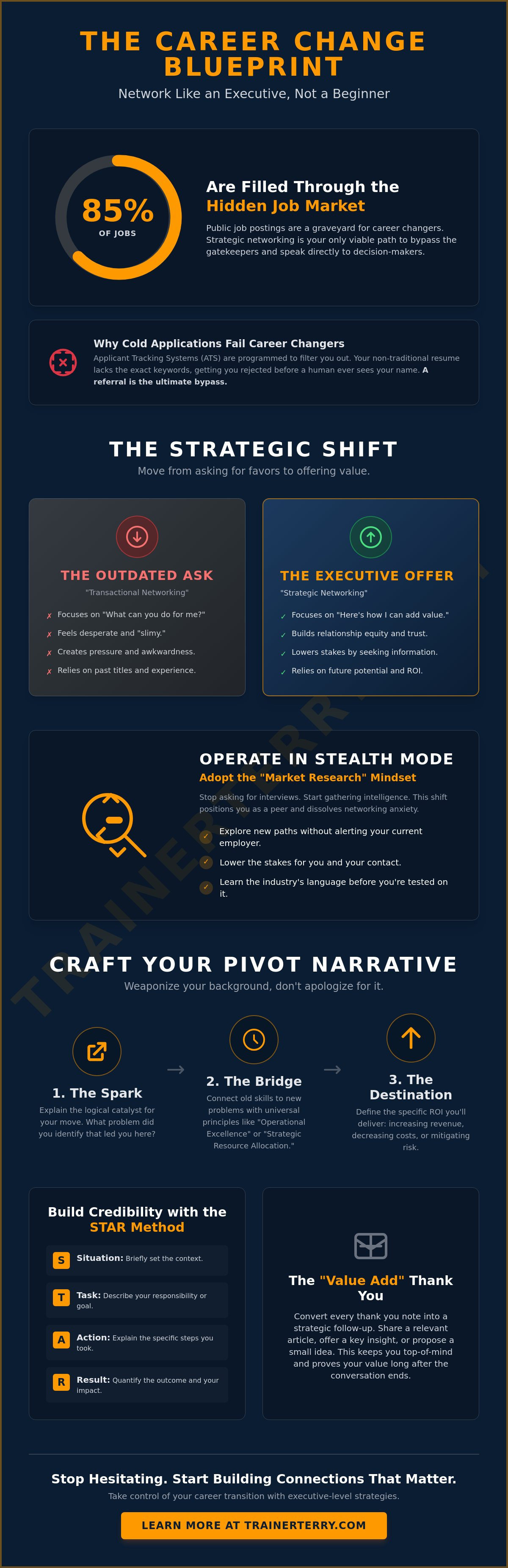
Networking isn't a favor you ask for; it's a trade you facilitate. If you're still treating it like a desperate plea for a job, you've already lost. In 2026, mastering how to network for a career change means shifting your focus from "getting hired" to building relationship equity and conducting deep market research. You aren't a seeker looking for a handout. You are a high-level solution looking for a specific problem to solve. This mindset shift is the difference between being ignored and being invited into the inner circle.
The public job market is effectively a graveyard for career changers. Forbes reports that 85% of jobs are filled through networking, leaving only a fraction for the thousands of people fighting over LinkedIn postings. For those switching industries, the "hidden job market" isn't just an advantage; it's the only viable path. Traditional job hunting relies on past titles. Strategic networking relies on your future potential. By applying foundational professional networking principles, you bypass the gatekeepers and speak directly to the decision-makers who value results over specific industry tenure.
Why Cold Applications Fail Career Changers
Applicant Tracking Systems (ATS) are more aggressive than ever. In 2026, these AI-driven filters are programmed to find the "perfect" match, which usually means someone who has already done the exact same job for five years. If you're pivoting, your resume lacks the specific keywords the machine craves. You'll be filtered out before a human even sees your name. Internal referrals are the ultimate bypass. Recruiters today prioritize "vouched-for" talent because it reduces the risk of a bad hire. A referral doesn't just get you an interview; it grants you immediate credibility that a PDF resume can't provide.
The "Market Research" Mindset
Stop trying to "get an interview" during your first outreach. It's too much pressure for you and the person you're contacting. Instead, shift your goal to gathering industry intelligence. Ask about the challenges the company faces or the emerging trends in the sector. This lowers the stakes and instantly reduces networking anxiety. When you approach a connection as a researcher, they stop seeing you as a threat to their time and start seeing you as a peer. Strategic Networking is the bridge between your past experience and future value. It allows you to learn the new industry's language before you ever sit down for a formal interview. Don't wait for a job opening to appear. Start building the equity now so that when the role is created, you're the only logical choice.
Developing Your Career Narrative: The Foundation of Every Connection
Your narrative is your most valuable asset. If you can't explain your move in thirty seconds, you'll lose your audience. Most professionals fail when learning how to network for a career change because they apologize for their background instead of weaponizing it. You need a structured approach to Career Narrative Development that turns your history into a competitive advantage. This isn't about fluff. It's about strategic positioning. If you don't control the story, the market will define you by your past rather than your potential.
The three pillars of a pivot narrative are the Spark, the Bridge, and the Destination. The Spark explains the logical catalyst for your move. The Bridge identifies the universal leadership principles you're bringing along. The Destination defines the specific value you'll deliver on day one in the new industry. When you align these pillars with a sharp LinkedIn Personal Brand Strategy, you stop looking like a risk. You start looking like a solution. Focus on Transferable ROI. Stakeholders care about three things: increasing revenue, decreasing costs, or mitigating risk. If you've delivered those results before, you can deliver them again, regardless of the industry code on your paycheck.
The "Bridge" Technique
Your old skills aren't baggage. They're your secret weapon. Think about a Corporate VP moving from Finance to Tech. If they focus solely on financial modeling, they're just another analyst. If they focus on "Operational Excellence" and "Strategic Resource Allocation," they're a leader who can scale a startup. This is how you connect disparate industries through universal principles. You aren't learning a new job; you're applying a proven framework to a new set of problems. This perspective builds immediate trust because it shows you understand the high-level business logic that drives every sector.
Testing Your Narrative
Never debut your story in a high-stakes meeting. Use low-stakes conversations to see which parts of your pitch land. If a connection asks for clarification, your Bridge is weak. If they lean in when you mention a specific result, that's your hook. Iterate your story based on real-world feedback. You can dive deeper into the mechanics of Career Narrative Development to see how this works in practice. If you need a safe space to refine your story before going live, joining a session like Office Hours can help you get the expert feedback required to pivot with confidence. Don't wait for perfection. Start testing, start failing, and start refining until your narrative feels like an inevitable success.
Stealth Networking: How to Pivot Without Alerting Your Current Employer
You're a leader, not a fugitive. When you're figuring out how to network for a career change while holding a high-stakes role, discretion is your greatest ally. You don't need to hide in the shadows; you need to change the frame. The goal is to explore new territories without burning the ground you currently stand on. This requires a level of tactical precision that entry-level guides simply don't cover. You must maintain your Executive Presence at all times, ensuring that your curiosity is viewed as professional growth rather than a lack of commitment.
Never disparage your current employer. It's the golden rule of stealth networking. Even if you're leaving because of a toxic culture or stagnant growth, you must speak of your current role with gratitude and professional detachment. High-level peers and recruiters value loyalty. If they hear you trashing your current team, they'll assume you'll do the same to them in six months. Instead, use the "Industry Research" cover. Frame your outreach as a desire to understand cross-sector benchmarks or emerging trends. It's a professional's way of saying "I'm curious" without saying "I'm quitting."
Treat your networking like an executive commitment. Set aside specific blocks of time, similar to the structured approach of Office Hours, to focus solely on these connections. This keeps your search organized and prevents it from bleeding into your daily responsibilities. By being disciplined with your time, you protect your current performance while building your future bridge.
The Informational Interview 2.0
Stop asking for an hour of someone's time. It's too much to ask of a busy professional. Instead, ask for 15 minutes of specific "industry insight." Structure the call like a board meeting. Spend 5 minutes on context, 8 minutes on targeted questions, and 2 minutes on "The Ask." Never ask if they're hiring. It shifts the dynamic from peer-to-peer research to a seeker-to-gatekeeper transaction. Instead, ask who else you should speak with to broaden your perspective. This keeps the conversation focused on intelligence gathering and relationship equity.
Protecting Your Digital Footprint
Your LinkedIn profile is a living document. You can optimize it for your future industry without signaling a departure to your boss. Use strategic LinkedIn Positioning to highlight the universal ROI we discussed earlier. Update your skills and featured content to reflect your new direction, but keep your current title accurate. Before you start, check your privacy settings. Turn off the feature that notifies your network of every profile change. It's a simple step that keeps your pivot under the radar while you build your narrative.
The STAR Method in Networking: Building Instant Credibility
Networking isn't just a friendly chat over coffee; it's a high-stakes performance. If you're learning how to network for a career change, you must realize that every interaction is an audition. People don't refer "nice" people. They refer "capable" people who won't embarrass them. To build instant credibility in a field where you have no track record, you need a framework that proves your competence without relying on industry-specific titles. That's where the STAR method moves from the interview room into your daily conversations.
You've likely used Situation, Task, Action, and Result in formal interviews, but in networking, you use "micro-STARs." These are 30-second bursts of proof. They prove you've solved problems similar to the ones your contact is facing right now. Don't just say you're a good leader. Tell a story about a time you led a team through a sudden 20% budget cut while maintaining peak retention. The result is what sticks. Career changers often focus on the "Action" because they're proud of the work. Stop that. Lead with the "Result." A 15% increase in efficiency is the universal currency of the executive world. If you lead with the number, the listener will naturally want to know how you did it.
Translating Your STAR Stories
Your success in finance won't land in tech if it's buried in jargon. Strip away the industry-specific terms. Focus on the universal business logic that drives results. If you saved a company $2 million through process optimization, that's a win in any language. You aren't just a "finance guy"; you're an efficiency expert. Practice your delivery with 1:1 Job Interview Prep to ensure your stories hit the mark every time. This isn't about lying. It's about translating your value so it makes sense to your new audience.
The "Reverse STAR" Questioning Technique
Networking is also about gathering intelligence. Use the "Reverse STAR" method to ask questions that reveal the "Situations" and "Tasks" the new industry is struggling with. Instead of telling your story, ask about their challenges. What is the biggest hurdle your department is facing this quarter? What actions have you tried to take? Their answers are the roadmap for your next outreach. Read our full guide on The STAR Method for more advanced tactics on structuring these narratives. Once you know their pain points, you can tailor your micro-STARs to show exactly how you can solve them.
Ready to see if your success stories are ready for the big leagues? Schedule a free strategy call to audit your narrative and start networking with total confidence.
Executing the Career Change Blueprint: From Connection to Offer
Execution is where "nice chats" transform into bankable offers. If you've followed the steps so far, you've built a narrative and started the right conversations. Now, you must close the loop. Most professionals fail here because they treat networking as a social event rather than a strategic sales funnel. Learning how to network for a career change is only half the battle. The other half is the relentless follow-up that keeps your name at the top of the pile when a high-stakes role opens up.
Don't just send a generic thank-you note. Convert that interaction into a "Value Add" proposal. If your contact mentioned a specific struggle with market volatility or team retention, send them a brief framework or an article that addresses that exact pain point. This proves you were listening and reinforces your position as a solution provider. Only once this trust is established should you introduce your Executive Resume into the loop. By the time they see your document, they should already be convinced of your value. The resume is simply the formal confirmation of the excellence you've already demonstrated.
Managing the Networking Pipeline
Treat your career pivot like a high-level business development project. Use a simple CRM or a spreadsheet to track every interaction within your Career Change Blueprint. You need to know exactly when you last spoke, what was discussed, and when to execute your next "touch." We recommend the Three-Touch rule: one follow-up immediately after the meeting, a second two weeks later with a value-add item, and a third a month later to check in on a specific project they mentioned. Once you've provided value three times, you've earned the right to ask for a formal referral. This systematic approach ensures no opportunity falls through the cracks.
Closing the Gap with Trainer Terry
The transition from a "connection" to a "candidate" is the hardest part of the journey. You don't have to guess your way through it. Our Career Change Blueprint program is designed to automate the heavy lifting of networking by giving you the exact scripts and strategies used by top-tier executives. We don't just give you a map; we provide the personalized coaching needed to refine your narrative until it's bulletproof. We invest in your success because we know that a career change isn't just about a new title. It's about taking control of your professional legacy.
Ready to stop guessing and start executing? Schedule a free strategy call to map out your pivot. Let's turn your experience into your greatest competitive advantage and secure the role you actually deserve. The clock is ticking. It's time to move.
Take Command of Your Professional Legacy
You've seen the blueprint. You know the hidden job market is where the real opportunities live. You've learned to build a bridge between your past and your future with a bulletproof narrative. Mastering how to network for a career change is no longer a mystery; it's a matter of disciplined execution. Stop waiting for the "right time" or a public listing that won't value your potential. The gatekeepers can't stop a candidate who has already built relationship equity with the decision-makers.
Terry Jones brings over 20 years of experience as a former Corporate VP to help you navigate this transition with precision. With specialized STAR method coaching and our proven "Career Narrative" framework, we turn your non-traditional background into your greatest asset. It's time to stop guessing and start winning. Start your transition with the Career Change Blueprint today. The change you want is happening right now. Don't let another quarter pass in a role that no longer fits your ambition. Step up, reach out, and claim your seat at the new table.
Frequently Asked Questions
How do I explain my career change in a networking email?
Lead with the specific value you bring to the new industry rather than focusing on your departure. Frame your move as a strategic alignment of your proven leadership skills with their current sector challenges. Use the "Bridge" technique to show how your past results solve their future problems. Keep the message concise and focused on gathering industry intelligence rather than asking for a job opening.
What is the best way to find people to network with in a new industry?
Identify "bridge" individuals on LinkedIn who have already successfully pivoted from your current field into your target industry. These professionals understand the translation of skills required and are often more willing to share high-level intelligence. Look for leaders in roles that intersect with your previous expertise. They can more easily recognize your transferable ROI and help you navigate the hidden job market effectively.
How can I network for a career change if I am an introvert?
Focus on structured, one-on-one informational interviews rather than large social gatherings. High-stakes networking is about the depth of connection, not the number of business cards collected. Use a 15-minute "Office Hours" format to maintain control over the conversation. This allows you to prepare your strategic questions in advance and demonstrate your executive presence without the exhaustion of a crowded room or forced small talk.
Is it okay to ask for a job during an informational interview?
No, you should never ask for a job during an initial informational session. It shifts the dynamic from a peer-to-peer exchange of intelligence to a transactional request. This puts the other person on the defensive and closes off the relationship. Instead, ask who else you should speak with to broaden your perspective. Your goal is to build enough trust that they eventually suggest a role to you.
How long does it typically take to network into a new career?
Research from 2026 shows that 71.07% of career changers complete their transition in less than six months. This isn't a matter of luck; it's a matter of strategy. If you're consistent with your "Three-Touch" follow-ups and narrative testing, you'll see results much faster than those relying on cold applications. Speed comes from the quality of your relationship equity and the clarity of your value proposition during every outreach.
How do I handle networking if I don’t have any experience in the new field?
Focus on your universal results rather than specific industry tasks. When you're figuring out how to network for a career change, lead with your ability to solve high-level problems like revenue growth or team retention. If you've managed a $10 million budget in one sector, you can manage it in another. Prove your competence through "micro-STAR" stories that highlight your transferable ROI and immediate value to their bottom line.
Should I update my LinkedIn profile before I start networking?
Yes, but do it strategically to avoid alerting your current employer. Focus on updating your headline and "About" section to reflect the universal business problems you solve. Use the privacy settings to turn off network notifications for profile changes. This allows you to build a dual-purpose profile that speaks the language of your new industry while maintaining your current executive presence and professional standing.
How do I follow up with someone after a networking meeting without being pushy?
Use the "Circle Back" strategy by providing immediate value in your follow-up note. Send a brief message within 24 hours that references a specific challenge they mentioned during your talk. Include a relevant resource, a market insight, or a thought-provoking question that addresses their pain point. This keeps you top-of-mind as a peer and a solution provider, rather than someone who is just checking in to ask for a favor.

Article by
Terry Jones
Terry Jones is the Founder and Chief Career Strategist of the Career Advancement Blueprint and Executive Coach and Lead Consultant at FireBridge Consulting.
As an ICF Certified Accredited Career Coach and Certified Master Career Services professional, he partners with professionals at all levels, including senior leaders and executives, to navigate career transitions, secure new opportunities, and position themselves for advancement. His approach goes beyond surface level coaching, focusing on how individuals think, communicate, and lead so they can operate with clarity, authority, and strategic intent in high stakes environments.
In his work as an executive coach, Terry engages in high impact advisory conversations that help leaders strengthen decision making, elevate their presence, and align their leadership style with organizational expectations. He is known for helping clients translate their experience into influence, ensuring they are not only seen for what they have done, but trusted for what they are capable of leading next.
With over 20 years of corporate experience, including serving as a Vice President and leading Learning and Development functions for three New York City organizations, Terry brings a deep understanding of how companies evaluate talent, develop leaders, and make promotion decisions. This allows him to bridge the gap between individual ambition and organizational reality.
His insights have reached over 630,000 followers and generated more than 70 million video views, where he shares direct, experience driven guidance that helps professionals think differently and take action.