How to Create a Career Change Strategy: The High-Performance Guide for 2026

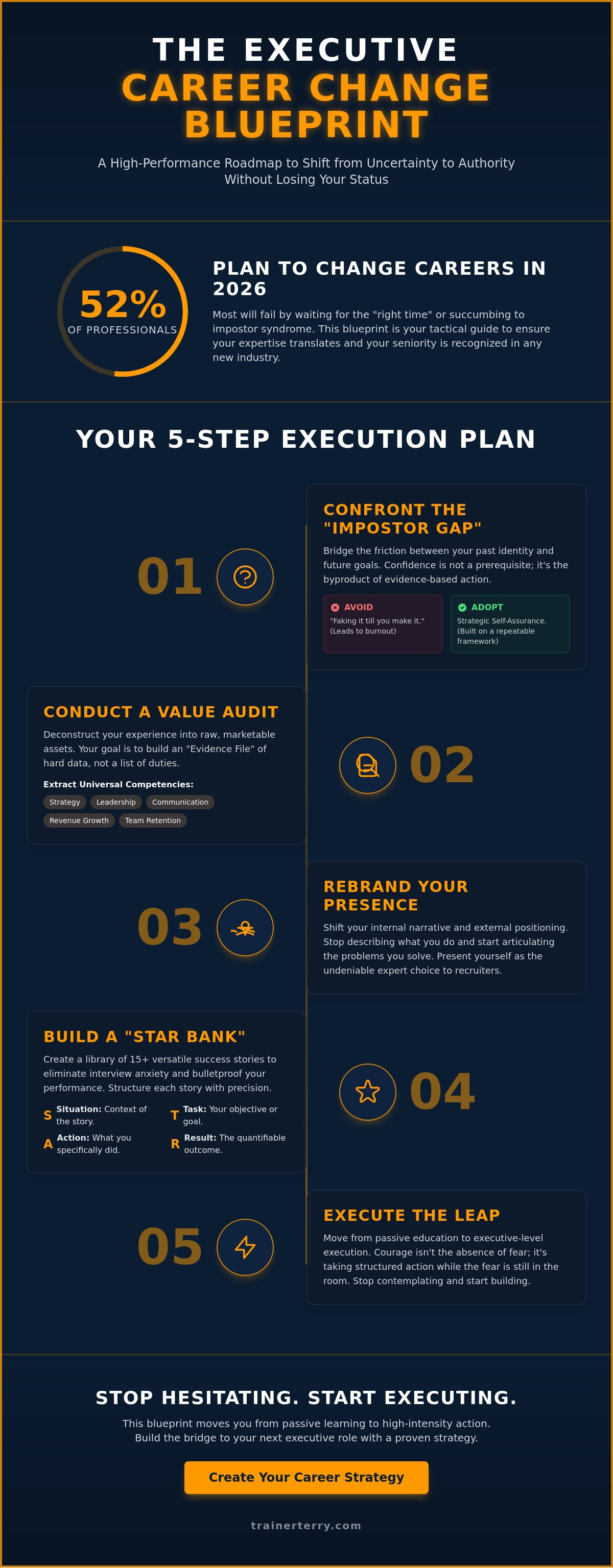
Did you know that 52% of professionals are actively planning to jump ship in 2026? Most of them will fail because they're waiting for the right time or feeling like a fraud in every interview. You don't have to be one of them. If you're worried about losing your status or struggling with how to create a career change strategy that doesn't reset your progress to zero, you're in the right place. It's normal to feel like your current expertise won't translate, but that's just a lack of tactical positioning, not a lack of value.
I understand the anxiety of staring at a blank resume and wondering if your years of leadership actually matter in a new industry. This guide is your high-performance blueprint to shift from uncertainty to total authority. You'll learn how to conduct a strategic value audit that validates your expertise and forces hiring managers to see you as the expert choice. We're going to build a clear roadmap for your mental and tactical readiness using the Career Change Blueprint so you can step into your next executive-level role with confidence. Let's stop the hesitation and start the execution.
Key Takeaways
- Conduct a Strategic Value Audit to extract universal competencies that prove your seniority translates to any new field.
- Discover how to create a career change strategy that closes the "Impostor Gap" and turns your past experience into a high-performance asset.
- Rebrand your professional presence to shift your internal narrative and present yourself as the undeniable expert choice to recruiters.
- Build a "STAR Bank" of 15 versatile success stories to bulletproof your interview strategy and eliminate interview performance anxiety.
- Follow a structured transition blueprint to move from passive education to executive-level execution without losing your hard-earned status.
Understanding the Impostor Gap: Why Career Change Strategy is a Capability
In 2026, a career change isn't just a job hunt. It's a high-stakes pivot that requires a professional-grade execution plan. Most professionals treat their transition like a side project, but a true career change strategy is a fusion of hard competence and undeniable evidence. You aren't just looking for a new title. You're bridging the friction between your past identity and your future goals. This friction is what I call the Impostor Gap. It's that nagging feeling that you're an outsider looking in, even if you have fifteen years of leadership experience. This gap exists because you're trying to apply old labels to a new context.
You don't need to "fake it till you make it." That approach is built on shaky ground and leads to immediate burnout once you're in the room. Instead, you need strategic self-assurance. This means viewing your transition as a professional development project rather than a crisis of identity. When you learn how to create a career change strategy, you stop relying on vague feelings and start relying on a repeatable framework. Confidence isn't a prerequisite for starting; it's the byproduct of consistent, evidence-based action. You build it by proving to yourself that your skills are universal.
The Myth of Waiting to Feel Ready
Waiting for confidence is just a sophisticated form of procrastination. Your brain is wired for survival, not fulfillment. When you face career uncertainty, your biological "fight or flight" response kicks in. It wants you to stay in your comfortable, high-paying role even if it's soul-crushing. Transition courage isn't the absence of fear. It's taking action while the fear is still in the room. This is a core part of the career development process where you move from exploration to commitment through execution, not just contemplation. Stop waiting for the "right time" because the clock is already running.
Confidence as a High-Performance Career Tool
Treat your confidence like a strategic corporate initiative. You wouldn't launch a new product line without a roadmap, so don't launch your new career without one. Focus on micro-wins to rewire your professional self-image. Every time you translate a past success into a universal competency, you're closing that Impostor Gap. If you're struggling to see your own value, you might need an outside perspective to audit your skills. High-level Executive Coaching and Advisory can help you build a narrative that commands authority before you even step into the interview. Mastering how to create a career change strategy requires you to move from passive learning to high-intensity execution. Stop thinking about the leap and start building the bridge.
The Strategic Value Audit: Mapping Your Transferable Skills
Confidence isn't a feeling; it's a data set. You need to look back at the last ten years of your professional life and strip away the job titles. This is the first step in how to create a career change strategy that actually works at the executive level. Most people look at their resume and see a list of duties. You need to see a list of universal results. A "Value Audit" forces you to deconstruct your experience into raw, marketable assets that any CEO would value, regardless of the industry.
Start by identifying your Universal Competencies. These are high-level skills like Strategy, Leadership, and Communication that transcend specific sectors. To silence the "Impostor Gap" we discussed earlier, you must build an "Evidence File." This is a curated collection of hard data points. Think of percentages, revenue growth, and team retention metrics. When you have hard data, self-doubt has nowhere to hide. You aren't just saying you're a leader; you're proving you can scale a department by 30% in twelve months.
Don't fear your lack of industry-specific experience. Often, being an outsider is your greatest competitive advantage. You bring fresh perspectives and cross-pollinated solutions that insiders often miss. While your competitors follow basic tips for a successful career change, you'll be positioning your "weakness" as a unique edge. You're the expert who brings a new playbook to an old game.
Deconstructing Your Current Role for a New Industry
Stop describing what you do and start describing what you solve. Take your industry-specific jargon and burn it. Instead of saying "Optimized supply chain logistics for retail," say "Reduced operational overhead by 15% through process automation." This is the "So What?" test. Every achievement in your audit must prove its future relevance. If a bullet point doesn't explain how you'll make the next company more profitable or efficient, it doesn't belong in your new narrative. If you find this process difficult, a focused Career Positioning Strategy session can help you translate your past into a high-value future.
Identifying the Transferable Bridge
Connect your old successes to the specific pain points of your target industry. This is where you build the bridge. You aren't "starting over"; you're applying your high-level Executive Presence to a new set of challenges. By mastering how to create a career change strategy through this audit, you ensure your transition is a move of strength. You're reframing your career narrative from one of "searching for a chance" to one of "providing a solution." Stop looking for a job and start offering your expertise as the definitive answer to their problems.
Strategic Rebranding: Building Confidence Through Professional Positioning
Rebranding is often dismissed as a surface-level marketing exercise. That's a mistake. In the context of how to create a career change strategy, your brand is the psychological armor you wear into battle. Most professionals stay stuck because they still see themselves as their old job title. You need to shift your identity before you can shift your industry. This is the "Mirror Effect." When you optimize your professional presence, the first person you convince is yourself. Seeing your value articulated clearly changes your internal self-talk from "Can I do this?" to "I am the solution they need."
You aren't just an applicant. You're an industry outsider with insider results. This narrative allows you to own your story. Instead of apologizing for your lack of industry tenure, highlight the fresh perspective you bring. This is where mapping your transferable skills becomes a tactical weapon. You're taking the raw data from your value audit and turning it into a compelling narrative that commands respect. Own your transition. If you don't define your value, someone else will define your limitations.
LinkedIn as Your Digital Confidence Anchor
Your LinkedIn profile is your digital home base. If your headline still lists your old role, your subconscious stays tethered to the past. Update it to reflect your future target. This isn't about being dishonest; it's about signaling market readiness. Use a strategic guide for LinkedIn to ensure your technical optimization is flawless. When you see a high-performance profile staring back at you, your executive presence naturally levels up. It's a constant reminder that you belong in the new space you're claiming.
The Resume Strategy for Career Changers
Stop using a chronological resume that highlights your "irrelevance" to a new field. Switch to a strategic format that leads with your universal competencies. Check out these resume examples to see how to lead with impact rather than just history. Seeing your achievements "in print" through a new lens is a massive confidence booster. It reduces interview anxiety because you've already done the hard work of proving your value to yourself. If you want to ensure your positioning is bulletproof, you can book a strategy call to nail your narrative.
The STAR Method: Bulletproofing Your Interview Strategy
The interview is where your career change strategy faces its ultimate stress test. You can have a perfect resume, but if you can't articulate your value under pressure, you'll stay exactly where you are. Learning how to create a career change strategy that actually lands offers requires you to stop winging your interviews. This is where the STAR method becomes your tactical advantage. It's not just a way to answer questions; it's the ultimate tool for evidence-based confidence. By structuring your past successes into a "STAR Bank" of 15 versatile stories, you'll never be caught off guard. These stories are your currency in a new industry. They prove that while the context might be different, your ability to deliver results is constant.
Performance anxiety usually stems from a lack of evidence. When you have a bank of stories ready, you aren't searching for what to say; you're selecting the best weapon for the moment. Use the "Result" phase of every story to prove your worth to new employers. Don't just tell them what you did. Tell them how much money you saved, how much time you gained, or how many people you developed. This tactical approach is the final pillar of how to create a career change strategy that eliminates the "fraud" feeling and replaces it with high-level interview strategy.
Structuring Your Success Stories for Impact
The STAR method stands for Situation, Task, Action, and Result. It's a simple framework, but most people mess up the "Action" and "Result" steps. For a career changer, the Action step is where you demonstrate transferable skill mastery. You need to show the specific steps you took that would work in any company. The Result is the "So What?" that justifies your executive-level status. For a deep dive into this framework, master the STAR method to ensure your stories hit with maximum impact every single time.
Rehearsing for Executive Authority
Knowing your stories is only half the battle. You have to deliver them with executive presence. This means maintaining vocal confidence, controlling your pace, and owning the room. Mock interviewing is the fastest route to certainty because it identifies the gaps in your delivery before they cost you a job. Feedback isn't an insult; it's the data you need to win. If you want the final tactical polish that turns a good interview into an undeniable offer, invest in professional 1:1 job interview prep. Stop practicing until you get it right; practice until you can't get it wrong.
Executing the Leap: The Career Change Blueprint
Execution is the only bridge between your current frustration and your future authority. You've audited your value and rebranded your presence, but now you have to move. Learning how to create a career change strategy is useless if you don't have the discipline to execute the leap. This is where most senior professionals stall. They get stuck in "analysis paralysis" because the stakes feel too high. A structured Career Change Blueprint eliminates the guesswork. It turns a chaotic life event into a series of calculated, high-performance tactical moves. You aren't just "trying something new"; you're executing a pre-validated plan.
Setbacks aren't signs to stop. They're data points. If an interview doesn't land an offer, it's not a failure of your worth; it's a signal to refine your narrative or your STAR Bank. Your strategic momentum depends on your ability to process rejection as professional feedback. High-performance professionals don't take "no" personally. They use it to recalibrate their positioning. Mastering how to create a career change strategy means building resilience into the framework so that one closed door doesn't stop the entire process. Stay focused on the system, not just the immediate result.
Managing the Transition Phase
The first 90 days in a new sector are critical. You aren't just learning a new role; you're establishing your executive presence in a foreign environment. Set realistic milestones that focus on quick wins and building internal alliances. You don't have to do this alone. High-performance momentum is much easier to maintain when you have a community that understands the executive struggle. Joining Office Hours gives you the ongoing mentorship and advisory needed to navigate the nuances of a new industry without losing your hard-earned footing.
Your Next High-Performance Move
2026 is the year of the strategic pivot. The market is shifting rapidly, and senior talent who can bridge the gap between industries will dominate the next decade. Remember the philosophy: confidence is a byproduct of strategy and evidence, not a prerequisite. You have the skills. You have the data. Now you need the execution plan. Stop overthinking the risks and start focusing on the cost of staying where you are. It's time to stop being a spectator in your own career. Schedule a Free Strategy Call today and let's build the high-performance blueprint that secures your next executive-level win.
Claim Your Executive Authority in 2026
Your career transition shouldn't be a gamble. By mastering how to create a career change strategy, you've moved from the anxiety of the "Impostor Gap" to the authority of a proven executive. You now have the tools to audit your universal value, rebrand your digital presence, and bulletproof your interview performance with a STAR Bank that commands respect. Success in 2026 belongs to those who replace hesitation with a structured, high-performance system.
Terry Jones, a former Corporate VP with over 20 years of experience, designed these frameworks to help senior leaders pivot without losing their status. Whether you're refining your specialized STAR method interview preparation or starting the comprehensive Career Change Blueprint program, the goal is the same: total market dominance. Don't let your current role be your final destination.
Ready to build your high-performance career narrative? Schedule a Free Strategy Call today.
The bridge to your next executive role is already under construction. Now, it's time to walk across it.
Frequently Asked Questions
How do I explain a career change in an interview without sounding like I am starting over?
Focus your narrative on universal results rather than industry-specific duties. You aren't starting over; you're applying a high-performance toolkit to a new set of challenges. Use your STAR Bank to show how your past leadership translates directly into solving their current pain points. This positioning ensures hiring managers see you as a strategic asset who brings immediate value, not a trainee who needs basic instruction.
Is it possible to build confidence for a career change while still working my current job?
You can build significant confidence while employed by treating your transition as a professional development project. Start your Strategic Value Audit and Evidence File during your off-hours to see your worth in black and white. Understanding how to create a career change strategy while you still have the security of a paycheck allows you to take calculated risks and build tactical readiness without the pressure of immediate financial need.
How long does it typically take to feel confident in a new industry?
Most executives report a significant shift in confidence within their first 90 days, provided they follow a structured transition plan. Confidence isn't a switch you flip; it's a byproduct of hitting specific milestones in your new sector. By focusing on quick wins and building internal alliances early on, you validate your expertise through real-world execution. The Impostor Gap closes as soon as you start delivering measurable results.
Can a career coach help me find confidence if I have no idea what I want to do next?
A career coach provides the objective audit needed to identify your universal strengths when you're too close to the problem. Through specialized Career Positioning Strategy, a mentor helps you deconstruct your past decade of experience to find the common threads of success. You don't need a final destination to start; you need a clear understanding of your marketable assets to see which high-level doors they can open.
What are the most common confidence-killers during a career transition?
The biggest confidence-killers are a lack of tactical clarity and staying in professional isolation for too long. When you don't have a clear roadmap, every rejection feels like a personal failure rather than a data point. Falling into the Impostor Gap happens when you stop focusing on your Evidence File and start listening to the "start over" myth. Staying connected to high-performance mentorship keeps your momentum from stalling during the pivot.
How do I handle the "overqualified" label when switching careers?
Deflect the overqualified label by positioning your seniority as a way to reduce their operational risk. Explain that your extensive leadership experience means you require less hand-holding and can deliver results faster than a less experienced hire. You aren't too senior; you're a high-performance executive who has already mastered the universal competencies they desperately need to scale their department. Frame your experience as a shortcut to their success.
What if I fail at my career change; how do I protect my confidence?
Protect your confidence by treating every setback as a tactical feedback loop rather than a final verdict. If a specific move doesn't work, return to your Career Change Blueprint to analyze the data and recalibrate your positioning. Resilience is built into the strategy itself. High-level pivots often require multiple iterations. A single "no" is just a signal to refine your narrative, not a reason to retreat to your old role.
Does a professional resume really help with self-confidence?
Seeing your achievements articulated through a high-performance lens creates the Mirror Effect that immediately shifts your internal self-talk. When your value is documented in a strategic resume format, you stop questioning your worth and start owning your authority. This is a critical step in how to create a career change strategy because it provides the visual proof your subconscious needs to project confidence during high-stakes executive interviews.

Article by
Terry Jones
Terry Jones is the Founder and Chief Career Strategist of the Career Advancement Blueprint and Executive Coach and Lead Consultant at FireBridge Consulting.
As an ICF Certified Accredited Career Coach and Certified Master Career Services professional, he partners with professionals at all levels, including senior leaders and executives, to navigate career transitions, secure new opportunities, and position themselves for advancement. His approach goes beyond surface level coaching, focusing on how individuals think, communicate, and lead so they can operate with clarity, authority, and strategic intent in high stakes environments.
In his work as an executive coach, Terry engages in high impact advisory conversations that help leaders strengthen decision making, elevate their presence, and align their leadership style with organizational expectations. He is known for helping clients translate their experience into influence, ensuring they are not only seen for what they have done, but trusted for what they are capable of leading next.
With over 20 years of corporate experience, including serving as a Vice President and leading Learning and Development functions for three New York City organizations, Terry brings a deep understanding of how companies evaluate talent, develop leaders, and make promotion decisions. This allows him to bridge the gap between individual ambition and organizational reality.
His insights have reached over 630,000 followers and generated more than 70 million video views, where he shares direct, experience driven guidance that helps professionals think differently and take action.