Best Industries to Pivot to for Work-Life Balance in 2026: An Executive Strategy

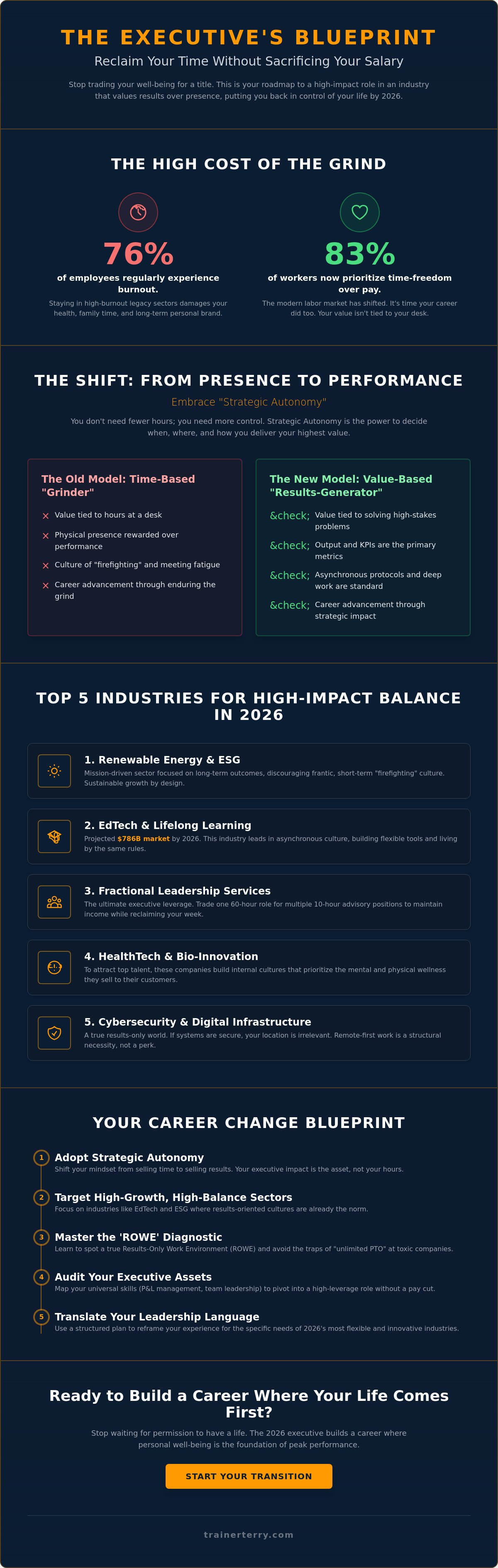
You've been told that reclaiming your time requires a massive pay cut, but that's a lie designed to keep you trapped in a 60-hour grind. If you want to know how to plan a career change for work-life balance, you must target high-leverage industries that value results over presence. You're likely feeling the weight of executive burnout affecting your health and family right now. It's frustrating to earn a top-tier salary when you don't have the energy to enjoy it. You aren't alone. Recent reports show that 83% of workers now prioritize time-freedom over pay, yet 76% still experience burnout regularly.
This article will show you exactly how to secure a high-impact role without sacrificing your executive compensation. We'll break down the high-growth sectors, from the $786 billion digital marketing market to specialized tech leadership, where autonomy is the standard. You'll get a clear roadmap for a 2026 transition that puts you back in the driver's seat of your life. Stop sacrificing your well-being for a title. It's time to find an industry where you can lead with impact and finally leave the office on time.
Key Takeaways
- Learn why traditional schedules are obsolete and how "Strategic Autonomy" allows you to reclaim your time without sacrificing your executive impact.
- Discover how to plan a career change for work-life balance by targeting high-growth sectors like Renewable Energy and EdTech that value results over physical presence.
- Master the Results-Only Work Environment (ROWE) diagnostic to spot healthy workplace cultures and avoid the common traps of unlimited PTO.
- Audit your universal executive assets to ensure you pivot into a high-leverage role that maintains your current salary level.
- Use a structured Career Change Blueprint to translate your leadership experience into the specific language of 2026's most flexible industries.
Redefining Work-Life Balance for the 2026 Executive
The 9-to-5 is dead. For a high-performing executive in 2026, the idea of clocking in and out is a relic of a failing system. You don't need fewer hours. You need more control. We call this Strategic Autonomy. It's the power to decide when, where, and how you deliver your highest value. If you're still understanding work-life balance as a simple 50/50 split of your time, you're already behind. The modern labor market has shifted. It no longer rewards the generalist "grinder" who stays late just to be seen. It rewards the specialist who solves high-stakes problems with surgical precision. Learning how to plan a career change for work-life balance starts with accepting that your value isn't tied to your desk. You must move from being a resource to being a results-generator.
The Cost of Staying in High-Burnout Legacy Sectors
Traditional sectors like finance and law are bleeding talent. They still demand physical presence over mental performance. Staying in a 60-hour-a-week grind isn't just tiring. It's a massive opportunity cost. You're trading your health and family time for a legacy brand that doesn't respect your boundaries. Data from early 2026 shows that 76% of employees experience burnout, with 28% feeling it "always." If you stay, you're damaging your long-term personal brand. You become seen as a "grinder" rather than a strategic leader. That label is a poison you can't afford. High-growth companies want visionaries, not people who only know how to suffer through a spreadsheet.
Strategic Leverage: The Key to Pivoting Without Pay Cuts
You don't have to start over from scratch. To succeed, you must shift from a time-based model to a value-based one. Expertise is your leverage. In agile industries, they don't care if you're at your computer at 2 PM on a Tuesday. They care that you hit your KPIs and lead your team to victory. This is exactly how to plan a career change for work-life balance without losing your executive salary. You bring your P&L management and leadership skills to sectors that prioritize output over optics. Your experience is a premium asset in these growth-focused environments. Stop selling your time. Start selling your results. The 2026 executive doesn't ask for permission to have a life. They build a career where their life is the foundation of their performance.
The Top 5 Industries for High-Impact Work-Life Balance in 2026
Stop looking at traditional corporate giants if you want your time back. The 2026 labor market has created clear winners where executive talent is treated like a high-performance asset rather than a battery to be drained. When researching how to plan a career change, you must look for industries built on "Strategic Autonomy." These sectors don't just tolerate balance. They require it for peak performance.
- Renewable Energy & ESG: This sector is mission-driven and booming. Growth here is sustainable by design. Leaders in ESG focus on long-term outcomes, which naturally discourages the frantic "firefighting" culture of legacy finance.
- EdTech and Lifelong Learning: With the digital marketing and education market projected to reach $786.2 billion by late 2026, this industry leads in asynchronous culture. They build tools for flexible learning, so they live by those same flexible rules.
- Fractional Leadership Services: This is the ultimate executive leverage. You trade a single 60-hour role for four 10-hour advisory positions. You maintain your income while reclaiming 20 hours of your week.
- HealthTech & Bio-Innovation: These companies are under intense pressure to solve wellness problems. To attract top talent, they've built internal cultures that prioritize mental health and ergonomic safety, often staying ahead of the July 2026 DOL remote safety mandates.
- Cybersecurity & Digital Infrastructure: This is a results-only world. If the systems are secure, nobody cares if you're working from a home office or a beach. It's remote-first by necessity.
Why These Industries Lead the 2026 Balance Rankings
Meeting fatigue is a choice, and these industries have chosen to kill it. They utilize asynchronous protocols that allow executives to review data and make decisions without being tethered to a Zoom call. Venture capital shifts have also played a role. Investors now demand efficiency over "growth at all costs." This shift forces senior leadership to prioritize high-impact work over busy work. If you're ready to map out your specific trajectory, our Career Advancement Blueprint can help you identify which of these sectors fits your existing leadership profile.
Roles Within These Industries for Senior Pivots
You aren't just changing jobs. You're changing your role in the ecosystem. We're seeing a massive rise in the "Chief of Staff" position. It's a high-impact role that acts as a strategic filter for the CEO, offering massive influence with more schedule flexibility than a traditional COO. Transitioning from Corporate HR to an ESG Lead or People Experience Director is another power move. These roles focus on culture and sustainability. They are built for leaders who understand how to plan a career change for work-life balance by leveraging their people skills in a modern, results-oriented framework. Don't just pivot. Pivot to where you have the most leverage.
Evaluating 'Balance Culture': How to Spot a Healthy Workplace
Don't get blinded by flashy office perks or "unlimited PTO." For a senior professional in 2026, unlimited vacation is often a trap. It creates a culture of guilt where nobody knows the baseline expectation, so nobody takes a break. You need to look for a Results-Only Work Environment (ROWE). In this model, your output is the only metric that matters. When you're researching five tips to explore a career change, vetting the actual day-to-day reality of a firm is the most critical step. You must look past the recruitment brochure and see how the machine actually runs under pressure.
Vetting a company's Slack and email culture is non-negotiable. If the hiring manager mentions "we're like a family," keep your guard up. Families often have messy boundaries; professional teams have clear ones. Adopt an Executive Career Coach mindset during the interview process. You aren't just a candidate looking for a paycheck. You're a high-value consultant auditing a potential partner. If their communication is chaotic during the hiring phase, it will be a nightmare once you're on the payroll. Look for signs of "Shadow Work," which are the invisible tasks that creep into your life after 6 PM.
Interview Questions That Reveal the Truth About Balance
Ask about their asynchronous protocols. Don't ask about "working hours." That sounds like you're watching the clock. Instead, ask how the team handles decision-making across different time zones. This reveals if they value deep work or if they expect you to be tethered to a Zoom call all day. You need to know how they handle "urgent" requests. If the answer is "we just hop on a quick call whenever," you've found a burnout factory. This is a vital part of how to plan a career change for work-life balance. You want to lead, not just react to pings.
The Role of Leadership in Modeling Balance
Never join a firm where the CEO treats sleep deprivation like a badge of honor. Leadership models the behavior of the entire organization. If the senior team doesn't take vacations, you won't either. Look for firms with high executive tenure. Low leadership turnover is the ultimate proof of a healthy culture. It shows that people can perform at a high level for years without hitting a wall. You want a seat at a table where the other leaders are as energized as you are. If you want to refine your approach, you can schedule a free strategy call to discuss your specific industry pivot.
Mapping Your Executive Leverage: How to Pivot Without Starting Over
You don't need a new degree to change industries. You need a narrative shift. Most professionals think they have to start from the bottom when they switch sectors. That's a myth. Your leadership and P&L management skills are "Universal Executive Assets." They transfer anywhere. If you want to know how to plan a career change for work-life balance, you must stop identifying as a "Finance Guy" or a "Retail Expert." You are a high-performance operator who delivers results. Period. The 2026 market doesn't care about your old industry. It cares about your ability to solve its current problems.
Translation is your secret weapon. If you come from a legacy sector, your resume is likely full of industry-specific anchors. These weigh you down. You must scrub the jargon. A strategic professional profile overhaul is the first step to signaling this shift to the 2026 growth markets. You need to present yourself as the solution to the problems these new industries face. When you get into the interview room, use the STAR Method to prove your adaptability with concrete evidence. Show them, don't just tell them. High-impact industries value proof over promises.
The Bridge Narrative: Your Pivot Power Tool
Your Bridge Narrative is the story that connects your past success to a balanced future. For example, if you're leaving a high-stress retail executive role, don't focus on "managing stores." Focus on "Customer Experience Innovation." You're moving from managing physical footprints to optimizing digital journeys in Tech. One sentence can change everything: "I leveraged operational efficiency to drive growth in legacy retail, and now I'm bringing that same rigor to mission-driven ESG initiatives." Remove the industry anchors. Focus on the universal impact of your work.
Networking into 'Closed' Industries
Cold applications are a waste of time for executives. You need a "Value-First" outreach strategy. Find mentors who have already secured strategic autonomy. Ask them about their transition, not for a referral. They've walked the path you're on. They know which firms actually respect boundaries and which ones are just using "work-life balance" as a marketing slogan. This is a vital part of how to plan a career change for work-life balance. Before you step into a high-stakes interview, use our Office Hours to test your pitch. We'll help you refine your narrative so it lands with maximum impact. You have the leverage. Now, learn how to use it.
Securing the Move: Your Blueprint for a High-Value Career
You've audited your assets and identified the growth sectors. Now, you must execute. Knowing how to plan a career change for work-life balance is only half the battle. The other half is having the courage to leave a legacy system that no longer serves you. You don't "find" a balanced role in 2026. You secure it through a structured Career Change Blueprint. This isn't about applying to dozens of jobs on a whim. It's about a surgical strike on industries that value your expertise over your physical presence. You need a transition that prioritizes your health without gutting your bank account.
A high-performance career requires a high-performance strategy. Your positioning must be flawless before you approach these new markets. This means your narrative must be sharp, and your value proposition must be undeniable. Don't settle for a generic transition. You want a role that allows for "Strategic Autonomy," as we've discussed. This is your chance to reset the terms of your professional life. If your current sector is draining your energy, it's already costing you more than your salary is worth. Stop paying the price of burnout. Stop waiting for permission to have a life.
Negotiating for Time, Not Just Money
The negotiation phase is where you win back your life. Most executives only focus on the base salary. You're different. You're playing for time. Consider trading a 10% bonus for 10 weeks of flexible work or guaranteed remote Fridays. This is the "Power Pivot." In the 2026 market, results-oriented firms are often happy to make this trade. They get your high-level expertise, and you get the freedom you've earned. Ensure your offer letter includes "Outcome-Based" performance metrics. If you hit your targets in 30 hours, you should be done. Don't let yourself get trapped in another presence-based contract that rewards hours over impact.
Your Next Step Toward Balance
Waiting for "the right time" is a recipe for permanent burnout. There will always be another project, another quarter, or another crisis. The right time is now. Every day you stay in a high-burnout sector, you're damaging your long-term marketability and your health. Our Career Advancement Blueprint provides the structure you need to move with confidence. A single strategy call can clarify your target industry in 30 minutes. You've spent years building someone else's dream. It's time to build a life you actually enjoy. Ready to reclaim your life? Schedule your free strategy call today and let's start your transition.
Take Control of Your Executive Future
Reclaiming your time doesn't mean stepping back from your ambition. You've seen that the 2026 market rewards those who prioritize Strategic Autonomy in high-growth sectors like ESG and HealthTech. By auditing your universal assets and mastering the STAR method, you can transition into a role that respects your boundaries without touching your salary. Understanding how to plan a career change for work-life balance is the ultimate power move for any senior professional feeling the weight of burnout. It's about moving from a time-based grind to a value-based lifestyle.
You don't have to navigate this transition alone. Terry brings over 20 years of experience as a former Corporate VP to help you execute a flawless pivot. Through the specialized Career Change Blueprint and expert executive positioning, we'll ensure your narrative resonates with the most flexible, high-impact firms in the world. Stop sacrificing your health for a legacy system that doesn't value your freedom. You've built everyone else's empire. It's time to build a career that actually supports your life.
Secure your 2026 career pivot-Schedule a free strategy call with Trainer Terry. Your transformation starts with a single decision. Let's make it happen today.
Frequently Asked Questions
What are the highest paying industries with the best work-life balance in 2026?
Renewable Energy, ESG, and HealthTech are the clear winners this year. These sectors are booming and prioritize long-term sustainability over short-term "grind" culture. The digital marketing market has also grown to $786.2 billion in 2026, creating high-paying executive roles that value results over physical presence. You don't have to choose between a top-tier salary and your personal time in these high-leverage industries.
Can I pivot to a new industry at the executive level without taking a pay cut?
Yes, you can maintain your compensation by focusing on your universal executive assets. Your ability to manage P&L, lead teams, and drive strategy is valuable in any sector. When you learn how to plan a career change for work-life balance, you stop selling your hours and start selling your high-impact results. Agile industries are willing to pay a premium for proven leadership that doesn't require constant supervision.
How do I explain my desire for work-life balance in a job interview without looking lazy?
Frame the conversation around performance and "Strategic Autonomy." Tell the employer that you're looking for a Results-Only Work Environment (ROWE) where you can deliver maximum value without legacy inefficiencies. Explain that you prioritize sustainability to ensure you're performing at 100% during your peak hours. This shows you're focused on the company's bottom line, not just trying to work less.
Which industries are most likely to offer remote-first or asynchronous work in 2026?
EdTech, Cybersecurity, and Fractional Leadership services lead the way in asynchronous culture. These industries are built on digital infrastructure and naturally favor flexible schedules. Many of these firms have already adapted to the July 2026 DOL rules regarding remote worker health and safety. They prioritize clear, written communication and outcome-based metrics over synchronous meeting marathons that drain your day.
Do I need new certifications to pivot to the Tech or Renewable Energy sectors?
Executive pivots rarely require you to go back to school. You need a narrative shift, not a new degree. Your leadership experience is your greatest asset. Focus on translating your legacy industry jargon into the specific language of your target sector. Show them how your past successes solve their current problems. Most high-growth firms value your "Universal Executive Assets" far more than a new certificate.
What is the 'Career Change Blueprint' and how does it help with industry pivots?
The Career Change Blueprint is a structured transition program designed for senior professionals who want to reclaim their time. it's a strategic roadmap that covers everything from executive positioning to high-level interview strategy. Instead of guessing, you get a clear path to identify high-leverage industries and build a bridge narrative. It's the fastest way to secure a balanced role without wasting months on ineffective job applications.
How can I tell if a company’s 'work-life balance' claims are actually true?
Check the executive tenure and ask about their asynchronous protocols during the interview. If the senior leadership team has been there for years and actually takes their vacation time, the culture is likely healthy. Look for signs of "Shadow Work," which are tasks that always seem to happen after 6 PM. If the hiring manager can't explain how they protect executive boundaries, their balance claims are probably just marketing fluff.
Is it better to pivot to a large corporation or a high-growth startup for balance?
Startups often offer more "Strategic Autonomy" and the chance to build a culture from scratch. However, large corporations might offer more structured "Remote-First" policies that are strictly enforced. Your choice depends on your need for structure versus your desire for influence. High-growth startups are often better for executives who want to lead by example and prove that high performance doesn't require a 60-hour week.

Article by
Terry Jones
Terry Jones is the Founder and Chief Career Strategist of the Career Advancement Blueprint and Executive Coach and Lead Consultant at FireBridge Consulting.
As an ICF Certified Accredited Career Coach and Certified Master Career Services professional, he partners with professionals at all levels, including senior leaders and executives, to navigate career transitions, secure new opportunities, and position themselves for advancement. His approach goes beyond surface level coaching, focusing on how individuals think, communicate, and lead so they can operate with clarity, authority, and strategic intent in high stakes environments.
In his work as an executive coach, Terry engages in high impact advisory conversations that help leaders strengthen decision making, elevate their presence, and align their leadership style with organizational expectations. He is known for helping clients translate their experience into influence, ensuring they are not only seen for what they have done, but trusted for what they are capable of leading next.
With over 20 years of corporate experience, including serving as a Vice President and leading Learning and Development functions for three New York City organizations, Terry brings a deep understanding of how companies evaluate talent, develop leaders, and make promotion decisions. This allows him to bridge the gap between individual ambition and organizational reality.
His insights have reached over 630,000 followers and generated more than 70 million video views, where he shares direct, experience driven guidance that helps professionals think differently and take action.