
What if I told you that 63% of candidates fail behavioral interviews simply because they can't articulate their impact in under 120 seconds? You've done the work and built the professional muscle, but if you can't showcase that results-driven form when the pressure is on, you're leaving the offer on the table. It's frustrating to watch a career you've spent 10 years building get dismissed because you started rambling during a "tell me about a time" question. You know you're the best fit for the role, but your stories lack the punch needed to command executive respect.
Stop settling for mediocre answers. This guide is your high-performance training plan for mastering star method interview questions. I'm going to show you how to audit your past wins and build a "STAR Bank" of narratives that land the offer. You'll learn to quantify your achievements with the precision of a pro athlete and lead the conversation with total confidence. We're going to break down the exact framework for 2026 that turns your history into a highlight reel recruiters can't ignore.
Key Takeaways
- Stop listing skills and start proving your ROI by learning why modern executives prioritize behavioral evidence over your resume history.
- Master the star method interview questions by cutting the fluff and highlighting your specific personal impact—stop hiding behind "we" and start owning your results.
- Build a high-performance narrative bank using the 5-Story Rule to dominate over 50 different interview scenarios with total confidence.
- Level up your delivery from "good" to "executive-grade" by learning how to pivot every response into a strategic conversation that commands respect.
- Integrate your power stories into your LinkedIn brand strategy to stop chasing leads and start attracting high-stakes offers.
Why the STAR Method is Non-Negotiable for Executive Success in 2026
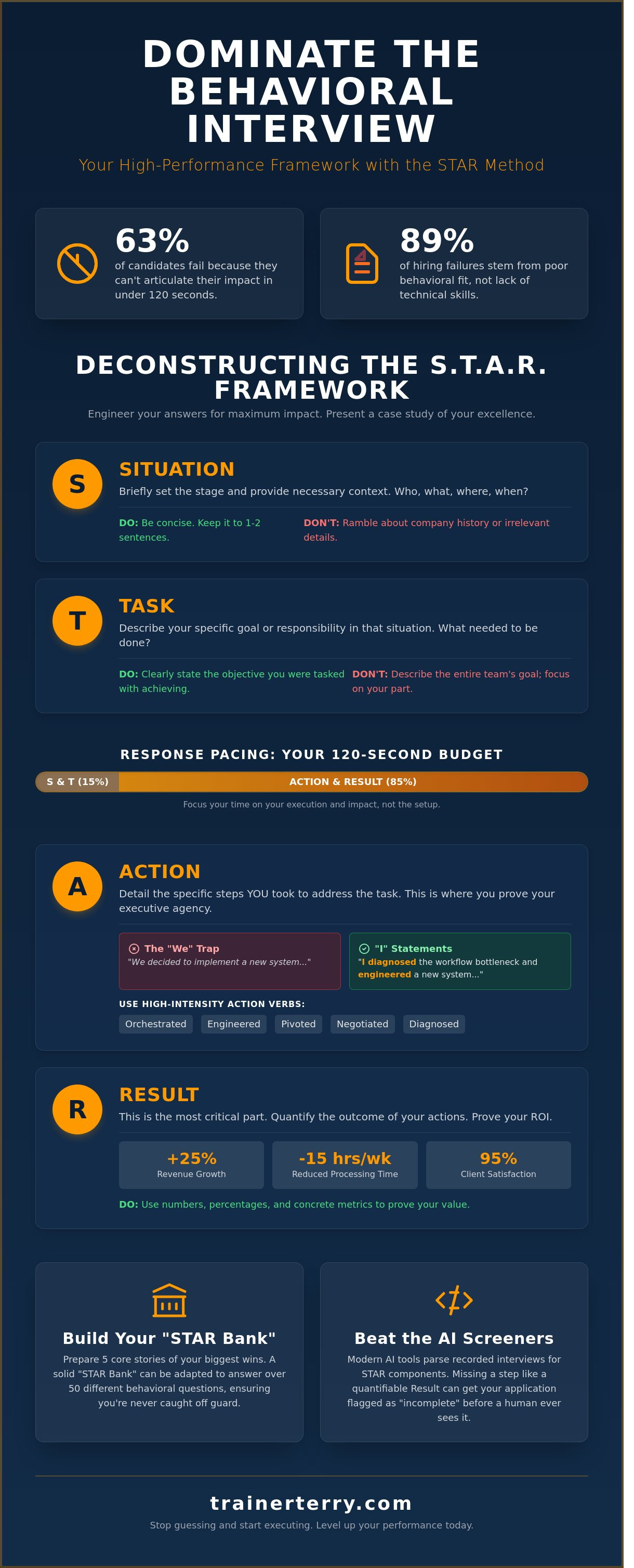
Listen up. In 2026, your resume gets you in the door, but your execution in the room determines your paycheck. The game has changed. Fortune 500 recruiters aren't looking for a list of certifications; they're looking for performance ROI. According to data from LeadershipIQ, 89% of hiring failures stem from poor behavioral fit, not a lack of technical skill. If you show up and try to wing it, you're dead in the water. Rambling is the quickest way to kill your executive presence. You need a strategic anchor to stay focused under pressure. That's where mastering star method interview questions becomes your ultimate competitive advantage.
Recruiters today operate with surgical precision. They use behavioral questions to strip away the fluff and see how you actually behave when the stakes are high. If you can't articulate your value with clarity, they'll move on to someone who can. You aren't just there to answer questions. You're there to prove you can solve their most expensive problems. Without a framework, you're just a person with a history. With the STAR method, you're a high-performance asset with a track record of success.
Defining the STAR Method: Situation, Task, Action, Result
Let's break down the mechanics of this system. The acronym stands for Situation, Task, Action, and Result. It's a four-step process that forces you to be concise and impactful. The STAR method is a tactical framework for evidence-based storytelling that proves you can deliver results under pressure. In 2026, this isn't just for humans. AI screening tools now parse your recorded responses for these specific markers. If you miss a component, the algorithm flags you as "incomplete." The evolution of recruitment means your stories must be tighter and more data-driven than ever before. Don't just tell them you're a leader; show them the blueprint of how you led.
The Psychology of the Behavioral Interview
Recruiters use these questions because of a concept called "Predictive Validity." Psychological research consistently shows that past behavior is the single best predictor of future performance. When an interviewer says, "Tell me about a time," they aren't making small talk. They're testing your grit, your ethics, and your decision-making speed. You must move from being a passive candidate who "was involved" to an active problem-solver who "drove the outcome." If you want to ensure your stories hit the mark every single time, you need to sharpen your delivery. You can level up your performance by booking a 1-on-1 job interview prep session to pressure-test your responses before the big day. Stop guessing and start executing.
Deconstructing the Framework: How to Build High-Impact STAR Responses
Most candidates treat the STAR method like a casual storytelling exercise. That is a mistake. In a high-stakes room, your words are your currency. You need to stop rambling and start engineering your answers for maximum impact. When you approach star method interview questions, you are not just answering a prompt; you are presenting a case study of your own excellence. Keep the Situation and Task lean. Spend exactly 10 percent of your time setting the stage. If you spend three minutes explaining the background, you have already lost the recruiter's attention. Define the problem, state the objective, and pivot immediately to the execution.
The Action Phase: Proving Your Executive Agency
This is where most people stumble into the "We Trap." You might be a team player, but the company is not hiring your team; they are hiring you. Stop saying "we decided" or "we implemented." If you want the role, you must own the moves. Focus on your individual agency. Did you identify the bottleneck? Did you negotiate the deadline? Use high-intensity action verbs that signal leadership. Think words like "orchestrated," "engineered," "pivoted," or "diagnosed."
Avoid ambiguity at all costs. If you say you "helped with a project," you sound like a bystander. Instead, state that you "designed a new workflow that cut processing time by 15 hours per week." Be specific about the tools you used and the logic behind your choices. Show them the mental muscle you used to solve the problem. If you need to refine your delivery, a free strategy call can help you cut the fluff and find your strongest "I" statements.
The Result Phase: Quantifying Your Career ROI
The Result is the only part of the story that truly matters to the bottom line. If you don't provide a number, the recruiter will invent one, and it won't be in your favor. You must quantify your impact with hard data. Use the "Before and After" technique to show transformation. For example, don't just say you improved customer service. Say that you "increased the Net Promoter Score from 65 to 82 within the first two quarters of 2025."
Even in roles that feel unquantifiable, you can find the metrics. Look for time saved, errors reduced, or people trained. If you are moving into a new field, you need to translate these wins into a language your new employer understands. I've built The Career Change Blueprint specifically to help you map these results to a completely different industry. It's about showing that your ability to deliver a 20% efficiency boost is a universal skill that travels with you.
The Terry Touch: The Reflection
End your response with a "Reflection" or "Lesson Learned." This is the secret sauce that separates high-performers from the pack. It shows you have a growth mindset and the maturity to analyze your own performance. Briefly state what that experience taught you and how you applied that lesson to a later challenge. It proves you aren't just a worker; you're a professional who evolves with every rep. Mastering star method interview questions requires this level of self-awareness to truly stand out in the 2026 job market.
25 Essential STAR Method Interview Questions and High-Impact Examples
Stop guessing what the hiring manager wants to hear. You win by being prepared, not by being lucky. Preparing for star method interview questions requires more than just memorizing stories; it requires a strategic breakdown of your professional wins. You need to categorize your experiences into four high-performance buckets: Leadership, Problem Solving, Conflict, and Adaptability. This ensures you aren't caught off guard when the pressure is on.
Leadership and Strategic Decision Making
Leaders don't make excuses. They make calls. When you're asked about an unpopular decision, the interviewer is looking for your backbone. They want to see if you can prioritize the mission over your ego. Consider these examples:
- "Tell me about a time you had to make an unpopular decision."
- "Describe a time you led a team through a significant organizational pivot."
Let's look at the difference between a "Good" and an "Executive-Level" response. A good response might say: "I told the team we had to change our software, and even though they were unhappy, we did it and it worked." That's weak. An executive-level response uses the STAR structure to show dominance: "I identified a 22% inefficiency in our legacy system. I transitioned a 15-member team to a new platform within 30 days. I addressed resistance by holding daily 15-minute alignment sessions, resulting in a 14% revenue increase by Q4."
Conflict Resolution and Emotional Intelligence
Conflict is just data that hasn't been processed yet. Your ability to handle a difficult stakeholder or deliver tough feedback defines your ceiling. If you can't manage people, you can't manage a department. You need to demonstrate that you can stay objective when things get heated.
- "Tell me about a time you dealt with a difficult stakeholder."
- "Describe a situation where you had to give tough feedback to a high-performer."
When you answer these, focus on the resolution and the growth that followed. Don't complain about the person. Talk about the process. If you struggle to find the right words for these high-stakes scenarios, you can get personalized coaching through 1:1 Job Interview Prep to sharpen your delivery. We'll strip away the fluff and focus on the results.
Handling Failure and Career Gaps
When you face star method interview questions about failure, don't blink. Honesty is your greatest weapon. A high-performer admits when they missed the mark, explains the 100% ownership they took, and shows the specific process they built to ensure it never happened again. If you missed a project deadline in 2023, don't blame the vendor. Own the lack of oversight and explain the new triple-check system you implemented.
The same logic applies to career gaps or pivots. Don't hide them. Treat a gap like a deload week in the gym. You weren't "off"; you were recalibrating. Frame your 8-month gap as a deliberate period of skill acquisition or a strategic pivot. Use the STAR method to describe the Situation (the need for change), the Task (re-skilling), the Action (completing 3 certifications), and the Result (bringing a fresh, data-driven perspective to this new role).
Building Your STAR Narrative Bank: Stop Guessing, Start Executing
Stop wasting time memorizing scripts for every possible scenario. You're training for a high-performance career, not a high school play. The secret to mastering star method interview questions isn't volume; it's versatility. I call this the 5-Story Rule. You only need five heavy-hitting narratives to dominate over 50 different behavioral questions. Each story must act as a multi-tool. A single narrative about a missed deadline can demonstrate time management, conflict resolution, and adaptability all at once.
In 2026, recruiters don't want to hear a rehearsed monologue. They want to see how you handle pressure. If you try to prepare 50 individual answers, you'll likely freeze when the pressure hits. Your brain can't process that much data in real-time. Instead, you'll map your five core stories to the specific pain points mentioned in the job description. If the company is struggling with a 15% churn rate, your "Hero Moment" better be about retention and client loyalty.
The Career Narrative Audit
You can't build a bank if you don't know your assets. Start by getting a clear read on your core character strengths and behavioral patterns, which is where assessments from a service like Tilt365 can give you a strategic edge. Then, audit your old resumes. Look past the bullet points and find the friction. Every professional experience has a "Hero Moment" where you shifted the outcome. Cross-reference these moments with Resume Examples 2026 to ensure your stories align with the high-performance standards of the modern market. If a story doesn't show a clear ROI or at least a 10% improvement in efficiency, cut it. Only the strongest narratives survive this audit.
Mastering the Delivery: Tone, Pace, and Confidence
Execution is everything. You can have the best star method interview questions prepared, but if you sound like a machine, you're done. This level of performance delivery is a universal skill, mastered by professionals in all high-stakes environments, from the boardroom to pivotal life events. To see how poise and preparation create a powerful delivery in a different field, visit Rev. Brenda O'Grady Wedding Solemniser & Family Celebrant. Avoid the "Robot Trap" by keeping your delivery conversational. In 2026, asynchronous video interviews are the norm. You have roughly 120 seconds to make an impact before the recruiter moves on. Use the "Tough Love" approach to practice. Record your answers, watch them back, and be your own harshest critic. Look for these three things:
- The Pace: Are you rushing? Slow down to show authority. Professionals don't panic.
- The Tone: Do you sound like a victim of your circumstances or the leader of the solution?
- The Clarity: Can a 10-year-old understand the "Result" part of your story? If it's too complex, it's not effective.
If you're struggling to find the right rhythm, use Office Hours to get live, real-time feedback on your story bank. Don't leave your career to chance. Get the feedback, refine the delivery, and walk into that room knowing you've already won. There are no excuses for poor preparation when the stakes are this high.
Ready to turn your history into a high-performance weapon? Book your 1-on-1 interview prep session today.
Leveling Up: Transitioning from STAR Preparation to the Offer
You've done the heavy lifting. You've mapped out your stories and mastered the star method interview questions that trip up 90% of your competition. But in a 2026 market where AI-driven screening has already eliminated the weak, being "good" isn't enough. You need to be undeniable. The transition from a candidate who answers questions to a professional who commands the room happens the moment you finish your story. Don't just stop talking. Pivot.
Use your "Results" phase as a bridge to an Executive Question. If you just explained how you increased team output by 25%, follow up immediately: "I've seen how that 25% lift transformed our quarterly targets. How does that specific type of scaling fit into your 2026 roadmap?" This moves you from the "interviewee" chair to the "consultant" chair. You aren't just looking for a job; you're looking for a problem to solve. That shift in power is how you secure the high-end offers.
Your STAR stories shouldn't stay locked in a notebook. They are the backbone of your LinkedIn personal brand. Take the "Action" and "Result" components and turn them into featured posts. When 87% of recruiters audit your profile before the first round, seeing documented proof of your 15% revenue growth or your 30% reduction in churn makes the actual interview a formality. You're pre-selling your value before you even say hello.
Finally, use these stories as your ultimate leverage in salary negotiations. When they offer a number, don't just ask for more. Point back to your STAR Results. If you've proven you can save a company $200,000 in operational waste, asking for an extra $25,000 in base salary is a logical business transaction, not a personal favor. Preparation is the only differentiator that matters when the stakes are this high.
From Interview to Internal Advancement
The star method interview questions aren't just for getting in the door. They are the key to your next promotion. If you aren't documenting your wins using the STAR framework every month, you're leaving money on the table during your annual review. Use the Career Advancement Blueprint to structure your long term growth strategy. By tracking your "Results" in real time, your next internal interview becomes an easy win because the data is already there.
Your No-Excuses Next Step
Stop settling for "good enough" performance. You've read the guide, but knowledge without action is just a hobby. The 2026 job market doesn't reward hobbies; it rewards elite execution. If your current interview technique feels shaky, it's time to fix the leaks in your game. Stop guessing and start winning. Schedule a Free Strategy Call right now to audit your stories and sharpen your delivery. The offer you want is on the other side of the work you're avoiding. Let's get after it. No excuses.
Stop Playing Small and Execute Your Career Breakthrough
You've got the 25 high-impact examples and the blueprint to build a narrative bank that sticks. In 2026, the corporate landscape doesn't reward 'trying'; it rewards precision execution. I spent 22 years as a Corporate VP in HR, and I've seen exactly where talented leaders fail. They fail because they rely on luck instead of a proven system. Mastery of star method interview questions is the tactical edge you need to move from being a candidate to becoming a closer. My Career Change Blueprint has been refined over two decades to ensure executive-level placement for those who are ready to level up. You've studied the framework, but knowledge without action is just noise. Success isn't a gift; it's earned through rigorous preparation and elite mentorship. It's time to stop wondering if you're good enough and start proving it in the room. You've done the work to learn the theory. Now, it's time to execute the strategy that wins offers.
Stop guessing and start executing; Book your 1:1 Interview Strategy Session now.
The next level is waiting for you. Go get it.
Frequently Asked Questions
What is the STAR method in simple terms?
The STAR method is a 4 part framework designed to structure your responses to behavioral interview questions. Think of it as a blueprint: Situation, Task, Action, and Result. You spend 10 percent of your time on the setup and 70 percent on your specific actions. This ensures you don't ramble and instead focus on the 1 clear outcome that proves your value.
Can I use the same STAR story for multiple interview questions?
You should have a minimum of 6 unique stories ready for your interview. Using the same example twice makes you look like a one hit wonder with no depth. Recycled stories fail to demonstrate the range of skills 92 percent of recruiters look for in high performance candidates. Prepare a diverse portfolio of wins so you can pivot quickly when the pressure hits.
How long should a STAR method answer be?
Aim for a duration of 90 to 120 seconds per answer. Short, punchy responses keep the interviewer engaged while long winded stories kill the momentum. Break it down: 15 seconds for the situation, 15 for the task, 60 for the action, and 30 for the result. If you talk for more than 3 minutes, you've lost the room and the job.
What if I don’t have a specific example for a STAR question?
You pivot to a Pro-STAR approach by using a closely related experience or describing exactly how you'd handle the scenario based on your 5 years of industry training. Never say "I haven't done that." Instead, bridge the gap by saying, "While I haven't faced that exact 10k deficit, here is how I managed a similar 5k resource shortage in 2024." Be a problem solver, not a spectator.
How do I use the STAR method for a leadership role?
Shift your focus from individual tasks to strategic delegation and team outcomes. When answering star method interview questions for leadership, emphasize how your direction led to a specific 20 percent increase in team productivity or a 15 percent reduction in turnover. Leaders don't just do the work; they design the system that wins. Show them the scoreboard you built.
Is the STAR method still relevant in 2026 with AI interviews?
It's more critical than ever because 78 percent of recruitment platforms in 2026 use AI to parse logic and keywords in your speech. AI algorithms look for the Action and Result nodes to calculate your competency score. If your answer lacks a clear structure, the machine flags you as low clarity. Mastering star method interview questions is how you beat the bot and get to the human.
What is the most common mistake people make with the STAR method?
The biggest failure is spending 60 percent of your time on the Situation instead of the Action. Interviewers don't care about the backstory; they care about what you did to fix the mess. Cut the fluff and get to the Action within the first 30 seconds. If you don't get to the Result with a hard number, your story has no teeth.
How do I quantify results if I don’t work in sales or finance?
You quantify results by measuring time saved, error rates reduced, or stakeholder satisfaction scores. If you streamlined a process, tell them it saved 4 hours of manual labor every week for a team of 10. Use a 1 to 10 scale for feedback or mention a 100 percent deadline completion rate over a 12 month period. Every role has a metric; find yours and own it.

Article by
Terry Jones
Terry Jones is the Founder and Chief Career Strategist of the Career Advancement Blueprint and Executive Coach and Lead Consultant at FireBridge Consulting.
As an ICF Certified Accredited Career Coach and Certified Master Career Services professional, he partners with professionals at all levels, including senior leaders and executives, to navigate career transitions, secure new opportunities, and position themselves for advancement. His approach goes beyond surface level coaching, focusing on how individuals think, communicate, and lead so they can operate with clarity, authority, and strategic intent in high stakes environments.
In his work as an executive coach, Terry engages in high impact advisory conversations that help leaders strengthen decision making, elevate their presence, and align their leadership style with organizational expectations. He is known for helping clients translate their experience into influence, ensuring they are not only seen for what they have done, but trusted for what they are capable of leading next.
With over 20 years of corporate experience, including serving as a Vice President and leading Learning and Development functions for three New York City organizations, Terry brings a deep understanding of how companies evaluate talent, develop leaders, and make promotion decisions. This allows him to bridge the gap between individual ambition and organizational reality.
His insights have reached over 630,000 followers and generated more than 70 million video views, where he shares direct, experience driven guidance that helps professionals think differently and take action.