
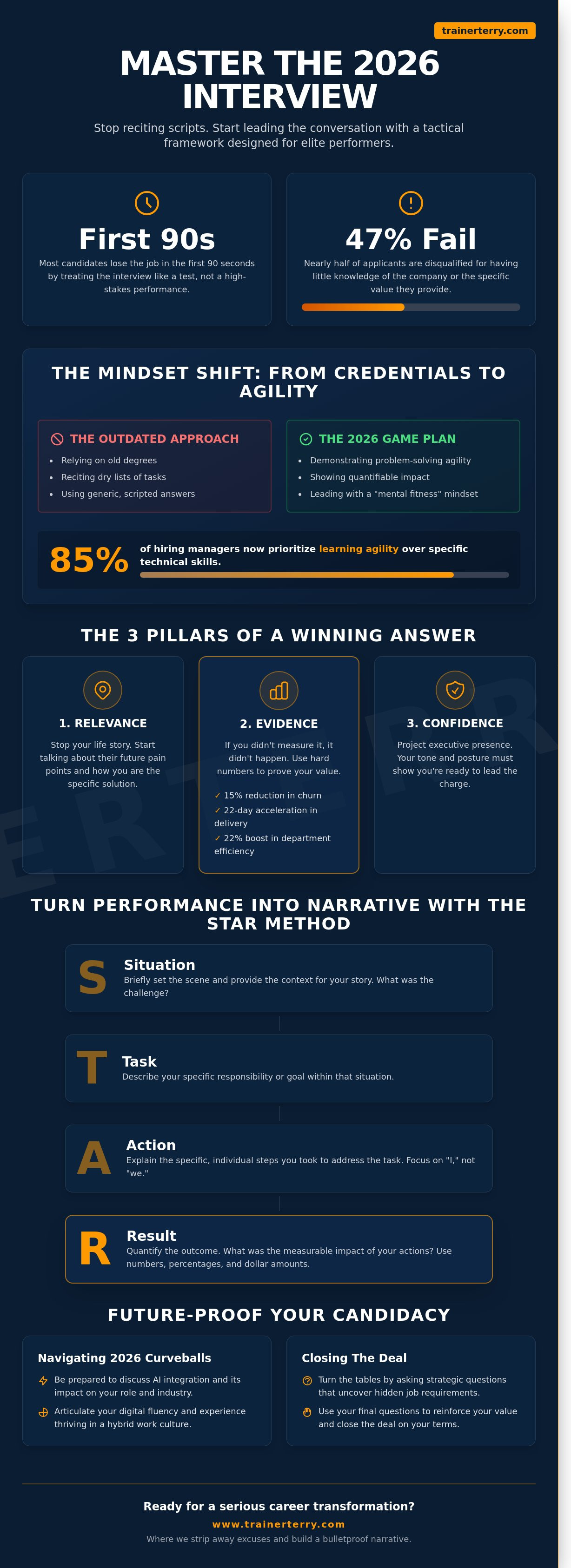
Most candidates lose the job in the first 90 seconds because they treat the meeting like a spelling bee rather than a high-stakes performance. If you're walking into the room hoping to remember a script, you've already lost the mental game. You know that feeling of your heart racing when they ask about your greatest weakness, or the way you ramble for four minutes without actually making a point. It's time to stop the guesswork and start executing a professional game plan. Research indicates that 47% of applicants fail because they have little knowledge of the company or the specific value they provide. Mastering common interview questions isn't about being a parrot; it's about showing up as a problem solver.
You're likely tired of feeling like an imposter while struggling to explain how you boosted department efficiency by 22% at your last firm. I get it. This guide is your training manual to master the strategy behind the conversation so you can stop reciting and start leading. We're going to replace your anxiety with a structured framework that makes you the only logical choice for the team. You'll learn how to quantify your wins and handle 60+ difficult scenarios with the discipline of an elite athlete. Let's dive into the tactical breakdown you need to land that offer letter in 2026.
Key Takeaways
- Stop relying on outdated credentials and learn how to demonstrate the problem-solving agility that 2026 hiring managers actually crave.
- Master the hidden strategy behind common interview questions to move past memorized scripts and position yourself as the only logical hire.
- Apply the STAR method to transform your past performance into a high-impact narrative that proves you’re ready for the next level.
- Future-proof your candidacy by learning to navigate curveball questions about AI integration and digital fluency in a hybrid world.
- Turn the tables at the end of the interview with strategic questions that uncover hidden job requirements and help you close the deal.
What Are Common Interview Questions Really Testing in 2026?
The 2026 job market doesn't care about your 20-year-old degree or a dry list of tasks you performed back in 2015. Recruiters have moved past the "can you do the job" phase. They have AI for basic tasks now. They want to know how you solve problems when the script breaks and the pressure is on. When they hit you with common interview questions, they're running a high-stakes diagnostic on your adaptability and your "mental fitness." A 2025 LinkedIn report revealed that 85% of hiring managers now prioritize learning agility over specific technical stacks.
The traditional job interview has evolved from a simple background check into a psychological assessment of your narrative. Your resume is just the ticket to the stadium. It gets you the meeting, but your story gets you the offer. If you can't articulate how your past wins solve their current $100,000 headaches, you're just another face in the crowd. Every question has a "Hidden Agenda." When they ask "Tell me about yourself," they aren't looking for a biography. They're asking if you're the specific solution to their most urgent problems.
The Three Pillars of a Winning Answer
To dominate the room, you need more than just "good" answers. You need a strategy. First, focus on Relevance. Stop talking about your life story and start talking about their future pain points. Second, bring the Evidence. If you didn't measure it, it didn't happen. Use hard numbers, like a 15% reduction in churn or a 22-day acceleration in project delivery. Finally, project Confidence. This isn't about arrogance; it's about executive presence. Your vocal tone and posture should scream that you've been here before and you're ready to lead the charge.
Why 'Generic' is Your Greatest Enemy
AI has flooded the market with "perfect" sounding candidates who all say the exact same thing. If you use a generic script from a chatbot, you'll sound like a robot, and recruiters can smell that lack of authenticity from a mile away. You must inject your own personality and raw experience into your responses to stand out.
I live by a "No-Fluff" rule: if your answer doesn't include a specific action you took and a measurable result, it's garbage. You're here to level up, not to blend in. For those ready for a serious career transformation, my 1-on-1 job interview prep is where we strip away the excuses and build a bulletproof narrative. When you're answering common interview questions, remember that they're testing your self-awareness and your commitment to progressive growth. They want to see if you have the discipline to identify a gap and close it immediately.
The 'Big Three' Common Interview Questions: Mastering the Essentials
Stop treating the start of your interview like a casual coffee chat. In 2026, hiring managers decide your fate in the first 120 seconds. You need to dominate these three common interview questions to prove you're the elite performer they need. It's about preparation, execution, and zero excuses. If you don't have a strategy for these, you're just hoping for a miracle. We don't hope; we train.
Tell Me About Yourself: The 60-Second Hook
I am a high-performance operations lead who slashes overhead by 22% using AI-driven automation to scale team output without increasing headcount. That's a unique value proposition. It hits hard and fast. Most candidates fall into the autobiography trap, rambling about their 2015 hobbies. Don't be that person. Use the Past-Present-Future formula to keep your narrative tight.
- Past: Mention one major achievement from a previous role that proves your baseline.
- Present: Explain your current mission and the specific "win" you just secured.
- Future: Align your trajectory with the company's 2026 growth targets.
Keep this under 60 seconds. You aren't giving a history lesson; you're selling a solution. If you can't summarize your value in a minute, you don't understand it well enough yet.
The Weakness Question: A Test of Self-Awareness
Saying "I'm a perfectionist" or "I work too hard" is a massive red flag in 2026. It tells the recruiter you're hiding something or lack the self-awareness to grow. High-level mentors want to see coachability. Choose a real technical or soft skill gap that doesn't disqualify you from the core job duties. Maybe your public speaking needed work in early 2025, so you joined a workshop to fix it.
Use the Action-Result loop to prove you're actively closing the gap. This UC Davis guide to interview questions emphasizes using the S.A.R. method to show progress through concrete actions. Show them the "Before" and the "After." It's not about the flaw; it's about the discipline you use to overcome it. That's how you build trust in a high-stakes environment.
Why Should We Hire You? (The Closer)
This is where you close the deal. Don't sound desperate. Don't tell them how much you "need" the job. Tell them why they need you. Map your skills directly to the keywords in their job description. If they mention "agile transformation" three times, your answer needs to focus on your experience leading agile teams to 15% faster delivery cycles.
Demonstrate "Day One" value. Identify a specific problem they're facing and explain how you'll solve it in your first 30 days. Recruiters want to see that you've done your homework on their 2026 strategic goals. If you want to stop guessing and start winning, Book a 1:1 Job Interview Prep session to refine these core answers. Let's get to work and land that offer.
Mastering Behavioral Questions with the STAR Method
Recruiters in 2026 don't care about your hypothetical theories. They want cold, hard evidence. Behavioral questions, those "Tell me about a time when..." prompts, now make up over 70% of common interview questions. The logic is simple: your past performance is the most reliable predictor of your future behavior. If you want the offer, you must stop talking in circles and start delivering data-backed stories. If you couldn't handle a crisis on August 12, 2025, they won't trust you to handle one in 2026.
Success requires a "Story Bank." Don't walk into the room with just one or two anecdotes. You need 5 to 7 versatile professional wins that you can adapt on the fly. You're training for a high-stakes performance, so your preparation must be surgical. Quantify everything. Instead of saying you "improved efficiency," state that you reduced processing time by 22% between Q1 and Q3 of 2025. Numbers build trust where adjectives fail. This is how you turn soft skills into hard, undeniable data.
The STAR Method Blueprint
The STAR method is your tactical framework for answering common interview questions without wasting breath. Follow this structure to keep your answers tight and punchy.
- Situation: Set the context in 20 words or less. Give the specific date, company, or project name to ground the story in reality.
- Task: Define the exact challenge or goal. What was the "impossible" metric you had to hit?
- Action: This is the hero phase. Focus on what YOU did, not the team. Use active verbs like "negotiated," "built," or "executed" to describe your specific steps.
- Result: The "Dollar" phase. Show the impact on the bottom line. Did you save the company $15,000? Did you retain 95% of a high-risk client base?
Common Behavioral Scenarios to Prepare
You'll face questions about conflict, and you can't dodge them. When discussing a coworker clash, focus on emotional intelligence (EQ). Show how you de-escalated a situation to keep a project on track for its November 2025 deadline. When a recruiter asks about failure, don't hide. Describe a specific setback, the immediate pivot you made, and the lesson that prevents it from happening again. This resilience is what separates leaders from followers.
Even if you aren't gunning for a director role, you must demonstrate leadership under pressure. If you're ready to level up your career trajectory, check out the Career Advancement Blueprint. Preparation is the only thing standing between you and the paycheck you deserve. For a full breakdown of the logistics, read my guide on How to Prepare for an Interview in 2026. Don't leave your future to chance. Master the method, own your stories, and go take what's yours.
2026 Curveballs: AI, Hybrid Culture, and Future-Proofing
The hiring market in 2026 doesn't care about your old scripts. You're facing algorithms before you ever see a human face, and the expectations have shifted from "can you do the job" to "can you evolve with the tech." These common interview questions now serve as a filter for your digital fluency and resilience. Stop making excuses about the changing economy. It's time to level up your strategy and show them you're a high-performer who thrives in chaos.
The AI Interviewer: Beating the Bot
In 2026, 65 percent of Fortune 500 companies use asynchronous video platforms like HireVue to screen candidates. You aren't talking to a person; you're talking to an AI that analyzes your micro-expressions and keyword density. To win, you must look directly at the camera lens, not your screen. Use high-impact keywords like "Scalability," "Data-driven," and "Cross-functional collaboration." The bot is looking for patterns of success. Keep your posture rigid and your energy high. If you lack presence here, you'll never get to the human round.
Culture and Values Alignment
The "Culture Fit" mindset is dead. Companies now hunt for "Culture Add." They want to know how your unique background improves their existing team. Research is your best weapon. Check the company’s 2025 Impact Report or their latest LinkedIn "Life" tab to see their actual DEI initiatives. When they ask about diversity, don't give a generic answer. Mention a specific instance where you collaborated with a global team to solve a bottleneck. Prove you're a self-starter who doesn't need a manager hovering over your shoulder in a hybrid setup.
- Research the "Real" Culture: Look for patterns in Glassdoor reviews from the last six months. Ignore the outliers; find the recurring themes.
- DEI with Sincerity: Focus on results. Explain how diverse perspectives led to a 15 percent increase in project efficiency in your last role.
- Hybrid Mastery: Mention the specific tools you use, like Notion or Slack, to maintain a 100 percent accountability rate while working remotely.
When the interviewer asks where you see yourself in five years, don't give a rigid title. In an unstable economy, companies value "Agile Growth." Tell them you plan to master the upcoming AI integrations in your field while leading a team that beats market volatility. Show them you have the discipline to stay the course even when the industry shifts. You aren't just looking for a paycheck; you're looking for a platform to dominate. If you want to refine your delivery and stop leaving your career to chance, book a 1-on-1 interview prep session today and let's get you ready for the big stage.
Closing the Deal: Turning Your Questions into an Offer
You've spent the last 45 minutes defending your record and tackling the common interview questions with precision. Now comes the moment that separates the finalists from the hires. Most candidates relax when the interviewer asks, "Do you have any questions for us?" That's a fatal error. This isn't a formality; it's your final set. If you don't finish strong, you lose the momentum you built. Your questions prove you're not just looking for a job, you're looking for a result. In 2026, companies don't hire for potential; they hire for immediate impact and cultural alignment.
Think of this section as your closing argument. You need to uncover the "hidden" job requirements that weren't in the 300-word job description. Every role has a pain point. Your job is to find it and position yourself as the only logical solution. Transitioning from the interview to salary negotiation starts here. By asking high-level strategic questions, you establish yourself as a peer, not a subordinate. This shift in power dynamics is worth a 15% to 20% bump in your starting offer because you've moved from "applicant" to "consultant."
Top 5 Questions to Ask the Interviewer
- What does success look like in this role 6 months from now? This forces them to give you the exact KPIs they'll use to evaluate you. If they can't answer this, the role is poorly defined.
- How has the company's strategy evolved with the latest industry shifts? Mention a specific 2025 or 2026 market trend. It shows you're already thinking about their bottom line.
- What is the biggest challenge the team is currently facing? This is where they reveal the "fire" they need you to put out.
- How does the team balance rapid execution with long-term technical debt? This shows you care about sustainable growth, not just quick wins.
- Based on our conversation, do you have any hesitations about my fit for this role? It takes guts, but it lets you address objections on the spot before they walk out the door.
The 'No-Excuses' Follow-Up Strategy
The interview doesn't end when you leave the building. You have a 24-hour window to cement your status. Send a personalized, value-add thank you email within one business day. Don't just say "thanks for your time." Reference a specific problem they mentioned and provide a brief, high-level thought on how you'd solve it. This isn't extra work; it's finishing the rep. If you get ghosted for more than 72 hours, send one polite, professional follow-up. After that, move on. Don't chase. Winners always have another lead in the pipeline.
Stop leaving your career to chance. You've learned how to handle common interview questions, but execution is everything. Ready to stop guessing? Schedule a Free Strategy Call to audit your interview game and lock in that offer.
Own the Room and Secure Your 2026 Career Breakthrough
Your career isn't a hobby, so stop treating your preparation like one. The 2026 job market won't reward "good enough" answers. You now have the blueprints for over 60 common interview questions that separate executive leaders from the rest of the pack. Mastering the STAR method is no longer a suggestion; it's a non-negotiable requirement for high-stakes roles. You must prove you can navigate AI integration and hybrid team dynamics with 100% certainty. I've spent 20 years as a Corporate VP in HR watching talented professionals fail because they lacked a cohesive strategy. Don't let that be your story. Use the 3-step closing technique we discussed to turn the final minutes of your meeting into a signed contract. You've got the tools. Now, it's time to execute with discipline and precision.
Stop guessing what recruiters want and start delivering results. I specialize in customized career transition programs for executives who are ready to level up. Ready to Ace Your Next Interview? Schedule Your Free Strategy Call with Trainer Terry Now!
You're closer to that offer than you think. Stand tall, speak with authority, and go get what's yours.
Frequently Asked Questions
What are the top 10 most common interview questions for 2026?
The top 10 common interview questions for 2026 focus heavily on AI literacy and your ability to adapt to rapid tech shifts. Expect queries like "How have you used Generative AI to increase your output by 20%?" or "Describe a time you led a remote team through a pivot." Recruiters now prioritize soft skills 15% more than they did in 2023. You must show you're ready to hit the ground running in a hybrid world.
How do I answer 'Tell me about yourself' without sounding like my resume?
You answer this by focusing on your recent wins and your future impact rather than a chronological history. Use the 30-60-10 rule: spend 30% of your time on your current role, 60% on your biggest achievements, and 10% on why you're the perfect fit. If you boosted department efficiency by 18% last year, lead with that. Your resume is the map, but this answer is the engine that proves you're a high performer.
What is the best way to explain a career gap in a 2026 job interview?
Address the gap directly and highlight the specific skills you mastered during that period. Whether it was a 6 month sabbatical or a 2 year family leave, show the "upskilling" you completed. Data from 2025 shows that 74% of managers hire candidates with gaps if they completed at least one industry certification. Stop making excuses for your time off. Start selling the growth and perspective you gained while you were away from the desk.
How do I use the STAR method if I don't have a lot of work experience?
You apply the STAR method by pulling concrete examples from your university projects, volunteer work, or even competitive sports. Discipline is discipline, regardless of where you practiced it. If you managed a $500 budget for a student club, that's your Situation and Task. Break your answer down into 1 sentence for the setup, 2 for your specific actions, and 1 for the measurable result. This structure keeps your answers tight and professional.
What should I do if I get a common interview question I don't know how to answer?
Take a breath and walk the interviewer through your logical process for finding the solution. Transparency builds trust faster than a fake answer ever will. A 2024 study found that 82% of recruiters prefer a candidate who says "I don't have that exact figure, but here is how I would calculate it" over someone who guesses. It shows you have the mental toughness to handle pressure without crumbling or lying to your team.
How long should my interview answers be?
Keep your answers between 60 and 90 seconds to maintain high energy and keep the recruiter engaged. Long monologues kill the rhythm of the conversation. If you talk for more than 2 minutes, you risk losing 40% of the interviewer's attention span. Use short, punchy sentences to deliver your common interview questions responses. Get to the point, deliver the value, and then stop talking so the interviewer can dig deeper into your success.
Is it okay to bring notes or a 'cheat sheet' to an interview?
You can definitely bring a notebook with 3 to 5 key achievements and specific questions for the employer. It shows you've done your homework and you're serious about the 2026 market. Don't read from it like a script because that kills your charisma. Use it as a tactical reference for hard numbers, like that 12% budget reduction you achieved. It proves you're a professional who values precision over vague guesses.
How do I handle questions about my salary expectations early in the process?
Handle early salary questions by providing a $10,000 range based on the 2025 Glassdoor industry benchmarks for your specific city. Never give a single, static number because you'll lose all your leverage in the final negotiation. Tell them you're looking for a total package that reflects your 5 years of specialized experience. This keeps the door open while showing you know your market value and won't settle for less than you've earned.

Article by
Terry Jones
Terry Jones is the Founder and Chief Career Strategist of the Career Advancement Blueprint and Executive Coach and Lead Consultant at FireBridge Consulting.
As an ICF Certified Accredited Career Coach and Certified Master Career Services professional, he partners with professionals at all levels, including senior leaders and executives, to navigate career transitions, secure new opportunities, and position themselves for advancement. His approach goes beyond surface level coaching, focusing on how individuals think, communicate, and lead so they can operate with clarity, authority, and strategic intent in high stakes environments.
In his work as an executive coach, Terry engages in high impact advisory conversations that help leaders strengthen decision making, elevate their presence, and align their leadership style with organizational expectations. He is known for helping clients translate their experience into influence, ensuring they are not only seen for what they have done, but trusted for what they are capable of leading next.
With over 20 years of corporate experience, including serving as a Vice President and leading Learning and Development functions for three New York City organizations, Terry brings a deep understanding of how companies evaluate talent, develop leaders, and make promotion decisions. This allows him to bridge the gap between individual ambition and organizational reality.
His insights have reached over 630,000 followers and generated more than 70 million video views, where he shares direct, experience driven guidance that helps professionals think differently and take action.