Executive Career Coach: Getting Unstuck and Mastering Your Positioning in 2026

You’ve built a successful career through sheer force of will and a playbook that always worked. Until now. Suddenly, you're a high-performing executive in New York City, earning well over $200k, and you’re stuck. That confidence that powered your rise has been replaced by a quiet, nagging uncertainty.
Let’s be clear: you don’t have a talent problem. You have a positioning problem. In the brutal 2026 NYC market, your old playbook is obsolete. It’s time to discover how to regain your executive confidence, break through this career plateau, and master the high-stakes positioning required to win.
Why High-Performers Get Stuck in the New York Executive Market
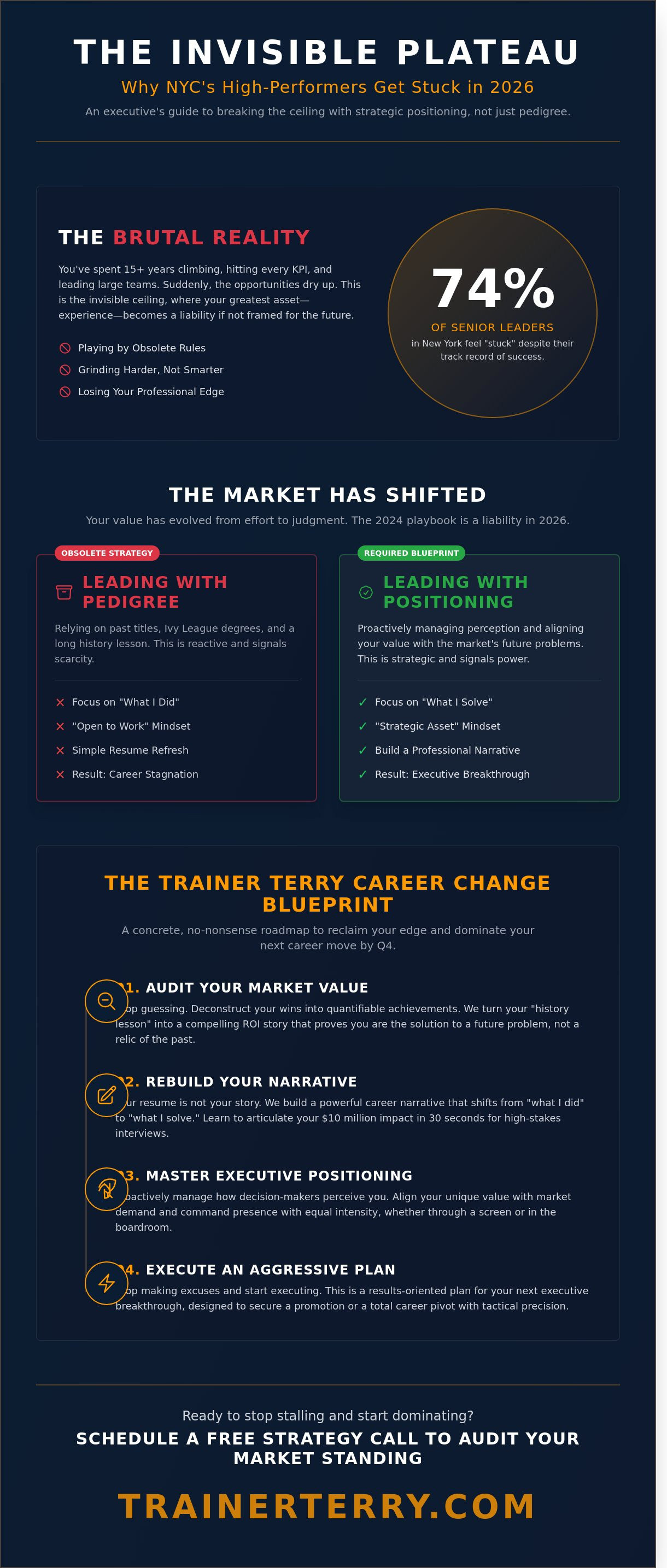
You’ve hit the "Invisible Plateau." It’s that baffling point where two decades of experience and a track record of success suddenly feel like a liability instead of an asset. The game has changed. In the 2026 New York City reality, the market is defined by ruthless competition and a decisive shift toward Positioning over Pedigree.
The difference between the executive who stalls and the one who soars is simple: one is still "working hard," while the other is "navigating strategically." You’ve reached a career inflection point where your judgment, narrative, and strategic presence outweigh sheer effort. Continuing to grind without a new map won't get you unstuck—it will only get you more tired.
[Image: A stylized graph showing a career plateau followed by a sharp upward trajectory, representing getting "unstuck".]
The Psychology of the Executive Plateau
Why does a leader who has managed multimillion-dollar P&Ls suddenly lose confidence? Because the rules they mastered no longer apply. Your traditional playbook has stopped working, and the uncertainty creates cracks in your professional identity.
This is where a dangerous mindset shift occurs. You move from being a "Strategic Asset"—a high-value problem solver—to having an "Open to Work" mindset, which signals desperation. You need an objective, expert perspective. This is where tough-love coaching comes in. It’s not about cheerleading; it’s about a strategic partner identifying the blind spots your peers and colleagues are too polite to mention. While a strategic partner is crucial, some leaders find that rebuilding confidence also requires addressing the underlying mindset. Practices like Keyzer Coaching integrate coaching with counseling and hypnotherapy to help individuals regain balance and overcome these mental blocks.
New York City Market Dynamics in 2026
New York is not a forgiving market. The pace is faster, the stakes are higher, and the expectations are more demanding. The rise of AI and complex remote-hybrid models has fundamentally altered C-suite expectations. They don’t just want a manager; they want a strategic leader who can navigate ambiguity with a clear vision.
This requires a more aggressive and concise career narrative than in any other market. Your ability to project Executive Presence—a potent mix of confidence, communication, and strategic clarity—is what secures seven-figure budgets and high-ticket promotions. Without it, you’re just another qualified candidate in a sea of thousands.
The Science of Executive Positioning: Beyond the Resume
Let's get one thing straight: updating your resume is not a strategy. It's a task. It's a quick fix that will fail every time if it isn't backed by a robust positioning strategy.
Executive Positioning is the proactive management of how you are perceived and evaluated by decision-makers. It is the strategic alignment of your proven value, your career narrative, and the specific demands of the 2026 market. When you achieve this clarity, your executive confidence doesn't just return—it becomes unbreakable because it’s founded on a clear, defensible strategy. This is the core of what a true career strategist provides.
[Image: A simple, elegant Venn diagram showing three overlapping circles: "Your Value," "Your Narrative," and "Market Demand." The intersection is labeled "Powerful Executive Positioning."]
Developing Your Career Narrative
Your resume is likely a list of duties. A chronology of what you did. This needs to stop. Decision-makers don't care about your responsibilities; they care about the results you delivered. You must pivot from a list of duties to a story of proven ROI.
The most powerful tool for this is the STAR method (Situation, Task, Action, Result). It’s not just for interviews; it’s the architecture for your entire career story. By anchoring your narrative in measurable corporate wins—revenue generated, costs saved, markets captured—you position yourself for the role you want, not the one you currently have.
LinkedIn as a Positioning Tool
In 2026, your LinkedIn profile is not an online resume. It's a digital broadcast of your executive brand. Optimizing it for algorithms and executive recruiters is non-negotiable. But the real power lies in shifting your approach.
Stop "active searching," which can look needy. Start practicing "strategic attraction." This is where your profile, content, and engagement work together to pull senior-level opportunities to you. It frames you as a sought-after expert, not just another applicant.
Evaluating an Executive Career Coach in New York: A Buyer’s Framework
Not all coaching is created equal. You wouldn't hire a general practitioner to perform heart surgery, so why hire a generic resume writer for a high-stakes executive career move? You need to differentiate between "Transactional Resume Writers" and "Strategic Career Architects."
A transactional coach polishes a document. A strategic architect—a true executive career coach—builds a blueprint for your next five years. This is why it's critical to partner with a coach who has real-world corporate VP experience. They haven't just read the book; they've lived the reality. In a 2026 coaching contract, look for a focus on ROI, a structured process, and mutual accountability. You're past the point of needing generic encouragement. You need direct feedback and a "tough love" approach that respects your time and ambition.
Strategic vs. Transactional Coaching
| Feature | Transactional Coaching (Resume Writers) | Strategic Coaching (Career Architects) |
|---|---|---|
| Primary Focus | The document (resume, cover letter) | The person and the path (strategy, narrative, confidence) |
| Goal | A one-time deliverable | A long-term career trajectory shift |
| Process | One-off sessions, editing | A structured "Career Change Blueprint" |
| Support Model | Rigid hourly billing | Flexible access (e.g., Office Hours) for real-time pivots |
The New York Specialty
An executive career coach without deep NYC market knowledge is navigating blind. Local intelligence is crucial for everything from tapping into the hidden job market to benchmarking and winning high-stakes salary negotiations. When evaluating a coach, assess their ability to handle C-suite-level interview prep. Can they pressure-test your narrative and prepare you for the boardroom?
The only way to know is to test the fit. Schedule a Free Strategy Call and see if the approach is strategic enough for your ambitions.
Rebuilding Your Confidence and Narrative for a 2026 Pivot
Getting unstuck is an active process. It requires a clear, disciplined plan to rebuild your confidence from a foundation of strategic truth.
- Step 1: Audit Your Value. Conduct a ruthless audit of your current "Market Value" versus your "Internal Perception." Where are the gaps? What skills are truly in demand?
- Step 2: Deconstruct Your Wins. Use the STAR method to deconstruct your five biggest career wins into powerful, interview-ready stories. Quantify everything.
- Step 3: Rebrand Your Digital Presence. Overhaul your LinkedIn and other professional profiles to reflect the 2026 leadership standards of your target role, not your past one.
- Step 4: Execute Your Campaign. Launch a "Stealth Search" (if external) or an "Internal Advancement" campaign (if internal) with precision and a clear message.
Mastering the STAR Method for Interviews
The STAR method is how you turn complex corporate challenges into the clear, high-impact stories that hiring committees remember. It’s the antidote to rambling, unfocused answers. For an executive, the "Result" is everything. It must be directly tied to a crucial business metric: revenue growth, cost efficiency, market share, or cultural transformation.
This isn't just about answering questions; it's about controlling the narrative and proving your value. For a deeper dive, dedicated 1-on-1 Job Interview Prep can transform your ability to perform under pressure.
[Image: A close-up of a whiteboard with the STAR method (Situation, Task, Action, Result) diagrammed out with executive-level examples.]
The "Unstuck" Mindset Shift
The most profound shift you must make is moving from "asking for a job" to "offering a solution." You are not a supplicant. You are a strategic partner proposing a solution to a CEO's or a board's most pressing problem.
This mindset is the ultimate cure for the imposter syndrome that often hits successful mid-career executives. When you operate from a position of offering clear, quantifiable value, the fear disappears. A structured "Career Advancement Blueprint" provides the certainty and process to make this mindset your default.
Breaking Through with the Trainer Terry Career Change Blueprint
If you’re a stuck NYC executive, you don't need more generic advice. You need a system. The Career Change Blueprint is the definitive, no-excuses solution designed specifically for this challenge.
My approach combines 20+ years of my own corporate VP experience with an aggressive, modern career strategy. The program is engineered to address the specific pain points of stuck leaders by forcing a structured rebranding of your value, narrative, and market position. It’s time to stop settling for a plateau and start your level-up journey.
What’s Inside the Blueprint?
- A High-Impact Arsenal: A comprehensive resume and LinkedIn strategy that is designed to get noticed by decision-makers, not just HR software.
- Compensation Mastery: Salary negotiation tactics that ensure your offer reflects your true 2026 market value in the competitive New York landscape.
- Real-Time Strategic Support: Direct access to Office Hours to handle curveballs, evaluate offers, and make strategic pivots without losing momentum.
The Trainer Terry Difference
There is no fluff here. No excuses. Just results-driven mentorship for the New York elite. My clients have used this system to secure $50k+ salary bumps, land C-suite titles, and regain the momentum they thought they had lost for good.
Your track record got you here. A new strategy is required to get you there.
Ready to get unstuck? Apply for the Career Advancement Blueprint and let's build your next chapter.
Frequently Asked Questions
What is the difference between a career coach and an executive coach in New York? A general career coach may help with broad career exploration. An executive career coach specializes in the unique challenges of senior leaders ($200k+), focusing on high-stakes issues like strategic positioning, executive presence, C-suite communication, and navigating complex corporate politics, especially within the hyper-competitive New York market.
How do I know if I actually need an executive career coach or just a new resume? If you are getting interviews for the right roles but not offers, you might just need interview prep. But if you feel stuck, lack clarity on your next move, are struggling to articulate your value at a senior level, or feel your confidence has waned, you have a positioning problem. A new resume won't fix that; you need a comprehensive strategy, which is what an executive coach provides.
Can an executive career coach help me get unstuck if I want to change industries? Absolutely. This is a core function. An executive coach helps you translate your existing skills and accomplishments into the language of the new industry, building a "bridge" narrative that makes your pivot logical and compelling to hiring managers.
How much does high-level executive career coaching cost in New York City? High-level executive coaching in NYC is a significant investment, often ranging from several thousand to over $15,000 for comprehensive programs. The cost reflects the coach's expertise, the depth of the program, and the potential ROI—which can include $50k+ increases in salary and accelerated career progression.
How long does it typically take to see results from an executive positioning strategy? Clients often feel a renewed sense of clarity and confidence within the first 2-3 weeks. Tangible market results, like increased recruiter outreach and high-level interviews, typically follow within 60-90 days of implementing the new positioning strategy across your resume, LinkedIn, and networking efforts.
What happens if I’m still stuck after a few coaching sessions? A structured coaching program, like a blueprint, is designed to prevent this. It’s not a series of disconnected chats. If progress stalls, the framework allows us to diagnose the issue precisely—is it the narrative, the targeting, the interview skills? We then adjust the strategy with data, not guesswork.
Is executive coaching effective for internal promotions, or only for job changes? It is highly effective for internal promotions. Getting promoted at the executive level requires more than just good performance. A coach helps you build a powerful internal brand, increase your visibility with key stakeholders, and strategically position yourself for the next-level role long before it even becomes available.
How does the STAR method apply to senior leadership interviews in 2026? For senior leaders, the STAR method is less about task execution and more about strategic impact. The "Situation" should be a complex business challenge. The "Action" should focus on your leadership, strategy, and decision-making. The "Result" must be a significant, quantified business outcome (e.g., "grew market share by 15%" or "reduced operating costs by $3M"). For more on this, explore these strategic guides to high-stakes career growth.

Article by
Terry Jones
Terry Jones is the Founder and Chief Career Strategist of the Career Advancement Blueprint and Executive Coach and Lead Consultant at FireBridge Consulting.
As an ICF Certified Accredited Career Coach and Certified Master Career Services professional, he partners with professionals at all levels, including senior leaders and executives, to navigate career transitions, secure new opportunities, and position themselves for advancement. His approach goes beyond surface level coaching, focusing on how individuals think, communicate, and lead so they can operate with clarity, authority, and strategic intent in high stakes environments.
In his work as an executive coach, Terry engages in high impact advisory conversations that help leaders strengthen decision making, elevate their presence, and align their leadership style with organizational expectations. He is known for helping clients translate their experience into influence, ensuring they are not only seen for what they have done, but trusted for what they are capable of leading next.
With over 20 years of corporate experience, including serving as a Vice President and leading Learning and Development functions for three New York City organizations, Terry brings a deep understanding of how companies evaluate talent, develop leaders, and make promotion decisions. This allows him to bridge the gap between individual ambition and organizational reality.
His insights have reached over 630,000 followers and generated more than 70 million video views, where he shares direct, experience driven guidance that helps professionals think differently and take action.