Leadership Team Development Plan Template: The 2026 Strategic Playbook

Stop treating your C-suite like a group of administrators and start treating them like the elite tactical unit they're supposed to be. If your current leadership team development plan template looks like a generic HR checklist, it's probably gathering digital dust while your executives retreat into their own silos. A 2024 industry report found that 72% of senior leaders ignore their development plans because the content feels irrelevant to high-stakes decision-making. You don't need more "professional development" fluff; you need a playbook that forces synergy and demands measurable ROI.
You've likely felt the frustration of watching brilliant individuals fail to move the needle because they aren't aligned on the same goal. It's a waste of talent and a drain on your bottom line. Let's build a 2026-ready strategic playbook that turns that friction into executive power. We'll explore the exact accountability structures and decision-making frameworks you need to see a 30% improvement in team alignment by the end of the next fiscal year.
Key Takeaways
- Identify the non-negotiable core competencies needed to bridge the "Capability Chasm" and turn individual stars into a cohesive executive force.
- Learn how to build a leadership team development plan template that maps every growth objective directly to your 2026 business ROI.
- Execute a high-stakes "Executive Audit" to uncover the specific friction points and silos that are currently stalling your team's decision-making.
- Establish a "North Star" alignment strategy that ensures every leader is pulling in the same direction with clear, measurable accountability.
- Discover why a document is only the starting line and how strategic coaching turns a static plan into a high-performance reality.
What is a Leadership Team Development Plan (and Why Most Fail)?
Stop thinking of your development plan as a dusty PDF or a checklist for HR. A true leadership team development plan template is a high-stakes tactical asset. It's the difference between a group of talented individuals and a unified executive force that actually wins. Most organizations fail here because they treat leadership as an individual sport. They send executives to isolated seminars and wonder why the boardroom still feels like a collection of disconnected silos. To fix this, you need a deep understanding of leadership development that prioritizes collective movement over solo performance.
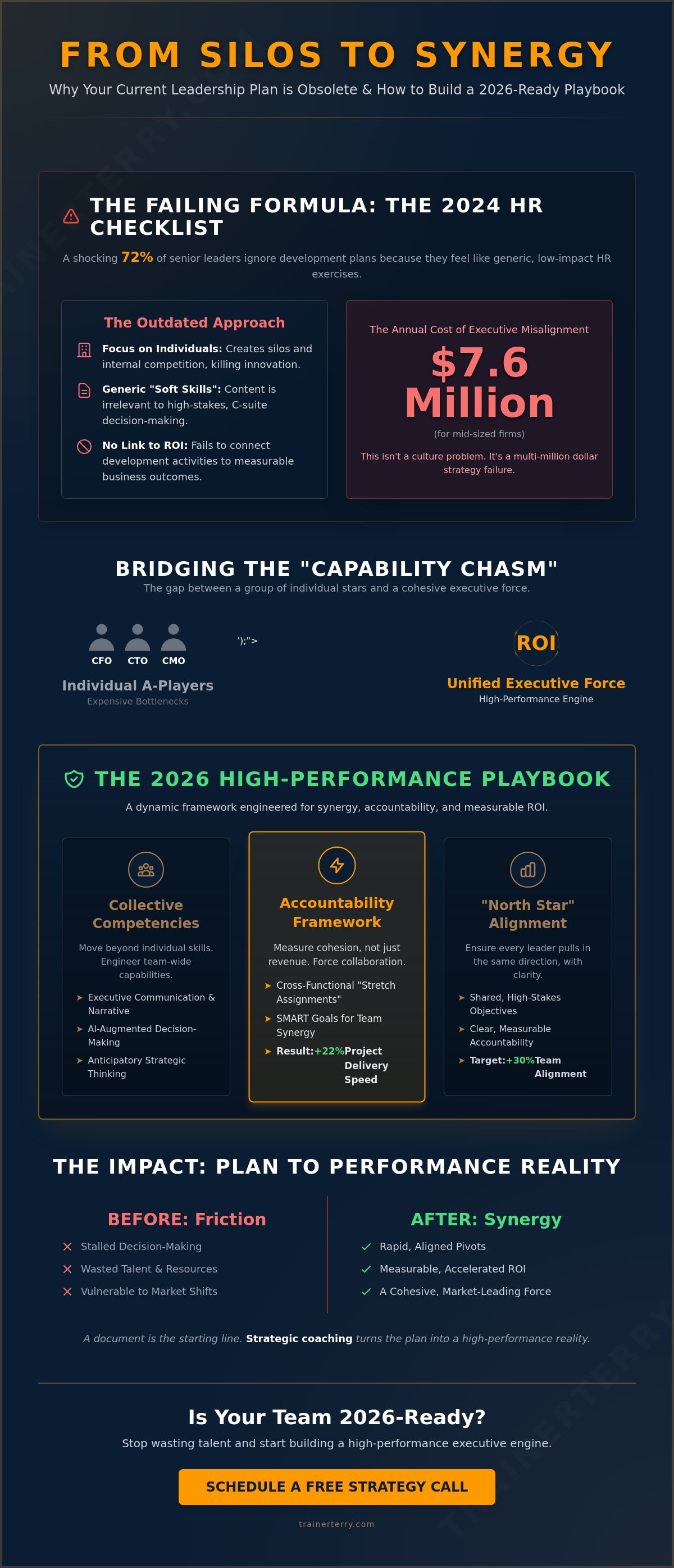
The "Capability Chasm" is where most growth dies. You might have five "A-players" in your C-suite, but if they aren't aligned, they're just expensive bottlenecks. By 2026, the old hierarchical management style is dead. We're moving toward leadership networks where speed and synergy are the only currencies that matter. You don't need a static document that sits in a drawer; you need a dynamic playbook that evolves as fast as the market does. If your plan doesn't force your leaders to sweat together, it isn't a plan. It's a suggestion.
The High-Performance Gap in 2026
Why do senior VPs roll their eyes at traditional HR templates? Because those forms don't account for the 2026 reality. A 2024 study showed that 68% of executive teams feel unprepared for the pace of AI disruption. Generic templates focus on "soft skills" without linking them to hard ROI. In a high-stakes environment, the cost of executive misalignment can reach $7.6 million annually for mid-sized firms. You can't afford to play it safe with outdated growth roadmaps. Your team needs to master rapid pivot strategies and AI-augmented decision-making right now, or they'll be left behind by more agile competitors.
From Individual Talent to Team Synergy
Your top performers are often your biggest problem. When a leader relies solely on their individual "Executive Presence," they stop listening and start defending their turf. This creates a silo effect that kills innovation. Collective accountability means the entire team owns the win and the loss. If the CFO doesn't understand the CMO's growth hurdles, your leadership team development plan template has already failed. True synergy happens when you stop rewarding "my department" and start measuring "our impact." It's time to stop making excuses for brilliant but isolated leaders and start building a cohesive board that operates as one unit.
The Anatomy of a High-Performance Team Development Template
Building a high-performance executive team isn't about filling seats with the loudest voices in the room. It's about engineering a machine where every part works in sync. A generic leadership team development plan template often fails because it treats leaders like isolated silos. To win in 2026, your template must be the skeleton of your team's success, focusing on the collective engine rather than just individual pistons. You need a structure that demands synergy and leaves no room for ego-driven bottlenecks. If you aren't sure where your team stands, it's time to schedule a free strategy call to audit your current leadership bench.
Defining Collective Competencies
Stop settling for "good communication" as a requirement. In the 2026 playbook, we demand Executive Communication and Narrative. This means your team doesn't just talk; they align the entire company's story through every interaction. You must map individual strengths to team-wide gaps. If your CTO is a technical genius but lacks "Executive Presence," the team plan must bridge that gap through peer-led coaching. At this level, Strategic Thinking is no longer an individual skill; it's the team's collective ability to anticipate market shifts 18 months before they appear on a balance sheet. This isn't optional. It's the price of entry.
The Accountability Framework
Revenue targets are easy, but measuring cohesion is the heavy lifting. Use SMART goals to track how often your leaders collaborate across departments. A 2025 analysis of Fortune 500 leadership groups found that teams using cross-functional "Stretch Assignments" saw a 22% increase in project delivery speed. These assignments force your VP of Sales and VP of Product to own the same outcome. You should also encourage your leaders to learn how to use LinkedIn to showcase the team's unified thought leadership, proving to the market that your executive board is a singular, powerful voice.
Communication protocols must be non-negotiable. High-stakes interactions require a standard that prevents "meeting after the meeting" culture. This is supported by a comprehensive succession management strategy, which ensures your next generation of leaders is already operating within these protocols. Finally, implement a feedback loop that uses 360-degree reviews to drive actual behavior change, not just to collect data. If a review doesn't result in a tactical pivot, you're just wasting time. Your leadership team development plan template must turn these insights into immediate action items that the entire board can see and track.
Choosing Your Framework: Individual Growth vs. Team Synergy
Egos kill progress. It's that simple. You can have the most expensive talent in the industry, but if they're operating as "Siloed Leaders," you're just paying for a high-speed collision. To move the needle in 2026, you must decide between a collection of individual stars and a Cohesive Executive Board. A 2024 analysis of underperforming C-suites showed that siloed leadership teams lose up to 20% in operational efficiency due to internal friction and redundant communication. Your leadership team development plan template should be the filter that separates the solo performers from the team players. Getting buy-in from "Alpha Leaders" is the first hurdle; they don't want "training," they want optimization. Show them how synergy increases their personal impact, and the resistance vanishes.
This is where an executive career coach becomes your most valuable player. They act as the objective referee who calls out the ego-driven bottlenecks that internal HR teams are often too afraid to mention. By mediating between individual ambitions and team requirements, a coach ensures that the growth framework actually sticks. You aren't just filling out forms; you're re-engineering how your top tier thinks and acts under pressure.
The Individual Leadership Plan (ILP) for VPs
Every VP has a blind spot. Data from early 2025 suggests that 45% of senior leaders overestimate their emotional intelligence and its impact on team morale. The ILP isn't about remedial work; it's about sharpening the blade. Focus on executive presence and personal brand positioning to ensure your leaders command respect without demanding it. When creating a successful leadership development plan at the individual level, you must target the specific gaps that prevent a leader from ascending. Integrating a structured tool like the Career Advancement Blueprint allows VPs to own their growth while aligning their personal trajectory with the company's 2026 milestones.
The Team Playbook for Executive Synergy
Synergy isn't a "soft" concept. It's a hard requirement for rapid decision-making. Your team playbook needs to establish clear conflict resolution protocols that prevent professional disagreements from turning into personal vendettas. You're building a "Leadership Narrative" that the entire organization can follow with absolute clarity. This requires a "Tough Love" approach. If a senior leader refuses to align with the team's collective goals, they're a liability to the 2026 roadmap. There are no excuses for failing to collaborate when the stakes are this high. A high-performance leadership team development plan template must demand absolute accountability from every member of the board, ensuring the win belongs to everyone.
Step-by-Step: Implementing Your Leadership Team Plan in 2026
Execution is where most strategies go to die. You've built the framework, but now you have to move the heavy weight. Implementing a leadership team development plan template isn't a one-time event; it's a series of tactical sprints designed to build collective muscle. A 2024 analysis showed that 85% of executive teams fail to meet their primary strategic goals because they lack a concrete implementation roadmap. We're going to change that. Your implementation starts with an Executive Audit to expose the friction points that are currently slowing you down. Don't guess where the problems are. Audit the data and find the truth.
Once the audit is complete, you must define your "North Star." This is the single strategic vision that every leader on the board must own without reservation. If there's any hesitation, the plan will fail before it starts. After alignment, you move into the deployment phase with clear timelines and monthly milestones. If you're ready to stop talking and start executing, join my next Office Hours session to troubleshoot your team's specific hurdles in real time.
Using the STAR Method for Team Performance
We don't just use the STAR method for acing interviews; we use it as a high-performance reporting tool. In the context of team roadblocks, "Situation" defines the specific market pressure your board is facing, while "Task" identifies the exact hurdle stopping the executive engine. This structure removes the fluff from boardroom updates and forces a focus on action. To prove the ROI of your development plan, you must document "Results" with hard numbers. A 2025 pilot program involving mid-market tech firms showed that teams using STAR for internal reporting reduced meeting times by 15% while increasing decision-making clarity by nearly 25%.
Establishing the Executive Feedback Loop
Radical Candor is the secret weapon of every high-performing team I've ever coached. If your leaders can't tell each other the truth without it becoming a personal battle, your 2026 roadmap is already in trouble. You need a dedicated space for this. Setting up regular Office Hours allows for real-time troubleshooting before small issues turn into executive stalemates. What about the "uncoachable" leaders? If a senior VP refuses to engage with the feedback loop, they're a liability to the entire organization. In a high-performance environment, there's no room for people who aren't willing to grow. You either step up or you step out.
Beyond the Template: Scaling Leadership with Strategic Coaching
You've downloaded the leadership team development plan template and filled in the blanks. Now comes the part where most executives fail: the execution. A template is only 10% of the battle. It's the blueprint, not the building. If you think a document alone will fix your team's communication silos or decision-making bottlenecks, you're setting yourself up for a massive disappointment. By 2026, the market won't care about your plans; it will only care about your results. A plan without a relentless focus on implementation is just a hallucination. You have to move the weight every single day if you want to see a real transformation in your boardroom.
Strategic coaching is the catalyst that turns a static document into a high-performance engine. It's about breaking the executive stalemates that cost your company time and money. When your leaders are stuck in a cycle of "polite disagreement" that leads nowhere, you need a mentor who isn't afraid to call out the BS. We're moving beyond simple development and into the territory of legacy strategy. This is where you decide if your team will be a footnote or a force of nature in the coming years.
The Executive Advisor Advantage
You can't audit your own ego. It's impossible to see your own blind spots when you're standing in the middle of them. That's why an outside perspective is vital for any team that wants to play at the elite level. I leverage more than 20 years of VP-level experience to identify the friction points that internal HR teams often miss. We don't do "feel-good" exercises; we do results-driven alignment. If you're ready to stop the circular arguments and start driving measurable ROI, schedule a free strategy call today. Let's get a custom audit of your team's dynamics and see where the real leaks are.
Building a Culture of Continuous Leveling Up
The work doesn't end once the initial leadership team development plan template is complete. In fact, that's just the warm-up. To sustain momentum, you must build a culture where "good enough" is considered a failure. This commitment to excellence is the foundation of the best career advice for 2026. Your leaders need to be in a state of constant progress, always looking for the next breakthrough. There are no excuses for stagnation in a high-stakes environment. You either commit to the "No Excuses" approach to executive excellence, or you watch your competitors take your market share. Level up your team now, or get left behind. The choice is yours.
Dominate the 2026 Market with Executive Synergy
You've got the roadmap. Now you have to decide if you're actually going to move the weight. A high-performance leadership team development plan template is just a piece of paper until you inject it with radical accountability and tactical drills. We've already established that executive misalignment can drain millions from a company's bottom line annually. You can't afford to let your VPs operate in silos while the market shifts beneath your feet. It's time to bridge the gap between individual talent and collective power using the STAR method and a "No Excuses" mindset.
Stop settling for mediocre boardroom dynamics. If you're ready to align your team and drive measurable results, Schedule a Free Strategy Call with Terry today. Benefit from 20+ years of high-stakes leadership experience and a specialized focus on Executive Presence. I'll help you turn that template into a living legacy strategy that wins. The 2026 roadmap is waiting. Let's get to work and prove what your leadership is truly capable of achieving together.
Frequently Asked Questions
What should be included in a leadership team development plan template?
A high-performance leadership team development plan template must include core collective competencies, cross-functional accountability metrics, and specific communication protocols. Don't just list skills; define the "Executive Narrative" and the "North Star" goals that bind the team together. You also need a section for succession readiness to ensure your 2026 roadmap doesn't depend on a single individual's presence.
How do I measure the ROI of a leadership development plan in 2026?
Measure ROI by tracking your "Decision Velocity Index" and the reduction in cross-departmental friction costs. A 2025 study showed that aligned teams reduce project delivery delays by 22% compared to siloed groups. If your leadership team is making 15% faster decisions on high-stakes pivots than they were six months ago, that's a direct win for your bottom line.
How often should a leadership team update their development plan?
Update your strategic playbook at least every 90 days to stay ahead of market shifts. While the "North Star" remains stable, the tactical drills and deployment milestones need monthly refinement during your regular troubleshooting sessions. Waiting for an annual review is a recipe for stagnation in a high-speed, AI-driven market where agility is your only real currency.
What is the difference between an individual and a team leadership plan?
Individual plans focus on personal "Executive Presence" and specific blind spots, while team plans focus on collective synergy and conflict resolution. Think of it like this: an individual plan sharpens the blade, but the team plan ensures all blades are swinging in the same direction. You need both to build a cohesive executive board that actually moves the needle.
How do I get senior VPs to take development plans seriously?
Tie the development plan directly to their personal impact and the team's measurable success. Senior VPs ignore generic HR forms because they feel like busywork. Show them how the leadership team development plan template removes the specific bottlenecks that prevent them from hitting their departmental targets. Once they see it as a tool for winning, they'll stop making excuses.
Can the STAR method be used for leadership team training?
Yes, the STAR method is a powerful tool for structured reporting and practicing high-stakes scenario drills. It forces leaders to strip away the fluff and focus on the Situation, Task, Action, and Result. Using this framework in training ensures that everyone on the board communicates with the same tactical precision, leaving no room for misunderstanding during a crisis.
What are the most common mistakes in leadership team development?
The biggest mistake is treating development as a one-time event rather than a continuous leveling up process. Many teams also fail by using generic templates that don't address the specific "Capability Chasm" within their own C-suite. If there's no "tough love" and no real accountability for behavior change, the plan is just a digital paperweight gathering dust.
Is a leadership development plan necessary for small executive teams?
Leadership plans are arguably more critical for small teams because each individual's misalignment has a higher percentage-based impact on the company. In a three-person executive board, one siloed leader represents 33% of your strategic power being wasted. Small teams need tighter alignment to compete with larger, more resource-heavy organizations that have more room for error.

Article by
Terry Jones
Terry Jones is the Founder and Chief Career Strategist of the Career Advancement Blueprint and Executive Coach and Lead Consultant at FireBridge Consulting.
As an ICF Certified Accredited Career Coach and Certified Master Career Services professional, he partners with professionals at all levels, including senior leaders and executives, to navigate career transitions, secure new opportunities, and position themselves for advancement. His approach goes beyond surface level coaching, focusing on how individuals think, communicate, and lead so they can operate with clarity, authority, and strategic intent in high stakes environments.
In his work as an executive coach, Terry engages in high impact advisory conversations that help leaders strengthen decision making, elevate their presence, and align their leadership style with organizational expectations. He is known for helping clients translate their experience into influence, ensuring they are not only seen for what they have done, but trusted for what they are capable of leading next.
With over 20 years of corporate experience, including serving as a Vice President and leading Learning and Development functions for three New York City organizations, Terry brings a deep understanding of how companies evaluate talent, develop leaders, and make promotion decisions. This allows him to bridge the gap between individual ambition and organizational reality.
His insights have reached over 630,000 followers and generated more than 70 million video views, where he shares direct, experience driven guidance that helps professionals think differently and take action.