Career Path Advice for Marketing Professionals: Navigating the 2026 Landscape

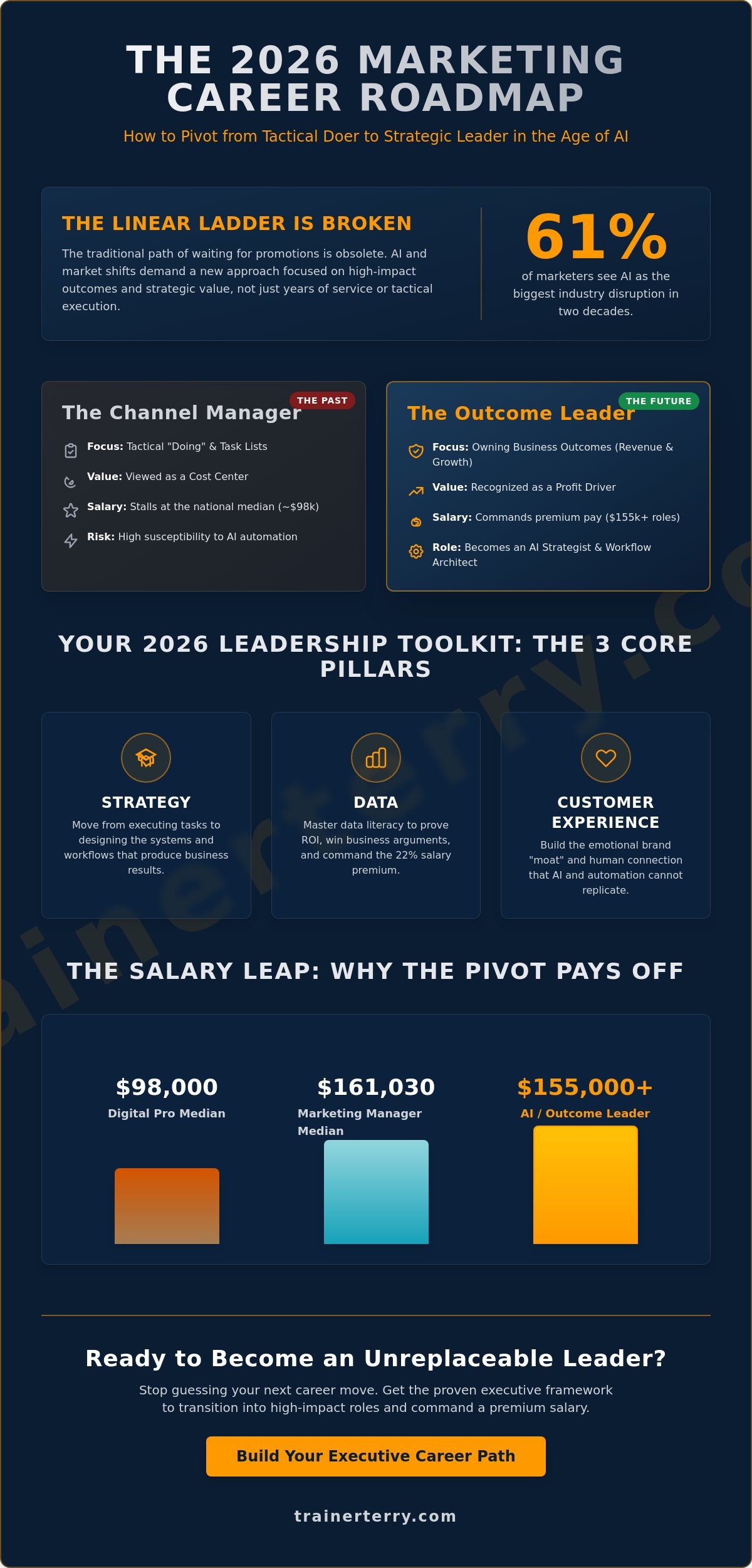
61% of marketers admit that AI has caused the biggest industry disruption in two decades, yet most remain buried in tactical execution. If you're feeling trapped in the "doing" phase while others land $155,000 AI-specialist roles, you need a different approach. This is the most critical career path advice for marketing professionals you'll hear in 2026: the linear ladder is dead, and only those who pivot to strategic leadership will thrive in this 9% growth market.
I know you're tired of being unable to prove ROI to skeptical executives while 68% of job postings now demand technical skills you haven't fully mastered. It's frustrating to watch your salary stall while the national median for digital pros hits $98,000. You want the decision-making power of a CMO, not just another task list. I'll show you how to stop managing channels and start owning business outcomes using a proven executive framework.
You're about to get a clear roadmap to VP roles, higher salary benchmarks, and a future-proof brand that makes you unreplaceable. We'll break down how to master the hybrid marketer model and use data literacy to command the 22% salary premium that elite leaders are earning today.
Key Takeaways
- Stop managing channels and start owning business outcomes to stay ahead of the AI-driven automation wave.
- Identify the high-value hybrid specializations that allow you to command premium pay and authority in the 2026 market.
- Break through the mid-career plateau by shifting your focus from doing the work to strategically enabling high-performing teams.
- Rebuild your LinkedIn presence into a 24/7 pitch that focuses on your impact rather than just your previous job descriptions.
- Follow this proven career path advice for marketing professionals to transition into high-impact leadership roles like VP or CMO.
The Marketing Career Landscape in 2026: Why the Ladder is Broken
The traditional marketing ladder is officially dead. If you're still waiting for a title change based on your years of service, you're falling behind. In 2026, the industry has shifted from a "Channel-Based" path to an "Outcome-Based" career trajectory. A channel manager focuses on "doing" the social media or the SEO. An outcome leader owns the revenue and the growth metrics. Stop hiding behind your task list and start owning the bottom line.
AI has already automated the entry-level tactical work that used to be the first few rungs of your career. This raises the bar for mid-career pros. You can't just be good at execution anymore. You must master the three core pillars of modern Marketing management: Strategy, Data, and Customer Experience (CX). This is the baseline for survival. The Strategic Pivot is the primary growth mechanism in 2026, where you move laterally to gain high-impact skills rather than waiting for a vertical promotion.
The Rise of the Fractional and Specialized Leader
High-growth startups don't want a "Jack of all trades" who is a master of none. They're hiring specialized experts for "Head of Growth" and "Chief Revenue Officer" roles. These positions demand that you own a specific business result, not just a department budget. To position yourself for these $155,000+ roles, you must stop being a generalist manager. Start by mastering one high-impact area like performance marketing or brand strategy, then layer on broad business acumen. This is how you move from being a cost center to a profit driver.
AI-Proofing Your Marketing Career Path
Stop trying to out-write a machine. 61% of marketers believe AI is the biggest disruption in 20 years, and they're right. You must move from being a "content creator" to an "AI strategist" and "workflow architect." This means you design the systems that produce the results. Your armor against automation is your soft skills. Empathy, leadership, and high-level negotiation can't be coded. Technical literacy is now non-negotiable for future CMOs. If you can't speak the language of data and AI, you won't have a seat at the table. This is the core of the career path advice for marketing professionals who actually want to lead.
Specialization vs. Generalization: Choosing Your High-Value Hybrid
Don't be a "jack of all trades" who is a master of none. In the 2026 market, generalists are the first to be replaced by AI automation. You need to become a "T-Shaped" marketer. This means you have a broad understanding of all marketing functions but possess deep, specialized expertise in one high-impact area. Think of it like your training. You need a solid core of general knowledge, but you also need a "power lift" skill if you want to win. This is the most practical career path advice for marketing professionals who want to scale their income past the mid-level plateau.
Why do so many talented managers hit a wall at $100,000 or $120,000? It's because they're seen as "doers" who can handle a bit of everything but lead nothing. According to the Bureau of Labor Statistics, the median salary for marketing managers is $161,030. You won't reach those heights by being average. High-demand specializations for 2026 include:
- Performance Marketing: Owning the math, the attribution, and the direct revenue impact.
- Product Marketing: Bridging the gap between technical builds and market demand.
- Brand Strategy: Building the emotional "moat" that AI can't replicate.
Stop waiting for a training budget that will never come. Use your current role as a laboratory. Test new AI workflows on your own time. Volunteer for cross-functional projects that scare you. If you want to level up, you have to put in the reps now. If you're ready to stop guessing and start leading, my Career Advancement Blueprint provides the specific career path advice for marketing professionals who want to jump from manager to director.
The Performance Marketer to CMO Route
If you love the numbers, this is your path. You win by proving ROI and direct revenue impact. The danger is getting stuck in the dashboard. Executives don't care about your click-through rate; they care about EBITDA. Pivot to leadership by using your data to win business arguments. Show them how a 10% increase in retention translates to millions in profit. That's how you earn your seat.
The Brand & Creative Route to Leadership
In an AI-saturated world, human connection is the ultimate premium. Brand equity is more valuable now than it was in 2020. But you can't just be a "creative." You must become a business strategist. Quantify the unquantifiable. Show how brand sentiment correlates with customer lifetime value. Move from "making things look pretty" to "making things valuable" for the company's future.
Breaking the Mid-Career Plateau: Moving from Manager to Director
Are you doing the same work every Tuesday that you did two years ago? If your days are filled with repetitive tactical tasks and you still have zero budget authority, you've hit the mid-career plateau. It's a frustrating cage. You're hitting your KPIs, yet your salary isn't moving toward that $161,030 median. This happens because you're still acting like an athlete when you need to become the coach. This is the most vital career path advice for marketing professionals who want to scale: you must stop doing the work and start enabling others to do it better.
To break through, you need political capital. Executive sponsorship isn't a luxury; it's a requirement for your next jump. You need leaders in the room who will advocate for your promotion when you aren't there. If you don't have a mentor or an executive sponsor, you're just a line item in the budget. You can use my Career Advancement Blueprint to map out exactly how to build this internal influence and secure your next promotion.
Developing Your Executive Presence
Confidence is a skill you train, just like your bench press. Your clothes, your communication, and your body language matter as much as your spreadsheets. If you want to lead, you must speak the language of the CEO. They don't want to hear about "engagement rates" or "brand vibes." They care about Profit, Loss, and Risk. When you frame your marketing strategy in terms of revenue growth and market share, you stop being a "marketer" and start being a business leader. For deeper insights on this transition, check out my Executive Career Coach guide.
Mastering the STAR Method for Leadership Interviews
Leadership interviews are a different beast. They aren't checking if you can run a campaign; they're checking if you can lead a department. You must use the STAR method to demonstrate high-level problem solving. Don't just talk about what you did. Talk about the Situation, the Task, the Action you took, and the massive Result you achieved for the business. When they ask, "What is your vision for this department?" they're looking for a strategy, not a to-do list. This is where the best career path advice for marketing professionals becomes reality: show them the future, don't just report on the past.
Strategic Personal Branding and LinkedIn Positioning
70% of senior marketing roles in 2026 are never posted on a job board. They're filled in the "Hidden Job Market" through referrals, headhunter pools, and executive networks. If you're waiting for a LinkedIn notification to find your next VP role, you've already lost the race. Stop treating your profile like a digital dusty resume and start treating it like a high-conversion landing page. It is your 24/7 pitch to CEOs and recruiters who are looking for leaders, not "doers."
The "No-Fluff" strategy is simple: delete your responsibilities and highlight your outcomes. Nobody cares that you "managed a team of five." They care that you "scaled a department from $10M to $25M in 18 months." This shift in perspective is the foundation of the best LinkedIn for Career Advancement tactics. If you want inbound offers, you must speak the language of business value. This is the most aggressive career path advice for marketing professionals: if you're invisible to the algorithm, you're invisible to the C-suite.
Optimizing Your Profile for Executive Search
Recruiters use specific filters to find leadership talent. If your profile doesn't include "P&L management," "cross-functional leadership," or "revenue architecture," you're getting filtered out before a human even sees your name. Your headline shouldn't be your current job title; it should be your value proposition. Your "About" section must weave a "Marketing Career Narrative" that connects your past wins to the future problems you're equipped to solve. Don't tell them you're "passionate about marketing." Tell them you're a strategic leader who eliminates waste and drives growth.
Thought Leadership as a Career Accelerator
You don't need 50,000 followers to be a thought leader. You need the right 50 people in your network. Use the "strategic commentary" method to build authority without burning out. Instead of posting long-form content every day, spend 15 minutes engaging with C-suite leaders in your niche. Provide data-backed insights on their posts. This builds a network of peers and mentors who see you as an equal. High-level engagement is your "cardio" for career growth. It keeps your brand lean, visible, and ready for the next level. If you're ready to stop being the best-kept secret in your industry, schedule a free strategy call and let’s fix your positioning today.
Executing Your Career Change or Advancement Strategy
The 2026 marketing career path isn't a slow crawl up a dusty ladder. It's a series of high-intensity, strategic pivots. You must be agile, outcome-focused, and unapologetically strategic. Generic career advice is the "participation trophy" of professional growth. It’s built for those who want a steady paycheck, not for high-performers chasing $180,000+ leadership roles. If you want a CMO seat, you have to stop following the crowd and start following a blueprint. This is the most direct career path advice for marketing professionals who are tired of being overlooked.
Take 15 minutes right now to audit your trajectory. Look at your last three months of work. Have you led a project that directly impacted the bottom line? Have you automated a legacy workflow using AI? If you're still just "doing the work," you're standing still while the market moves at a 9% CAGR. You can't afford to be stagnant in an industry where 61% of your peers are already being disrupted. If you aren't growing, you're decaying. Stop waiting for your company to notice your hard work. Permission is never given; it's taken.
Your Next 90 Days: A Strategic Action Plan
Success requires a training schedule. You don't get a promotion by accident. You get it through disciplined execution. Here is your 90-day roadmap to level up:
- Month 1: Skill Audit and LinkedIn Refresh. Be honest about your gaps. Update your profile to focus on revenue outcomes rather than job duties. Kill the fluff.
- Month 2: High-Level Networking and Internal Positioning. Start building your political capital. Identify three executive sponsors and start providing them with data-backed insights.
- Month 3: Interview Prep or Promotion Request. Use the STAR method to pitch your value. Whether you're staying or leaving, this is the month you demand the market rate for your expertise.
Partnering with Trainer Terry for Executive Growth
Partnering with me means bypassing the years of trial and error that kill most careers. You wouldn't walk into a gym and guess how to hit a new PR, so don't guess with your livelihood. Executive coaching is your shortcut to the C-suite. It’s about more than just a resume; it’s about your leadership narrative and executive presence. Your career is the most valuable product you'll ever market. Treat it with the respect it deserves. Schedule a Free Strategy Call and let’s build your personalized path to the top. The 2026 landscape is moving fast. Don't get left behind.
Secure Your Seat at the Leadership Table
2026 waits for no one. You've seen why the traditional ladder is a trap and how the 9% industry growth only rewards those who pivot to strategy. Whether you're mastering the "T-shaped" model or using the STAR method to dominate interviews, you must take ownership of your growth. This is the ultimate career path advice for marketing professionals: your results are your only real currency. Stop waiting for permission to lead.
Don't waste another year on tactical "doing" when you could be leading high-impact teams. Led by former Corporate VP Terry Jones, our Career Advancement Blueprint framework is designed to help you skip the line. As a STAR Method Interview Specialist, I know exactly what CEOs are looking for when they hire for $180,000+ roles. It's time to stop guessing and start executing with a proven mentor by your side.
Ready to skip the ladder? Schedule your Free Career Strategy Call with Terry today.
You have the drive. Now you need the map. Let's get to work and make your next level a reality.
Frequently Asked Questions
What are the most in-demand marketing skills for 2026?
AI integration and data literacy are the top requirements for any high-level role today. 68% of marketing job postings now list AI tool proficiency as a mandatory skill. You must also master "T-shaped" expertise, combining deep knowledge in areas like performance marketing or SEO with a broad understanding of business operations and revenue architecture.
Is a Master’s in Marketing worth it for career advancement?
In most cases, a Master's degree is less valuable than proven business results and specialized certifications. While a Kellogg Digital Marketing Strategies program costs $2,750 and offers prestige, many leaders prioritize candidates who can demonstrate a 20% increase in ROI over those with just a degree. Only pursue a Master's if you're targeting a specific academic or legacy corporate environment that requires it.
How do I pivot from a different industry into a senior marketing role?
You must stop talking about your past duties and start translating your previous wins into marketing outcomes. If you managed a $5M budget in operations, that is P&L management experience that translates directly to a Director of Marketing role. Use a structured career change strategy to map your transferable skills to the specific revenue goals of the marketing department you're targeting.
What is the average salary for a Marketing Director in 2026?
While the median salary for a marketing manager sits at $161,030 according to the U.S. Bureau of Labor Statistics, Director-level roles in 2026 typically range from $185,000 to $240,000. Professionals with deep AI expertise can command a salary premium of 15-22% above these standard rates. Your ability to negotiate depends entirely on your ability to prove your impact on the company's bottom line.
This is why the best career path advice for marketing professionals focuses on owning business outcomes rather than just managing channels. If you can't show the revenue, you won't see the top-tier salary.
How can I move from a tactical role to a strategic one at my current company?
Stop waiting for your boss to give you a strategy project and start creating one. Audit a current workflow, find a 10% efficiency gain using AI, and present the projected cost savings to your leadership. Moving to strategy requires you to stop "doing" and start "enabling" growth through data-backed insights and high-level planning.
Does the STAR method work for executive marketing interviews?
The STAR method is the most effective way to demonstrate high-stakes leadership during an interview. It forces you to move past vague claims and provide concrete evidence of your problem-solving abilities. When you're interviewing for a VP or CMO role, use this method to show how your actions led to specific, multi-million dollar results for your previous employers.
How do I explain a career gap in my marketing resume?
Be direct and frame the gap as a period of intentional growth or a "strategic reset." Don't make excuses; instead, highlight the new skills you acquired or the consulting projects you handled during that time. In 2026, employers value transparency and a "growth mindset" over a perfectly linear resume with no breaks.
What is the "hidden job market" in marketing leadership?
The hidden job market refers to the 70% of senior roles that are never publicly posted on job boards. These positions are filled through executive recruiters, headhunters, and personal networks. To access these roles, you need high-level career path advice for marketing professionals that emphasizes LinkedIn positioning and building "political capital" within the C-suite.

Article by
Terry Jones
Terry Jones is the Founder and Chief Career Strategist of the Career Advancement Blueprint and Executive Coach and Lead Consultant at FireBridge Consulting.
As an ICF Certified Accredited Career Coach and Certified Master Career Services professional, he partners with professionals at all levels, including senior leaders and executives, to navigate career transitions, secure new opportunities, and position themselves for advancement. His approach goes beyond surface level coaching, focusing on how individuals think, communicate, and lead so they can operate with clarity, authority, and strategic intent in high stakes environments.
In his work as an executive coach, Terry engages in high impact advisory conversations that help leaders strengthen decision making, elevate their presence, and align their leadership style with organizational expectations. He is known for helping clients translate their experience into influence, ensuring they are not only seen for what they have done, but trusted for what they are capable of leading next.
With over 20 years of corporate experience, including serving as a Vice President and leading Learning and Development functions for three New York City organizations, Terry brings a deep understanding of how companies evaluate talent, develop leaders, and make promotion decisions. This allows him to bridge the gap between individual ambition and organizational reality.
His insights have reached over 630,000 followers and generated more than 70 million video views, where he shares direct, experience driven guidance that helps professionals think differently and take action.