Feeling Stuck in Career After 10 Years: The Strategic Pivot Guide for 2026

Working harder is the exact reason you haven't been promoted in over 1,000 days. You’ve spent 3,650 days grinding in the same lane, yet you’re still feeling like a corporate ghost while the 2026 AI-driven market accelerates past you. It’s a brutal reality: feeling stuck in career after 10 years isn't a lack of talent. It's a failure of strategy. You’re trying to win a senior-level game using entry-level tactics that expired years ago. Stop waiting for permission to level up.
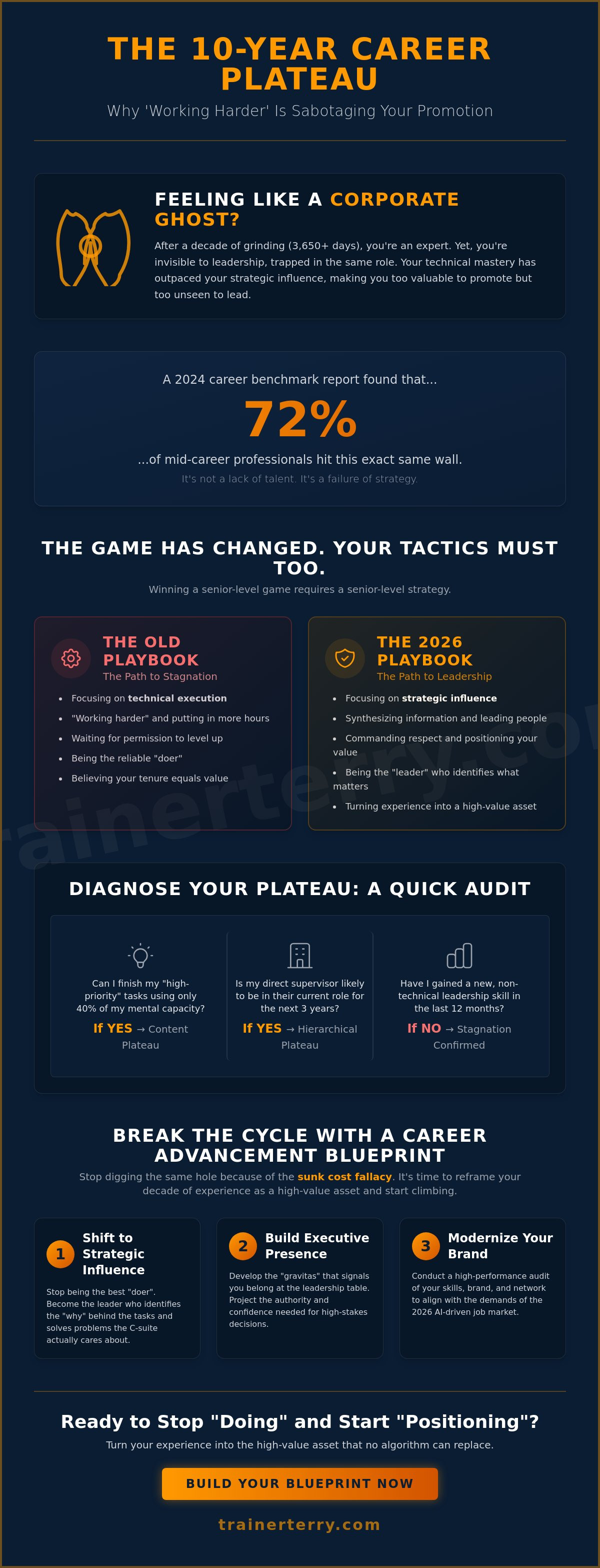
I get it. You feel overlooked and exhausted from repeating the same tasks since 2016. You’re worried your skills are becoming obsolete, but your decade of experience is actually your strongest weapon if you know how to wield it. A 2024 career benchmark report found that 72% of mid-career professionals hit this exact wall. This guide will show you how to stop "doing" and start "positioning" so you can command the respect and salary you’ve earned. We’ll break down the three-step pivot strategy to turn your experience into a high-value asset that no algorithm can replace.
Key Takeaways
- Stop being the "Corporate Ghost" by shifting your focus from technical execution to high-level strategic influence that the C-suite actually notices.
- Discover why feeling stuck in career after 10 years is a strategy problem, not a lack of effort, and why "working harder" is sabotaging your growth.
- Break the sunk cost fallacy by reframing your decade of experience as a high-value asset rather than a reason to stay in a dead-end role.
- Execute a high-performance career audit to modernize your personal brand and accelerate your network velocity for the 2026 job market.
- Build a structured Career Change Blueprint that prioritizes executive presence and strategic positioning over the traditional job hunt grind.
The 10-Year Wall: Why Mid-Career Professionals Feel Trapped
You’ve put in 3,650 days of work. By now, your technical skills are razor-sharp. You can handle crises that make juniors sweat without even spilling your coffee. But here’s the cold truth: you’re hitting the 10-year wall. This is the exact point where your technical mastery outpaces your strategic influence. You’re the best at what you do, yet your title hasn’t changed since 2021. This isn't a lack of effort. It’s a structural trap.
Many professionals become a "Corporate Ghost" at this stage. You’re so efficient in your current role that moving you would actually hurt the department’s performance. You’re too valuable to promote but too invisible to lead. Don't confuse this with burnout. Burnout is when your tank is empty; a plateau is when your engine is redlining but you’re still in neutral. Feeling stuck in career after 10 years is the most common ceiling for high-performers because the rules of the game just changed, and nobody gave you the new playbook.
Hierarchical vs. Content Plateaus after a Decade
A hierarchical plateau happens when the org chart is frozen. If your manager has no plans to move in the next 1,000 days, you’re stuck behind a lead car that’s doing the speed limit. A content plateau is different. This is when your brain starts atrophying because you could do your job in your sleep. If you’re unsure which one is killing your drive, use this quick diagnostic:
- Can I finish my daily "high-priority" tasks using only 40% of my mental capacity?
- Is my direct supervisor likely to be in their current role for the next 3 years?
- Have I gained a new, non-technical leadership skill in the last 12 months?
If you answered "yes" to the first two and "no" to the third, you aren't just tired. You’re stagnant. You need to stop focusing on the "how" of your job and start mastering the "who" and "why" of the organization.
The Psychological Toll of the 'Decade Mark'
The "is this all there is?" realization usually hits right around the ten-year mark. It’s a gut-punch that leads to a total loss of professional identity. You start feeling like a cog rather than a creator. Many stay because they fall for the sunk cost fallacy, believing that because they’ve already "invested" a decade, they must keep digging in the same hole. This 10-year malaise is a painful mismatch between your massive contribution and the stagnant recognition you receive. To break this cycle, you need a structured Career Advancement Blueprint that prioritizes your executive presence over your task list. Stop digging and start climbing.
Decoding the Stagnation: Is It the Industry or Your Strategy?
Most people think the solution to feeling stuck in career after 10 years is to put in more hours. Wrong. That’s a 2016 mindset. In the 2026 economy, "working harder" is a trap that keeps you buried in the weeds while the world moves on. If you’re still focusing on technical output, you’re making yourself replaceable by an AI agent. You need to shift from being the engine to being the navigator. The market doesn't reward your overtime anymore. It rewards your ability to synthesize information and lead people through uncertainty.
Research into mid-career change motivations shows that internal frustration often stems from a lack of autonomy and recognition. The C-suite doesn't promote the person who does the most work; they promote the person who solves the biggest problems. This is Strategic Positioning. It’s about controlling the narrative of your value. Stop being the "doer" who executes tasks. Start being the "leader" who identifies why those tasks matter to the bottom line. If you don't define your value, the organization will define it for you, and they’ll usually define it as "mid-level support."
The Hidden Executive Presence Gap
Executive Presence is the "gravitas" that tells leaders you belong at the table. Without it, you’re just a senior individual contributor with a long tenure. It's the missing link for professionals who have the skills but lack the influence. A lack of this presence keeps senior managers stuck in the "middle" because they don't project the authority needed for high-stakes decisions. You need to sound, act, and think like the role you want, not the one you have. If you’re struggling to project authority, check out The Executive Career Coach for a breakdown on navigating leadership in the 2026 landscape.
Skills Relevance in the 2026 Landscape
Be honest: do you have 10 years of experience, or one year of experience repeated 10 times? In 2026, skills have an expiration date. Technical mastery is "perishable." Strategic thinking, emotional intelligence, and AI orchestration are "durable." Many professionals feeling stuck in career after 10 years assume they need a brand new degree to stay relevant. You don't. You need to re-skill by applying your existing industry nuance to high-value problems. Focus on the 20% of your skills that drive 80% of the results. If you're ready to stop the drift, jump into my office hours to audit your current trajectory and find your next level. No excuses. Just results.
Breaking the Sunk Cost Fallacy: Reframing Your 10-Year Asset
Stop looking at the last decade like it’s a prison sentence. Most professionals feeling stuck in career after 10 years fall into the trap of the sunk cost fallacy. They believe that because they’ve already "invested" 87,600 hours into a specific path, they have to keep digging in that same hole. That’s a lie that will cost you your future. Your time is a spent resource; you can't get it back. The only thing that matters now is the return on your next 1,000 days. If your current role doesn't offer a path to growth, staying out of "loyalty" or "time invested" is professional suicide.
You need to reframe your decade of work as a masterclass in industry nuance. You aren't starting over from zero. You’re starting from a foundation of deep expertise that 90% of the market lacks. Think of your career like a fitness journey. You don't lose your muscle mass just because you switch from powerlifting to cross-training. You take that strength with you. The cost of inaction is the real danger here. If you stay stuck for another 1,825 days, you won't just be bored; you'll be obsolete. The 2026 market moves too fast for you to sit on the sidelines.
Narrative Development: Owning Your Decade
You must stop describing your history as a list of tasks. Nobody cares that you "managed budgets" for ten years. They care that you optimized capital to drive a 15% increase in operational efficiency. To move up, you must translate "doing" into "results." This requires a radical shift in how you talk about yourself. The Pivot Pitch is a bridge between your past successes and your future value that proves your 10 years of experience is a strategic launchpad rather than a liability. When you master this narrative, you stop looking like a job seeker and start looking like a solution to a company’s biggest problem.
The Risk of the 'Comfort Zone'
In 2026, "safe" is the riskiest place you can be. A stagnating role is a shrinking asset. You need to calculate the ROI of a career move by looking at the long-term salary ceiling of your current path versus a strategic pivot. Staying put might feel comfortable today, but it’s a slow-motion disaster for your earning potential and professional purpose. If you want to break the cycle, you need a promotion strategy that focuses on high-stakes leadership. Use this Career Advice 2026 guide to build your strategic blueprint for executive growth. Don't wait for a "better time" to move. The best time was yesterday; the second best time is right now. If you're ready to stop the excuses and start the work, book a free strategy call to map out your next level.
The High-Performance Career Audit: 4 Steps to Unstick Your Growth
You’ve been coasting on your reputation for too long. Feeling stuck in career after 10 years happens when you stop auditing your own performance and start relying on tenure. Tenure is just a number; impact is what gets you paid. You need a cold, hard look at your professional standing to see why the engine has stalled. This four-step audit will expose exactly where your growth has hit a ceiling and how to break through it in the next 90 days.
- Step 1: The Personal Brand Audit. Does your online presence scream "2016" or "2026"? If your profile still lists basic tasks instead of strategic outcomes, you’re telling the market you haven't evolved in a decade.
- Step 2: The Network Velocity Check. When was the last time you spoke to an industry peer outside your current company? If your network is 100% internal, you’re living in an echo chamber. You need fresh data to stay relevant.
- Step 3: The Value-to-Visibility Ratio. Are you doing the heavy lifting while others take the stage? High performance without high visibility is just a recipe for remaining a "corporate ghost."
- Step 4: The Market Value Test. Apply for one high-level role this month. Not because you want it, but to see if your decade of experience actually commands a premium. If you aren't getting callbacks, your skills are perishable and need an immediate upgrade.
Optimizing Your LinkedIn for the 10-Year Pivot
Scrub the "entry-level" language from your headline immediately. Words like "experienced" or "passionate" are filler; they don't move the needle. You must position yourself as a thought leader who solves specific, high-stakes problems. Your profile should be a landing page for your expertise, not a digital version of a dusty resume. Learn how to use LinkedIn in 2026 to shift your narrative from job seeker to strategic asset.
Leveraging the STAR Method for Internal Advancement
If you want a promotion, stop asking for one and start proving why it’s a smart business move. Use the STAR method to document your biggest wins from the last 3,650 days. Focus on the "Result" — use specific numbers, like a 20% increase in revenue or a $50,000 reduction in costs. This data allows you to pitch for a "created" role that addresses a gap your boss hasn't even noticed yet. Check out The STAR Method Guide to master this high-performance communication style. If you're ready to stop the drift and start the climb, book your free strategy call today. No more excuses. Let’s get to work.
Designing Your Second Act: From Stuck to Strategic
You’ve finished the audit and seen the gaps in your 2026 strategy. Now it’s time to execute. Feeling stuck in career after 10 years isn't a permanent condition; it’s a signal that your current operating system is obsolete. You don't need a new job; you need a new strategy. Most people fail because they try to "struggle" their way out of stagnation. They send 50 resumes a week and hope for a 2% response rate. That’s not a plan. It’s a lottery. Strategy over struggle means identifying the specific, high-value problems you solve and positioning yourself as the only person capable of solving them.
Your second act requires a "First 90 Days" roadmap. Data from a 2024 leadership study shows that mid-career professionals who set specific milestones for their first three months in a new role see a 40% higher success rate in securing a secondary promotion within two years. You aren't just filling a seat anymore. You’re taking ownership of a business outcome. This shift in mindset from "employee" to "strategic partner" is what separates those who stay stuck from those who soar. Stop waiting for the perfect moment. It doesn't exist.
The Career Change Blueprint Approach
Stop "spraying and praying" with your resume. A structured curriculum is the only way to exit the 10-year rut without losing your salary level. You need to align your personal values with the next decade of your work to avoid hitting another wall in 2029. We focus on results, not activity. If you're ready to stop guessing and start winning, schedule a free strategy call to build your personalized blueprint and identify your unique market leverage.
Taking the First Step: The 24-Hour Challenge
I’m giving you a 24-hour challenge: take one "micro-move" today. This could be reaching out to one person for a 15-minute coffee chat or rewriting your LinkedIn headline using the results-oriented language we discussed. Momentum is built through action, not contemplation. Don't wait for Monday. Don't wait for 2027. The stagnation ends the moment you decide to move. For a total growth strategy that covers every angle of your pivot, check out the Career Advancement Blueprint. You aren't stuck. You’re just waiting for a better plan. No more excuses. It’s time to level up.
Command Your Next Decade of Growth
You’ve seen the map. You know that technical mastery alone won't save you in the 2026 market. To break the cycle of feeling stuck in career after 10 years, you must abandon the "work harder" myth and embrace strategic executive presence. We’ve covered how to audit your personal brand, leverage your industry nuance, and stop falling for the sunk cost fallacy. Now, the only thing left is the execution. You can either stay a corporate ghost or become a strategic leader who commands the room and the salary you deserve.
I’ve helped hundreds of professionals make this exact shift. Led by a former Corporate VP with 20+ years of experience, my system provides the specialized STAR method interview prep you need for high-stakes roles. It’s time to stop the drift. Stop feeling stuck and start your pivot with the Career Change Blueprint today. This proven 'Career Catalyst' curriculum is built to turn your decade of experience into your greatest asset. You’ve put in the time; now it’s time to get the results. Let’s get to work.
Frequently Asked Questions
Is it normal to feel stuck after 10 years in the same career?
It’s the most common professional plateau in the modern market. A 2024 workforce survey found that 72% of mid-career professionals experience this exact slump around the decade mark. It happens because your technical growth has outpaced the available leadership opportunities in your current environment. You’ve mastered the "how" of your job, but you haven't been given the "why" or the "who" that leads to senior influence.
How do I know if I should quit or just ask for a promotion?
Check your "Value-to-Visibility" ratio before making a move. If you’ve delivered a 15% increase in department efficiency or saved the company $50,000 in the last 12 months without a title change, ask for the promotion. If the leadership says "not right now" despite your data, it’s time to quit. Don't waste another 365 days waiting for permission to grow when your results already prove you’ve leveled up.
Can I change industries after a decade without taking a pay cut?
Yes, provided you stop selling yourself as a "worker" and start selling yourself as a "problem solver." Professionals feeling stuck in career after 10 years often take pay cuts because they try to start over at entry-level. Instead, map your existing 8,000 hours of industry nuance to a high-value problem in the new sector. When you lead with strategic results, you maintain your executive salary regardless of the industry.
What are the first signs of a career plateau?
The most obvious sign is when you can finish your high-priority tasks using only 40% of your mental capacity. If you haven't learned a new strategic skill since early 2023, you’re on a content plateau. Another major red flag is the "frozen org chart." If your direct manager hasn't moved in over 1,000 days, they are likely blocking your upward trajectory and forcing you into a stagnation trap.
How do I explain a 10-year stint at one company when applying for new roles?
Focus on your internal evolution rather than the company name. Break that decade into three distinct "chapters" of growth and measurable results. Show how you solved progressively harder problems as the market changed. A 10-year tenure is a sign of loyalty, but you must prove it wasn't just one year of experience repeated 10 times. Highlight your adaptability to prove you aren't institutionalized.
Does the STAR method work for internal promotion interviews?
The STAR method is actually more effective internally because you have the exact data to back up your claims. Use it to document how your specific actions led to a 20% reduction in project timelines or a measurable increase in team retention. It turns a subjective conversation about your "potential" into an objective business case for your promotion. It’s the fastest way to prove you’ve outgrown your current role.
What should I do if my boss is the reason I'm feeling stuck?
You need to build a strategic network that bypasses their influence. If your manager is a bottleneck, start building visibility with their peers or the C-suite through cross-functional projects. If 100% of your career growth depends on one person who doesn't support you, you’re in a high-risk situation. Start your pivot now before their stagnation becomes your professional identity. No more excuses; take control of your own narrative.
How can a career coach help me if I've been stuck for years?
A coach provides the "tough love" and strategic lens you can't see from inside the weeds. Many people feeling stuck in career after 10 years just need a structured blueprint to modernize their narrative for the 2026 market. A coach helps you identify "perishable" skills and replaces them with durable leadership strategies. We stop the aimless searching and replace it with a high-intensity plan that gets you to the next level.

Article by
Terry Jones
Terry Jones is the Founder and Chief Career Strategist of the Career Advancement Blueprint and Executive Coach and Lead Consultant at FireBridge Consulting.
As an ICF Certified Accredited Career Coach and Certified Master Career Services professional, he partners with professionals at all levels, including senior leaders and executives, to navigate career transitions, secure new opportunities, and position themselves for advancement. His approach goes beyond surface level coaching, focusing on how individuals think, communicate, and lead so they can operate with clarity, authority, and strategic intent in high stakes environments.
In his work as an executive coach, Terry engages in high impact advisory conversations that help leaders strengthen decision making, elevate their presence, and align their leadership style with organizational expectations. He is known for helping clients translate their experience into influence, ensuring they are not only seen for what they have done, but trusted for what they are capable of leading next.
With over 20 years of corporate experience, including serving as a Vice President and leading Learning and Development functions for three New York City organizations, Terry brings a deep understanding of how companies evaluate talent, develop leaders, and make promotion decisions. This allows him to bridge the gap between individual ambition and organizational reality.
His insights have reached over 630,000 followers and generated more than 70 million video views, where he shares direct, experience driven guidance that helps professionals think differently and take action.