Cover Letter Templates 2026: The Strategic Blueprint for High-Stakes Career Moves

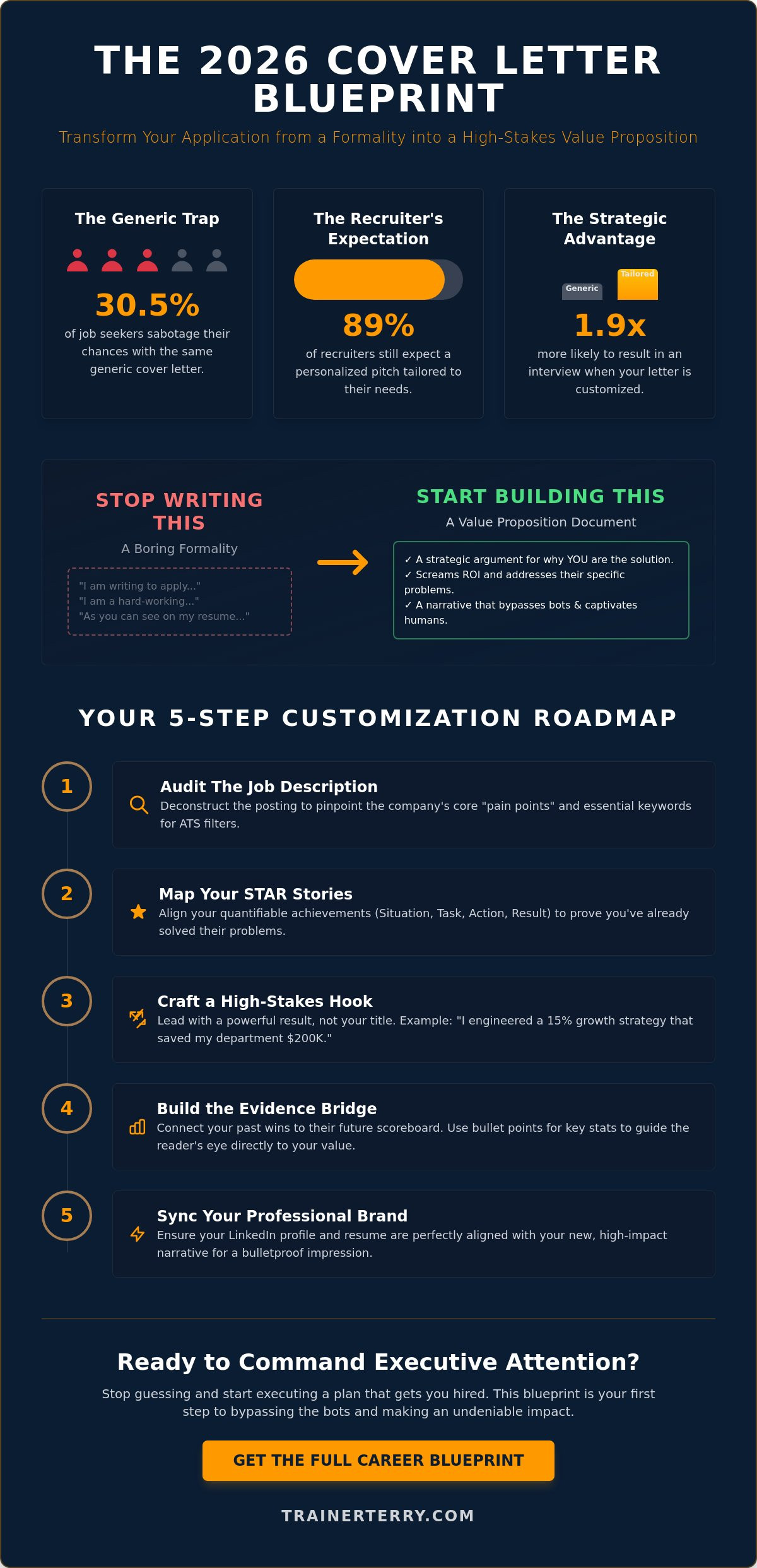
Did you know that 30.5% of job seekers are still sabotaging their careers by submitting the exact same generic cover letter for every single application? It's the professional equivalent of trying to run a marathon in flip-flops. You aren't just slow; you're invisible to the 89% of recruiters who still expect a personalized pitch. You're likely feeling the burn of a crowded market, struggling to translate your past wins into a new industry while AI filters toss your hard work into the digital trash.
Stop settling for "good enough." I'm here to show you how to take standard cover letter templates and turn them into a high-stakes strategic blueprint. You'll learn how to craft a narrative so compelling that hiring managers can't ignore you. In fact, tailored letters make you 1.9 times more likely to result in an interview. This article provides the exact framework you need to showcase quantifiable achievements and bypass the bots. It is time to stop guessing and start executing a plan that commands executive attention. Let's get to work.
Key Takeaways
- Stop wasting time on formalities; learn why your letter must be a high-impact Value Proposition Document to survive 2026 AI filters.
- Pick the right cover letter templates for your mission, whether you're commanding a boardroom or switching industries.
- Master the 5-step customization roadmap to audit job descriptions for "pain points" and crush them with your mapped STAR stories.
- Ditch the generic intros for a strategic hook that proves you've already solved their future problems.
- Scale your success by syncing your LinkedIn profile with your new narrative for a bulletproof professional brand.
Beyond the Layout: Why Most Cover Letter Templates Fail High-Performers
You have been lied to. Most people think picking the right cover letter templates is about finding the prettiest colors or the sleekest font. That is like picking a gym based on the wallpaper. In 2026, a template is just a skeleton. If you don't put muscle on those bones, you're just another piece of digital noise. I want you to stop thinking about a cover letter as a polite request for a job. Instead, view it as a "Value Proposition Document." It is a strategic argument for why you are the only solution to their specific problems. If your document doesn't scream "ROI," it's going in the trash.
Generic phrases like "I'm a hard-working professional" are the junk food of recruitment. They fill space but offer zero nutrition. When you use these clichés, you fall into the "Template Trap." Recruiters see thousands of these every month. If your letter sounds like everyone else's, you have already lost. The 2026 reality is cold; AI filters for keywords, but humans hire for narrative. My blueprint flips the script. We prioritize strategy first and formatting second. You're not just a candidate; you're a high-performing asset ready to execute.
The Difference Between a Formality and a Strategy
A formality letter just repeats your resume in paragraph form. It's redundant and boring. A strategic letter explains the "Why" behind your wins. You need to understand what a cover letter is truly meant to do; it is your chance to speak directly to the person with the power to promote you. If your current template doesn't force you to address their specific pain points, it is holding you back. Are you writing to be seen, or are you writing to be hired? High-performers don't ask for permission. They present a plan. Check out my Career Advancement Blueprint to see how a real strategy looks in action.
ATS Compatibility in 2026
Let's talk about the tech. Many candidates get seduced by complex graphic designs from sites like Canva. Stop doing that. In 2026, many automated parsers still struggle with multi-column layouts and heavy graphics. I recommend a "Clean-Tech" approach. You need a layout that looks sharp to a human but remains transparent to a bot. ATS optimization is the delicate balance between bot-readability and human-persuasion. If the bot can't read your cover letter templates, the human never will. Choose a layout that focuses on white space and clear hierarchy. This ensures your narrative actually reaches the person making the decisions.
The Strategic Anatomy of a 2026 Cover Letter Template
If your opening line is "I am applying for the position of X," you have already lost the locker room. That is a waste of prime real estate. Think of cover letter templates as your pre-game speech. You don't start a championship game by stating you're there to play; you start by stating you're there to win. Your anatomy must follow a rigid, high-performance structure: the hook, the evidence bridge, and the decisive call to action. Each block serves one purpose: moving the hiring manager from "maybe" to "we need to talk to this person today."
Your evidence sections are where you connect your past trophies to their future scoreboard. Don't just list what you did. Explain how what you did solves the specific pain points they mentioned in the job description. Research shows that writing a compelling cover letter requires you to mirror their needs with your results. If they're bleeding revenue, talk about how you've patched holes before. If they're scaling, show them your growth metrics. Use white space aggressively. Bullet points for stats aren't just for resumes; they guide the human eye directly to your value in a sea of text.
Crafting a High-Stakes Hook
Lead with a result, not a title. Your first sentence should be a punch to the gut of their biggest problem. For example, instead of saying you're an experienced manager, say: "While others saw a 10% market dip, I engineered a 15% growth strategy that saved my department 200,000 dollars." This immediately signals authority. To build this kind of evidence, you need to master the STAR method. It's the only way to ensure your cover letter templates actually carry weight instead of just taking up space.
The Connection Bridge for Career Changers
If you're switching industries, your template must act as a translator. Don't expect the hiring manager to do the math for you. You have to translate your industry-specific jargon into universal value like efficiency, leadership, or revenue generation. Your "Pivot" shouldn't feel like a risk; it should feel like an upgrade. If you're struggling to frame this, my Career Change Blueprint breaks down the exact psychology of a successful transition. You can also schedule a free strategy call to refine your narrative before you hit send. Finish with a call to action that creates urgency. Tell them you're ready to discuss how your specific skills will impact their next quarter. Don't ask for an interview; offer a solution.
Choosing Your Template: Executive Presence vs. Career Transition
Stop trying to squeeze a high-octane career into a template designed for an entry-level intern. It doesn't work. Your choice of cover letter templates signals your level of professional maturity before the recruiter even reads the first word. If you are aiming for the C-suite, you need a layout that breathes authority through minimalism. If you are pivoting to a new industry, your layout needs to act as a bridge that connects your past wins to their current needs. You wouldn't wear a tracksuit to a board meeting; don't send a "creative" template to a traditional firm.
I want you to apply the "Corporate Vice President Test." Imagine a high-stakes executive like Terry Jones. He has exactly 3 minutes between meetings to scan your application. If your template is cluttered with unnecessary graphics or a three-column layout that hides your contact info, he will toss it. For executive roles, the layout must be invisible so the results can be the star. For career changers, the layout must be strategic enough to highlight your "transferable skills" as "proven solutions" for the new role. Let's break down the two main blueprints you should consider.
Executive Presence on Paper
High-stakes leadership roles require a "less is more" philosophy. You don't need flashy borders to prove you can manage a 50 million dollar budget. You need clarity and organizational impact. Elevate Your Executive Presence by choosing a template that prioritizes white space and high-level achievements. In 2026, the most effective cover letter templates for executives are those that use a standard business header and a clean, single-column body. This shows you value the recruiter's time and possess the communication discipline required for leadership.
The Career Transition Blueprint
When you're changing lanes, your industry gaps are the "dead weight" we need to cut. A skills-first layout is your best weapon. Instead of a chronological summary, use a narrative-heavy template that groups your achievements by skill set rather than by previous company. This forces the hiring manager to see your value first and your history second. As I always tell my clients, "the best template is the one that makes your transition feel inevitable, not accidental." You aren't just trying something new; you are bringing a specialized toolkit to a new arena. Frame your skills as universal solutions to ensure you don't get filtered out as "unqualified" simply because your last title doesn't match the new one.
Creative or portfolio-style templates have their place, but use them with extreme caution. If you're a designer or a marketing lead, a splash of brand-aligned color can work. If you're in finance, legal, or operations, stick to the clean-tech approach. A pretty layout will never save a weak story. Focus on the narrative muscle first, then wrap it in a professional, distraction-free skeleton. If you're ready to stop guessing and start winning, schedule a free strategy call to find the exact blueprint for your next move.
5 Steps to Customise Your Template for Maximum Impact
You have the skeleton. Now you need the muscle. Simply filling in the blanks of your cover letter templates is a recipe for mediocrity. If you want to stand out to the 72% of hiring managers who demand customization, you must treat your template as a dynamic tool, not a static form. Follow this five-step blueprint to ensure every word you send carries the weight of a high-performer ready to execute from day one.
- Step 1: Audit the Job Description. Every job posting is a confession of a company's pain. Find the "Pain Point" keywords. Are they losing market share? Is their team disorganized? Highlight these.
- Step 2: Map Your Wins. Take those pain points and match them with your specific STAR stories. If they need growth, show them the 15% revenue increase you delivered in your last role.
- Step 3: Use Executive Action Verbs. Passive language is a weak handshake. Replace "responsible for" with "engineered," "spearheaded," or "orchestrated." High-stakes roles require high-impact language.
- Step 4: The AI Tone Polish. Use AI to check your emotional resonance, not to write your story. Ask it to analyze your draft for "Executive Presence" and "Authority."
- Step 5: The Human Final Pass. Read your letter aloud. If it sounds like a robot or a desperate plea, delete it and start over. It should sound like a confident professional offering a solution.
Integrating the STAR Method
You don't have room for a novel. You need to condense your STAR stories into two punchy sentences. Start with the result to grab attention immediately. For example: "I reduced operational costs by 22% by redesigning our logistics workflow, solving a two-year deficit in just six months." This "Result-First" formatting trick ensures the hiring manager sees your value before they see the process. If you're struggling to trim the fat from your stories, my 1:1 Job Interview Prep will help you sharpen your narrative until it's razor-sharp.
AI as a Strategist, Not a Writer
Never copy-paste AI output directly into your cover letter templates. Recruiters can smell an algorithm from a mile away. Use AI as a spotter. Give it your draft and ask it to "Identify three areas where my tone lacks authority." Prompt it for a "Corporate Narrative" that aligns with the company's specific culture. Your unique voice is your strongest asset; don't let a machine drown it out. Use the tech to refine your strategy, but keep the soul of the story yours. Ready to turn your stories into offers? Sign up for 1:1 Job Interview Prep and let’s sharpen your narrative together.
From Template to Offer: Your Strategic Career Roadmap
Stop treating your application like a lottery ticket. You've learned how to strip the fat from generic cover letter templates and build a lean, result-driven narrative. But don't get comfortable yet. That document is just the first set in a much larger workout. It is the entry point of my Career Advancement Blueprint. If you want the offer, you have to stop thinking about "applying" and start thinking about "positioning." A high-conversion letter gets you the interview, but a consistent strategy gets you the contract.
You need to move from the paper application into the strategic networking phase immediately after hitting send. Use the narrative you've built in your template as a script for your outreach. If you've identified a company's pain point, don't just tell the hiring manager; find the people currently working in that department and start a conversation about it. This is how you bypass the 30.5% of job seekers who are still stuck in the generic-application loop. You are not just a name on a screen; you are a solution waiting to be deployed.
Aligning Your Personal Brand
Does your LinkedIn profile match the "Hook" you just sent in your cover letter? If you claim to be an elite growth engineer in your letter, but your profile looks like a digital graveyard, you've lost all credibility. Authority is built on consistency. Every single platform must tell the same high-stakes story. Check out my guide on how to use LinkedIn in 2026 to ensure your digital presence backs up the claims in your cover letter templates. If there's a disconnect, the hiring manager will find it. Don't give them a reason to doubt your narrative.
Take the Next Step in Your Strategy
Templates are the foundation, but high-level execution requires a coach. You wouldn't try to break a world record without a trainer in your corner. Why would you treat your career any differently? It is time to move beyond the basics and into high-level coaching where we refine your "Executive Presence" until it's undeniable. I'm inviting you to schedule a free strategy call today. We will audit your current materials and find the gaps that are keeping you from your next level.
The "No Excuses" philosophy applies here just as much as it does in the gym. Your dream job isn't a matter of luck; it's a matter of preparation and narrative timing. You have the blueprint. You have the tools. Now, you need the discipline to execute the plan until the offer is on the table. Don't just apply. Position yourself for the win. Let's get to work.
Execute Your Narrative and Claim Your Win
You have the blueprint. Now you need the discipline to execute. We have dismantled why standard cover letter templates fail high-performers and replaced them with a result-driven strategy. You now know how to audit job descriptions for pain points and map your STAR stories to deliver a narrative that proves your worth. Remember, a template is just the starting line; your strategic narrative is what carries you through the finish. I have spent 20 years as a Corporate VP seeing exactly what makes a hiring manager stop scrolling. My "Career Change Blueprint" is not just theory; it is a proven system for professionals making high-stakes moves.
Don't let your potential rot in a generic inbox. My results-oriented "Tough Love" coaching is designed to turn your past wins into a future offer. You have the tools to be 1.9 times more likely to land that interview; don't waste the opportunity by falling back into old habits. Your dream role is waiting for a story that commands attention. It's time to stop wishing and start winning.
Ready to move beyond templates? Schedule your Free Strategy Call with Trainer Terry today.
Frequently Asked Questions
Do hiring managers actually read cover letters in 2026?
Yes, they absolutely do. Recent data shows that 83% of hiring managers read most of the cover letters they receive, even when the job posting lists them as optional. For 94% of these decision-makers, the narrative in your letter directly influences their final interview decisions. If you want to stand out in a crowded market, you can't afford to skip this step.
Can I use the same cover letter template for every job application?
No, that is a guaranteed way to remain invisible. While 30.5% of job seekers submit the same generic letter every time, those who use tailored cover letter templates see a 35.8% hiring rate. Customization makes you 1.9 times more likely to result in an interview. You wouldn't use a marathon training plan to prepare for a powerlifting meet; don't use a generic pitch for different roles.
How long should a professional cover letter be?
The sweet spot is between 250 and 400 words. Research indicates that 49% of hiring managers prefer a letter that is exactly half a page long. You need to be concise and high-impact. Every sentence must either highlight a win or solve a problem. If it doesn't add value, it is just dead weight that distracts from your results.
Should I use a creative template or a traditional one for an executive role?
Stick to a traditional, minimalist layout to project authority. For six-figure roles, "Executive Presence" is built on clarity and organizational impact, not flashy borders or complex graphics. A clean, single-column design ensures that your 20 plus years of experience remain the star of the show. Minimalism signals that you are a disciplined communicator who values the recruiter's time.
How do I mention a referral in my cover letter template?
Put the referral in your very first sentence to establish immediate social proof. Name-dropping a mutual contact bypasses initial skepticism and builds instant trust. For example, start with: "John Smith suggested I reach out to discuss how my revenue growth strategies can solve your current department deficit." This establishes your value before the hiring manager even finishes the first paragraph.
What is the biggest mistake people make when using a cover letter template?
The biggest mistake is being generic and using passive language. Phrases like "hard-working professional" are resume killers that offer zero proof of your ability. You must replace these clichés with specific numbers and "Executive Action Verbs." If your cover letter templates don't include quantifiable achievements, you are just another name in a pile of digital noise.
Is it okay to use AI to fill out my cover letter template?
Use AI as a strategist, but never as your ghostwriter. While AI tools are mainstream in 2026, 72% of hiring managers state that deep personalization is the most important factor in a letter. If you copy-paste AI output, you lose the unique voice and "tough love" authority that gets you hired. Use the tech to audit your tone or find keywords, then write the narrative yourself.

Article by
Terry Jones
Terry Jones is the Founder and Chief Career Strategist of the Career Advancement Blueprint and Executive Coach and Lead Consultant at FireBridge Consulting.
As an ICF Certified Accredited Career Coach and Certified Master Career Services professional, he partners with professionals at all levels, including senior leaders and executives, to navigate career transitions, secure new opportunities, and position themselves for advancement. His approach goes beyond surface level coaching, focusing on how individuals think, communicate, and lead so they can operate with clarity, authority, and strategic intent in high stakes environments.
In his work as an executive coach, Terry engages in high impact advisory conversations that help leaders strengthen decision making, elevate their presence, and align their leadership style with organizational expectations. He is known for helping clients translate their experience into influence, ensuring they are not only seen for what they have done, but trusted for what they are capable of leading next.
With over 20 years of corporate experience, including serving as a Vice President and leading Learning and Development functions for three New York City organizations, Terry brings a deep understanding of how companies evaluate talent, develop leaders, and make promotion decisions. This allows him to bridge the gap between individual ambition and organizational reality.
His insights have reached over 630,000 followers and generated more than 70 million video views, where he shares direct, experience driven guidance that helps professionals think differently and take action.