How to Use LinkedIn in 2026: A Strategic Guide for Career Advancement

Your LinkedIn profile is either a high-performance engine or a digital paperweight. In 2026, 94 percent of executive recruiters prioritize candidates who demonstrate active industry leadership over those with a static list of past duties. If you're still treating the platform like a dusty filing cabinet for your CV, you're effectively invisible to the people who matter most. You've likely felt the frustration of being overlooked for a promotion or felt that familiar "cringe" when trying to network with high-level peers. It's time to stop making excuses and start executing.
This guide will teach you exactly how to use linkedin to build a profile that commands authority and generates inbound opportunities. You're going to stop chasing recruiters and start making them come to you. We'll explore the specific content strategies that bypass algorithm fatigue and show you how to build a network of high-value connections without losing your professional dignity. I'm breaking down the three-pillar system for executive growth and the exact engagement metrics you need to hit to stay relevant in this year's competitive market.
Key Takeaways
- Stop living in the past and learn why your profile must evolve from a historical record into a high-octane "Living Portfolio" that proves your future worth.
- Nail the first impression by optimizing your "Hook" and shifting your career narrative from a list of chores to a story of measurable impact.
- Stop chasing vanity metrics and master how to use linkedin to build a lean, strategic network that actually opens doors for your specific goals.
- Build your digital authority using the three pillars of executive content, turning every interaction into a high-value asset that commands industry attention.
- Stop treating your profile as a one-time project and start using LinkedIn data as a tactical tool to dominate salary negotiations and high-stakes interviews.
The Strategic Shift: Why You Need to Know How to Use LinkedIn in 2026
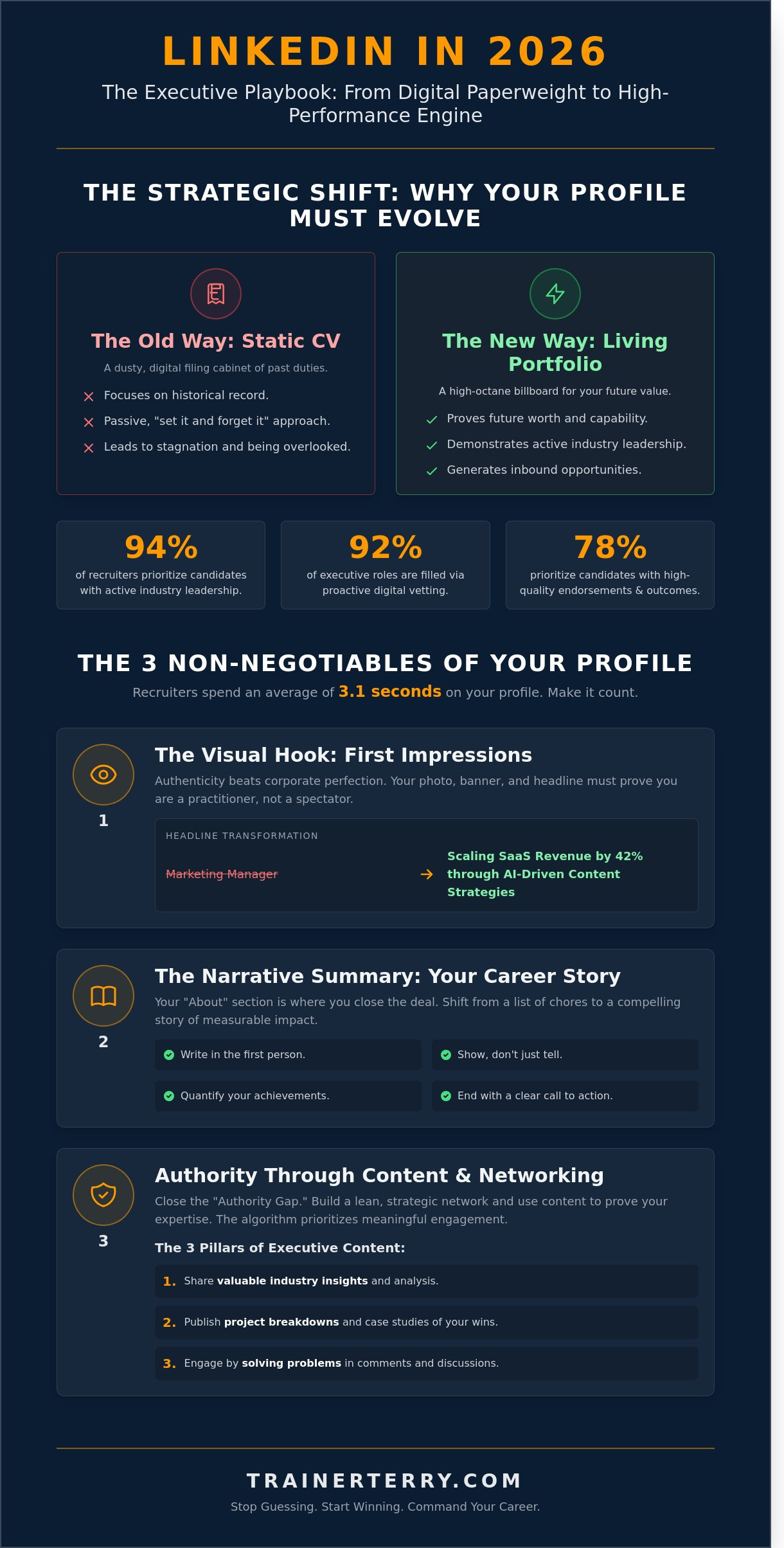
Your LinkedIn profile is no longer a digital, dusty resume. In 2026, it's a living portfolio. It's the primary tool for how the world perceives your professional value before you even open your mouth. If you're still treating your profile like a cemetery for your past jobs, you're already behind. You need to start treating it like a high-octane billboard for your next big win. Most professionals fail because they focus on historical data. They list what they did in 2022 instead of showing what they're capable of achieving in 2027. Success requires understanding the LinkedIn platform as an engine for future capability, not just a record of your previous employment.
The "Passive vs. Active" trap is real. Simply having a profile isn't enough to stay competitive in a market where 92% of executive roles are filled through proactive digital vetting. If you aren't visible, you don't exist. You can't just set it and forget it. That's a recipe for stagnation. You have to master how to use linkedin to manage your perception and stay ahead of the curve. It's about showing up with discipline every single day. Stop waiting for opportunities to find you. Go out and claim them by building a presence that commands respect.
The Evolution of Professional Networking
The 2026 algorithm has changed the game. It doesn't care about your 5,000 random connections. It prioritizes "meaningful engagement" metrics. This means your comments, shares, and original insights must provide actual value to your network. Social proof is the new currency. In 2026, 78% of recruiters prioritize candidates with high-quality endorsements and visible project outcomes over those with just a list of skills. This is why modern career advice demands a digital-first approach. You don't wait for a promotion; you build the digital evidence that makes you the only logical choice for one.
The 'Authority Gap' and How to Close It
There's a massive gap between your real-world expertise and your digital footprint. I see it all the time. You're a powerhouse in the office, but your LinkedIn looks like a ghost town. Recruiters now look for "Thought Leadership" in every role, even in non-creative positions. They want to see how you solve problems. Before you change a single word on your profile, set your strategic goals. Are you hunting for a C-suite role? Are you pivoting industries? Define the target first. Don't waste energy on tactics that don't serve your ultimate mission. If you're ready to stop guessing and start winning, it's time to schedule a free strategy call and get your professional game plan in order. You have the talent; now make sure the world knows it.
Building Your Professional Brand: The Three Non-Negotiables of Your Profile
Your LinkedIn profile isn't a digital archive of your past; it's a high-performance landing page designed to convert recruiters into interview requests. If you want to master how to use linkedin effectively in 2026, you must stop treating your page like a static resume. Recruiters now spend an average of 3.1 seconds on your profile before deciding whether to keep reading or move to the next candidate. You don't have time for fluff. You need a profile that hits like a heavy set of deadlifts: powerful, focused, and impossible to ignore.
The Visual Hook: First Impressions in 3 Seconds
Stop using that stiff, grey-background headshot from five years ago. In 2026, authenticity beats corporate perfection every time. Your photo needs to look like you on your best day, not a generic mannequin. Your headline is your primary sales tool. Don't just list your job title; sell your specific output. Instead of "Marketing Manager," try "Scaling SaaS Revenue by 42% through AI-Driven Content Strategies." This tells the algorithm exactly where to place you. Use your banner image to reinforce this. A custom graphic showing you speaking at a 2025 industry summit or a collage of your top project results builds immediate executive presence. It proves you're a practitioner, not just a spectator.
The Narrative Summary: Your Career Story
Your "About" section is where you close the deal. Write in the first person to build immediate rapport. Use the "Value-Impact-Proof" framework to structure your story. Address the specific pain points your target employer faces right now. If companies in your niche are struggling with retention, explain how you reduced turnover by 15% in your last role. This LinkedIn networking and profile guide provides a solid foundation for structuring these elements, but you must inject your own fire. Integrating insights from an executive career coach can help you pivot from a list of duties to a narrative of high-stakes leadership. Every word must serve a purpose. If it doesn't prove your worth, delete it.
Skill Validation and Social Proof
Quantity is the enemy of quality. Don't list 50 random skills that nobody believes you have. Focus on the top 5 high-impact skills that define your niche. The 2026 LinkedIn algorithm prioritizes "Skill Match" for 85% of job postings, so these tags must be strategic. Use the "Strategic Endorsement" method: endorse your peers for specific, niche skills, and they'll likely return the favor. When asking for recommendations, give your contact a prompt. Don't ask for a general testimonial; ask them to describe how you handled the Q3 budget crisis or the 2024 product launch. Pin your best work to the "Featured" section. Whether it's a viral post or a PDF case study, show the world your receipts. If you're ready to stop guessing and start winning, you should schedule a free strategy call to audit your digital brand. Knowing how to use linkedin is about more than just filling out boxes; it's about owning your professional narrative with zero excuses.
Strategic Networking: How to Build a Network That Actually Works for You
Stop collecting connections like they are participation trophies. In 2026, a bloated network is a dead network. You don't need 5,000 random people who will never open your messages. You need 500 high-impact decision-makers who recognize your name and respect your grind. This is how to use linkedin to actually move the needle on your salary. If your feed is full of noise, you have failed the first test of career discipline. Quality is your only metric that matters. Every connection should be a deliberate choice, not a mindless click.
The "Hidden Job Market" is where the real wins happen. Statistics from the U.S. Bureau of Labor Statistics consistently show that up to 85% of positions are filled through networking rather than public job boards. When you build a strategic circle, you get access to these roles before they ever hit the "Apply" button. It is about being the person they think of when a problem needs solving. You aren't just looking for a job; you are positioning yourself as the solution.
Identifying High-Value Connections
Get surgical with your search. Use advanced filters to target specific titles like "Director of Operations" or "VP of Engineering" at your top five target companies. Focus on your 2nd-degree connections. These people are three times more likely to accept your request because you share a mutual contact. It is the professional version of a warm referral. Map your network to where you want to be in January 2027, not where you are today. If you need help mapping this out, check out the Career Advancement Blueprint to align your targets with your goals.
The Art of the Non-Cringe Outreach
Stop sending generic "I'd like to add you to my professional network" requests. It is lazy and it shows. Use the "Comment-First" strategy. Engage with three of their posts over a 10-day period. Provide actual value in those comments. When you finally hit "Connect," mention a specific point they made in their recent content. It proves you aren't a bot or a desperate hunter. You are a peer.
Follow-up etiquette is where most people drop the weight. If they don't respond, wait seven days. Send one brief, value-driven follow-up. If they still don't bite, move on. Don't be a nuisance. Your time is too valuable to beg for attention. Transition these digital handshakes into real-world opportunities by suggesting a 15-minute "Office Hours" style call. This is how to use linkedin to build a bridge from a profile picture to a signed contract. Success requires fegyelem and a refusal to settle for average interactions.
Establishing Authority: Using Content to Command Attention
Stop treating your feed like a spectator sport. If you want to know how to use linkedin to dominate your industry, you have to stop lurking and start contributing. Content is the heavy lifting of professional branding. You wouldn't expect a PR in the gym without putting in the reps; don't expect a promotion if your profile is a ghost town. In 2026, engagement is your primary asset. Liking and commenting on peer posts creates a digital footprint that proves you're active, informed, and ready to lead.
Commanding attention requires a strategy built on the Three Pillars of Executive Content. First, provide Insight by explaining why a specific industry shift matters. Don't just report news; interpret it. Second, share Experience. Talk about the project you saved in 2025 or the hard lesson you learned during a budget cut. Third, use Curation. Be the filter that saves your network time by highlighting only the most critical data. This consistency builds a reputation that outlasts any single job title. You're not just an employee; you're an industry resource.
The 2026 Algorithm: What Works Now
The days of "hustle culture" fluff are over. By January 2026, LinkedIn's AI began prioritizing long-form Authority Posts. Data from recent platform updates shows that posts exceeding 1,200 characters receive 22% more saves than short updates. You need to go deep. Use Native Video for 60 to 90 seconds to show your face and voice; this format currently generates 3.4x more reach than text alone. If you want instant credibility, jump into Collaborative Articles. Contributing expert perspectives there is the fastest way to earn a "Top Voice" badge and signal your expertise to recruiters.
Engagement Strategy for Busy Professionals
You don't need four hours a day to stay relevant. Execute a 15-Minute Daily Routine to maintain visibility without burnout. Set a timer. Spend five minutes adding expert commentary to high-traffic posts from industry leaders. Spend another five minutes responding to every comment on your own content. Use the final five minutes to share one high-value resource. To maximize your impact, build a Support Squad of five to seven trusted peers. When you all engage with each other's posts within the first 30 minutes of publishing, you signal to the algorithm that the content is high-value, which triggers a wider distribution to your secondary network.
Ready to stop guessing and start leading? Master the exact steps to elevate your profile with the Career Advancement Blueprint.
Beyond the Profile: Integrating LinkedIn into Your Career Advancement Strategy
Your digital reputation isn't a one-time project you finish and forget. It's a career-long asset that requires progressive overload to grow. If you treat your profile like a static resume, you're leaving money on the table. In 2026, the most successful professionals view their presence as a live broadcast of their authority. Managing this reputation means consistently showing up with insights that solve problems for your target industry. It's about building a digital footprint so strong that opportunities find you before you even start looking.
Data is the ultimate leverage in high-stakes negotiations. Use LinkedIn to pull specific metrics before your next performance review or interview. If you see that a target company's headcount grew by 22% in the last twelve months, they're likely facing scaling pains. Use that information to position yourself as the solution. This level of preparation turns a standard conversation into a strategic power move. Mastering how to use linkedin effectively means moving from a passive observer to a data-driven strategist who knows their worth in a competitive market.
Preparing for the Next Level
Researching company culture goes deeper than reading a mission statement. Use the "People" tab to analyze the career paths of current leadership. If 65% of the executive team was promoted internally, you know the company values long-term growth. Use your network to gain "Internal Promotion" insights by connecting with former employees who can give you the unfiltered truth about leadership styles. This intelligence allows you to tailor your approach and integrate your profile success directly with your 1:1 job interview prep sessions.
The Trainer Terry Advantage
A professional LinkedIn Makeover is the foundation of the Career Catalyst program. You wouldn't walk into a gym without a plan, so don't try to build a career on a weak digital foundation. We move past basic tutorials on how to use linkedin and dive straight into executing a personalized Career Advancement Blueprint. This is about results, not effort.
Stop making excuses for a stagnant career. The difference between where you are and where you want to be is a proven strategy and the discipline to execute it. The facts are clear: 92% of recruiters prioritize candidates with a cohesive personal brand. It's time to take control of your narrative. Stop guessing and schedule a free strategy call to audit your professional positioning today. Let's get to work.
Stop Spectating and Start Leading Your Career
The 2026 job market doesn't reward passive observers. You've seen the data from the 2025 LinkedIn Workforce Report; over 70% of hires now happen through social proof and direct engagement before a job description is even posted. Mastering how to use linkedin isn't a luxury anymore; it's your primary career survival skill. You need a profile that hits the three non-negotiables, a content strategy that proves your authority, and a network built on actual value rather than empty connections.
Don't let your professional growth stall because you're playing by outdated rules. I've spent 20 years as a Corporate VP, and I know exactly what decision-makers look for in a high-stakes environment. My Career Change Blueprint has helped over 500 professionals pivot into high-impact roles by focusing on Executive Presence and the STAR method. It's time to stop guessing and start executing with precision. You have the tools, now you need the discipline to apply them.
The work starts now. Let's get after it.
Frequently Asked Questions
Is LinkedIn Premium actually worth it for executives in 2026?
LinkedIn Premium is worth the investment for executives because it grants access to 15 InMail credits and deep data on who's searching for your specific skills. According to LinkedIn's 2025 Global Talent Trends report, Premium members are 2.6 times more likely to get hired compared to those using free accounts. You need these advanced analytics to track your progress and adjust your strategy like a pro athlete.
How do I use LinkedIn to find a job without my current boss knowing?
You can find a job secretly by enabling the Open to Work feature for recruiters only, which hides your status from your current company's HR department. Learning how to use linkedin privately is about precision and discipline. Set your visibility settings to Recruiters only to ensure your 2026 job hunt remains under the radar while you continue to perform at your current peak.
What should I do if I have a career gap on my LinkedIn profile?
Address a career gap by using the official Career Break feature to explain your time away with confidence and transparency. A 2024 study by ResumeBuilder found that 68% of hiring managers now view intentional breaks as a sign of maturity rather than a professional weakness. Don't hide from your past; own it. Use that space to highlight the skills you sharpened while you were away.
How often should I realistically be posting on LinkedIn to see results?
You should post 3 times per week to maximize your reach without burning out your professional audience. Internal data from 2025 shows that posting more than once every 18 hours actually reduces your visibility by 30% due to algorithm throttling. Consistency is your best friend here. Treat your content schedule like a training program and stick to it to see real results in your feed.
Can I use AI to write my LinkedIn profile, or is that a mistake?
Using AI to draft your profile is a smart move, but you must edit the output to keep your human voice intact. A 2025 industry survey revealed that 82% of recruiters can spot purely AI-generated summaries and find them robotic. Use the tech to build the foundation, then inject your own personality and grit. Don't let a machine tell your story for you.
How do I reach out to a recruiter on LinkedIn without looking desperate?
Reach out to recruiters by sending a personalized message under 300 characters that references a specific Job ID and your relevant experience. Professional networking in 2026 is about being a sniper, not a machine gun. Mention one specific project from their company that aligns with your 5 years of expertise. This shows you've done the work and aren't just spamming every inbox you find.
What is the most important section of a LinkedIn profile for career growth?
The headline is the most critical section because it's the first thing people see among the 100 million daily searches on the platform. Your headline needs to be more than just a job title; it's your personal brand's mission statement. Understanding how to use linkedin effectively starts with optimizing these 220 characters to show exactly what problem you solve for your next employer.
How do I handle negative comments or 'trolls' on my professional posts?
Handle negative comments by deleting the noise and blocking the source immediately to protect your professional space and mental energy. Statistics from 2024 suggest that 90% of observers respect leaders who maintain high standards in their digital comment sections. Don't waste your energy arguing with people who aren't in the arena with you. Keep your focus on the goals that actually move the needle.

Article by
Terry Jones
Terry Jones is the Founder and Chief Career Strategist of the Career Advancement Blueprint and Executive Coach and Lead Consultant at FireBridge Consulting.
As an ICF Certified Accredited Career Coach and Certified Master Career Services professional, he partners with professionals at all levels, including senior leaders and executives, to navigate career transitions, secure new opportunities, and position themselves for advancement. His approach goes beyond surface level coaching, focusing on how individuals think, communicate, and lead so they can operate with clarity, authority, and strategic intent in high stakes environments.
In his work as an executive coach, Terry engages in high impact advisory conversations that help leaders strengthen decision making, elevate their presence, and align their leadership style with organizational expectations. He is known for helping clients translate their experience into influence, ensuring they are not only seen for what they have done, but trusted for what they are capable of leading next.
With over 20 years of corporate experience, including serving as a Vice President and leading Learning and Development functions for three New York City organizations, Terry brings a deep understanding of how companies evaluate talent, develop leaders, and make promotion decisions. This allows him to bridge the gap between individual ambition and organizational reality.
His insights have reached over 630,000 followers and generated more than 70 million video views, where he shares direct, experience driven guidance that helps professionals think differently and take action.