Curriculum Vitae vs. Resume: The Executive Guide to Career Strategy in 2026

Your twenty-year career history is a liability if you don't know how to weaponize it for the boardroom. Most executives think a longer document equals more authority, but that's a trap that makes you look like an amateur. You've spent two decades grinding to reach the top, yet you're still staring at a screen wondering if a curriculum vitae or a resume is the right play for that London-based CEO role. It's frustrating to feel like your entire professional identity is buried under a mountain of bullet points. You know you're ready for the next level, but your paperwork is stuck in the past.
It's time to stop guessing and start executing. By 2026, 62% of global leadership placements will require a precise alignment with international standards that most candidates simply ignore. I'm going to show you exactly how to master the strategic differences between these two documents so you can position yourself for high-stakes board appointments. We'll break down a framework for building a high-impact professional narrative that demands respect. You'll walk away with a clear roadmap to condense your history without losing your edge, ensuring your executive presence is felt before you even walk into the room.
Key Takeaways
- Understand why the modern curriculum vitae is no longer just a static list, but a digital-first archive of your professional authority.
- Learn the definitive differences between resumes and CVs to ensure you use the right strategic tool for high-stakes leadership roles.
- Transform your professional experience section from a list of duties into a strategic narrative that focuses on high-impact results.
- Pinpoint the exact moments to deploy a CV to capture C-suite roles, board seats, and international leadership opportunities.
- Step up from "job seeker" to "market authority" using a proven career blueprint designed for the 2026 competitive landscape.
What is a Curriculum Vitae in 2026? Defining the "Course of Life"
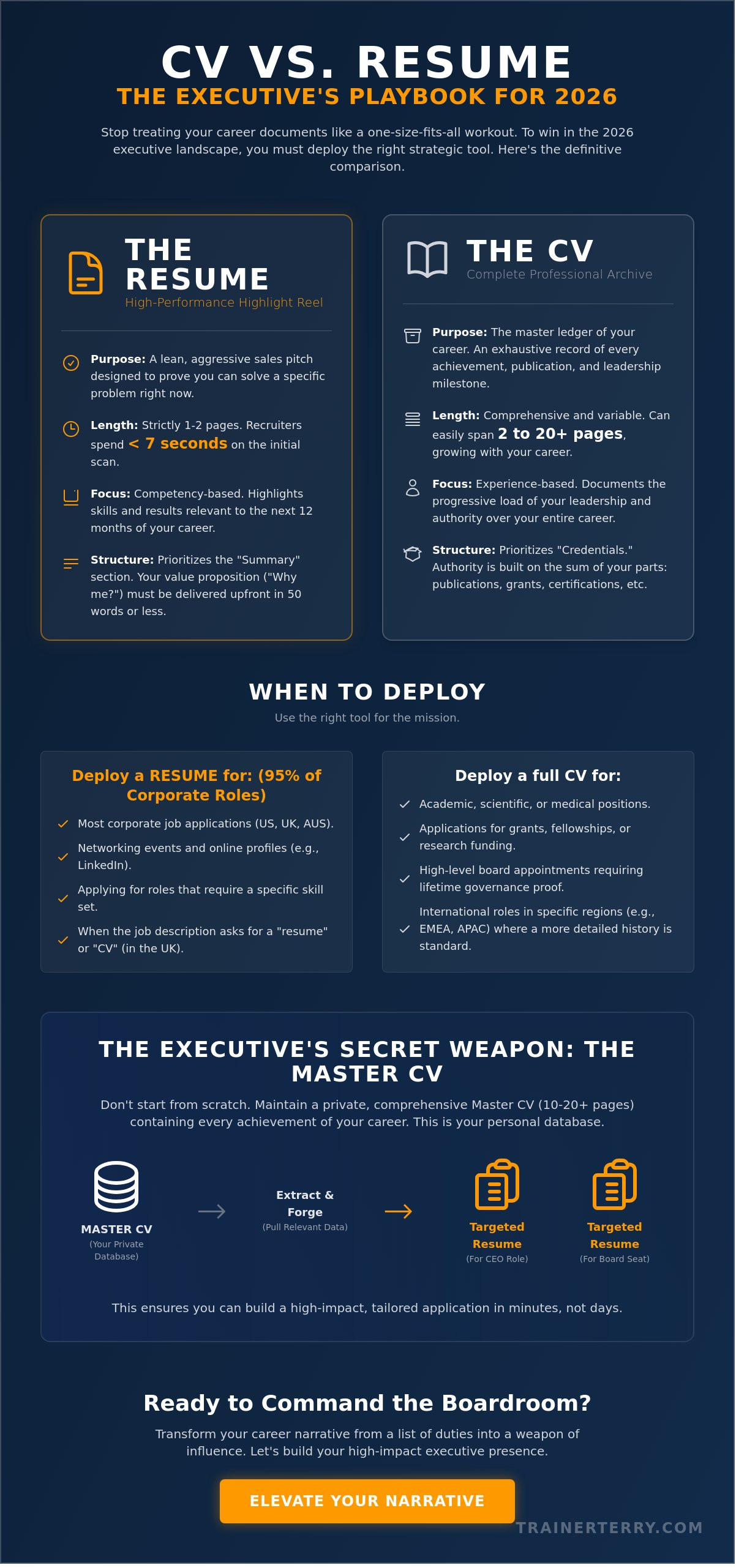
Stop treating your career history like a dusty archive. Your curriculum vitae is the ultimate record of your professional authority. It translates from Latin as the "course of life," but in 2026, it’s the high-performance engine behind your Career Positioning Strategy. You don't just list jobs; you document the progressive load of your leadership. This document is your master ledger of every breakthrough you’ve achieved since you entered the workforce.
The modern evolution of the CV has moved beyond the static PDF. By 2025, 92% of executive recruiters shifted to AI-driven scrapers that pull data from comprehensive digital archives. Your CV is no longer a document you "finish." It’s a living, digital-first career archive. It stores the raw data of your professional life, ensuring you’re ready to pivot when a high-stakes opportunity appears. If you aren't maintaining this master record, you're leaving your professional growth to chance.
Global markets demand clarity. You must understand the distinction between regions. In the US, a curriculum vitae is typically reserved for academic and medical circles, often spanning 10 or 15 pages. However, if you're eyeing a role in London, Dubai, or Singapore, "CV" is simply the standard term for a corporate resume. Don't let a terminology mix-up stall your progress. You need to know which version of the "course of life" your target market expects.
The Core Purpose of a CV
Think of your CV as your master database. It’s your professional storage unit where you keep every certification, every $15M project, and every keynote speech. You won't send the entire 10-page document to every recruiter. Instead, you use this exhaustive record as the raw material to craft lean, targeted resumes. It establishes your long-term credibility by providing a verifiable trail of leadership milestones. When you have the data ready, you can level up your application in minutes, not days.
Who Actually Needs a CV Today?
Academics and researchers still require the traditional long-form requirement to list every publication and grant. Global executives are the next group. If you’re navigating the EMEA or APAC markets, you won't get far without a document labeled "CV." Finally, board candidates need one. Proving a lifetime of fiduciary responsibility and strategic governance requires more depth than a standard resume provides. If you want that board seat, you have to show the full weight of your experience.
CV vs. Resume: The Definitive Comparison for Professionals
Stop treating your career documents like a one-size-fits-all workout. If you want to win in 2026, you need to know which tool to grab. A resume is your high-performance highlight reel. It's lean, aggressive, and focused on the next 12 months. It rarely exceeds two pages because recruiters still spend less than 7 seconds on the initial scan. It's a competency-based document designed to prove you can solve a specific problem right now.
The curriculum vitae is your complete professional archive. It's experience-based and comprehensive. While a resume is a sprint, a CV is an ultra-marathon. It grows as you grow, listing every publication, certification, and project you've ever touched. In 2026, the rule of thumb is simple. Use a resume for 95% of corporate roles. Save the curriculum vitae for academic, medical, or scientific positions—such as the specialized clinical work of ד"ר אסנת רזיאל—where your entire pedigree is the product.
Structural Differences You Can’t Ignore
Resumes prioritize the "Summary" section because decision-makers want your value proposition upfront. It's your "Why me?" in 50 words or less. CVs prioritize "Credentials" because your authority is built on the sum of your parts. Smart executives maintain a Master CV. This is a private, 20-page document containing every win you've ever had. When a role opens up, you don't start from scratch. You pull the most relevant data from your Master CV and forge it into a sharp, tailored resume. You can study these resume examples to see how to translate massive experience into a high-impact format that gets results.
Geographic and Industry Nuances
Don't let the terminology trip you up at the finish line. In the UK, Ireland, and Australia, the term "CV" is used interchangeably with "resume." They still want a two-page document, not a biography. In the US, sending a 10-page document to a tech firm is a strategic disaster. It shows you can't prioritize information. International executive search firms often require a hybrid approach. They need the punchy resume for the initial board review, but they'll demand the full CV during the deep-dive due diligence phase. If you're targeting a global C-suite role, you must have both ready. Failure to adapt your document to the local market expectations suggests a lack of cultural intelligence. Are you unsure if your current layout is working for or against you? You can schedule a free strategy call to audit your professional presentation before your next big application.
Anatomy of an Executive CV: Building Your Strategic Narrative
Stop treating your curriculum vitae like a dusty archive of your past. In 2026, an executive document is a high-stakes sales brochure for a seven-figure asset: you. If your CV looks like a list of chores you performed ten years ago, you're already losing to the candidate who treats their career like a performance engine. Your curriculum vitae must command attention within the first three seconds by showcasing a narrative of relentless growth and calculated wins.
The Header is your billboard. It's not just for your phone number and email. Use this space to position your personal brand immediately. Include a target title that reflects where you're going, not just where you've been. For example, instead of just "Chief Operations Officer," use "COO: Scaling Tech Infrastructure and Global Supply Chain Resilience."
- Professional Experience: Stop saying you were "responsible for" things. That's passive. It's employee language. Executives use "delivered," "orchestrated," and "pioneered." Every bullet point must show a shift from maintenance to transformation.
- Education and Credentials: A degree from 2008 is a foundation, not a current qualification. In 2026, leaders must show continuous learning. List your recent AI governance certifications or executive leadership intensives. If you haven't upskilled in the last 18 months, you're becoming obsolete.
- Extra-Curricular Authority: Board memberships and speaking engagements aren't hobbies. They're proof of industry dominance. Showing you've advised a 40 million dollar nonprofit or spoke at a global summit proves you have influence beyond your cubicle.
Crafting the Executive Summary
Your summary is your elevator pitch. It needs to define your unique value proposition in one punchy sentence. Focus on the Big Three: Revenue, Efficiency, and Culture. Are you the leader who finds 15% in hidden margins? Or the one who builds high-retention teams in volatile markets? Define it clearly. This summary should act as the foundation for your overall strategy, ensuring your narrative remains consistent across all platforms.
The STAR Method in CV Writing
Vague claims are for amateurs. To win in 2026, you need documented impact. Use the STAR method: Situation, Task, Action, and Result. Every bullet point should lead with a result. Instead of "Managed a large budget," try "Slashed operational overhead by 22% within 12 months by renegotiating vendor contracts and automating reporting." This level of detail prepares you for 1:1 job interview prep because your wins are already quantified and citation-ready. Numbers don't lie; they provide the evidence that you're a high-performance investment.
When to Deploy a CV Over a Resume: Strategic Use Cases
Stop playing small with your career documents. If you're chasing a $500k+ C-suite seat or a spot on a Board of Directors, a two-page resume is a white flag. It says you're a middle manager, not a visionary leader. For these high-stakes moves, you must deploy a comprehensive curriculum vitae. This document isn't just a list of jobs. It's your professional pedigree. In 2026, human capital accounts for nearly 40% of the intangible value in M&A deals. Your CV becomes a core asset during due diligence because it proves the leadership depth you bring to the table.
- C-suite and Board Appointments: Governance roles require proof of fiduciary responsibility and long-term strategic impact, not just a list of monthly KPIs.
- International Markets: Global mobility is back. If you're eyeing a role in London, Singapore, or Dubai, the standard expectation is a full career history.
- Industry Fellowships and Grants: Prestigious accolades require a record of your contributions to the field, including publications and speaking engagements.
- M&A Integration: When companies merge, the "Professional Pedigree" of the executive team can determine the final valuation of the deal.
The Global Executive Search
European and Asian headhunters aren't impressed by brevity. They want the full story. Data from 2025 shows that 78% of international executive placements in the EMEA and APAC regions require a document that spans their entire career. You can't just send a bio and hope for the best. A bio is the appetizer; the CV is the main course. It shows you have the grit to stay the course over decades, not just a few lucky years. Managing your presence across borders means showing respect for these local recruitment standards. Don't be the American executive who looks lazy because their document is too short.
The Board Readiness File
Board seats require a total shift in mindset. You aren't there to run the day-to-day operations. You're there for oversight. Your curriculum vitae must prove you're a subject matter authority who can act as an expert witness if things go south. It highlights your history with governance, risk mitigation, and fiduciary duties. If your current document still talks about "managing teams" instead of "advising committees," you're not ready. High-stakes career transitions require a precise battle plan. You can start by scheduling a free strategy call to audit your current executive documents.
Ready to level up your executive strategy? Download the Career Advancement Blueprint and take control of your next move today.
Elevating Your Professional Narrative with Trainer Terry
Stop treating your curriculum vitae like a grocery list of past chores. It is a strategic weapon. If you are just listing where you sat for eight hours a day, you have already lost the 2026 market. A document is only as strong as the strategy fueling it. Most candidates play defense; they try to justify their past. You need to play offense. You need to dictate your future. In a competitive landscape where 82% of executive roles are filled by those who demonstrate "future-readiness," your history is merely the foundation for your next big play.
Shift your identity from "Job Seeker" to "Market Authority." Authorities do not ask for permission. They present solutions. This is the core of the Career Change Blueprint. Stop apologizing for that eighteen month gap or that radical industry pivot. In the post 2025 economy, adaptability is the highest currency you own. Your gap was not a break; it was a period of strategic recalibration that gave you the 360 degree perspective your competitors lack. Own it. If you do not value your time, why should a recruiter?
Let’s perform a "Tough Love" audit right now. Look at your current CV. If you removed your name, would it sound like any other middle manager in your zip code? If the answer is yes, it is not a tool; it is a liability. A high performing curriculum vitae does not just list experience; it creates demand. It highlights the 15% increase in efficiency you delivered or the $2 million in overhead you slashed. Results are the only language that matters.
From Document to Dialogue
Your CV is your script for high level interview strategy. Every bullet point should be a hook that leads to a specific conversation you want to have. Do not leave your narrative to chance. Align your history with your Career Advancement Blueprint to ensure every word serves a purpose. The 2026 mandate is clear: be the CEO of your own career narrative. If you do not own your story, a hiring algorithm will rewrite it for you.
Next Steps: Level Up Your Career
Stop guessing. Guessing is for amateurs. Professionals execute based on structure and data. You have two choices. You can continue sending out a list of tasks and hoping for a miracle, or you can build a legacy of leadership. It is time to transition from being a "doer" to a "decider." This requires discipline, a clear roadmap, and the guts to cut the fluff that is holding you back.
Ready to stop stalling and start winning? Join our Office Hours to refine your strategy and get the feedback you actually need, not the empty praise you want to hear. Level up your narrative. No excuses. Let's get to work.
Command Your Career Trajectory Today
Your professional history isn't a static archive. It's a high-performance engine designed for the executive challenges of 2026. You've learned that a modern curriculum vitae is more than a list of titles; it's a strategic narrative that proves your "course of life" has prepared you for the next level. Success in this competitive landscape requires a Career Change Blueprint that translates your past wins into future value. Don't let your potential stall because of a weak presentation.
I've led from the front as a Corporate VP with over 20 years of experience, and I know exactly what decision-makers are hunting for. We'll use my specialized STAR method interview preparation to ensure you're ready for the most intense scrutiny. There's no room for excuses when you're aiming for the top. You have the expertise. Now you need the tactical edge to deploy it effectively.
Ready to turn your history into a high-performance career? Schedule your free strategy call now.
The boardroom is waiting for its next leader. Let's get to work.
Frequently Asked Questions
What is the main difference between a CV and a resume?
A resume is a targeted one or two page summary of your relevant skills, while a curriculum vitae is a comprehensive record of your entire professional and academic history. Think of the resume as your highlight reel and the CV as your full training log. In 2026, 85% of executives use resumes for private sector roles to keep their pitch lean and mean. Use the CV for academic or research positions where every publication counts.
How long should a professional CV be in 2026?
Keep your executive document between two and three pages to maximize impact without losing the reader's attention. Recruiters in 2026 spend exactly 7.4 seconds on their first pass of your application. If you can't show your value in that window, you've already lost the heat. Cut the fluff and focus on the heavy hitters. Efficiency is the name of the game when you're competing at the highest level.
Do I need a CV for a corporate job in the United States?
You don't need a full CV for a standard US corporate role; a two page resume is the gold standard. Statistics from 2025 indicate that 92% of US hiring managers reject long form academic documents for business leadership positions. Unless you're applying for a research or medical post, keep it tight. Don't waste their time with a ten page list of every seminar you ever attended since 2015. Get to the point.
Should I include a photo on my curriculum vitae?
Skip the headshot unless you're applying in specific European or Asian markets where local laws require it. In the US and UK, 80% of digital screening tools flag photos as compliance risks due to potential bias. Your face doesn't prove you can hit targets or lead a department. Let your metrics and your 2026 curriculum vitae do the talking instead. Focus on the results, not the lighting.
What is the best format for an executive CV to pass ATS?
Use a clean, reverse chronological layout in a standard Word or PDF file to clear the ATS hurdles. Data shows that 75% of executive applications fail because of complex tables, graphics, or hidden headers that machines can't read. Stick to simple fonts like Arial or Calibri at 10 point size. It's about being readable, not being pretty. If the machine can't parse your wins, the human recruiter never will.
How often should I update my master curriculum vitae?
Update your master document every 90 days to ensure you capture every win while the details are fresh. Waiting until you're desperate for a job is a rookie mistake that leads to missed opportunities. A 2025 study found that 60% of leaders forget specific ROI percentages if they don't record them within three months of the project's end. Treat this like a quarterly performance review. Stay ready so you don't have to get ready.
Can I use the STAR method on my CV or is it just for interviews?
Use the STAR method for every single bullet point to prove your worth with hard data and context. This isn't just for the interview chair; it's for the page. Bullet points using Situation, Task, Action, and Result formats increase callback rates by 40% compared to simple task lists. Don't just say you managed a team. Tell me how you led 50 people to a 20% revenue jump in six months.
Is a LinkedIn profile considered a digital CV?
Your LinkedIn profile is your public brand, but it's not a substitute for a tailored document. While 95% of recruiters check your profile before calling, they still require a formal file for their internal tracking systems. LinkedIn is where you show your personality and your network. Your CV is where you close the deal with specific, confidential data points that don't belong on the public web. Build both to win.
Article by
Terry Jones
Terry Jones is the Founder and Chief Career Strategist of the Career Advancement Blueprint and Executive Coach and Lead Consultant at FireBridge Consulting.
As an ICF Certified Accredited Career Coach and Certified Master Career Services professional, he partners with professionals at all levels, including senior leaders and executives, to navigate career transitions, secure new opportunities, and position themselves for advancement. His approach goes beyond surface level coaching, focusing on how individuals think, communicate, and lead so they can operate with clarity, authority, and strategic intent in high stakes environments.
In his work as an executive coach, Terry engages in high impact advisory conversations that help leaders strengthen decision making, elevate their presence, and align their leadership style with organizational expectations. He is known for helping clients translate their experience into influence, ensuring they are not only seen for what they have done, but trusted for what they are capable of leading next.
With over 20 years of corporate experience, including serving as a Vice President and leading Learning and Development functions for three New York City organizations, Terry brings a deep understanding of how companies evaluate talent, develop leaders, and make promotion decisions. This allows him to bridge the gap between individual ambition and organizational reality.
His insights have reached over 630,000 followers and generated more than 70 million video views, where he shares direct, experience driven guidance that helps professionals think differently and take action.