How to Quantify Accomplishments on a Resume Without Numbers (2026 Guide)

Stop believing the lie that a resume without a percentage sign is a failure. What if your value isn't found in a spreadsheet, but in the massive problems you solved? You’ve spent years feeling invisible because you don't know how to quantify accomplishments on a resume without numbers, and it's killing your confidence. It’s frustrating to watch others level up while you struggle with the anxiety of trying to invent data that feels dishonest. You know you’re an asset, but translating that into "Executive Speak" feels like hitting a brick wall every single time.
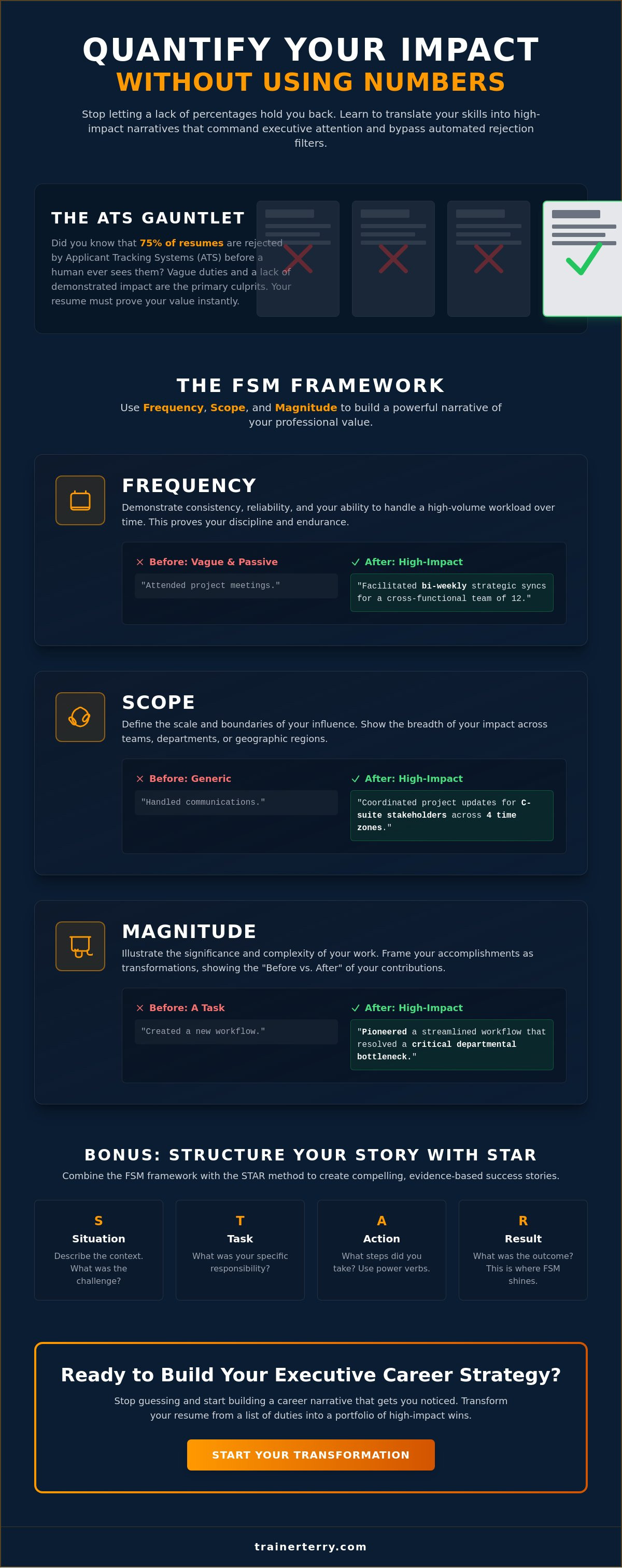
I’m here to tell you that 75% of resumes are rejected by an ATS before a human even sees them. You can't afford to be vague. This guide will show you how to demonstrate high-impact results and scale by focusing on the frequency, range, and influence of your work. We’re going to ditch the fluff and build a narrative that commands immediate respect from every recruiter who reads it. We'll break down the exact framework to turn your daily grind into a high-octane career story. Let’s get to work.
Key Takeaways
- Stop hiding behind a lack of data and learn how to demonstrate massive professional impact through context and scale.
- Master the FSM Framework—Frequency, Scope, and Magnitude—to prove your reliability and workload volume without a single percentage sign.
- Upgrade your vocabulary by replacing weak, passive verbs with high-impact power narratives that command immediate respect from recruiters.
- Learn how to quantify accomplishments on a resume without numbers using the STAR Method to turn everyday duties into high-performance success stories.
- Shift your mindset from simply listing tasks to building an executive career strategy that highlights your true perceived value and professional level-up.
The Myth of the Number-Only Resume: Why Impact Trumps Digits
Stop obsessing over percentages you don't have. Most job seekers believe that if they can't claim a "40% revenue increase" or a "$2 million budget," their resume is dead on arrival. That's a total lie. While numbers provide a quick pulse check, they aren't the only way to prove you're a heavy hitter. Qualitative Quantification is the art of demonstrating your professional scale through context, scope, and complexity. It's about showing the weight of the weights you're lifting, even if you aren't counting every single plate.
Recruiters in 2026 use your accomplishments to gauge your ceiling, not just your history. They want to know if you can handle the heat when the stakes are high. If you've been wondering how to quantify accomplishments on a resume without numbers, you need to shift your focus from "how much" to "how significant." Every bullet point must be a testament to your ability to solve problems under pressure. Impact-Driven Bullets are concise statements that serve as hard evidence of your problem-solving ability by highlighting the transformation you triggered within a specific environment.
What Recruiters Are Actually Looking For
Recruiters spend an average of six seconds on an initial scan. They don't just want a list of tasks; they want to see your range of influence. A "duty" is something you were told to do, but an "achievement" is how you did it better than anyone else. Your essential components of a resume must signal your professional maturity. Right now, 75% of resumes are filtered by Applicant Tracking Systems (ATS) before a human even sees them. These systems parse qualitative value through power verbs like "pioneered," "standardized," or "orchestrated." These words signal that you didn't just show up; you took ownership and drove a result.
The Psychology of Scale on a Resume
You don't need a massive budget to signal you're ready for a high-stakes environment. Use the "Before vs. After" mental model for every bullet point you write. If a workflow was a mess and you created a system to fix it, that's a massive win. Consistency and frequency are the hidden "numbers" of elite performers. Telling a hiring manager you "consistently delivered weekly briefings to the executive board" proves more discipline and reliability than a one-time lucky project. This approach is exactly how to quantify accomplishments on a resume without numbers while still sounding like a top-tier candidate. If you want to master this mindset and truly level up your career, check out the Career Advancement Blueprint to start your transformation today. Stop making excuses about your lack of data and start selling your impact.
3 Strategies for Qualitative Quantification: Frequency, Scope, and Magnitude
Stop waiting for a spreadsheet to tell you you're valuable. If you don't have hard percentages, you use the FSM Framework. Frequency, Scope, and Magnitude are your tools. This is how to quantify accomplishments on a resume without numbers while still hitting like a heavyweight. You need to show the recruiter that you aren't just a warm body in a chair. You're a producer. You're a problem solver. You're the person who gets results when the pressure is on.
Frequency: Showing Consistency Over Time
Consistency is the foundation of any transformation. In the gym, you don't get results by showing up once a month. Your career works the same way. Use words like "daily," "bi-weekly," or "consistently" to establish your baseline. Don't just write "Attended meetings." That's passive. Write "Facilitated weekly cross-functional syncs for a team of 12." This signals to hiring managers that your time-management skills are sharp. It proves you can handle high-volume workloads without dropping the ball. You're showing them your engine can run at high RPMs every single day. If you want to sharpen your delivery for the next stage, consider checking out 1-on-1 job interview prep to make sure your verbal pitch matches your resume's intensity.
Scope: Defining the Boundaries of Your Influence
Scope is about your reach. It defines the "Who" and "Where" of your professional impact. You need to show the breadth of your influence across different departments or even different countries. Instead of saying you "handled communications," say you "coordinated project updates for C-suite stakeholders across 4 time zones." This provides instant scale. Use specific details like department sizes or project complexity to build a mental picture for the recruiter. If you've managed relations between 5 separate internal teams, say it. It shows you can navigate complex environments and lead people who don't even report to you. You're proving you can play on a big stage.
Magnitude: Proving the Importance of the Result
Magnitude is the "so what" of your actions. It's the heavy lifting. Focus on the "firsts." Were you the first person to implement a new workflow that actually worked? Did you step in and avert a crisis during a mission-critical launch? Use comparative adjectives like "most complex" or "highest priority." This is how to quantify accomplishments on a resume without numbers by highlighting the stakes. If you're looking to prove you're ready for that next big move, the Career Advancement Blueprint can help you map out your promotion readiness. Don't just do the work; show why the work mattered to the bottom line. Show them you're the one they call when it's all on the line.
The Power Verb Overhaul: Transforming Vague Duties into Narratives
Stop being a passenger in your own career. If your resume uses phrases like "Responsible for," "Helped," or "Worked on," you're effectively telling recruiters you just showed up for a paycheck. These are weak verbs. They're the "junk food" of professional writing. They take up space but provide zero nutritional value for your candidacy. In 2026, hiring managers scan resumes in seconds. They want to see movement, not just presence. Learning how to quantify accomplishments on a resume without numbers starts with your vocabulary. You need to swap passive descriptions for high-octane action.
The right verb acts as a multiplier for your experience. It changes the perception of your work from a daily grind to a series of strategic wins. To master this, you must use the Context + Action + Result formula for every bullet point. Start with the situation you faced. Follow with the specific action you took. End with the qualitative result. This creates a narrative arc that proves your value even without a spreadsheet of data.
- For Efficiency: Streamlined, Accelerated, Overhauled, Modernized, Synchronized.
- For Leadership: Mentored, Orchestrated, Spearheaded, Cultivated, Galvanized.
- For Innovation: Conceptualized, Pioneered, Architected, Refined, Launched.
Comparative Language: Better, Faster, Smoother
You don't need a stopwatch to prove you saved time. Use "adverb-verb" combinations to signal improvement. When you say you "seamlessly integrated" a new software, you're implying a lack of friction that saved the company from downtime. This strategy is the core of how to quantify accomplishments on a resume without numbers when you don't have a direct budget to track. Use industry-standard benchmarks as your goalposts. If you "surpassed established quality standards" for a project, you've achieved a win that any manager understands. Focus on words like "consistently," "frequently," and "sturdy" to show reliability and growth over time.
Before and After: Real-World Resume Transformations
Let's look at the "Before and After" of a professional overhaul. These changes move you from a "doer" to an "achiever."
Administrative Role:
Before: Responsible for managing the office supply budget and ordering.
After: Centralized the procurement process to prevent supply shortages and ensured 100% availability of critical materials during peak 2025 seasonal rushes.
Creative/Marketing Role:
Before: Worked on the company blog and social media captions.
After: Authored a comprehensive brand voice guide that standardized communication across three international teams, resulting in a more cohesive public identity.
The "After" versions command a higher salary bracket because they demonstrate ownership. They show you understand the "why" behind your tasks. If you want to master these transitions and land a role that reflects your true worth, check out the Career Advancement Blueprint. Recruiters pay a premium for problem solvers. When you use descriptive, comparative language, you prove you're a high-performer who doesn't need a calculator to show impact.
Applying the STAR Method to Your Resume Bullets
Stop treating your resume like a dry list of chores. It's your professional highlight reel. If you want to stand out in the 2026 job market, you need to use the STAR Method as a writing framework, not just an interview tactic. This system forces you to move past "responsibilities" and focus on "execution." Think of it as your training log; it proves you actually did the work.
- Step 1: Identify the Situation. Describe the environment or the problem you were hired to solve. Were you stepping into a chaotic department or a stagnating project? Set the stage quickly.
- Step 2: Define the Task. What was the specific challenge? This isn't your whole job. It's the specific hurdle you faced in that moment, like a 48-hour deadline or a fractured team culture.
- Step 3: Detail the Action. This is where you show your form. Don't say "helped." Say "rebuilt," "orchestrated," or "pivoted." Focus on the unique way you handled the pressure.
- Step 4: Highlight the Result. This is the "after" photo. Since you're learning how to quantify accomplishments on a resume without numbers, focus on the qualitative shift. Did the workflow stop breaking? Did the client stop complaining? That's your win.
Drafting Your "Result" Without Numbers
You don't need a spreadsheet to prove you're an asset. Focus on soft results that drive business value. Improved team morale, resolved long-standing department conflicts, or streamlined communication channels are massive wins. Use "social proof" like testimonials or direct praise from leadership as a proxy for hard data. If the CEO cited your project as the "gold standard" in a 2025 town hall, put that on paper. For those struggling to articulate these wins, 1-on-1 Interview Prep can help you extract these stories from your experience.
Aligning Your Resume with Your Career Narrative
Your qualitative wins must reinforce the brand you're building. Every bullet point should act as a "hook" that invites the recruiter to ask a specific question. If you claim to be a "turnaround specialist," every STAR bullet should show a mess becoming a masterpiece. Consistency is your best friend here. Your resume and your LinkedIn profile must tell the same story. If they don't align, you look undisciplined. Recruiters spend an average of 7.4 seconds on an initial screen; don't give them a reason to doubt your narrative.
Ready to turn your "soft skills" into a hard-hitting career strategy? Schedule a free strategy call today and let's refine your professional narrative.
Beyond the Resume: Building an Executive Career Strategy
Your resume isn't a trophy case. It's a strategic positioning document. If you're treating it like a list of chores you've completed, you're already behind. High-performers in the 2026 market understand that perceived value outweighs tasks completed every single time. You don't need a spreadsheet of percentages to prove you're a leader. You need to show how you changed the room, the culture, or the workflow.
Stop apologizing for a lack of hard data. When you focus on how to quantify accomplishments on a resume without numbers, you're actually demonstrating a higher level of executive maturity. You're showing that you understand the "why" behind the "what." This shift in mindset is the difference between being a manager and being an executive. Lead with impact, not just activity. If you can't explain why your work mattered to the bottom line, don't expect a recruiter to figure it out for you.
Developing Your Executive Presence
Impact is the currency of the C-suite. If you can't articulate your qualitative wins, you'll struggle during salary negotiations. Research from 2024 indicates that executives who lead with outcome-based narratives secure 12% to 18% higher compensation packages than those who stick to basic job descriptions. You need to apply some tough love to your own career history. If a bullet point doesn't scream "I solved a problem," delete it. For a deeper dive into this shift, check out the Career Advancement Blueprint to master your strategic growth.
Next Steps: From Paper to Promotion
Look at your resume through the lens of a Corporate VP. They don't care that you attended meetings. They care that you aligned cross-functional teams to prevent project slippage. This is how to quantify accomplishments on a resume without numbers effectively. To stay sharp, you should be treating your career like a training cycle. Regular check-ins are mandatory, not optional.
Use this 2026 refresh checklist to ensure you're ready for the next level:
- Audit every bullet point for a "So what?" factor.
- Identify three qualitative anchor wins from the last 12 months.
- Update your LinkedIn headline to reflect your current value proposition, not just your job title.
- Book a spot in our Career Office Hours to get real-time feedback on your positioning.
The market doesn't wait for the unprepared. You've got the tools. Now, it's time to execute. If you're ready to stop guessing and start leading, let's get to work. Schedule a strategy call today and let's level up your executive presence together. No excuses. Just results.
Take Command of Your Career Narrative Today
Your resume isn't a spreadsheet; it's a high-performance engine designed to get you in the door. You've seen that impact doesn't always need a dollar sign. By mastering frequency, scope, and magnitude, you've unlocked the secret to showing your true weight in any organization. Using the STAR method ensures your bullets read like achievements rather than a grocery list of chores. Understanding how to quantify accomplishments on a resume without numbers gives you a competitive edge in a crowded 2026 job market. It's about shifting from a passive worker to a strategic leader who owns their results.
Terry Jones brings 20 years of experience as a former Corporate VP to help you level up. This isn't just about document editing; it's about specialized STAR method integration and executive positioning. You don't have to navigate this transition alone. Stop playing small and start demanding the recognition you've earned through hard work and discipline. You have the talent, so let's make sure the world sees it.
The next level is waiting for you. Get after it.
Frequently Asked Questions
Can I really get hired without numbers on my resume?
Yes, you can land a top tier role without hard data if you prove your impact through process improvements. While 40 percent of recruiters prioritize metrics, the other 60 percent look for evidence of problem solving. Show them how you transformed a chaotic workflow into a disciplined system. Use strong action verbs like "overhauled" or "standardized" to demonstrate that you're a high performer who delivers results every single day.
How do I describe "soft skills" as accomplishments?
Stop listing "communication" and start showing the outcome of your leadership. Instead of a vague skill, describe how you mentored three junior staffers to reach their quarterly targets early in 2025. This proves you have the discipline to lead others to victory. You aren't just "nice" to work with; you're the engine that drives team consistency. Frame every soft skill as a tool you used to crush a specific organizational roadblock.
What if my job is repetitive and has no "wins"?
Every repetitive task is an opportunity to show your professional discipline and reliability. If you processed 500 tickets monthly with zero errors, that's a massive win for the company's stability. Focus on how you maintained peak performance during high pressure periods. You didn't just "do the job." You became the reliable foundation the team leaned on. Consistency is the hallmark of a pro, so highlight your 100 percent attendance or error free record.
How do I quantify my impact if I was part of a large team?
You must isolate your specific role in the team's success to show you weren't just a passenger. If the team launched a product in June 2025, explain that you authored the technical documentation that prevented user errors. You are the specialist who made the group victory possible. Don't hide behind the "we." Use "I" to define your unique contribution to the collective milestone. Own your piece of the win.
Is it okay to use ranges (e.g., 5-10) instead of exact numbers?
Ranges are actually superior because they show you're a transparent professional who values accuracy over fluff. Saying you managed 5 to 10 projects simultaneously in 2024 tells a recruiter you can handle a heavy workload. It builds trust immediately. Don't guess and lose your credibility. A range provides a clear "before and after" snapshot of your capacity. It proves you have the stamina to perform at a high level.
How do I handle a resume for a career change where I have no relevant data?
Focus on your transferable habits and the systems you built in your previous life. Learning how to quantify accomplishments on a resume without numbers is vital when you're switching lanes. If you were a teacher moving into HR, highlight how you managed 30 different personalities daily to meet strict curriculum deadlines. You're showing the recruiter you have the mental toughness and organizational skills to dominate any new environment you enter.
Do ATS scanners reject resumes that don’t have enough numbers?
ATS software doesn't reject you for a lack of digits, but it will flag you if you lack the right keywords and context. These systems look for specific verbs and industry terms that prove you've done the work. Focus on high impact language that mirrors the job description. If the posting asks for "project management," show how you led a project from start to finish. You win by matching their energy, not just by hitting a "number" quota.
How can I prove I saved the company time if I didn’t track it?
Prove your value by describing the "before and after" of the processes you touched. If a task used to take the whole morning and now it's done by 10 AM because of your new template, that's a 50 percent time save. Explain the specific steps you eliminated to create that efficiency. You're showing you have the "trainer" mindset. You see a bottleneck, you apply a solution, and you make the whole system leaner and faster.

Article by
Terry Jones
Terry Jones is the Founder and Chief Career Strategist of the Career Advancement Blueprint and Executive Coach and Lead Consultant at FireBridge Consulting.
As an ICF Certified Accredited Career Coach and Certified Master Career Services professional, he partners with professionals at all levels, including senior leaders and executives, to navigate career transitions, secure new opportunities, and position themselves for advancement. His approach goes beyond surface level coaching, focusing on how individuals think, communicate, and lead so they can operate with clarity, authority, and strategic intent in high stakes environments.
In his work as an executive coach, Terry engages in high impact advisory conversations that help leaders strengthen decision making, elevate their presence, and align their leadership style with organizational expectations. He is known for helping clients translate their experience into influence, ensuring they are not only seen for what they have done, but trusted for what they are capable of leading next.
With over 20 years of corporate experience, including serving as a Vice President and leading Learning and Development functions for three New York City organizations, Terry brings a deep understanding of how companies evaluate talent, develop leaders, and make promotion decisions. This allows him to bridge the gap between individual ambition and organizational reality.
His insights have reached over 630,000 followers and generated more than 70 million video views, where he shares direct, experience driven guidance that helps professionals think differently and take action.